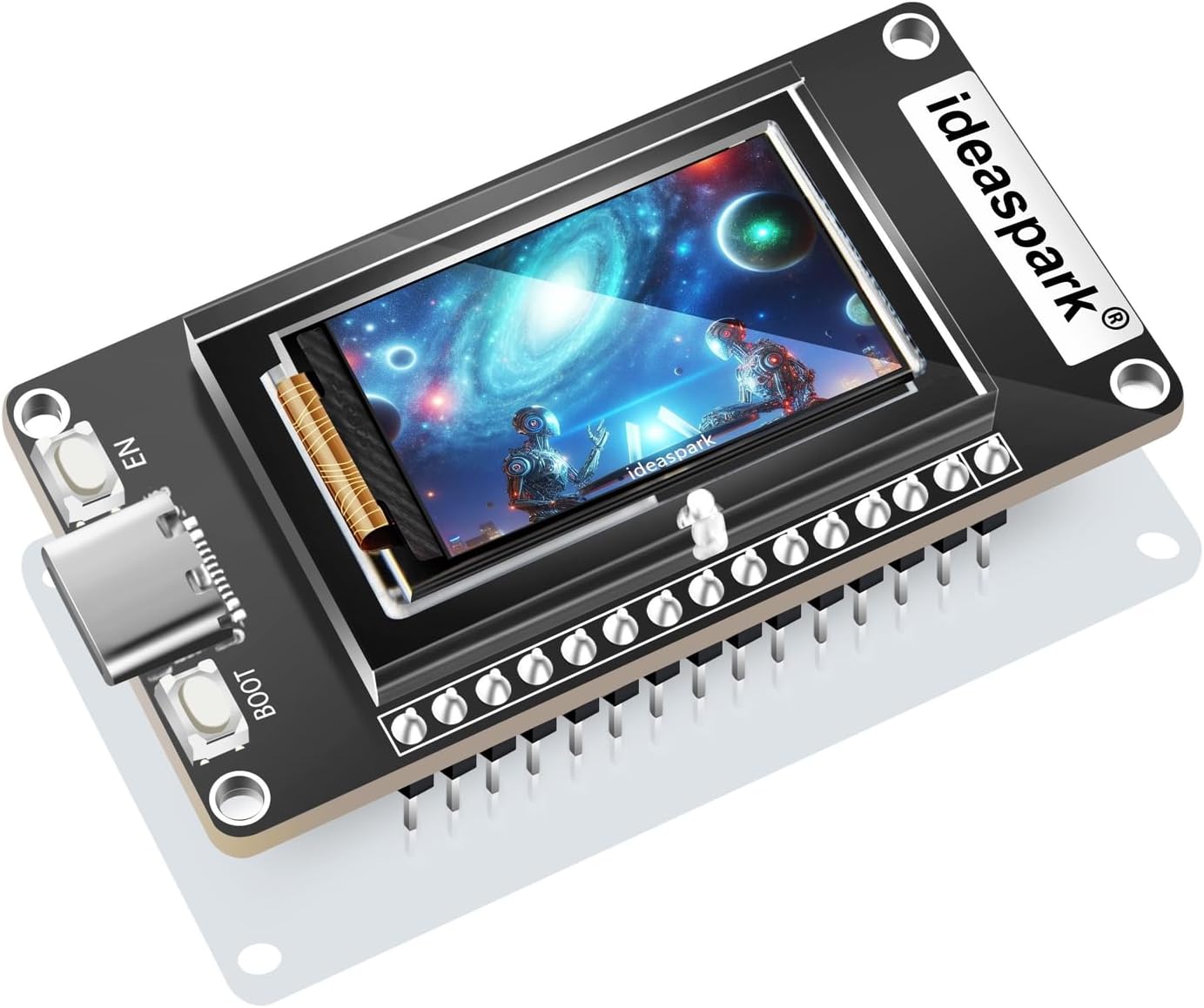
🚀 Elevate your IoT game with instant visuals & wireless freedom!
The ideaspark® ESP32 Development Board integrates a vibrant 1.14-inch 135x240 TFT LCD with a powerful ESP32-WROOM-32 dual-core module featuring 2.4 GHz WiFi and Bluetooth. Designed for streamlined prototyping, it uses a USB Type-C interface with CH340 driver support, eliminating clutter and accelerating your Arduino or Micropython projects. Ideal for professional-grade IoT applications requiring compact size, low power consumption, and real-time data display.


| ASIN | B0D7S7YQMC |
| Best Sellers Rank | #619 in Single Board Computers (Computers & Accessories) |
| Brand | ideaspark |
| Customer Reviews | 4.2 4.2 out of 5 stars (39) |
| Date First Available | June 22, 2024 |
| Item Weight | 1.13 ounces |
| Item model number | ESP32 1.14 inch LCD(Solder PIN) |
| Manufacturer | ideaspark |
| Number of Processors | 2 |
| Operating System | Linux |
| Package Dimensions | 2.91 x 1.97 x 0.87 inches |
| Processor | ARM_9_2818 |
| RAM | LPDDR4 |
| Series | ESP32 1.14 inch LCD(Solder PIN) |
| Wireless Type | 802.11bgn |
I**H
Performed as Expected
Performed as expected. Wanted an easy dev board with a screen present. The directions for arduino was rather simple and easy to hook up. From opening box to having an image on display only about a half hour.
M**A
USB A - C cable required.
Use a USB-A to USB-C cable or be hugely disappointed. It will not power up with USB C-C cable.
I**Y
Large readable display
First experience with an ESP32 after previously using an ESP8266. In the end it worked very well, although I found WiFi was not very sensitive when powering with the USB-C cable attached to a PC. After searching found that powering via rear pins handled the WiFi signal better.
M**Y
FEATURE PACKED!!!
Doesn’t come with literature so you have to do your own research but they are amazing little devices with a TON of capabilities for the price and size. Perfect for a tinkerer
D**N
Don't get unless you really want this model spend a few more bucks and get an esp32-S3
This board uses the ESP32-WROOM-32 rather than something more robust like the esp32-s3, which means that aside from other limitation the implementation of the serial to USB function inst fully native to the chip and does not have direct access but acts as a sort of pass through. This mean that anything that needs direct access to the Serial/USB function like running a badusb/bashbunny/rubberducky firmware will not work. Although the device has 3 buttons you really can only use 1 of them, the others are just reset button for the screen and boot button and there is no way through code to alter this behavior. As others have stated you cannot power this from a USB-C to USB-C you must use a USB-A to USB-C cord. If these limitation are not an issue for you and you just want a simple ESP32 for learning or prototyping this is a good enough board but I would recommend going for something with better support and documentation. The build quality seems good but not perfect the screen on min isn't aligned square to the board and caused issues when making a 3d printed case for it. It does have a battery connector but it does not seem to "just work" when you plug a battery in maybe this is how all ESP32s work and you need to code for it but you cannot just plug the battery in and expect it to charge or even get power from the battery. The screen size is a bit on the small side and there are other boards out there with bigger screen for around the same price I would save my money and get a better board.
M**O
Great combo of ESP-WROOM-32 with an ST7789 I2C screen!
This is a very capable little Espressif ESP32 microcontroller with a beautiful ST7789 based screen. Download the Adafruit ST7789 support library, and the Adafruit GFX library and you can draw photos, or programatically render text or geometric objects, like the little balls I made to bounce around in this video. Little computers are so fun to work with... kind of like home PCs from the dawn of the era. Dive in and imaging yourself coding on an ancient Apple II computer back in the early 1980s. These little things are many orders of magnitude more powerful than those old home computers were though, of course.
D**T
Doesn't work with normal USB-C to USB-C cable
This board is improperly engineered and missing the resistor needed to use a cable that has USB-C on both ends. This means for instance that you cannot plug it into a MacBook with USB-C. It won't power on. The designer did not follow the USB-C specification.
L**S
Perfecto
Excelente
Trustpilot
3 days ago
3 weeks ago