⚡ Speed meets precision — never settle for slow network installs again!
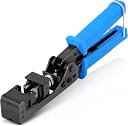
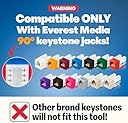
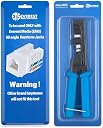
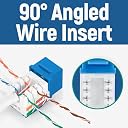
The Everest easyJACK is a specialized 90° angled punch down tool designed exclusively for Everest Cat5e, Cat6, and Cat6a keystone jacks. Featuring a one-handed, fluid operation that terminates 8 wires in a single motion, it saves significant time and effort. Its adjustable seating depth ensures precise connections, while rust-resistant stainless steel blades and ergonomic rubber handles guarantee durability and comfort during extended use.


| ASIN | B094WB91H3 |
| Batteries Required? | No |
| Batteries included? | No |
| Colour | Blue |
| Customer Reviews | 4.4 4.4 out of 5 stars (447) |
| Date First Available | 13 May 2021 |
| Handle material | Rubber |
| Item Package Quantity | 1 |
| Item Weight | 418 g |
| Item model number | 14000 |
| Manufacturer | Everest Media Solutions |
| Material | A DURABLE TOOL Our punchdown tool Cat6 is made with stainless steel blades that won't rust. It also features strong, grooved rubber handles that easily withstand constant pressure. |
| Part Number | 14000 |
| Product Dimensions | 30 x 11.99 x 0.1 cm; 418 g |
| Size | Lengte: 11.81 inch, Breedte: 4.72 inch |
| Usage | network installation and maintenance |
F**.
No puedo creer tanto tiempo de creer que no necesitaba esta herramienta. Total. Que tanto es hacer 8 impactos por cada conector. Lo que primero me llamó la atención es lo delgado del cuerpo, se acomodan en las placas para 6 conectores. Y la rapidez en lo que se preparan los conectores es increible.
E**P
Works great with the Everest jacks. Speeds up installs for sure saving a lot of time. Tool is solid, smooth, and well made. It provides quality connections.
D**E
First off—yes, this works perfectly with VCE RJ45 CAT6 Keystone Jacks, even though the packaging only mentions Everest Media. Don’t worry—it’s fully compatible. This was my first time terminating keystone jacks, and I wanted something that would help me work efficiently and confidently. I was running 10 new network lines in my basement, relocating everything because I was installing a new network rack and space was too tight at the original location near the hot water tank. The keystone jack kit I bought came with a basic punch-down tool, but I didn’t fully trust it for clean, reliable terminations. That’s where the Everest easyJACK came in—and let me tell you, it’s a game changer. At around $50, this tool is great for both beginners and more experienced users. You just follow the color code, drop in the wires, and crimp. I was using 24AWG Cat6 cable, and while I had a couple of misses (probably because I didn’t press the wires all the way in), the tool overall made the process fast and frustration-free. It’s comfortable to use, feels well-built, and saved me a ton of time. Even if it costs a bit more than a cheap punch-down tool, this one feels like a buy-it-once, use-it-for-life kind of tool. Highly recommend it for anyone doing home networking projects.
M**.
I'm a geek with fairly extensive experience with coaxial networks and that probably helped somewhat, but I had never put cat6 jacks (keystone or otherwise) on Cat6 cable before. The above images are the result of using this product with one of their keystone jacks. For a first time users, it went extremely well. I only had a couple jack early on in the process that failed, always the blue pair with them (last pair I insert before punchdown) so I suspect that was my error. Some notes for others - things I did learn the hard way. To cut the Cat6 shielding, I used a tool from trueCable. You have to have the dial on it set just right so it only scores the Cat6 shielding or the blade can nick the wire pairs. The proper setting seems to very by Cat6 maker so practice first. Twist to finish breaking where it scored, save the empty tube. It probably doesn't matter if you use the T568A or T568B standard as long as both ends are terminated the same, but I always just use B because compatibility is 6P4C color codes doesn't matter to me. When untwisting a pair to lay it out in the jack, use the empty shield tube that you cut off. You can use your fingernail to start the separation, but then put the empty tube over one of the wires in the pair and it just easily separates the pair. When doing T568B I do the orange pair first, making sure the remaining Cat6 shield is very close to the back of the jack. Then I do the brown pair, then the green pair (same side as brown pair), then finally the blue pair (same side as orange pair). With one hand I hold the tool that does the punch-down and with the other, a hold the shielding of the Cat6 where it meets the keystone jack. After making the connection, I use a Klein Tools Scout Pro 3 to verify the termination is correct - and then insert the keystone jack in the plate and re-test. First few I made I had a high failure rate with blue pair but after the first few that stopped being an issue. Speed I'm getting during early AM hours when no one else is using the Internet maxes out the Internet connection, and sustained large downloads work well, so this tool with the matching jacks seems like a good combination. Sorry for being somewhat long-winded but there doesn't seem to be a good instructional video for this specific tool, so I thought I'd share my experience using it for the first time as a n00b.
C**J
Very please with buying this. One handed use, great for working on ladders and saves A LOT OF TIME. If you've ever done wiring / termination / network keystone jacks, you'll understand punching down is no longer the way to go. Go for it - get this, and get the job done FAST. One press and you're cut and terminated properly with speed!!!
Trustpilot
3 days ago
1 month ago