

Desert Online General Trading LLC
Dubai, United Arab Emirates
Desert Online General Trading LLC
Dubai, United Arab Emirates




🖨️ Snap, Support, Succeed — Print Like a Pro with PolySupport!
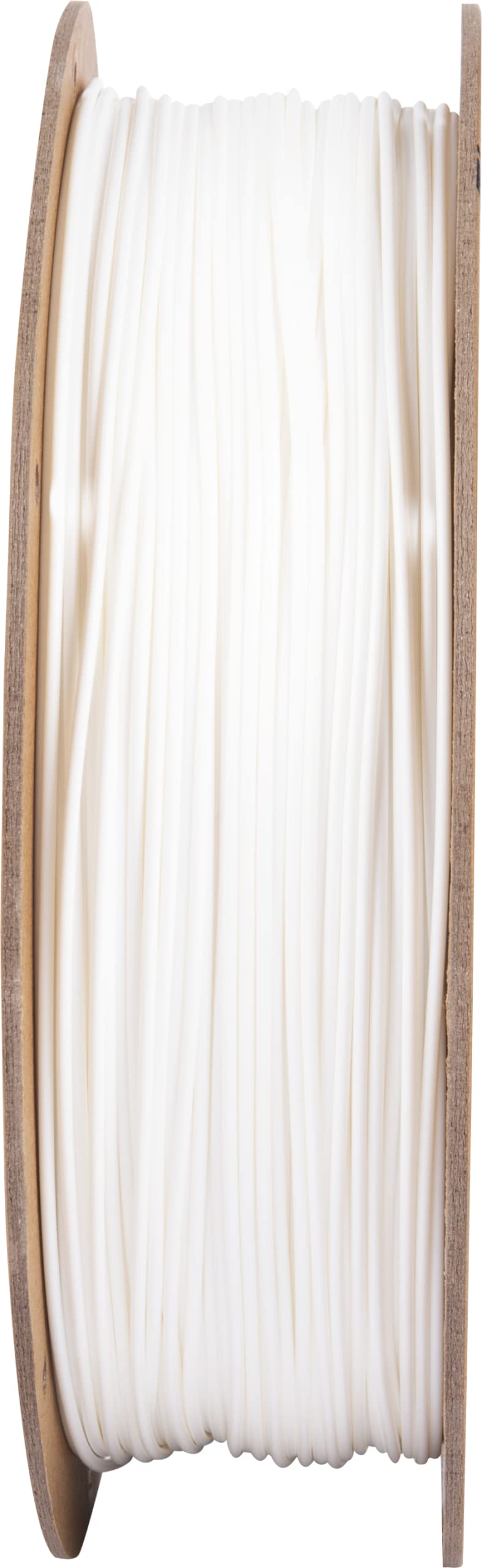
Polymaker PolySupport is a 0.75kg spool of 1.75mm PLA break-away support filament designed for easy mechanical removal, ideal for complex geometric prints. It comes vacuum-sealed with desiccant to prevent moisture, wound tangle-free, and packaged in eco-friendly recycled cardboard spools. Optimized printing parameters ensure smooth, reliable support structures that save time and hassle compared to dissolvable alternatives.
| Manufacturer | Polymaker |
| Brand | POLYMAKER |
| Item Weight | 1.65 pounds |
| Product Dimensions | 3.94 x 4.72 x 2.36 inches |
| Item model number | PD04001 |
| Color | 115 - Polysupport 1.75mm Pearl White (Hex Code: #F6f1ec) |
| Material Type | PLA Break Away Support |
| Number of Items | 1 |
| Size | 0.75kg |
| Manufacturer Part Number | PD04001 |
J**N
Finicky, but when it works it works well.
TLDR: I recommend getting 2 spools so you can switch them out every 12 hours or so. One printing and one in the drier. As far as dissolving the filament, I just put it in a tub of water for several hours, there were some areas that were still sticking after, I just scrubbed them a bit with a dish brush or tooth brush and they cleaned up well.There is not a lot for me to say that hasn't been said in these reviews already. I just wanted to add that if you're running this in a Bambu AMS system, you will need a filament drier. This filament was superb the first few prints, but then once it absorbed enough moisture to be out of spec, it was terrible. It would keep breaking while being retracted and get jammed in the hot end. Had to completely dismantle the hot end 4 or 5 times. After drying it out, it worked well again.I have read discussions online about people not needing a filament drier because the general atmosphere is dry in a particular region where the person lives. I live in the desert in the Southwest United States where humidity is 20% or less (often 10% or less), and I run a filament drier for all my filaments. You will especially need it for this one. It is designed to absorb water so it will dissolve. It will suck up whatever moisture it comes in contact with.
K**D
as advertised
as advertised
B**N
I give up
This was my 2nd, and at this price, last shot at trying dissolvable support. I've tried cheap, and now not so cheap PVA and both performed in every possible way absolutely identical. Printer is a snapmaker artisan for what it's worth. Made for dual extrusion/multi material.Does not adhere even to glue on the bed. Tried at all temps. Slowest speeds even. It just goops (even with longer retraction) and then gets knocked off the bed and print ruined. I've concluded that PVA is a waste of money across the board.
R**E
Easy to remove support material
I've tried this stuff with PLA and PETG on a dual extruder printer. It's great for printing rafts and supports, but will not adhere well to the topside of your printed part. Therefore, you will need to set your slicer to only generate supports from the build plate. Tree supports may help here.
J**F
Works great once it’s dry
As a 3D printing newbie I thought the pouches and desiccant that spools ship with would be sufficient to dry the filament. That theory seemed to hold with PLA so I figured I would try it with this on my first print with supports.NOPE. Goopy mess. Tried different temps, retract settings, nothing made a difference. Saw a suggestion to dry this so I picked up a filament dryer, sat it at 50C for 8 hrs, and now it’s working great with the generic PVA settings for my printer (Bambu P1P with AMS).
J**F
Should of bought some sooner, great stuff. But some Important Caveats.
I should of bought some of this stuff much sooner. Its fantastic for full contact supports. Situations where surface finish and accuracy when using support are critical.However its extremely sensitive to humidity. You really need a dry box, and filament dryer for this stuff. To keep it in good working condition. Even more so if you live in an area with high humidity (like i do). If you do these two things, it should behave extremely well for you. With wonderful results. enclosed chamber is probably also a good idea. I haven't tried too use it on anything that doesn't have a fully enclosed print chamber.So far I have not needed to submerge my parts in water to remove the material. Since its about 80-90% humidity here most of the time. After its out of the print chamber 10-15 minutes in the open air, and I can usually separate and remove this PVA support. With my finger and a small spudger (just to start the separation).I will definitely be purchasing this again.
D**X
Close but no cigar
I bought this material thinking I would save some time/effort on my prints, but instead it mucked up the hotend of my printer 3 times.The first print was fantastic, just a straight test. Then the second things went poorly.The start of the print was on point, however when left unattended (about 9 hours into the print), I came back to the material jutting out of the side of the track.The material clogged in the end and I wrote it off as operator error. Another test print and I believed this was confirmed.A few hours in on another print. Same result.This happened over and over again, going through the temp ranges 5 degrees at a time.Thankfully I had a number of ends, I had to rebuild the hotend 3 times, and I wasted nearly 2 days trying (unsuccessfully) to get a working result as a support structure for a full print.
D**N
Works Great!
This support interface material works the best that I've tried. It works as good as the Bambu product that came with my Bambu printers. Happy with the performance. I think that Polymaker is the official manufacturer for Bambu Labs.
B**Y
Meh
The only PVA filament I’ve used, so maybe others aren’t any better, but I find it very tricky to print. It doesn’t stick to PLA and it burns and clogs nozzles. I rarely get good results the first time with it. Brilliant in theory, frustrating in practice.I’ve found 200C to be the best printing temperature for it. I dissolve it by putting it in a big mixing bowl full of water. Without agitation, it takes about 24 hours to dissolve; much less if you use warm water and agitate it, but I don’t bother.I’m not very experienced with 3d printing, so your mileage may vary.
C**T
Inconsistent and fuses with prints
I'm not sure what's going on, but the support material often fuses with the PLA. I'm using it on a Bambu X1C with the "Bambu Support W" profile.
A**R
Very Poor Adhesion
Im finding that this filament won't stick to any other material other than the bed. It even has problems sticking to itself. I've adjusted the temperature, flow rate and more but consistently get poor results. I should send it back.
A**R
Cannot get it to bond with PLA
Tried different temperatures for the PVA, PLA and Bed. Cannot get the PVA to bond with PLA
Trustpilot
1 month ago
1 month ago