🌟 Print Bold, Print Outside — ASA That Outlasts the Rest!
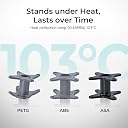
Polymaker ASA 1.75mm Black filament is a premium 3D printing material combining ABS-like toughness with superior UV and weather resistance, ideal for outdoor functional parts. It withstands temperatures up to 100°C and comes on an eco-friendly recycled cardboard spool. Designed for professionals seeking durable, high-performance prints with expert lifetime support.


| ASIN | B09DKPYYBP |
| Best Sellers Rank | #721 in Industrial & Scientific ( See Top 100 in Industrial & Scientific ) #69 in 3D Printing Filament |
| Brand Name | POLYMAKER |
| Color | 111 - 1.75mm Black (Hex Code: #17161a) |
| Customer Reviews | 4.5 out of 5 stars 2,032 Reviews |
| Global Trade Identification Number | 06938936709947 |
| Item Diameter | 1.75 Millimeters |
| Item Height | 6 centimeters |
| Item Weight | 1 Kilograms |
| Manufacturer | Polymaker |
| Material Type | Acrylonitrile Styrene Acrylate |
| Unit Count | 1.00 Count |
M**E
Prints clean, strong, and built to last outdoors
I picked up this Polymaker ASA in orange to start printing some functional outdoor parts, and it hasn’t disappointed. The color is vibrant, the spool was neatly wound, and it fed smoothly right out of the box. Print quality is excellent—layer adhesion is solid, surface finish is clean, and it handles bridging and overhangs better than I expected for ASA. I’m running it in an enclosed printer, and once dialed in, it’s been very consistent. Slight warping on the first print, but after tweaking bed temps and using a brim, no further issues. What really stands out is the durability. This filament is tough and UV/weather resistant, which makes it perfect for brackets, mounts, or anything you need to survive outdoors. I’ve printed parts for my patio setup and a few car accessories, and they’ve been holding up great in sun and heat. If you’re looking for something tougher than PLA and more outdoor-friendly than PETG, this ASA is a solid choice. Highly recommend for functional prints.
A**N
Very close match to Magpul FDE
My first attempt at printing anything other than PLA. There was a bit of a learning curve, but it worked great. Babysit it for a couple of small prints and it should be pretty easy to dial in. Bed adhesion seems to work well with a textured PEI plate, 110 degrees, with a brim. It will pop itself off if you allow the bed to cool to room temperature. I haven't tried any large prints and I'm not sure how much I would trust the bed adhesion without glue for something large. Parts seem very durable. Color is a fairly close match to Magpul FDE. Printed at 255 degrees on a Flashforge Adventurer 5m. No fan for first 3 layers, 15% fan for the next 20 or so, 50%-100% fan for the rest. Printer is in a Creality zip-up enclosure, feeding filament from a Creality Drybox 2.0. I use the Drybox as more of a spool holder than anything else, so it wasn't on for the first 12 hours or so of the filament being out of the package. I printed several times successfully, but then it started to have some significant stringing, so I turned the Drybox on to 60 degrees. Stringing decreased after the Drybox ran for a while. So it seems like this stuff needs to be kept pretty dry. That or I messed up that one print and it was just a coincidence. Idk. (Edit: turns out my retraction setting was too low, so the stringing was most likely user error) For what it's worth, I was printing it at 300mm/s, which is way faster than it advertises, and I managed to get pretty decent parts with no clogging. But I was also printing relatively small parts that were designed to be easily printable. Your mileage may vary. I'm quite happy with this filament and would order it again.
A**Y
Great Quality
Quality is great. It works and prints well. Keep in mind you need to adjust your printer appropriately before using this filament. Before judging adhesion to the bed, and warping: Remember this is a more advanced filament, you need to use a proper environment and proper settings. You also need to think about how you print your prints when using this. If you look into best practices for ASA, you'll do well. It's easy to use, it's just that you do need to prepare more. This is high quality!
T**D
Better than ABS
First and foremost, this was my first time ever printing in ASA. Initially, I started with ABS but could not stand the smell. Even with my air purifier on high, it was horrible. Out of the box it had alot of moisture that made it unbearable to print with so tbh, im never touching the stuff. Looking for alternatives, Polymaker came up and decided to check them out for the first time. I'd only ever printed PLA but mostly PETG. This project required either ABS or ASA for thier properties. If you've never printed with either of these, its not for the faint of heart. I liked Polymaker alot better as the smell wasn't so nauseating. Subtle with no enclosure and barely noticable with. I always run an air purifier that can filter any offgassing. I plan to print a nevermore filter also. It was a challenge for me to get this dialed in but in the end, this is what worked: - The bed really needs to be properly leveled, I cannot stress this enough. - I have a flex plate with a piece of probably 1mm pei on it. I sanded it to get it scuffed up with 80 grit sand paper (didn't have textured pei so this was the alternative). Washed it with dish soap, dried it and wiped it down with iso alcohol 90%. - Enabled Linear Advance and used teaching tech's video to configure (easy). This is optional but I've been hearing about it and found that it truly does improve the quality of the print. - Ensured that Z/ESteps were configured (I had to change extruders). The calibration cubes all measured the correct size. - Adjusted the flow rate. This really needs to be checked to avoid over extrusion even if the steps are correct. - Use elmers glue stick (the xtreme version). Believe me, I experienced warping when first attempting to print this. Initially, tried ASA juice/slurry which I advise against because it reeks and is a PITA to clean. Also tried sugar water which is laughable but seems to work for some. Get the glue stick. It's cheaper, water soluble, non-toxic and it just works. Not spending $20+ for the competition. Just run your flex plate under water and boom. If using on a bed take something to wipe it off (safely) if needed. Done cleaning. - Consistent heat. Do a PID tune. I found that this was one of the main reasons for warping. Whether using your printer in an enclosure or wherever, make sure there are no windy drafts of air. Also, I was used to setting certain temperatures for the first layer then reducing it when printing PETG. Not this time. Leave it be. - I stopped using brims. They work to reduce warping/corner lift but I can't stand them. Even though this ASA is relatively easy to sand, its annoying to remove/post-process especially when you have alot of small parts. Settings/Printer: Tevo Tornado Prusa Slicer 250 Nozzle Bed is preheated for 10m (heat soak) 90 bed (truly dont need to go higher than this) 2 skirt lines Draft protection (hey it works but is probably not needed) I highly recommend this brand. Once you get things dialed in, it prints like butter. No moisture issues as the filament is well vaccum sealed and I keep all of my filament in an airtight container with dessicant at rest and in use. Love the natural color.
A**R
Polymaker Black - Great Print Quality - Inconsistent Color
I purchased some of this in Black. Overall this filament printed Great on my Prusa Mk3. Ive had a couple warping failures with it, but nothing that can't be mitigated with a brim or raft. The print quality looks great and has very little stringing. My only complaint with this filament is an off black/grey color that is inconsistent through the roll. I almost seem to have stripes through the layers and part to part the color is slightly different shades. This issue is more noticeable when vapor smoothing to a glossy finish. However I imagine this is less noticeable with lighter colors (not black) Vapor Smoothing: I have been using a cold smoothing bin with a PC fan and Acetone. The method I found works best with this filament is 20-30 min smooth cycles with enough time in between to harden. If I leave the part in for more than 30 min I start getting ugly bubbles on the surface leaving an inconsistent finish. Following a 20-30 min smooth has great results after about 3-5 cycles. Overall a good filament, however I will be purchasing a different filament due to the color inconsistency. This is only because the parts I'm making need to be consistent in color and as close to a true black as possible.
S**4
Perfect ASA filament
I’ve been printing in both resin and filament for a long time and ASA had always been something I avoided due to past issues with ABS. When I decided to use this filament for a project I was pleasantly surprised at how easily and readily it turned out great results. Polymaker Polylite ASA has become one of my go to filaments moving forward. I have yet to have a tangle or a clog even in a 0.2mm nozzle with this. While like all ASA filaments it requires a slower speed than PLA, I have been able to push a little past what the manufacturer specs for this filament and I’ve not had any problems at a 40-70 speed range. The finish has been immaculately smooth even printing at 0.08mm layers with a 0.4mm nozzle. I have found my ASA of choice moving forward. And for the cost of this filament, it is an exceptional product and I will be buying again. Machine: Elegoo Centauri Carbon Bed temp: 100 Nozzle temp: 260 Chamber temp:35+ External perimeter speed: 40mm/second Support speed: 70mm/second All other speeds: 60mm/second
S**N
As easy as PLA in my Bambu P1S
I use this filament (Polymaker ASA) in a Bambu P1S with a Bambu smooth, high temperature plate. I can't vouch for any other printer or plate. I have had great results with the Polymaker ASA. Not one print has failed and that includes about 30 prints ranging from small and simple to large and detailed. On many prints I have used tree supports and have been very pleased that the supports come off very easily and cleanly. Cleaner and easier than with PLA. I printed some of the same parts with both the ASA and with Bambu PLA and could not tell the difference except the PLA was printed on a textured plate. The result are very good. All prints have been done with the Bambu presets for Polymaker ASA. Those are 260 degrees C for the hotend and 100 degrees C for the bed. I wouldn't attempt to print ASA without a closed chamber. The prints are much easier to remove from the plate if it is completely cooled. Prints also leave a raised shadow on the plate but this disappears the next time the plate is used. I am also fastidious about cleaning the plate. Oily finger prints show on the smooth plate and could cause a print failure. Overall I'm very pleased with the Polymaker ASA. I wouldn't hesitate to use it in any enclosed Bambu printer.
A**R
Fantastic filament
Love this stuff, burning through my third roll right now! Seems to come really dry and ready to print.
Trustpilot
4 days ago
1 week ago