We remain fully operational. Our teams are working around the clock to ensure your deliveries continue safely.

DOWNLOAD THE APP


Customer Services
Copyright © 2025 Desertcart Holdings Limited
DOWNLOAD THE APP
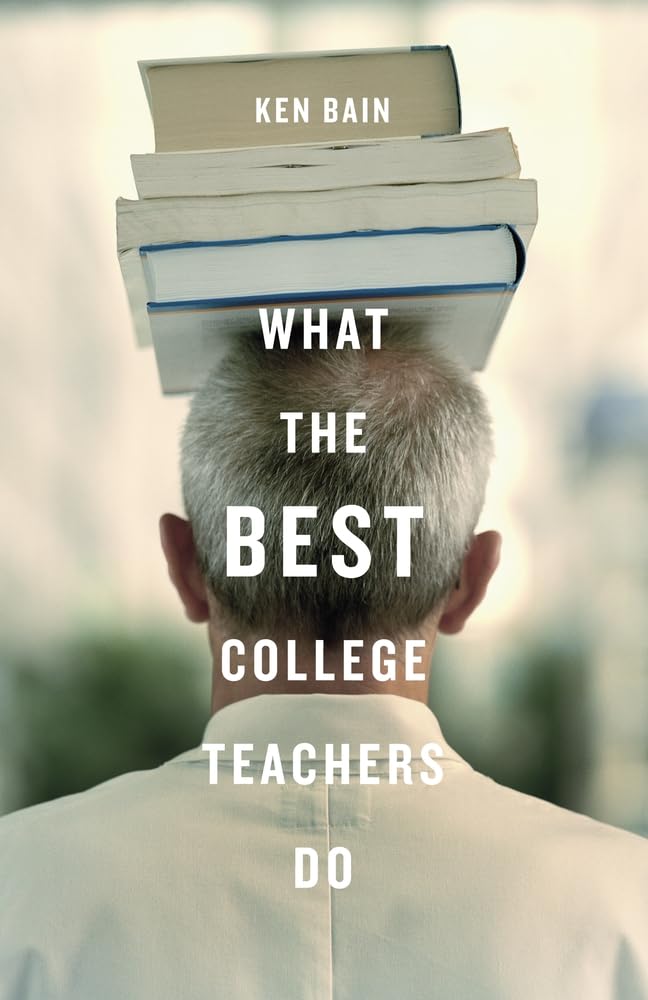
Buy What the Best College Teachers Do by Bain, Ken online on desertcart.ae at best prices. ✓ Fast and free shipping ✓ free returns ✓ cash on delivery available on eligible purchase. Review: A must read, with tons of valuable practice suggestions for those leading adult classrooms! Review: arrived on time and as described. could not ask for more.
| Customer reviews | 4.5 4.5 out of 5 stars (360) |
| Dimensions | 13.97 x 2.54 x 20.96 cm |
| Edition | 1st |
| ISBN-10 | 0674013255 |
| ISBN-13 | 978-0674013254 |
| Item weight | 294 g |
| Language | English |
| Print length | 224 pages |
| Publication date | 30 April 2004 |
| Publisher | Harvard University Press |
D**N
A must read, with tons of valuable practice suggestions for those leading adult classrooms!
T**M
arrived on time and as described. could not ask for more.
D**R
good
A**R
Is this book somewhat vague and light on how-to's? Yes, of course. Thank goodness. You can't survey everything from theater to calculus and expect to produce a how-to manual worth 5 minutes of your time. The two take-home points, and the big values, of the book are: 1. There is a general mode of learning that transcends disciplines. IT EXISTS. It's a single thing that comes in many, many varieties, but it's still one basic thing. And it's not a mystery or the lottery. The particular details that motivate students, and the skills and challenges they bring to the classroom, may change with the times, but people's basic cognitive (and, I would even say, spiritual) needs that are satisfied with real learning *do not change*. Halle-fricking-lujah. The target has stopped moving. 2. Therefore, there is a corresponding general model for effectively facilitating that learning. Unsurprisingly, good teaching is a path, a journey, that does not end. But, by repeatedly circling around to several basic pedagogical questions and concerns, the quality of your teaching will spiral upwards. It's a craft, and not just a skill like riding a bike. Through the various chapters, the author presents and discusses those general questions that you should concern yourself with to improve your craft. He compares and contrasts highly effective teachers with less effective teachers (and occasionally abysmal teachers) in terms of using vs. not using these general pedagogical principles, including copious specific examples from various disciplines. Methodologically, I like this book because: 1. It's basically a report of a study (formatted to be readable, interesting, and useful). It's not just some guy serving up opinion, soap-boxing, cherry-picking, or re-gifting the same pedagogical fruitcake that's been passed around for the last couple of decades. If you want to object on samples or bias or whatever, he gives you the info to make an informed objection. I think many of the critiques above respond to the book as if it was just another guy's opinion, but it's the results of a lengthy study. 2. It lays out the general framework for good teaching in terms of questions and principles - or, I would say, the principle of asking yourself a certain set of questions, repeatedly, for the rest of your teaching career. This enables you to exercise your expertise, creativity, and freedom of judgment as an instructor to do what works for you, your discipline, your students, and your institution. (I can't believe people object at the scarcity of how-to's in the book, given the scope implied by the title; do people just want to hand off the responsibility of thinking??) It also means that you only have to remember one set of guidelines no matter what kind of class you are asked to teach, now or in the future. What if you're a lab junkie and you get stuck with a freshman writing seminar (albeit in your field of science)? What if you co-teach a multidisciplinary seminar; are you content to only contribute to your portion of the class and hope someone else "knits it all together" for the students? You don't have to wing it. That's excellent. It enables us as instructors to do what we do best without demanding that we re-invent the teaching wheel every time we do something slightly different. Three cheers for principles. And yes, the author covers a lot of territory and ideas that are not new. But there's a lot of value in 1) having the principles and associated questions set down concretely, vs. letting them remain as nebulous, guilt-inducing ought-to's in the back of your mind, and 2) connecting the dots at the level of discipline-transcendent principles, and not just suggestions or rules of thumb. This allows you to have the confidence to just focus on a few things that are known to work vs. trying to implement a hodge-podge of nice ideas that other people claim you ought try. Because if you're not in education research yourself, who has time to do the research to produce these kinds of principles?
F**A
I've been on Amazon for more than 10 years. I've tried to buy some used books since I don't need them as part of my personal library. However, most of the books that I've bought here are brand-new ones. Most of the time the used books that I need are not available in my area making the shipping more expensive. This time I've finally found a book close enough to my city, I ordered it and got it. The book is in good condition.
Trustpilot
2 months ago
2 weeks ago
1 week ago
1 month ago