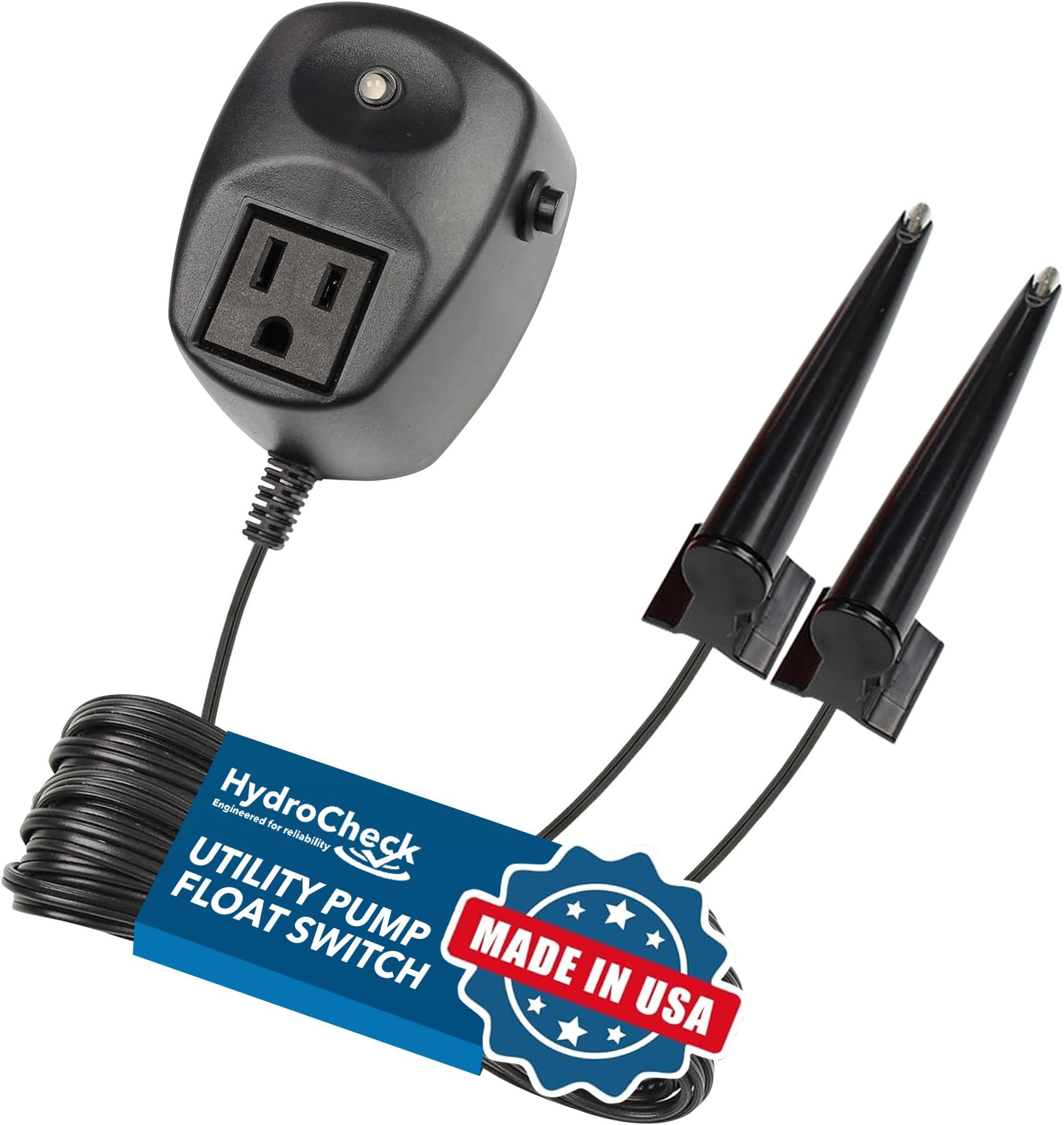
🚨 Stay dry, stay smart — the ultimate no-fail sump pump switch!
The HC5000T Electronic Sewage Pump Switch offers a revolutionary no-pit-entry design with a 12ft cord for easy external installation. Featuring a debris- and chemical-resistant sensor with no moving parts, it guarantees reliable, low-maintenance operation. Its programmable pump cycle and built-in smart alarm system provide precise flood prevention and instant alerts, compatible with all pump models and pit sizes—making basement flooding a worry of the past.


| Brand | HydroCheck |
| Color | Black |
| Material | Plastic" // or "Polypropylene |
| Power Source | AC power |
| Product Dimensions | 2.75"L x 3.75"W x 2.5"H |
| Style | HC5000 |
T**.
Should have bought this long ago! (...& NO ground wire required for my installation)
Over the years, the tethered float design has proven unreliable for me; I experienced a couple of failures that caused at least one flooded basement. (I now also have a battery back-up system.) Most recently, the float switch "on" position changed a bit higher, causing my backup pump to activate. Not sure why that float changed, but it did and it seemed erratic. From the beginning, it was very tricky to install the old tethered float so that it would not touch walls of the sump or anything and to adjust it to activate i.e. turn on and off where it should. Then comes this product...what a relief! I definitely recommend the additional few dollars for the sensor installation kit; https://www.amazon.com/dp/B08L425Z83?psc=1&ref=ppx_yo2ov_dt_b_product_details BTW, in my system, I do not need to add a ground wire. Works perfectly without. Recommend that you test the system and only add the ground wire if it does not activate and shut off properly. Mine's working perfectly without it. Easy to install - I tie-wrapped the old teathered switch to the pump (up, so it was always ON, and then installed this electronic sensor system. I am now able to very easily adjust the heigth of the "ON" sensor; Just loosen a hose clamp a bit and can precicely adjust the height of the sensor pcv pipe the sensors are mounted on. Takes up much less room in the sump than a teatherd float switch which is important to me as I also have a backup battery system installed in the sump. Watched the operation of the new sensor and it is precise and accurate and appears reliable (no moving parts). Wish I had installed this from the beginning years ago! UPDATE 10/25/2023: IGNORE THE GUY WHO INSTALLED A RED PIPE FOR THE UPPER SENSOR ONLY. THAT DOES NOTHING TO PREVENT A STRAY GROUND FROM CAUSING THE LOWER SENSOR TO MALFUNCTION AND COULD RESULT IN THE PUMP NOT SHUTTING OFF!!!! THIS RED PIPE ACCOMPLISHES NOTHING! THAT GUY HAS NO CLUE!!! Again, I recommend that you buy and install the kit I mentioned above to install the sensors, insulating them from the drain pipe and the rest of the system. and prevent a stray ground problem in the future. It's only $10 and I think you can also get it bundled with the sensors for only $5 more.
D**6
Must ground into water, per included instructions!
Works great when you read the manual and follow the instructions! Included internal failure alarm in this switch worked great when I tested it separately. Loud enough to hear all over the basement. Nice feature. Simply attach a wire (not provided) from a known ground source. Existing copper cold water pipe in basement worked fine. Before using a 'suggested' grounding wire (see the manual), after initial installation, I tested the unit and it would not work properly. Grounding was an easy solution. After putting grounding wire into the sump and attaching other end to an existing grounded cold water pipe in basement, unit tested perfectly and has worked reliably for a few months, so far. DO NOT open any of your wall sockets to ground this unless you really know what you're doing!! It should NOT be necessary if you simply connect a non-provided grounding wire to an existing metal pipe, assuming that existing pipe is grounded. Contact a licensed electrician before opening up any live wall plates or connections anytime you have a basic home electrical issue! It's only common sense. I quickly got Excellent live advice from the manufacturer's help phone line (again, read the manual!). This new unit replaced an older unit from the same manufacturer which had worked seamlessly for 10 years or so. Decided to replace it with this updated unit when I replaced the old sump pump with a new one. Cheaper solutions are available, but went with this new one because of my good previous experience with the old switch. I learned the hard way (2 sump pumps ago) to NOT rely on sump pump internal float switches provided with most consumer sump pumps and have had no switch problems since I added external float switches. Not all of your old sump pumps may be easily controlled by an external switch. Some designs require you to bypass the original internal pump float switch without internal pump wiring changes. See the simple first test (below) and/or check with the manufacturer of your old sump pump to make sure before you go to the trouble of installing an add-on switch like this reviewed switch. You should be home free if your old pump installation has two separate electrical power wires which must be plugged in the wall: one for the actual pump and one for the internal pump switch. If so, unplug the old pump switch and substitute the new unit, into which you simply plug your old pump unit. If you have this existing sump setup, I'd pour sufficient water into the sump and separately plug in each of the existing wires to see if the pump starts up without a switch. If neither wire works, the pump might be dead or the breaker for that wall socket might be tripped. Don't bother buying a new switch for the old pump until you can determine the old pump still works. And even if it does work, seriously consider a new pump and switch if the old one has been in use for years. Most submerged machines don't last forever! You might save a few bucks when buying a new pump if buy a model with no internal float switch which will absolutely require an external switch like this reviewed unit. When trouble-shooting a non-working pump it's a lot easier to isolate a switch problem when you use an external add-on 'float' switch or if you have the ability to simply disconnect an internal original switch's plug and plug the separate pump switch into the wall to determine if the problem is the pump or the internal switch. Keeps you from throwing away an existing pump which still has usable life. But again, all machines wear out eventually. Like people. Pumps and switches don't last forever! Test your setup at least annually to try to avoid a very messy and expensive pump/switch failure! And an additional Backup battery pump can be excellent insurance, though even backups can fail. Good luck.
J**.
best switch you can get for active sump pumps
Hands down the best sump pump switch on the market. If you have an active sump pump during wet periods, or high ground water levels in the area like I do, this is the answer. You can adjust the on/off position to your liking or needs, change it with the season, snow melt, rain levels, etc. A fixed mechanical switch offers none of the flexibility and reliability of this switch. I have a pretty broad throw in our pit - the distance between on and off is about 8" when it's wet out. We live in a part of town where the ground water levels rise with heavy rain and we just had 2 bad storms with very heavy rain producing about 8" of rain for the week. I had the off switch lower due to very dry weather previously but that caused the pump to run too much when the rains came, so I just went down and tweaked it. Perfect. Now we have longer run times with wider gaps between - MUCH better for the pump life as well as short-cycling kills pumps. If your sump pump is at all active, if you get tired of hearing it run too often or if it's starting and not removing enough water per run, THIS IS THE ANSWER. I just bought a new one, my last one was 7 years old with (guesstimating) 600,000 to 700,000 cycles. It still worked perfectly. When I proactively replaced the sump pump (Zoeller N98 1/2HP is the way to go IMO) I proactively replaced the switch. I kept the old switch and pump as backup, just in case. You never know. As an aside, the customer service from Stak is excellent. I've called them with questions and they are very responsive. One issue I will forewarn you about if you DO buy one, keep the switches away from the vent hole stream, if you have one drilled in the head pipe. If the pump runs too long, interference from the stream is likely the culprit. I have 7 1/2 years experience using this thing, so I know a bit what I'm talking about. It's well worth the money. No float to jam up. Reliable operation. I've directed a number of friends to these, and every one has loved it.
C**D
Good quality product
Easy to install and work effectively as advertised.
J**N
Satisfied so far. Works as advertised. Pumping peace of mind.
Pros: - Easy to install. Even the alternate instructions that were for situations of high mineral content water where not too bad. - Very adjustable. You can experiment with different pump On/Off water heights just by sliding the sensors up and down the pipe you have them zip tied to. - Increased piece of mind knowing it's less likely that the pump will get stuck in the On position. This controller does still have some relay in the controller module, but it switches On/Off in a smarter fashion that a traditional float switch. - The tech support from the company that makes the unit is very helpful. Prior to purchase I had questions and the person I dealt with there was very knowledgeable. Cons: - I wish the controller module had a way to manually force the pump to run. A push and hold button to manually cycle the pump when the water level is in between the sensors. - The wires to the sensors are electrically sufficient, but from a touch and feel perspective they don't seem very robust. I'd prefer beefer wire OR wire with some additional protective wrap. Additional Info: I have an old 1940's orginal construction sump pit (some rusting away ~5-6 gallon metal liner) that is roughly 14 inches in diameter and 18 inches deep. My scenario is that usually my sump pit only gets water for two periods each year. A few weeks in the spring and a lesser number in the fall when the water table rises. However, for the weeks my pit does start filling, historically my vertical float actuated the 1/2 hp Flotec pump about every 50 seconds due to the orginal vertical switch turning on/off with only about 6 inch water height change. I wanted to increase time between pump cycles. I also wanted to find a non-traditional switch that should be less prone to getting stuck in the On position and frying the pump. I found info for this HC6000 Hi-Lo Pump Controller about a year ago. Honestly, I delayed my purchase because I was being cheap. This spring I decided to go wild and treat myself...so I bought this controller. It has been working great for the past three weeks during which I have been pumping every 1 min 30 sec. Each time my pump switches on it runs for about 4 seconds to drain the water down to the shut-off height I have set. I'd buy another even if this one just lasts a few years.
T**R
Wet floor pickup
Works great for sensing a wet floor! It runs a wet/dry vacuum keeping a wet basement under control.
E**R
These Sump Controllers are Amazing!
Our house has two sump pump pits and is located in a high water table area, which means our sump pumps run every couple moments as opposed to most peoples which might only run once a week or once a month. In our household Sump Pumps are a serious concern to keeping the basement water free. We have a finished basement and in the last 4 years since the house was built we have lost 3 basements to flooding from the sump pumps not being able to keep up so we have researched our options on a regular basis. We now are running dual commercial fountain pumps which are built to run 24 hours a day and pump out more than 15,000 gallons of water per hour per pump, we have used the ball floats which just have disappointed us, the single unit electronic floats are tall and work except you must pull them out of the sump pit every couple weeks and completely clean them off from the build up of calcium which the sensor will misread as water and allow the pumps to run forever without water till they burn up, but these HC6000 units have been totally amazing and works flawlessly. My only regret is not finding this product and buying it sooner. This system allows you to determine where the water line should be before the pump kicks on and where the water line should be for the pump to stop. This is very helpful depending on how large of a pit you have installed, you have the ability to dictate the on and off levels. The traditional floats or electronic sensors do not give you this flexibility, it is preset when they kick on and off. These units were incredibly easy to install and gives you peace of mind once they are operating. I have reservations about these units working for our setup since we are using sump pumps that are 4 times or more larger than a traditional pump and thus absorbing more electricity to run, I was afraid that these units would not be built to maintain that kind of power through them but I was assured by my research that it would work and It does indeed work well. The only issue that I had with this product after installation was every time the pumps were activated the HC6000 would start alarming a set of very large tones, after reading the instructions and finding out that those tones represent high power consumption which is a sign of a sump pump going out (not in our case of course) I was able to disable the alarms and have not heard them since. I would recommend this product to everyone!
J**R
1 year update - still working perfectly
Sewage pump started running constantly after a power failure. I unplugged it, dreading having to open the tank and replace the float switch. Then I found this electronic switch that does not require opening the tank. It is twice as expensive as a normal float switch. BUT, since I don't have to open the tank it's well worth the extra dollars. I had to purchase a 5/8" drill bit to drill a hole in the tank cover. I selected a location that seemed to be away from the pipes and wires that go down into the tank. Then I drilled a 1/8 " hole and pushed a straightened coat hanger wire down into the tank to get an idea how deep the tank was. I measured about halfway down the tank and pulled that much wire through the supplied grommet. I then drilled the 5/8 hole and placed the sensor into the hole and tested it. Worked perfectly the first time. Then I secured the wire to a pipe with the supplied wire tire. I put some silicone around the grommet and wire for extra sealing. Done - 15 minutes... no opening the tank! I adjusted the pump-off timer to 6 seconds and tested it a few more times. It's been working perfectly for 2 days. Hopefully, I will not need to touch this again. If it lasts a few years, it will be easy to replace. From my experience, a good sewage pump rarely fails. It's the float switch that fails. So, if this is reliable, I may never need to open that tank again. I will update this post later if it fails or not. 60-day update: The switch has been installed and in use for 60 days now. It is working flawlessly. We have had one power outage that lasted about 3 hours. Once the power returned, the switch continued to work as before without any attention. I am extremely happy with this purchase. 120-day update: Still working perfectly.
Trustpilot
1 month ago
1 month ago