
Buy anything from 5,000+ international stores. One checkout price. No surprise fees. Join 2M+ shoppers on Desertcart.
Desertcart purchases this item on your behalf and handles shipping, customs, and support to Nicaragua.
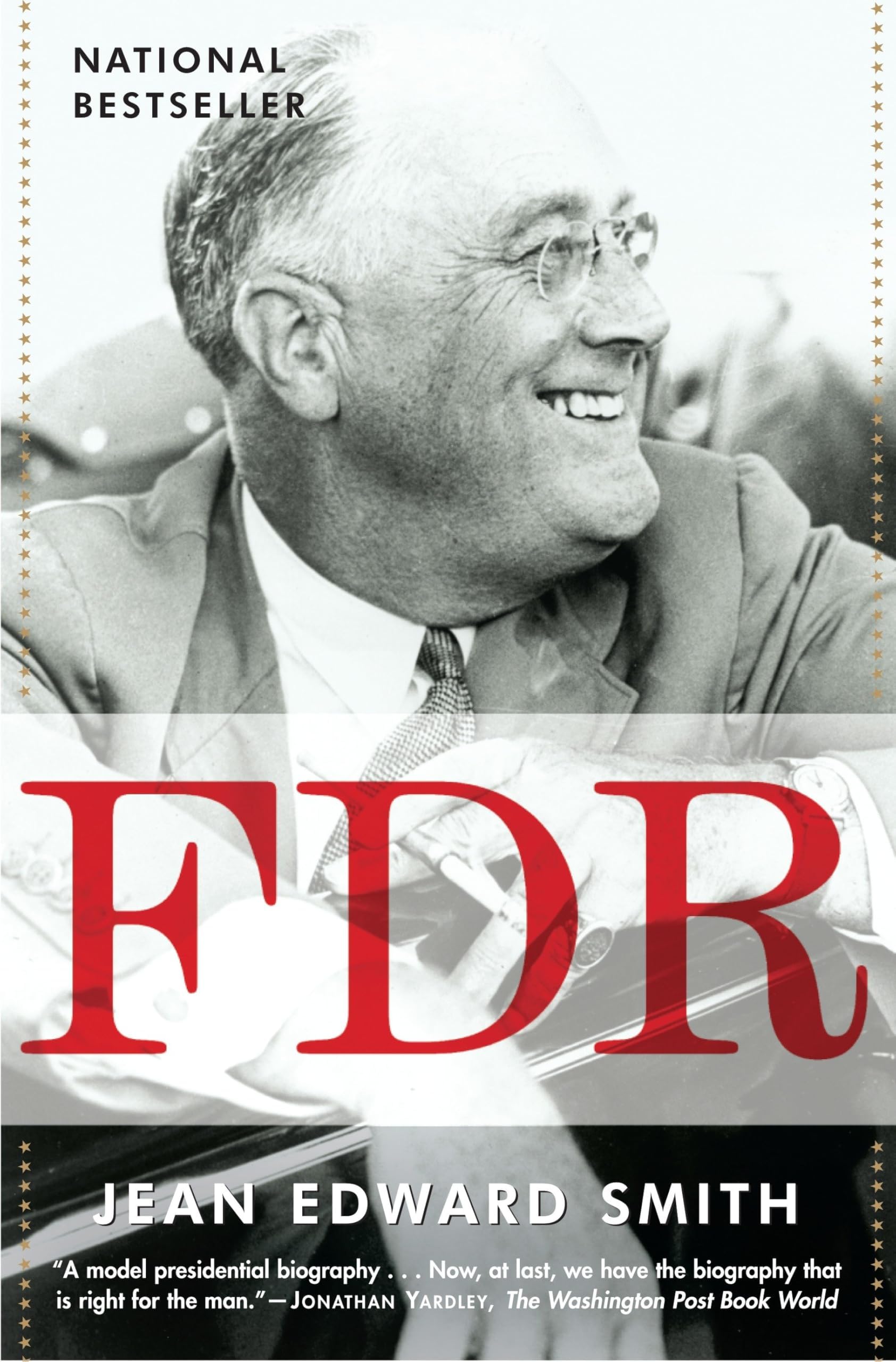
NATIONAL BESTSELLER - "A model presidential biography... Now, at last, we have a biography that is right for the man" - Jonathan Yardley, The Washington Post Book World One of todayโs premier biographers has written a modern, comprehensive, indeed ultimate book on the epic life of Franklin Delano Roosevelt. In this superlative volume, Jean Edward Smith combines contemporary scholarship and a broad range of primary source material to provide an engrossing narrative of one of Americaโs greatest presidents. This is a portrait painted in broad strokes and fine details. We see how Rooseveltโ s restless energy, fierce intellect, personal magnetism, and ability to project effortless grace permitted him to master countless challenges throughout his life. Smith recounts FDRโs battles with polio and physical disability, and how these experiences helped forge the resolve that FDR used to surmount the economic turmoil of the Great Depression and the wartime threat of totalitarianism. Here also is FDRโs private life depicted with unprecedented candor and nuance, with close attention paid to the four women who molded his personality and helped to inform his worldview: His mother, Sara Delano Roosevelt, formidable yet ever supportive and tender; his wife, Eleanor, whose counsel and affection were instrumental to FDRโs public and individual achievements; Lucy Mercer, the great romantic love of FDRโs life; and Missy LeHand, FDRโs longtime secretary, companion, and confidante, whose adoration of her boss was practically limitless. Smith also tackles head-on and in-depth the numerous failures and miscues of Rooseveltโ s public career, including his disastrous attempt to reconstruct the Judiciary; the shameful internment of Japanese-Americans; and Rooseveltโs occasionally self-defeating Executive overreach. Additionally, Smith offers a sensitive and balanced assessment of Rooseveltโs response to the Holocaust, noting its breakthroughs and shortcomings. Summing up Rooseveltโs legacy, Jean Smith declares that FDR, more than any other individual, changed the relationship between the American people and their government. It was Roosevelt who revolutionized the art of campaigning and used the burgeoning mass media to garner public support and allay fears. But more important, Smith gives us the clearest picture yet of how this quintessential Knickerbocker aristocrat, a man who never had to depend on a paycheck, became the common manโs president. The result is a powerful account that adds fresh perspectives and draws profound conclusions about a man whose story is widely known but far less well understood. Written for the general reader and scholars alike, FDR is a stunning biography in every way worthy of its subject. Review: Great man, good writing, well-researched - It took me an epic amount of time to read this epic biography โ not because it was boring, but because it contained so much information. There were hundreds of footnotes for every chapter, and because they often contained additional information beyond the source, I felt compelled to keep a bookmark in the back and read all that was there, slowing down my progress considerably. This doesnโt mean I didnโt enjoy FDR, quite the contrary. Itโs just not a book you read between the covers when falling asleep at night. You need to be on your toes to keep track of who is who and of the timeline of events. Iโm almost tempted to go back to the start and read it all over again, now that Iโve done all the heavy lifting. If you want to understand how FDR came to be president, what his views were, and what made him such an effective leader, this book is for you. Youโll also get a glimpse of the life of Eleanor Roosevelt, though if youโre really interested in her, then her memoirs are probably a better start. The same goes for Winston Churchill, who by necessity gets quite a bit of coverage during the war years, and who for FDR was not only the head of an allied state but also a friend. For further reading about the relationship between the two, I recommend Meachamโs Franklin and Winston. Iโm not a historian so canโt attest whether youโll gain new insights from the pages of this book or not, but thatโs precisely why I enjoyed it so much. Itโs easy enough for a layman to read, but I donโt doubt that it would also be a great resource for scholarly research. While the war years are certainly described in detail, I found Rooseveltโs early years even more fascinating, because they are not as much written about. His time as secretary of the navy, as governor, even the domestic policy years of his presidency โ those all gave great insight into his thinking while making him more human. Itโs easy to forget that with all his successes and political savviness, he made his fair share of mistakes. The court stacking scheme during his first term comes to mind. But what made FDR such an exceptional leader and person is that he was able to learn from his mistakes, swallow his pride, and move on. I also was never quite aware of just how much FDR worked himself to death in the pursuit of what he felt was his duty. Whatever you think of his politics, there is no doubt that he sacrificed his health, and ultimate his life, to the American people. Review: A Leader Through Dark Times - This book is perfect for those who wish to have a comprehensive view of FDR's life from beginning to end. It is well-written and remains interesting throughout. There was a lot to tell about the man who led the country through one of the most tumultous times in our history. After reading, I was left with both respect and some doubts about Roosevelt. He did provide leadership and new ideas during the depression. He deserves credit for his work programs and those that came later that helped seniors and veterans. He was also a brave man despite his aristocratic beginnings. He battled polio bravely and wasn't afraid to put himself in harm's way. As far as the negatives, he shouldn't have remained in office for as long as he did. Yes, it was war time but he was in poor heath towards the end. At times, he also came across as a political bully and the author doesn't hide this. Probably worst of all was his plot to pack the Supreme Court because they weren't doing what he wanted. Probably the strangest part of his life was his relationship with his wife. They both had affairs but the fact that he built her a "cottage" on his property so that she could live with her female friends is just bizarre, especially for those times. We're also kind of left wondering about the relationship between he and his secretary who he named in his will. For better or worse, FDR was one of the most legendary presidents in the nation's history and this book covers the story nicely.

| Best Sellers Rank | #40,942 in Books ( See Top 100 in Books ) #53 in WWII Biographies #56 in US Presidents #129 in World War II History (Books) |
| Customer Reviews | 4.7 out of 5 stars 1,218 Reviews |
E**E
Great man, good writing, well-researched
It took me an epic amount of time to read this epic biography โ not because it was boring, but because it contained so much information. There were hundreds of footnotes for every chapter, and because they often contained additional information beyond the source, I felt compelled to keep a bookmark in the back and read all that was there, slowing down my progress considerably. This doesnโt mean I didnโt enjoy FDR, quite the contrary. Itโs just not a book you read between the covers when falling asleep at night. You need to be on your toes to keep track of who is who and of the timeline of events. Iโm almost tempted to go back to the start and read it all over again, now that Iโve done all the heavy lifting. If you want to understand how FDR came to be president, what his views were, and what made him such an effective leader, this book is for you. Youโll also get a glimpse of the life of Eleanor Roosevelt, though if youโre really interested in her, then her memoirs are probably a better start. The same goes for Winston Churchill, who by necessity gets quite a bit of coverage during the war years, and who for FDR was not only the head of an allied state but also a friend. For further reading about the relationship between the two, I recommend Meachamโs Franklin and Winston. Iโm not a historian so canโt attest whether youโll gain new insights from the pages of this book or not, but thatโs precisely why I enjoyed it so much. Itโs easy enough for a layman to read, but I donโt doubt that it would also be a great resource for scholarly research. While the war years are certainly described in detail, I found Rooseveltโs early years even more fascinating, because they are not as much written about. His time as secretary of the navy, as governor, even the domestic policy years of his presidency โ those all gave great insight into his thinking while making him more human. Itโs easy to forget that with all his successes and political savviness, he made his fair share of mistakes. The court stacking scheme during his first term comes to mind. But what made FDR such an exceptional leader and person is that he was able to learn from his mistakes, swallow his pride, and move on. I also was never quite aware of just how much FDR worked himself to death in the pursuit of what he felt was his duty. Whatever you think of his politics, there is no doubt that he sacrificed his health, and ultimate his life, to the American people.
J**Y
A Leader Through Dark Times
This book is perfect for those who wish to have a comprehensive view of FDR's life from beginning to end. It is well-written and remains interesting throughout. There was a lot to tell about the man who led the country through one of the most tumultous times in our history. After reading, I was left with both respect and some doubts about Roosevelt. He did provide leadership and new ideas during the depression. He deserves credit for his work programs and those that came later that helped seniors and veterans. He was also a brave man despite his aristocratic beginnings. He battled polio bravely and wasn't afraid to put himself in harm's way. As far as the negatives, he shouldn't have remained in office for as long as he did. Yes, it was war time but he was in poor heath towards the end. At times, he also came across as a political bully and the author doesn't hide this. Probably worst of all was his plot to pack the Supreme Court because they weren't doing what he wanted. Probably the strangest part of his life was his relationship with his wife. They both had affairs but the fact that he built her a "cottage" on his property so that she could live with her female friends is just bizarre, especially for those times. We're also kind of left wondering about the relationship between he and his secretary who he named in his will. For better or worse, FDR was one of the most legendary presidents in the nation's history and this book covers the story nicely.
J**5
Search for perfect FDR bio goes on ...
Jean Edward Smith is a fine writer and biographer, with an ear for anecdotes, who paints in broad strokes. As with his biography of U.S. Grant, Smith is a sympathetic admirer of his subject. He's written a solid and easily readable one-volume account of a man whose life could (and has) clearly fill several volumes. Most authors who've written about FDR are very favorable toward Roosevelt and his policies. The resulting cascade of hagiographic books has given rise to a smaller batch of tracts arguing that Roosevelt ushered in all kinds changes detrimental to the long-term health of the U.S. What's yet to be written in a truly balanced account of Roosevelt that judges him as harshly for his failures as it does generously for his successes. Smith's account doesn't do that, either. Roosevelt was a great president and the nation was truly fortunate to have him in charge for his leadership during World War Two. Even if conservative critics are right about most of FDR's economic policies, the perceived harm is outweighed by his masterful guidance of the U.S. in war. His handling of the military and the allies was generally superb. If anything, Roosevelt is underpraised for his actions during his third term. He would not be considered a great president today if his tenure ended after his second term and another president presided over World War Two. Nor would the New Deal be seen in such a favorable light. That's because his handling of the Great Depression is decidedly mixed. FDR signed some vital legislation in the early days of his first year that contributed the future stability of the U.S. economy. Banking and Wall Street reform fit the bill. Yet an impatient Roosevelt, eager for a faster recovery, also pushed laws that extended and even deepened the depression (1937-38). The biggest monstrosity was the National Industrial Recovery Act, arguably the worst piece of economic legislation ever passed in the United States. It was later struck down as unconstitutional by the Supreme Court. Other acts of folly included the advent of costly farm-crop subsidies that linger to this day and the imposition of tax and regulatory policies that punished business, especially the undistributed profits tax. It was not all FDR's fault. He was not much of a public-policy intellectual and didn't know a lot about economics. The science of economics was not as well understood then as it is now and Roosevelt frequently changed advisers when the results of prior policies were not to his liking. His willingness to constantly change policies - favoring monopolies in his first term, for example, and antitrust enforcement in his second - could be seen as the work of a nimble mind showing "bold, persistent experimentation." Or it could be seen as the sort of inconsistency that confused business and prolonged the bad times. When things did not go Roosevelt's way, he could be extremely vindictive toward his political adversaries. His effort to pack the Supreme Court is a perfect example. He was shockingly disingenuous about his naked political reasons for doing so and he even campaigned against members of his own party who refused to go along (disastrously for FDR, as it turned out). Roosevelt also lacked political courage at key junctures to resist the political tide, such as the move to impress Japanese-Americans after Pearl Harbor. He too easily gets a pass for that ill-fated decision, though in this particular case Smith is unrelenting. In his personal life, FDR strayed on his wife, was often absent for his kids and would distance himself from friends, especially political friends, when he sensed they were no longer useful. In short, he was a gregarious public man who was privately inscrutable. The master politician was not self-reflective and seldom let people know what he really thought. Smith's book only touches on only some of this. He ignores FDR's economic failures, perhaps because he is not deeply versed in the subject matter. He largely skirts past domestic policies after the first year of the New Deal (1933) and the court-packing plan (1937). And he does little to explain exactly why Roosevelt was such a great wartime leader. The war years are rushed through. More details, as another reviewer wrote, would have made the book even better. And yet for all those flaws, Smith has arguably produced the most readable and accessible one-volume biography of Roosevelt. A fuller and fairer treatment of FDR - one that is more critical about his shortcomings - has yet to be written. Perhaps it never will. FDR is in the exalted company of George, Abraham and Teddy - the only presidents who to this day generate deep respect, admiration and even awe among scholars and the general public alike.
R**.
Bravest Man I've Ever Seen
I read this bio of FDR a few months ago. I had previously read Jean Smith's two excellent bios on Grant and Eisenhower. It is generally thought our two greatest Presidents are Lincoln and FDR--principally because they led the country through its two greatest crises--the Civil War and preserving the Union, in the case of Lincoln; the Great Depression and WWII in the case of Roosevelt. After reading this book, I wonder if FDR wasn't the greater President--considering his extraordinary length of office--4 terms--and the fact that he was handicapped--a cripple with heavy leg braces who could not walk. And yet he lived his life as though he had no braces. A man of such amazing courage and determination as I have never seen. And it carried to his sons as well, who were highly decorated in WWII with two Navy Crosses and other medals. FDR is a very important man in American history. Without him, there would be no Social Security, which is a lifeline for most retired people these days. Interesting he had to fight some of the same Congressional battles as we have seen recently to get his Depression legislation passed. The difference is that unemployment in the 30s was 25%--not the 8% observed in our recent financial crisis. It was a much tougher battle. And then there was the great battle of WWII, in which FDR organized the greatest war machine in history to defeat the forces of evil. FDR was an outstanding leader, and I believe his experience in his college days as Editor of the Harvard Crimson, for three years--staying on an extra year beyond graduation, as I recall--may have contributed to his leadership skills. I say that as a former Editorial Board member of my college newspaper many years ago. On a more personal note, I recently saw the movie "Hyde Park On Hudson," which dealt with his personal relationship with his cousin Daisy Suckley. The movie suggests the relationship had a romantic element to it, which was not covered in Smith's book. It was based on her personal letters found after her death. It is clear that his relationship with his wife, Eleanor, was platonic for a good deal of their lives. And so it is not surprising that Franklin turned elsewhere for romance--to Lucy, Missy, Daisy and perhaps other women. From a male standpoint, it is not difficult to fathom. Indeed, his mother, an admirer and friend of Eleanor, was also aware of his relationships. Some have written that in our times, FDR's handicap and his extramarital relationships would have prevented him from becoming President, because of media exposure of private lives. I wonder what leaders we have lost since then because of it.
S**O
An informative, easily read biography of one of history's best leaders.
I forget why I chose Jean Edward Smith's biography over the Pulitzer finalist by H. R. Brands. But I did and I was not dissatisfied. Over the last few years I have read David McCullough's JOHN ADAMS, Ron Chernow's WASHINGTON, Martin Gilbert's CHURCHILL, and John Toland's ADOLF HITLER. To my reading accomplishments, I can now add Smith's FDR. They were all easy, informative reads about prominent historical persons. The prose in those books is never stilted or pedantic, or even scholarly. But you should have some college under your belt before you tackle them. Or you should have been at least a good English student in high school. A veteran reader of history will have no trouble. With a degree in political science and a minor in history, I did not have any difficulty. They were not quick reads, but they levitated my plateau of experience. Indeed I look forward to similar books, like Brands's TR and Smith's GRANT. From FDR I learned that after 1916, Eleanor and Franklin were for practical purposes not married. After discovering Franklin's liaison with Lucy Rutherford, Eleanor was ready to say good-by. After all, she bore the proud surname "Roosevelt" even before she married (she was a niece of Theodore). But after negotiations and thinking, she decided to remain legally married. She was liberal minded, she was kind, and she did not want Franklin's political career ruined by a scandal of divorce. In short, FDR's remarkable qualities are its easy prose, its extraordinary tidbits of information, and its avoidance of boring commentary. Photos are plentiful, footnotes and bibliography are more than plentiful, and the index is excellent. Maps are missing. Recently I have been discouraged by fiction. Though I keep trying it. Too many authors are flippant, breezy, lazy, and unconvincing to the point of exasperation. Fortunately there is good nonfiction to fall back on. Like this one.
C**.
Perhaps the Best One-Volume Biography of FDR You Are Going to Find.
Not too long ago I read the FDR Biography Franklin D. Roosevelt: A Rendezvous with Destiny by Frank Freidel and was rather disappointed by it. After consulting with some friends on Goodreads, I bought this biography and, I have to say, it was money well spent. Mr. Smith has written a fabulous one-volume biography of FDR that truly brings the man to life. Despite it being roughly 630-plus pages, Mr. Smith's narrative flows freely and rapidly with few wasted words. It is also surprisingly detailed about his relationship with Eleanor Roosevelt, the first three conventions and elections of FDR's presidency, his New Deal policies, and more. Not only that, but his chapter on U.S. foreign policy with Japan prior to the attack on Pearl Harbor surprisingly nuanced and well worth studying. His analysis on the major points in FDR's life and career seem spot on. Where Mr. Smith seems to fall flat is in the very last chapter, which covers FDR's life from D-Day to his death in April 1945. Mr. Smith's descriptions of the prior conventions and campaigns were thrilling as was his coverage of the Tehran conference before this chapter, but that was totally missing in this chapter as Mr. Smith seemed to just want to get through the last convention and campaign swiftly as well as through Yalta. FDR's failing health is given a great deal of scrutiny, but some more analysis dealing with the controversy over Yalta would have been appreciated. And there was no mention at all about FDR's funeral and little about the outpouring of national grief upon hearing the news of FDR's death. Also, oddly the Dust Bowl of the mid-1930s is mentioned only obliquely, but never by name nor how serious it really was nor FDR's response to it. In spite of these failures, this is a must-read biography for anyone interested in Franklin D. Roosevelt.
G**A
Great book
The author overall does a great job providing unbiased opinions and additional footnotes with facts to support the opinions. The book does a nice job of giving a complete overview of FDR's life. There are only a few times where the author uses language that is not appropriate and does not provide a more unbiased opinion. For example in explaining how there was very little cross over from any class, ethnicity, religion, etc. in America and not just with the Roosevelts. It doesn't make it right or wrong its just explaining the way it was during the early 1900's. The only other suggestion would have been to include a family tree to make it easier to follow the family ties, the relationships, and connections. The author highlights in great detail the family relationships and importance but a picture would have really helped. Overall, again a great book that you really feel like you are there with FDR living his life and the challenges, mistakes, and triumphs. He was truly a remarkable person with great strengths and yet human with weaknesses, faults, etc. but how he was able to rebound from polio to lead the country, handle the travel, interaction with people, heads of state, etc. was amazing. I also thought how he set up a program in Georgia at the warm springs to help others; established the March of Dimes, in what would become a model for other foundations to follow; and how he tackled pasteurizing of milk and sterilizing of bottles based on losing their son just showed a man of action and commitment to others. The other changes he led with the New Deal, the war, development of the Atomic bomb, etc. were not new to me. But, it did remind me how he worked as hard to establish a post world war era with the United Nations, outlining the preliminary Marshall Plan, etc. and for the U.S. created the G.I. Bill to keep things rolling when the armed forces came home. He truly set the table for Truman and IKE. I did read the 4 months with Truman and he did face some significant challenges stepping into FDR's shoes and he was impressive on how he handled those situations. But, it was FDR's legacy.
D**I
and like other reviewers have said it is a highly readable ...
This is the first and only biography of FDR that I have read, and like other reviewers have said it is a highly readable book that encompasses FDR's entire life - personal and political. Given the richness, complexity and controversy associated with FDR persona and presidency, it was a major challenge to capture all of this in a single volume, but Smith succeeds for the most part in doing so. My goal in reading this book was to learn how a man born into wealth and privilege became such a strong proponent of labor and the poor, as well as of unprecedented government activism aimed at helping the common man. Smith speculates that FDR's polio affliction changed his view of both himself and others as it taught him the most peoples struggles in life of are often the result of circumstances largely out of their control. In addition, FDR's visits to Warm Springs in the rural south exposed him to devastating poverty that he had never seen before. But why then did FDR turn such a blind eye to southern racial discrimination? Smith addresses this question only tangentially, suggesting that FDR needed the political support of southern Democrats to be elected and to pass much of his New Deal, and that he simply could not politically afford to confront southern Jim Crow laws and racial segregation. But that explanation leaves many questions. Are we to believe that FDR never spoke or wrote or confided in others his feelings about the appalling racial discrimination he must have witnessed in the south? Similarly, I was left with questions about the origins of FDR's liberal politics and commitment to government activism. Smith really never addresses this, implying only that FDR was not an ideologue but rather a political pragmatist that was willing to try new approaches to addressing the staggering effects of the Great Depression. So, to counter the failed laissez faire policies of the Hoover administration, FDR went hard left and tried what had never been tried before. But there must be more in the historical literature about the origins and evolution of FDR's political philosophies. Overall, this is an excellent overview of FDR's life and presidency, especially for a single volume. But if you want greater insight into FDR the man and his core beliefs you will have to look elsewhere.
R**P
Fascinating insight into a major US President
I did not think l would like this book as l had little interest in the man or the era. But l was at once absorbed into this fascinating story of a man who rode his luck and connections. But he was also a great politician, a smart operator on many levels and a great reader of others. His relationship with Churchill is particularly well drawn and gives a real insight into the power-broking which went on around these great men and Stalin. If l have a criticism it is that it all seems a bit rushed at the end, as if his decline and death were almost an afterthought. No do you get much, if any, of what went on with Truman - maybe the answer is, as with many VPs, not much! Well written, well paced and well researched l would recommend anyone, even those with passing interest to dip into this life of the only man to be elected President three times.
M**E
Great book
A great book about a great President. Franklin Delano Roosevelt had a fascinating life. "I'm pledged to no man, I'm influenced by no special interests." --FDR
T**N
Would recommend
Very enjoyable and interesting read on a president whose importance can hardly be overestimated.
M**R
A complete picture of a complex individual
The most interesting fact about Jean Edward Smith's FDR is the thorough and complete picture made of a complex individual. Born with such wealth he didn't have to work a day in his life, he nonetheless choose to become a politician. This politician whom everything had come so easily, who had so much in commun with the upper class nevertheless was the savior of the farmers, workers, and middle-class people of America during the depression. The New Deal saved millions from hunger, despair. Single handedly, by sheer force of will and the upmost confidence in himself, he took innovative and risky steps to help the US recover. Electrification of rural regions, education and sound banking policies were the basis of FDR plan. You'll also benefit of the author view about what went on before Pearl Harbor. What did the administration knew? Did FDR deliberately let it happen? Those questions finds answer in the book. However, the only drawback, if you can even call it that is that the relations between FRD, Churchill and "Uncle Joe" Stalin should have been deepen, As the book ended, I wish I had more.
B**A
A live walk with FDR
An Amazing book. You can almost see FDR and live through the pages. Highly recommended
Trustpilot
2 months ago
3 days ago