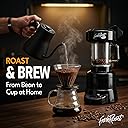
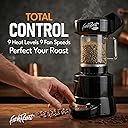
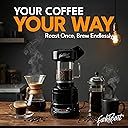
☕️ Roast Fresh, Sip Bold — Your Coffee, Your Rules!
The Fresh Roast SR800 is a high-capacity, manual coffee bean roaster designed for home use, featuring 9 adjustable heat levels, a powerful convection fan, and a digital temperature display. It roasts up to 8 oz of green beans in under 10 minutes, enabling coffee enthusiasts to unlock fresh, customizable flavors with precision control. Ideal for millennials who value artisanal quality, speed, and the freshest coffee experience possible.

| ASIN | B07Z9Q3TLQ |
| Age Range Description | Adults |
| Brand | Fresh Roast |
| Brand Name | Fresh Roast |
| Caffeine Content Description | Caffeinated |
| Coffee Roast Level | Medium Roast |
| Coffee Type | Coffee Bean |
| Country as Labeled | China |
| Customer Reviews | 4.4 out of 5 stars 537 Reviews |
| Included Components | Coffee Bean Sample Trays, Optional glass EXT tube, Top lid and chaff basket, Variable manual heat controls, glass roasting chamber |
| Item Dimensions | 20.3 x 20.3 x 35.6 centimetres |
| Item Form | Whole Bean |
| Item Package Weight | 2.81 Kilograms |
| Item form | Whole Bean |
| Manufacturer | Fresh Roast |
| Model Number | SB-800 |
| Number of Items | 1 |
| Number of Pieces | 1 |
| Number of items | 1 |
| Roast level | Medium Roast |
| Size | 1 count (Pack of 1) |
| UPC | 745114655967 |
| Unit Count | 1.0 count |
| Unit count | 1.0 count |
M**Y
Perhaps the best machine for home coffee roasting
The SR-800 replaces our old roaster, which was a smaller, programmable roaster from the same company. The newer version has two distinct benefits in my opinion. First, the new roaster has twice the capacity (180 grams of green beans vs. 90 grams). This means I’m brewing only two batches a week instead of 3-4. That’s a huge time saver. Second, the SR-800 is operated manually, which means you stand by the roaster and adjust the fan and temperature as required during the roast. This may not sound like an advantage, but our previous roaster (now discontinued) was a pain to program and only stored one roasting profile at a time. Not good if you like to try coffee from around the world, because one roasting profile does not suit all coffees. With a manual roaster, you just put in 180 grams of beans and start the machine. What I discovered with the SR-800 is that there are only a few basic principles to follow for a consistently good roast. Hot air is blown into the glass roasting chamber, which pushes the beans in the center up and the beans on the outside down, and so the first principle is to keep the beans moving this way to ensure they are evenly roasted and none are scorched. You start with a high fan speed to circulate the heavy beans and a medium temp to remove moisture, and then gradually increase to maximum temp during the first two minutes. The second principle is to reduce the fan speed step by step as the beans lose their moisture and become lighter. You only need enough fan speed to push the beans in the center to the top so that the outside beans will sink to the bottom. The beans don’t need to be flying around the chamber. As you lower the fan speed, the temp becomes substantially hotter. My roasts generally peak at 450+ degrees Fahrenheit. The third principle is to finish heating the beans within about 8 minutes. I like the beans to start popping at around 6 minutes, and then become evenly dark and plump in the next two minutes. You finish with the cool setting at the highest fan speed and lowest temp for a total time in the roaster of about 10 minutes. If you roast the beans too long, the flavor will become muted and bland. The above is my recipe for a medium dark roast just short of any oil coming out of the beans. I don’t like oily beans because they are messy and the oils starts to go rancid in a few days. I also don’t care for the acidic taste of very light roasts, but to each his own. You can adjust the time and temp as you please to achieve your ideal roast. It takes a few batches to get the hang of it, but it’s not all that hard if you pay attention to what the beans are doing in the roaster for about 8 minutes. Personally, I like watching the beans roast and tweaking the fan and temp. It’s fun and I love the results. The SR-800 seems to be the ideal starter roaster for 2-3 coffee drinkers in one household. Better machines start at double the price and not everyone can taste the difference.
G**T
Besides some flaws I love this Roaster.
Lets talk about the flaws first. When its 60 degrees outside it is a bit underpowered. Instead of 220 grams of coffee I roast at a time, I use about 170 grams. You will have to turn up the heat to full, and turn the fan on the highest setting for the drying process. Your beans must always move. At first the beans do not move much as they have moisture in them in the first phase of the drying process. I stir them without the chaff collector on. I have a fan that blows the chaff away from the chimney on the roaster. I do this out in the back yard so I do not care if it makes a mess i just wash it down with water when I'm done. I always check the bean temps with a infrared temp gun through the top of the glass chimney I do not follow the built in temp meter because its a bit off until way in the roasting process. When the beans start moving on there own, I turn the fan to 8 for a minute, then turn the fan to 7 and still on full heat power. Then the beans will get to 360 degrees for a few minutes, on the mallard phase where the beans develope the Sugars. After about 8 minutes in the beans will get to 390 degrees for finishing. You want to keep the beans for about 3 minutes between 350 and 370 to convert the sugars in the bean. After that its the roasting phase, and the temp will go up to 390 or more by that time. If its hotter outside you can add more beans to 220 grams, and should not have a problem getting bean temp to 420 degrees. You really want to check the bean temperature with a infrared temp gun. Dodn't rely trying to get a temp through the glass when your using the chaff collector through the glass with the infrared temp gun. The Chaff collector needs to be off and then you can lazor right into the top of the glass to the beans. if you want to use the chaff collector then fine, but the real bean temperature is abit off on the roaster concerning bean temp. Otherwise when its warm outside, I just fill up 220 grams and go to town. No problems underpowered on warm days. You will need to turn the power down to 8 or seven, and the fan. Remember 3 or 4 mins drying, 3or 4 minutes between 360 and 370 (not over 380 degrees as this is the mallard phase converting starches to sugars and will stop the mallard or sugar developing phase, your coffee will not taste any sweetness.) And the next phase is the real roasting phase. Please unless you like totally black beans with the oils covering the beans its nasty. I do not ever go over 410 degrees. If you see oils on the beans there way overcooked, and your coffee will taste totally bland without good flavors. Primos Coffee on Amazon is good coffee beans very fresh, not too expensive, and really plump up and they are from a single estate so not every Tom, Dick, and Harry's beans is not mixed together. I like green coffee from Mexico the best so I ordered some from Anthony's There products are high quality also, and organic from Mexico. Do try Single Estate coffee its way better.
S**T
Great roaster just be very gentle with the chaff catcher
I love this roaster, it took me a few you tube videos (I had never roasted coffee b4) to get it just right but now it’s really easy to roast the beans. Just one set back is the chaff catcher that goes on top has a huge design flaw, it catches the chaff fairly well but if you tap it to clear the chaff the rim cracks and then chaff starts blowing out. I had to buy a replacement and it cost about 40 bucks. From now on I ll let it cool completely then use compressed air or a vacuum to clean it.
S**3
Good but not great. But I would buy it again. You get a lot for your money here.
I use this with the Fresh Roast extension tube. I set mine up to record roast data using Artisan coffee roasting software. To do this I have two temperature probes (thermocouples) that send data to a Mastech MS6514 Digital Thermocouple Thermometer. This sends data to my laptop. The reason why I do this is so I can keep a record of each one of my roasts - temperatures, time, and roasting events, etc so I can repeat roasts for various beans, roast levels, amount of beans I am roasting - and with various ambient temps (which has a huge affect upon roasts). I'm 76 roasts in with this roaster. My first roasts were not very good because I needed some experience roasting with it (it was not my first air roaster, but it was different than what I owned before this one). The more roasts I did with this machine the better my results. One thing I don't like about the controls on this roaster is that the dial-input (for air and heat adjustment) are multi-function. You push the dial "in" and click a number of times to choose the input option you want during your roast, and then you twist once you get to your function wanted. It doesn't work very well. It's often (like every single roast) advancing to an incorrect input level. This is soooooooooooooo frustrating due to the fact an air roast is moving pretty darned fast and you can end up ruining your roast if you're over/under heating beans due to this awkward input setup. It would be so much better to have inputs that do 1 function and only 1 function. If you need to increase air flow, hey, have one input for that. Heat needs raised or lowered, well have one input for that control. This would be a huge improvement to this roaster. One thing I learned early on is that the ambient temperature has a significant impact on your roast. I live where winters are cold and I roast in my garage. The roasts are wildly different from 70 degrees versus 50 degrees - and yesterday it was 90 degrees in the garage. Now I have saved roast plans to account for this. But initially I ruined some roasts because I did not have a roast plan that fit the ambient temp range I was roasting in. But now I'm fine with whatever the ambient temps are because I have a recorded plan for them. I also have roast plans for the various type beans I am roasting - some beans roast very differently than others... but with experience I now understand what each type of bean requires. I hope this doesn't sound like a negative review. It isn't meant to be. I just wish I had understood some of these things about the roaster when I began my journey with using it. For the money, it is a really good roaster. I am getting incredible bean roasts now... fantastic coffee. It did take some work to get to this point - but maybe I'm a slower learner than most. Hope this is helpful.
L**N
Great value for quality roaster!
Fantastic quality (though I broke the top part shortly after buying it). Knobs sometimes reverse the direction of the time and fan speed, but I'm fine with that. The quality of coffee that it produces is top notch. I struggled for years using popcorn poppers. I finally decided that I had spent more than what I spent on this buying poppers.
Trustpilot
3 weeks ago
1 week ago