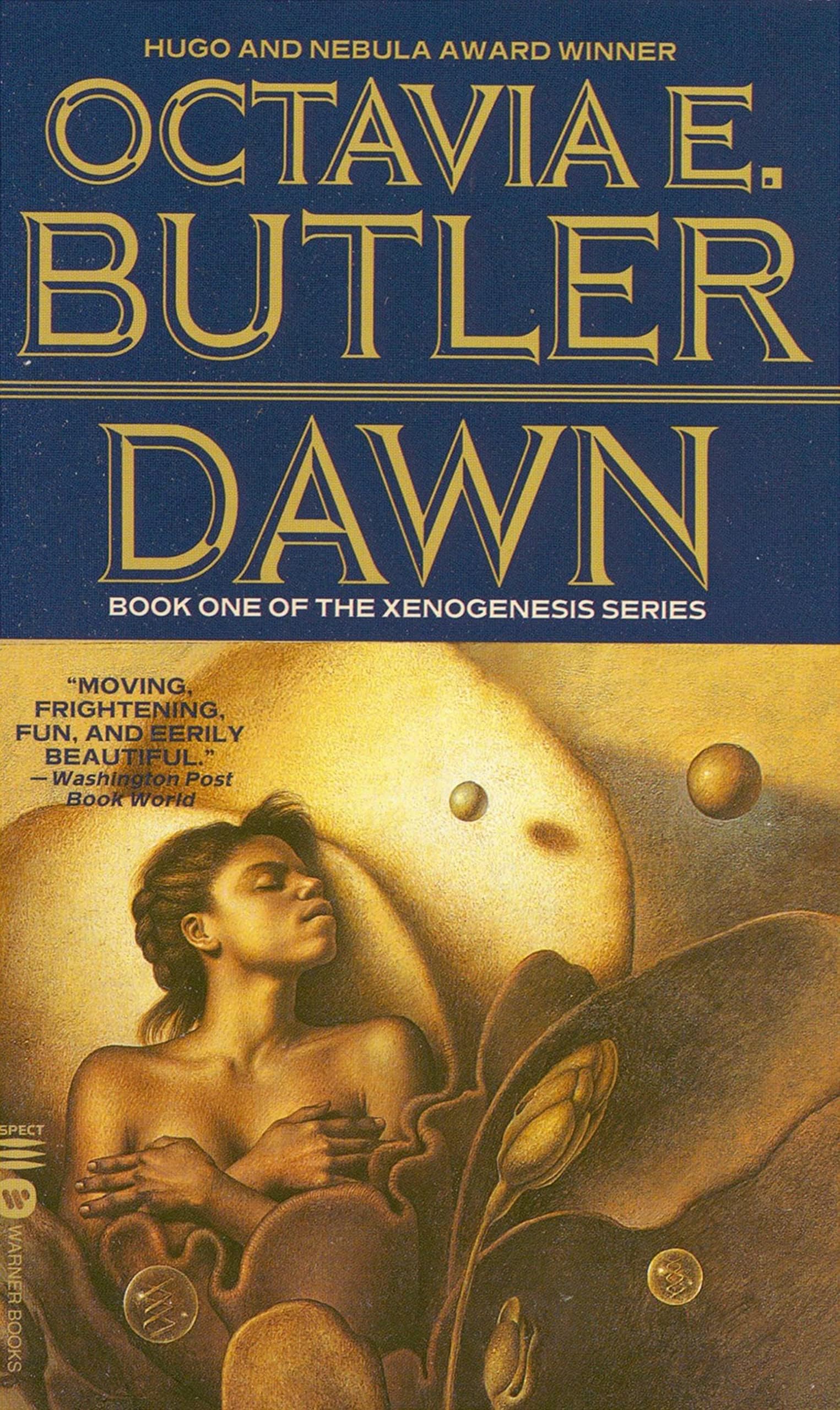
Dawn (Xenogenesis, Bk. 1)
Product ID: 7349933
Buy anything from 5,000+ international stores. One checkout price. No surprise fees. Join 2M+ shoppers on Desertcart.
Desertcart purchases this item on your behalf and handles shipping, customs, and support to Nicaragua.
One woman is called upon to rebuild the future of humankind after a nuclear war, in this revelatory post-apocalyptic tale from the award-winning author of Parable of the Sower. When Lilith lyapo wakes from a centuries-long sleep, she finds herself aboard the vast spaceship of the Oankali. She discovers that the Oankali—a seemingly benevolent alien race—intervened in the fate of the humanity hundreds of years ago, saving everyone who survived a nuclear war from a dying, ruined Earth and then putting them into a deep sleep. After learning all they could about Earth and its beings, the Oankali healed the planet, cured cancer, increased human strength, and they now want Lilith to lead her people back to Earth—but salvation comes at a price. Hopeful and thought-provoking, this post-apocalyptic narrative deftly explores gender and race through the eyes of characters struggling to adapt during a pivotal time of crisis and change. Review: DAWN, by Octavia Butler is a fantastically awesome book. - What a great read. I couldn't put it down. Its the first of a 3 part sci-fi series. I discovered this amazing writer after reading KINDRED. Another sci-fi, that one with time travel. Also thoroughly enjoyed. Ms. Butler has a real talent for creating deep, rich characters you get invested in and want to learn more about. The plot never loses your interest. She doesn't bog you down with a lot of scientific jargon; just enough explanation to understand what's going on. No sooner was I hooked on her writing, when I learned, sadly, that Ms. Butler had died in 2006. Happily, she left a shelf full of 60 of her books to read and enjoy and expand our minds. I'm on to the next book in her exogeniic series, ADULTHOOD RITES, then after that, IMAGO! I rarely read sci-fi, but I will work my way through all of her offerings. Review: Interesting But Unsettling - Enthralling, dawning horror. That’s probably the best way to describe my evolving response while reading Octavia Butler’s Dawn—an emotional journey that shares much in common with the experience of Lilith, the book’s protagonist. The story begins when she’s awakened from stasis by Oankali, aliens who rescued her and a handful of other survivors after a nuclear holocaust ravaged the Earth. While these “lucky” few slept, the Oankali spent the intervening centuries restoring the planet and readying it for humanity’s return. Lilith is tapped to lead the first wave. But the Oankali aren’t acting solely out of the goodness of their hearts (or whatever organs function as the metaphorical equivalent in their bizarre, many-tentacled bodies). Salvation comes at a price. And the cost is genetic. Much of this is fascinating. For one thing, the worldbuilding is particularly well done. We only get the broad strokes of the conflict between the United States and Russia that precipitated intergalactic intervention. But that’s all we need—Butler devotes most of her exposition to slowly revealing the Oankali’s biology and culture. We learn about their lifecycle, from puberty to adulthood. We see how they form triads rather than couples, with gender-neutral ooloi forming the link between male and female. And we glimpse the differences between their broad peoples—Dinso, Toaht, and Akjai—in a way that hints at even greater distinctions. The Oankali are also technologically advanced but in organic fashion. They grew their ship. They replicate organisms and objects from “prints” of each entity’s molecular makeup. They store their subjects in Venus flytrap-like plants that sustain them in hibernation. And, as Lilith explains to some of the humans she’s charged with leading, the Oankali “manipulate DNA as naturally as we manipulate pencils and paintbrushes.” This is the entry point for one of Dawn’s many unsettling aspects. Lilith notes more than once that she feels like a lab rat caught up in a captive breeding program. “We used to treat animals that way,” she tells one of her Oankali handlers. “We did things to them—inoculations, surgery, isolation—all for their own good. We wanted them healthy and protected—sometimes so we could eat them later.” But the Oankali (the ooloi especially) aren’t interested in that form of consumption. They see “great potential” in humanity’s various mutations. It’s an uncomfortable turning of the tables. And while Butler never really gets into intra-species racial dynamics, it’s hard not to think about historical parallels like the abominable Tuskegee Study. This theme of coercive experimentation carries over to sex. The rapes attempted by other humans in the book are the familiar sort of terrible. (In Dawn, terrestrial tensions and barbarity don’t improve when the constraints of civilization are stripped away.) But the chemical and neurological manipulation the ooloi use to tempt and control their patients corrodes consent in a different, more insidious way. Ultimately, though, Dawn comes down to a classic sci-fi quandary: What does it mean to be human? It can’t simply be a question of genetics—fluidity has always been baked into our DNA, an evolutionary malleability Butler hints at when an ooloi reverts Lilith’s physical strength back to the level of our primate forebears’. The Oankali suggest that what truly defines us is our tendency to be both intelligent and hierarchical. Yet for all their strangeness, the aliens have these traits in common. (Paternalism might be too gendered a term for the form of “we know what’s best for you” condescension they levy at Lilith and her cohort, but the attitude is uncomfortably familiar.) Some of the Oankali are even likable. And while they display feelings like love and grief differently, there’s enough overlap with the human varieties of these emotions to make you wonder where the lines of delineation are—or if they even exist. So did I enjoy reading Dawn? Not entirely. I found it more thought-provoking than thrilling, partly because Lilith doesn’t have much agency. Her rebellious impulses never really mature into a plan; mostly, she fulfills the role the Oankali set for her, resigned to playing a “Judas goat” the majority of her fellow humans will always see as an agent of the enemy. But I won’t soon forget this book. And I intend to continue on in the series. I just might read some lighter fare first.
| Best Sellers Rank | #1,311,807 in Books ( See Top 100 in Books ) #25 in Genetic Engineering Science Fiction (Books) #141 in Dystopian Fiction (Books) #476 in Post-Apocalyptic Science Fiction (Books) |
| Customer Reviews | 4.4 out of 5 stars 6,245 Reviews |
L**H
DAWN, by Octavia Butler is a fantastically awesome book.
What a great read. I couldn't put it down. Its the first of a 3 part sci-fi series. I discovered this amazing writer after reading KINDRED. Another sci-fi, that one with time travel. Also thoroughly enjoyed. Ms. Butler has a real talent for creating deep, rich characters you get invested in and want to learn more about. The plot never loses your interest. She doesn't bog you down with a lot of scientific jargon; just enough explanation to understand what's going on. No sooner was I hooked on her writing, when I learned, sadly, that Ms. Butler had died in 2006. Happily, she left a shelf full of 60 of her books to read and enjoy and expand our minds. I'm on to the next book in her exogeniic series, ADULTHOOD RITES, then after that, IMAGO! I rarely read sci-fi, but I will work my way through all of her offerings.
N**)
Interesting But Unsettling
Enthralling, dawning horror. That’s probably the best way to describe my evolving response while reading Octavia Butler’s Dawn—an emotional journey that shares much in common with the experience of Lilith, the book’s protagonist. The story begins when she’s awakened from stasis by Oankali, aliens who rescued her and a handful of other survivors after a nuclear holocaust ravaged the Earth. While these “lucky” few slept, the Oankali spent the intervening centuries restoring the planet and readying it for humanity’s return. Lilith is tapped to lead the first wave. But the Oankali aren’t acting solely out of the goodness of their hearts (or whatever organs function as the metaphorical equivalent in their bizarre, many-tentacled bodies). Salvation comes at a price. And the cost is genetic. Much of this is fascinating. For one thing, the worldbuilding is particularly well done. We only get the broad strokes of the conflict between the United States and Russia that precipitated intergalactic intervention. But that’s all we need—Butler devotes most of her exposition to slowly revealing the Oankali’s biology and culture. We learn about their lifecycle, from puberty to adulthood. We see how they form triads rather than couples, with gender-neutral ooloi forming the link between male and female. And we glimpse the differences between their broad peoples—Dinso, Toaht, and Akjai—in a way that hints at even greater distinctions. The Oankali are also technologically advanced but in organic fashion. They grew their ship. They replicate organisms and objects from “prints” of each entity’s molecular makeup. They store their subjects in Venus flytrap-like plants that sustain them in hibernation. And, as Lilith explains to some of the humans she’s charged with leading, the Oankali “manipulate DNA as naturally as we manipulate pencils and paintbrushes.” This is the entry point for one of Dawn’s many unsettling aspects. Lilith notes more than once that she feels like a lab rat caught up in a captive breeding program. “We used to treat animals that way,” she tells one of her Oankali handlers. “We did things to them—inoculations, surgery, isolation—all for their own good. We wanted them healthy and protected—sometimes so we could eat them later.” But the Oankali (the ooloi especially) aren’t interested in that form of consumption. They see “great potential” in humanity’s various mutations. It’s an uncomfortable turning of the tables. And while Butler never really gets into intra-species racial dynamics, it’s hard not to think about historical parallels like the abominable Tuskegee Study. This theme of coercive experimentation carries over to sex. The rapes attempted by other humans in the book are the familiar sort of terrible. (In Dawn, terrestrial tensions and barbarity don’t improve when the constraints of civilization are stripped away.) But the chemical and neurological manipulation the ooloi use to tempt and control their patients corrodes consent in a different, more insidious way. Ultimately, though, Dawn comes down to a classic sci-fi quandary: What does it mean to be human? It can’t simply be a question of genetics—fluidity has always been baked into our DNA, an evolutionary malleability Butler hints at when an ooloi reverts Lilith’s physical strength back to the level of our primate forebears’. The Oankali suggest that what truly defines us is our tendency to be both intelligent and hierarchical. Yet for all their strangeness, the aliens have these traits in common. (Paternalism might be too gendered a term for the form of “we know what’s best for you” condescension they levy at Lilith and her cohort, but the attitude is uncomfortably familiar.) Some of the Oankali are even likable. And while they display feelings like love and grief differently, there’s enough overlap with the human varieties of these emotions to make you wonder where the lines of delineation are—or if they even exist. So did I enjoy reading Dawn? Not entirely. I found it more thought-provoking than thrilling, partly because Lilith doesn’t have much agency. Her rebellious impulses never really mature into a plan; mostly, she fulfills the role the Oankali set for her, resigned to playing a “Judas goat” the majority of her fellow humans will always see as an agent of the enemy. But I won’t soon forget this book. And I intend to continue on in the series. I just might read some lighter fare first.
A**D
Mixed bag
I didn't realize this was the first book in a trilogy. It's incredibly well crafted and genuinely brilliant. However, this is the end of our lead's story, as the other books are about children. So naturally, the ending to this book is hugely unsatisfying.
N**L
Third time reading Xenogenesis in a Ta-Nehisi Coates frame of mind.
This review is for the entire Xenogenesis Trilogy aka Lilith's Brood. I was Introduced to Octavia E. Butler by another sci-fi loving friend of mine. When I read the Trilogy several years ago the novels were published together in one book titled Lilith's Brood. I had no idea it was originally titled something else and I also knew nothing about Butler. I'm so glad that I originally read them in this state of ignorance because it has made it possible for me to review and appreciate the novel(s) for the amazingly imaginative story and the evocative prose used to tell it. I won't summarize the books as others have already done so. I will say that in my opinion Butler has reframed the Genre of extra-terrestrial, space travel and dystopian stories. Xenogenesis is a thought provoking trilogy that will make the reader question her beliefs regarding humanity's origins and its future. I was completely fascinated by the Oankali's ancestral knowledge. Oh to be able to truly understand who we are and where we came from! That brings me to my other reading of Xenogenesis. When I discovered that Butler was an African American woman I began to rethink my understanding of Lilith and her descendants stories. I now see it more as an allegory of the African American experience. Like Africans kidnapped and sold into slavery Lilith is forced into a world that she despises. Her story illustrates two of the oposing methods for slaves to live with being enslaved. Like some slaves Lilith believes there was no hope for escape for her. She finally decides to survive by enduring. I kept picturing Bell Waller - Kunte Kinte's wife in Roots. She also endures. Just as "resistors" of the Oankali invasion despise Lilith for surviving WITH the Oankali Kunte Kinte feels disgust for the American born slaves including Bell. he sees them as weak and degraded just as the rebels see Lilith. Like the resistance some slaves formed rebellions or attempt escape. Some survived by enduring like Lilith. additionally i could not stop thinking of the rape of black women by white masters as I read of Lilith's reluctant joining with her Oankali mates. Like many of those African American slave women she must have been torn apart by her love of her children born off rape and her hatred of their human/Oankai mix. I recall Kunte Kinte fearing that his child would be light skinned and not pure African. Also like the American slave experience The human's culture is obliterated. They are also forced into a mass exodus from their homes to a barely liveable planet. There are too many more examples to list and not enough time . It's an even more thought provoking piece of literature when read with the knowledge of Butler's own heritage. I found that my respect for Lilith grew when I thought of her in this way. She ensured that at least a small piece of humanity would survive just as American enslaved women ensured that one day their culture would survive. It's these women's' ability to endure that makes them honorable and heroic in my eyes. It's a new and unique way to think of the dirty history American slavery and the extraordinary people who survived that awful institution. This should be required reading for all Americans - especially in today's NOT-post-racism-culture
M**S
I wanted and expected more.
I looked forward to reading Octavia Butler, given her reputation. This was the first book of hers I have read, and I wavered between 3-4 stars. Giving it 3 because I wont be reading the sequels, as I didn't find this work compelling enough. Why not? Her writing is crisp and clear, her descriptions are good enough to convey scenery, etc. well and enable really excellent worldbuilding, so where did I get lost? Characters. Her protagonist is well drawn and fleshed out, and has flaws and personality and a point of view, which I loved. All her supporting human characters, though, are drawn so sparingly that they are more cliches than people. MILD SPOILERS BELOW At one point, she is literally reviewing dossiers about other humans in order to make some decisions, and the brief sketches she reads in them are the primary method for introducing these characters. Carl is exactly what he is presented as, and we never hear these supporting characters enough to really dig into their personalities, conflicts, etc. so when there is conflict. It is more like ‘character versus NPC’ than against another character. The book is so short, it would have been easy to add dimension to the supporting characters to illuminate the protagonists choices and challenges. Instead, we get a lot of eloquent internal monologue and a bare-minimum of external dialog. Some characters oppose the protagonist? Well, an NPC will tell her ‘X, Y and Z are plotting against you!’ So now the reader knows. This is her story, but it is told with so little else in terms of other characters that we get a one-dimensional view of her and a zero-dimensional view of the other human characters. The aliens are slightly more fleshed out and there is more interaction, but I feel like Butler focused too much on the protagonists inner thoughts and ignored the opportunity to show her as a full, rounded character by giving us other more richly-drawn characters for her to bounce off of. This book was good enough I wish it had been better.
W**Y
*Review from The Illustrated Page*
Trigger warning for rape and sexual assault Dawn is the story of a woman who wakes up in an alien spaceship centuries after the Earth is largely destroyed by a nuclear war. The Oankali pick up the survivors, but it is ambiguous as to whether they are saviors or kidnappers. At any rate, the humans are given no choice in the matter. Dawn is a good book, and it has a lot to consider. It just isn’t really the book for me. It’s difficult for me to put into words. Maybe it’s because so much of the book involves the intersection of sex, power, and reproduction. Like I said before – weighty stuff. But this did mean that there was a certain amount of what I’d refer off hand to as “weird alien sex stuff.” It was completely necessary for the plot and themes, but it wasn’t the sort of thing I liked to read. Dawn in general wasn’t a comfortable read (that’s the point). So much of it deals with the idea of being powerless and under other people’s control. Lilith has literally no control or choices. She’s completely in the hands of the Oankali, who do treat her like an independent person with rights. She’s more like a tool to them, or at best, the beloved family pet. Yet, Lilith still has strength. She’s resilient and intelligent. She keeps thoughts of resistance and ambitions of escape within her. The fact that she’s still sane and functioning at the end is nothing short of miraculous. I did wonder where LGBT people fit into this scenario, but their complete absence may be explained by the fact that this book was published in the 80s. Or maybe the Oankali just never let any out of imprisonment because they didn’t align with the aliens reproductive goals. It’s possible that this is addressed in sequels, but I wouldn’t get my hopes up. I would recommend this one, but it’s hard for me to say who to. If you want to read Dawn, you need to be prepared for a rather bleak book that deals with some difficult subject matter. However, if you do pick it up you will find an excellently written science fiction novel addressing gender and oppression. Really, this should probably be on the classics list.
E**Y
Amazing SF Read - Love Octavia Butler
It's hard to believe, but this was my first time reading anything by Octavia Butler, although she's been on my list of authors to read for quite some time. I was impressed with Dawn (the first book in the "Lilith's Brood" or "Xenogenesis" trilogy). I read it for my science fiction book club, and I have to say that we ended up having some really good discussion about the book. I'll dive in and share some of the reasons why this was ultimately such a powerful book for many of us in my club. I should start off by saying that in my opinion, Butler's writing is somewhat sparse and to the point - not full of flowery descriptions or long, flowing narratives. I actually really appreciated that about this book - mainly because when Butler decides to use those descriptive techniques, she uses them with power. Those scenes will whack you over the head. My impression is that this was intentional on her part - she used her narrative prowess to pull you into scenes that were significant and meaningful. She's not self-indulgent in her writing. I was immediately impressed with Lilith, the protagonist, from the start of the book. She certainly wasn't perfect, but she was real - human. As the story progressed, she struggled to find where she fit - did she fit anywhere? Ultimately, she was neither seen nor accepted as human, but she also wasn't alien. She was alone, and constantly faced the challenge of adjusting her expectations based on ever-changed situations. Her pessimism and optimism often worked against each other - it was difficult for her to find balance. The biggest part of what made this book so powerful for me were the question it raised - none of which had clear answers: - What is the line between coercion and consent? - Is a "trade" really a trade is there's no choice involved? - Does any character in the book ultimately have the freedom of choice in any regard, or is every interaction about manipulation? - What does it mean to be human? - Are humans really doomed to ultimately self-destruction without outside intervention? - Are the aliens offering a type of facilitated evolution? Or is the change so drastic that it can't even be seen as facilitated evolution? (i.e. will humans still be human? Is Lilith still human?) - Are the aliens good or bad? Does "good" or "bad" even exist? Honestly, it was these question that made me most appreciate this book and Octavia Butler as a writer. She's not forcing her opinions on anyone. She leaves it up to the reader to decide what they thing the right answers are. It was these questions that kept my book club discussing this book and it's themes for over two hours. I honestly think that if some of us hadn't had to leave, we would have kept talking about it. If you're someone who likes a clear resolution or stories where there is a clear line between good versus evil, then this book isn't for you. This one clearly lives in the grey space - where it's more about questions than answers. Ms. Butler will definitely have a permanent space on my bookshelf, and I'm looking forward to reading the other two in this series (Lilith's Brood Trilogy).
J**S
Good book.
I wasn’t sure about this book, but in the end I really liked it. I will read the next one. I hope it will be good. I read this book in two days which is fast for me.
M**A
Me gusto mucho!
Me gusto mucho! Un exito!
T**N
Excellent, though strangely frustrating
Grabbed me from the first page; I couldn’t put it down and finished it in one sitting. Having said that - and this is not a criticism, more an observation - I found it incredibly frustrating at times since were I in the same situation I would be welcoming the Oankali’s involvement with open arms. I suppose it’s the misanthrope in me coming out; the thought of being genetically modified didn’t fill me with the same feeling of horror or with the stubborn insistence to maintain our genetic autonomy that the human protagonists feel. Frankly, as a species, I think we could use all the help we can get. The fact that I felt this dichotomy with the human characters was what made it doubly entertaining to me, quite apart from the story itself and the fascinating concept of the aliens’ appearance and existence. Onto the next.
A**.
Very interesting aliens
The aliens in this story are extremely interesting, especially the societal/moral questions.
T**A
Five Stars
A few typesetting errors but the book itself is awesome. Highly recommended if you're into confronting science fiction.
K**A
A sci-fi pages turner that questions morality
The first book in the Lilith Brood Trilogy is a great fast read. My second Octavia Butler novel, and it's an excellent work of fiction. It questions a lot of that we humans take for granted by putting humans in the place animals and plants. A much more advanced alien species, with broadly good intentions, is helping reseed human civilization on Earth, but in a controlled agricultural way. Read it!
Trustpilot
2 months ago
3 weeks ago