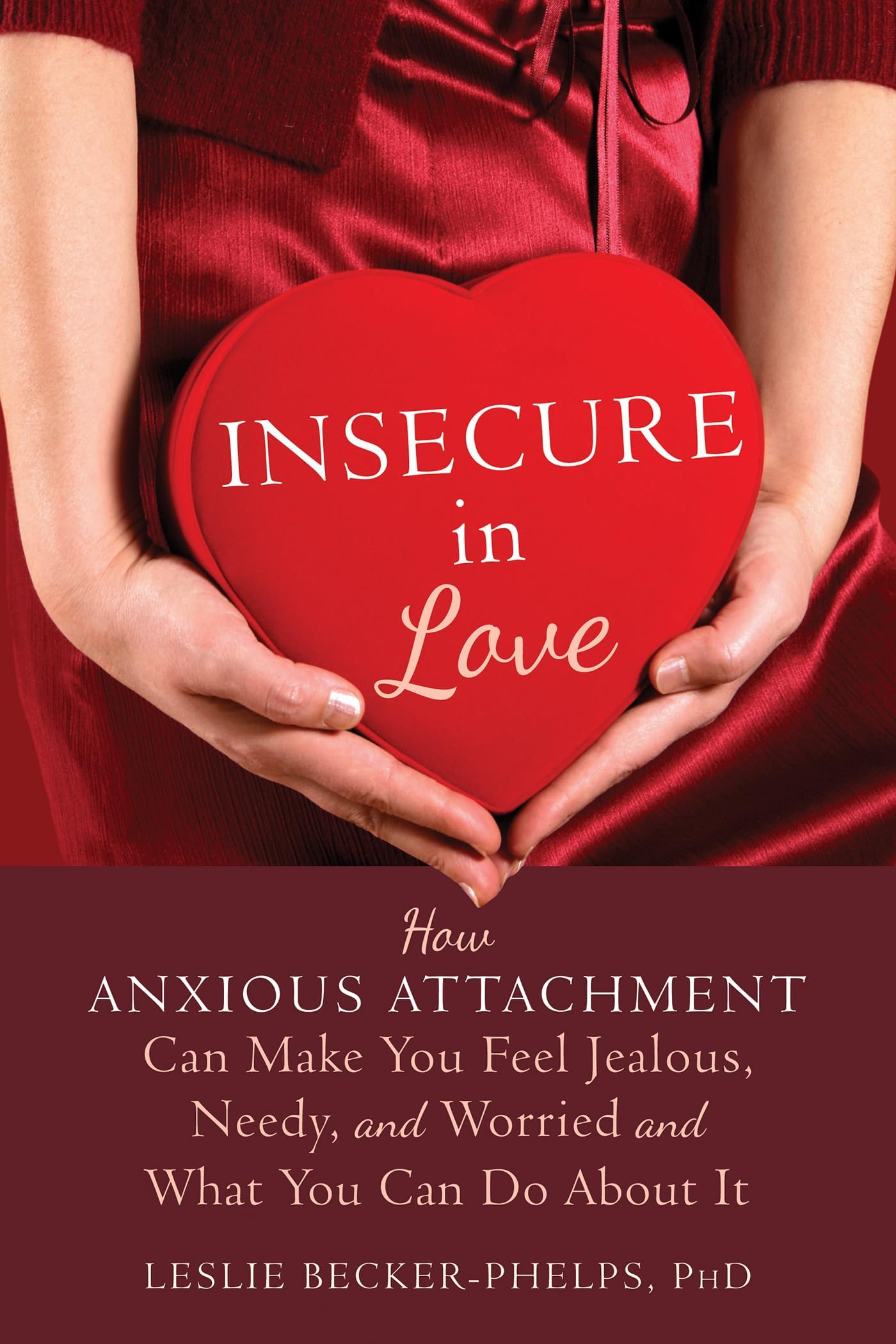
Insecure in Love: How Anxious Attachment Can Make You Feel Jealous, Needy, and Worried and What You Can Do About It
Product ID: 6993944
Buy anything from 5,000+ international stores. One checkout price. No surprise fees. Join 2M+ shoppers on Desertcart.
Desertcart purchases this item on your behalf and handles shipping, customs, and support to Nicaragua.
Do you struggle with anxious attachment in relationships? If you constantly worry about your partner pulling away, feel jealous or insecure, or fear abandonment in romantic relationships, you may have an anxious attachment style. Rooted in early attachment experiences, attachment anxiety can leave you overthinking texts, seeking reassurance, or feeling overwhelmed by relationship uncertainty. In Insecure in Love , you’ll learn how to overcome anxious attachment using compassionate self-awareness―a practical, research-informed approach that helps you regulate emotions and build secure relationships. In this book, you’ll learn how to: Identify the signs of anxious attachment and fear of abandonment Break patterns of jealousy, reassurance-seeking, and emotional reactivity Stop overthinking and calm relationship anxiety Communicate your needs clearly without pushing your partner away Replace self-criticism with self-compassion Build the foundation for secure, lasting love Through guided exercises and clear explanations, you’ll understand how attachment insecurity affects communication, conflict, and intimacy―and gain the tools to change those patterns without shame or self-blame. If you’re tired of repeating the same painful relationship cycles, this compassionate guide will help you move from attachment anxiety to emotional security―so you can build the loving, stable relationship you deserve. Review: Teaches you how to heal your attachment vs. slapping you with a label - This book is great. It's clear, very well explained and offers exercises for learning and growing. About 2.5 years ago I was having a lot tensions in my relationship because of the attachment "issues." I'd read the classic book on attachment but it was more like a label and it seemed to offer the only solution of finding a different partner. It seemed quite prescriptive and not about what a person can do to heal or lessen the friction. Did I probably have some childhood wounds with attachment? For sure. Who doesn't? Did I have a traumatic break up in my formative years. Yep--didn't you? I did therapy; I processed all the things years and years ago but I still had patterns come up that felt suffocating. Did I have to forever be trapped in reproducing those patterns. Absolutely not. Read this book to learn how to step out of it. I believe I found out about it via lawyer turned life coach Kara Loewentheil's podcast (UFYB) or coaching on relationships. The book works very well with coaching because it gently shows you how there are other ways to be in relationships that aren't driven by an anxiety label and how to work with anxious attachment habits. (Yes, I mean habit and not a diagnosis.) There are exercises and a lot of concrete tactics for working with and learning from your emotions and notions of attachments and rejection. As I learned and got curious, I learned how I was setting up / interpreting lots of things as rejection outside my relationship. For example, I am in a field that requires me to submit projects or proposals that could be rejected. If I don't pay attention, I can go through the rejection spin out here or in lots of other areas of my life. This is not a fun way to live and a sure-fire road to writer's block. This is pattern that I've largely unlearned and, when it does come up, I can recognize it much more quickly than before. It doesn't wreck my world. [NB: I read this book first and most recently read the Bouncing Back from Rejection one so I might be conflating the two a tad.] In all honesty, I might even love the Bouncing back from Rejection book even more. The ways of processing emotions and related thoughts resonates with how I deal with emotions like these when they come up (usually through self-coaching). I more often return to the rejection one because it helps me distance my learning from solely looking at my intimate relationships. Iterations of this pattern come up in all sorts of relationships and life endeavors and it's worth investing in learning about how to shift it. While not easy, these books and learning process have been life altering. They give you many concrete tools to unlearn these sort of patterns and can help you re-articulate your close relationship/friendships and your reactions to real or perceived rejection. Review: IF you're struggling to feel secure and comfortable in your relationships, help is here! - Words can't express how grateful I am that this book was written! Learning about Attachment Theory and learning about being Anxiously Attached has been extremely liberating. "Insecure in Love" helped me to understand not just who I am, yet why I am, who I am. Something that no counseling (individual or group), no church service or bible scripture or any conversation with anyone could help me see or understand. I always knew that something was different and understood that I just don't operate in relationships like other people, yet the missing piece to the puzzle was why and where it began. Being a therapist myself, I recognize that w/out a proper diagnosis, you can't treat the real issue. "Insecure in Love" allowed me the opportunity to address the real problem from the root. I must admit that I am still very afraid of being able to make the necessary changes as I am slowly (and consciously) working through the exercises as instructed. I am courageously confident that finding peace is an option, because I at least feel understood and I have a name for what it is and a plan to fix it. This book was wonderfully written and provides examples to make it even more comprehensive. If you truly want to take a step in the right direction, this book will help you get there, not to mention, the author affords you the opportunity to contact her personally if needed (I actually spoke to her). She is a true HELPER and that speaks volumes about the impact that her work will have (and is having) on those in need.


| Best Sellers Rank | #44,951 in Books ( See Top 100 in Books ) #54 in Parenting Teenagers (Books) #64 in Anxieties & Phobias #176 in Love & Romance (Books) |
| Customer Reviews | 4.5 out of 5 stars 1,957 Reviews |
B**M
Teaches you how to heal your attachment vs. slapping you with a label
This book is great. It's clear, very well explained and offers exercises for learning and growing. About 2.5 years ago I was having a lot tensions in my relationship because of the attachment "issues." I'd read the classic book on attachment but it was more like a label and it seemed to offer the only solution of finding a different partner. It seemed quite prescriptive and not about what a person can do to heal or lessen the friction. Did I probably have some childhood wounds with attachment? For sure. Who doesn't? Did I have a traumatic break up in my formative years. Yep--didn't you? I did therapy; I processed all the things years and years ago but I still had patterns come up that felt suffocating. Did I have to forever be trapped in reproducing those patterns. Absolutely not. Read this book to learn how to step out of it. I believe I found out about it via lawyer turned life coach Kara Loewentheil's podcast (UFYB) or coaching on relationships. The book works very well with coaching because it gently shows you how there are other ways to be in relationships that aren't driven by an anxiety label and how to work with anxious attachment habits. (Yes, I mean habit and not a diagnosis.) There are exercises and a lot of concrete tactics for working with and learning from your emotions and notions of attachments and rejection. As I learned and got curious, I learned how I was setting up / interpreting lots of things as rejection outside my relationship. For example, I am in a field that requires me to submit projects or proposals that could be rejected. If I don't pay attention, I can go through the rejection spin out here or in lots of other areas of my life. This is not a fun way to live and a sure-fire road to writer's block. This is pattern that I've largely unlearned and, when it does come up, I can recognize it much more quickly than before. It doesn't wreck my world. [NB: I read this book first and most recently read the Bouncing Back from Rejection one so I might be conflating the two a tad.] In all honesty, I might even love the Bouncing back from Rejection book even more. The ways of processing emotions and related thoughts resonates with how I deal with emotions like these when they come up (usually through self-coaching). I more often return to the rejection one because it helps me distance my learning from solely looking at my intimate relationships. Iterations of this pattern come up in all sorts of relationships and life endeavors and it's worth investing in learning about how to shift it. While not easy, these books and learning process have been life altering. They give you many concrete tools to unlearn these sort of patterns and can help you re-articulate your close relationship/friendships and your reactions to real or perceived rejection.
C**N
IF you're struggling to feel secure and comfortable in your relationships, help is here!
Words can't express how grateful I am that this book was written! Learning about Attachment Theory and learning about being Anxiously Attached has been extremely liberating. "Insecure in Love" helped me to understand not just who I am, yet why I am, who I am. Something that no counseling (individual or group), no church service or bible scripture or any conversation with anyone could help me see or understand. I always knew that something was different and understood that I just don't operate in relationships like other people, yet the missing piece to the puzzle was why and where it began. Being a therapist myself, I recognize that w/out a proper diagnosis, you can't treat the real issue. "Insecure in Love" allowed me the opportunity to address the real problem from the root. I must admit that I am still very afraid of being able to make the necessary changes as I am slowly (and consciously) working through the exercises as instructed. I am courageously confident that finding peace is an option, because I at least feel understood and I have a name for what it is and a plan to fix it. This book was wonderfully written and provides examples to make it even more comprehensive. If you truly want to take a step in the right direction, this book will help you get there, not to mention, the author affords you the opportunity to contact her personally if needed (I actually spoke to her). She is a true HELPER and that speaks volumes about the impact that her work will have (and is having) on those in need.
A**A
Easy read and informative
Helpful to learn all the skills. Learning how To recognize attachment issues and how to manage them.and what to do to change it into a healthy life
D**.
Gentle, useful book; advice could have been more practical and less
This was a great read, and is now a useful reference book to understand attachment typologies. What I find striking is that this author argues that to overcome anxious attachment, one needs to actively find a healthy relationship (friendly, familial, romantic, otherwise). This is easier said than done, and possibly easier in some life areas than others. Also, I find that this approach could put a lot of undue burden on the “healthily attached” person; in fact, many advice columns continually argue that if a partner is too needy, to drop them. I suppose this is where genuine love, understanding, and communication come in, and possibly the lacking factors that might have contributed to anxious attachment. In all, my self-awareness has heightened and I am less emotionally reliant on others, however I am not sure that I am closer to attracting the kind of complementary partner that is described in the book. In this regard, I feel the author should have spent more time discussing just ways that one can reframe one’s interactions and strategies for the individual to use with a potential partner, friend, colleague, child, pet, etc. versus rely heavily on finding successful healthy romantic attachment; this would have been more practical because we form many, many relationships over our lifetime, and the author could have spent more time on the common denominator in all of them: the individual.
C**T
A really good book, very accessible and practical
I love that the author of this book does provide practical ways to resolve the issues that come with the attachment styles, as well as give you understanding around whether it's something you can work on or it's something that requires you to move on. It's written in very accessible and relatable language and mentions a lot of things that really hit home. I think everyone with anxious attachment should read this book to better understand what can be done about it. As for how much I've changed from it, I'm not sure. It definitely got me to think about a lot of things in my last relationship when I felt anxious (which is why I picked up the book in the first place), and I'd have yet to experience the changes with someone suitable. I'll likely re-read it a few times over the next year before hopefully being in a more suitable relationship!
S**M
Decent resource
This book is a decent/okay resource. I'm sure when it was first published, it was a lot more appropriate for its time, but I feel it no longer serves the original niche. I read this book after having read Polysecure, and I'm glad I read them in that order. This is a good supplemental read to Polysecure if you can read between the lines and look past the obvious issues. To be clear, this book is NOT inclusive, and the gendered language feels very forced. I got some helpful information from it, but not nearly as much as I could have. The author does give a disclaimer about her book and research being very Western society focused, but the more I read, the more I felt the disclaimer doesn't excuse the extreme lack of inclusivity. That being said, I would still recommend reading it after reading Polysecure.
S**H
Give it a chance: Freedom in Pages
I have about 20 to 30 relationship books. I can tell you that this is the only book truly validates me feelings and gives me a recipe to help me, whether it works or not. I don’t know yet. Just knowing that what we want is not something crazy is a relief by itself. We are living in a society that desiring a romantic companionship is a sign of weakness, stupid or mental illness. What crazy is to replace human beings with dogs. I first started reading Attached by Amir Levine, now this is an extended version of that, and it started helping me already. I also read Homecoming by John Bradshaw, which focuses on healing inner child and I did the exercises which helped me a lot. It’s because mostly anxious attachment, rooted in childhood. I can say in matter of four months, I have improved a lot more than last eight years of talk therapy.
B**D
Important for those who struggle in relationships
This is an important book for people who have trouble finding and maintaining good relationships. We have all been shaped by our early caretakers to have certain kinds of attachment styles in relationship - anxious, avoidant and secure. It is important to know which yours is and how it can dominate your love relationships. This is the self awareness that the author promotes. It is also important to be kind to yourself when your attachment style kicks in and leads you to act in unhelpful ways. This is the self-compassion side of the author's equation. This can be accomplished by taking the time to step back and detach from the emotions. Not an easy task, by any means, but a necessary one that helps you understand your attachment emotions and that you are not some sort of needy or cold person, but a product of your environment who now has the resources to improve your relationships.
K**E
Although some of these concepts were familiar to me Leslie ...
Although some of these concepts were familiar to me Leslie Becker-Phelps writes in a clear, concise way which helped the ideas sink deeper. If you're inclined to attach quickly and struggle with feelings of low self-worth, jealousy and insecurity this is a must read.
R**A
Highly recommended for the anxiously attached.
This is an excellent resource for the anxiously attached. I read a number of books on the subject of attachment issues in relationships, but this one was by far the most helpful for me - so useful that I have it in Kindle and paper versions. It encouraged me to examine how these issues have developed over time in my life, and suggests a number of useful exercises to address them, ideas that I continue to use and return to. I'm grateful I found this shortly after meeting the person I want to spend my life with. For the first time in my life, I actually have the confidence to say that I won't f*!k this relationship up. Much of this is thanks to my understanding and wonderful partner, but this book and an excellent EFT therapist have been a significant help.
M**S
Thumbs up, seems very helpful so far..
Not even finished the book yet and it has already made a difference on the way I think about some situations and opened my eyes to some issues I hadn't noticed before.. Brilliant!
L**E
Mauvais
Ce livre est tellement décevant que je suis en train de prendre la peine et le temps d’écrire ce commentaire. L’auteure tourne autour du pot, répète les mêmes notions au fil des pages et finalement ne donne aucune solution concrète à la problématique posée. Je vous conseille de ne pas l’acheter et de poursuivre vos recherches vers un autre livre sur le même sujet. Bonne chance
H**I
Verdiente 5 Sterne
Das war mit Abstand das beste Buch was ich je gelesen hab bis jetzt. Jahrelang hab ich mich gewundert, was mein Problem ist, wenn es um Beziehungen geht und dieses Buch deckte alles auf und bot großartige Hilfe. Ein riesiges Danke an die Autorin! This was by far the best book I've ever read. For years I was struggling with love and relationships and this book helped me uncovering my issues with that and provided awesome techniques to help me. A big thanks to the author!
Trustpilot
3 weeks ago
1 week ago