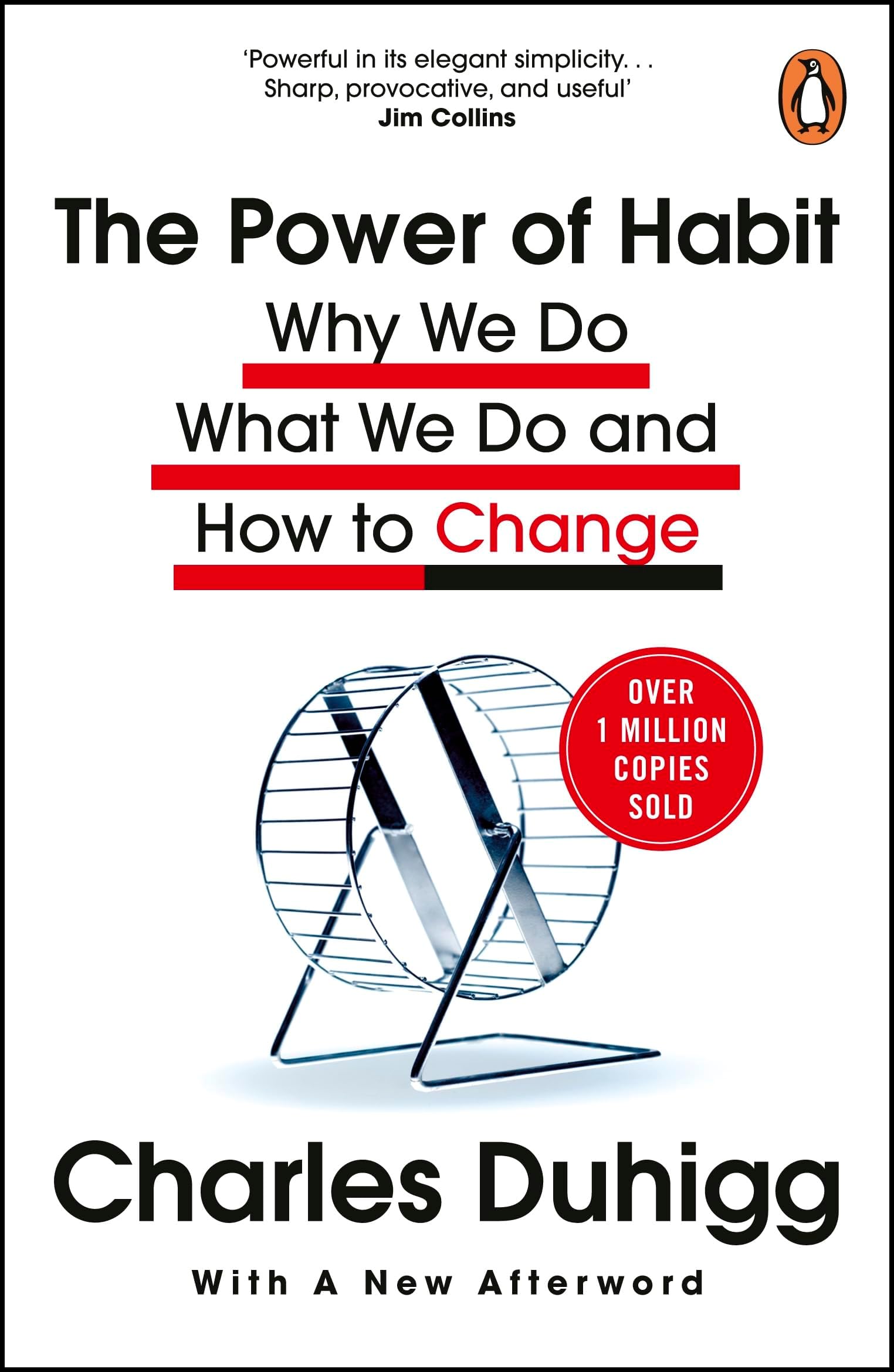
The Power of Habit: Why We Do What We Do, and How to Change
Product ID: 64659195
📚Deep research-backed insights
🔥Proven habit transformation methods
🧠Neurological science explained
Buy anything from 5,000+ international stores. One checkout price. No surprise fees. Join 2M+ shoppers on Desertcart.
Desertcart purchases this item on your behalf and handles shipping, customs, and support to Nicaragua.
🚀 Change your habits, change your life — don’t get left behind!
The Power of Habit by Charles Duhigg is a bestselling, research-driven guide that reveals how habits form and how they can be transformed. Combining neuroscience, psychology, and compelling case studies, this book equips professionals with practical strategies to reshape personal routines, influence organizational culture, and understand societal behaviors. A must-read for anyone aiming to unlock lasting success through the science of habit.


| Best Sellers Rank | #2,914 in Books ( See Top 100 in Books ) #30 in Self-Esteem (Books) #84 in Motivational Self-Help #90 in Self-Help for Success |
| Customer Reviews | 4.5 out of 5 stars 30,402 Reviews |
A**I
It really helps in improving and building good habits
"Once a small win has been accomplished, forces are set in motion that favor another small win." —Cornell Professor. . We all in our life seek to this question which is the subtitle of this book, "Why we do what we do and how to change". Quite often we think about this and sometimes we ace in our own way and sometimes we get fail. . This book is based on hundreds of interviews and thousands of scientific research and social psychology. It's completely a human psychology read where so many personalities have shared their anecdotes from their life experiences and some through their sickness. . Generally, we want to make good habit and reflect best out. Have you ever noticed why do we sometimes even think to change our habits? It may be for our personal advantage, make by peer of society or get Influenced by friend or family. When we start making habit we need to break our previous routine which is quite tough for us. We get stuck at the "routine" thing. This is what affect us. Here's a key to solve this. . ✓Author has penned down the Hopkins formula after getting so many scientific studies — "Cue >>> Routine >>> Reward" ✓First, find a simple and obvious cue and second, clearly defined the rewards. For example- Hopkins had identified the cue as a yellowish layer teeth, reward is beautiful shiney teeth. He made the film where a lady showing shiney and beautiful smile. People want this habit because reward was tempting. So, Cue➡️ Routine➡️ Reward this is habit loop. There are numerous such examples are given in this book from sports, medical, company like Alcoa and many more which totally follow this formula. . This book is more like a compilation rather than writing out own segments. I recommend this book who have so much patience to go through each paper as every topic is thought provoking. . There's a medical case where memory is governed by habit, not through actual brain activity. That's quite fascinated me. That one case became the scientist research of interest and all these came out. If you want to make habit this book will help you but not effortlessly.
A**B
Power of change in your hands! Reinforced.
What’s the common success factor between Michael Phelps, Aluminium Company of America and African-American Civil Rights Movement ? Talent, Scale, Persistence? Nopes. Habit.Says the author. In this well researched book, Charles Duhigg takes us through an interesting journey of human behavior and the underlying habits which lead us to different paths. He refers several psychological and neurological studies to first illustrate what habits are, how they work and then how these can be changed. In the process gives us an almost scientific method of how to develop or change habits. It did help me see habits in a new light and also gave the confidence to change or build these, through a step by step process. The book defines Habits as 3 step process – Cue, Routine and Reward. Cue is what triggers the habitual behavior, Routine is the behavior itself and the Reward is the end result. For example – Boredom is the Cue which leads an office worker to routinely take a coffee break and get rewarded with some socializing in cafeteria. While you may look at habits in multiple other ways, the author relates the above process with many studies and examples and wonderfully divides each into these 3 steps. The book further illustrates how tackling each of these steps can help one to transform or change habits. One of the interesting example is how these constructive routes have helped Michael Phelps build habits with the ultimate reward – excellence. The book is divided into three parts - Habits of Individuals, Organisations and Societies. As you navigate through the book , from examples of personal transformation of addicts and sportsmen to those of Corporations and further of Communities , you do notice the logic paradigm, so painstakingly build by the author, becoming weaker. The author starts to rely more on the strength of narrative than the scientific basis. You may start noticing these chinks as you read through elaborate examples of Organisational Habits and get very distant from initial logic and inspiration by the time you are mid way in the Society. Nevertheless the examples throughout the book are well written, elaborate and make for an inspiring read and the first part is possibly much scientifically convincing than the 7 habits by Stephen Covey. The concept of Keystone Habits seems good reminder of how small key changes can cause dominos effect, leading to change in many other behaviors. In the end, the author compensates with a well written last chapter on how to apply the learnings from the book for personal transformation. In a nutshell, this is a personal transformation, management philosophy and socio-cultural research rolled into a single book. The book is entertaining, inspiring, not necessarily unputdownable but never a drag. I m sure this isn’t the last word from Charles Duhigg and keen to read and review his next work, which I hear is already out. Recommended read.
S**S
Quality of Book
Packaging is good and quality of book is outstanding
A**M
Reprogramming The Habit Loop
Firstly, I would like to congratulate Charles Duhigg on the success of his book which I think is well deserved for the time he has spent in writing. You often come across books such as this one where reading is insightful and an absolute pleasure. This book is not work of fiction but hours and hours of research - we're talking academic journals, interviews, etc. As a reporter for New York Times, Duhigg's really knows how to captivate his readers by illustrating stories. His way of writing is interesting because, the way he's written this book is through case studies and while explaining one case, he'd jump to a different story entirely but still on the same subject keeping the reader at suspense. The case studies are basically real life examples on how habits are created and explains with the help of Neurological Sciences in the first couple of chapters. Personally speaking, it was a fascinating read. Few chapters in, there is a repetitive pattern in writing where the writer keeps emphasising on habit loop - whether it's good or bad.Well of course, being the author, he has to go by the title. The case studies or real life examples written covers what goes in changing or reprogramming that habit loop and it's divided into three sections with chapters in those sections - (I) As an individual (Part One. The Habits Of Individuals) Chapters: 1. The Habit Loop - How Habits Work 2. The Craving Brain - How to Create New Habits 3. The Golden Rule of Habit Change - Why Transformation Occurs (II), As an Organisation (Part Two - The Habits Of Successful Organisations) Chapters: 4. Keystone Habits, or The Ballad of Paul O'Neill - Which Habits Matter Most 5. Starbucks and the Habit of Success - When Willpower Becomes Automatic 6. The Power of a Crisis - How Leaders Create Habits Through Accident and Design 7. How Target Knows What You Want Before You Do - When Companies Predict (and manipulate) Habits (III) As a society (Part Three - The Habits Of Societies) Chapters: 8. Saddleback Church and the Montgomery Bus Boycott - How Movements Happen 9. The Neurology of Free Will - Are We Responsible for Our Habits? I'm unaware of how long Duhigg spent writing this book but I can easily say it has taken a while. Brilliantly put together and never boring, Charles Duhigg has done a fantastic job with The Power of Habit. A thorough read into reprogramming the habit loop.
T**T
Fascinating
Edit: (After almost an year) The main themes conveyed: 1.Habit Loop Cycle 2.Keystone Habits 3.Habits & Society 1.Habit Loop Cycle consists of 3 components namely Cue, Routine, Reward. Cue - Signal (such as time, place, environment etc.) Routine - Action (habit) Reward - How does a habit satisfy us ? Is it Physical ? Emotional ? For example, John exercises regularly. John see clock striking 6AM (Cue) and he starts exercising (routine) and after exercise, he feels proud (emotional reward). Some people do exercise in the evenings (Cue) and they may drink a smoothie (Physical Reward) after exercising (Routine).Everyone has set their own cues and rewards In order to break a habit, Rewards must be the same but routine should be replaced. For example, replace exercise with playing Tennis but keep reward same as before. 2.Keystone Habits are Contagious. In other words, they spread into other aspects of life. For example, exercise in morning can improve self-esteem which may indirectly lead to better health, less credit-card spending, more confidence and better social skills. Everyone can create Keystone habits in their life by carefully observing their life style. Keystone habits have changed companies like Alcoa, Starbucks. They can change individuals as well as organizations. Book is also filled with fascinating stories. It just feels like reading a Malcolm Gladwell or Dale Carnegie book. Language is easy to understand. A must-buy for everyone who want to be more aware of their day-to-day actions. I am glued to this book atm. For anyone who is interested to know more about premise of this concept, watch the author's [Charless Duhigg] video : [...] Second HALF of the book IMO is a filler. That being said. This book is definitely a MUST read. Its worth reading.
R**A
Good. Anecdotal. Not Too Many Insights
The book is good and readable. Charles Duhigg has structured the book well, dividing it into three sections - 1. personal habits. 2. the corporate angle, 3. and ending with society. He focussed on the essential nature of habit, and I sense that he got some information from other authors. However, while the anecdotes are interesting, the lessons are buried deep. The insights are not particularly deep.
V**I
Good Book
Good Book
A**H
Good research good
Eye opening and very insightful
B**N
Kitap hasarlı
Nem veya ıslaklıktan dolayı kitap kabarmış bir şekilde elime ulaştı
C**H
Now I Understand How to Create Lasting Change
Following a prologue in which a subject transforms utterly transforms herself, Duhigg lays out the structure of the book. "Part One: The Habits of Individuals" is broken into three chapters. Chapter 1, "The Habit Loop" describes the (wait for it...) the habit loop, which is the foundation for everything that follows. This is a 3-step process, in which a cue triggers a routine which is reinforced by a reward. Duhigg does a great job of describing the science that describes this pattern, and the science which explains it, without making the information so dry that you can't absorb it. Chapter 2, "The Craving Brain," examines individuals who suffered neurological damage and the impact that habits had on their ability to perform various functions and routines. This chapter had heart: imagining the daily lives of these individuals and their caregivers brought some real drama to the study of how habits operate in our brains. The point of the chapter was basically that habits are surprisingly delicate, to use Duhigg's term, and can be easily disrupted, with the right information. Chapter 3, "The Golden Rule of Habit Change: Why Transformation Occurs" focused on the coaching career of of NFL coach Tony Dungy, and how he used his understanding of habits to transform the Tampa Bay Buccaneers and the Indiana Colts. The Golden Rule is You can't extinguish a bad habit, you can only change it. Midway through Chapter 3 Duhigg breaks away from NFL to consider Alcoholics Anonymous. If Chapter 2 is the heart of Part One, then Chapter 3 is the soul: both AA and Dungy's football program achieve their greatest success when the people operating under their respective guidance both arrive at belief in something greater than the individual. Duhigg shares more than that in this chapter, but there is a ton of information in this chapter about how habits can be disrupted to make way for more positive patterns. In Chapter 4, "Keystone Habits, Or the Ballad of Paul O'Neill: Which Habits Matter Most," Duhigg offers Paul O'Neill of Alcoa to illustrate how altering a single habit in an organization (albeit in a highly focused and disciplined manner) can transform the total organization. Chapter 5, "Starbucks and the Habit of Success," opens with a powerful story of a young man who was raised by drug addicts, and his subsequent struggles to maintain his employment. His pattern of failure changed when he went to work at Starbucks. This chapter discusses the importance of willpower and its limitations, how willpower can be strengthened, and planning for success. Chapter 6, "The Power of a Crisis," uses the examples of doctor error in a Rhode Island hospital, which Duhigg asserts was made inevitable by the toxic atmosphere in the workplace, and a fire in King's Cross Station, London, which was made inevitable by strictly observed divisions of labor, to provide opportunities for transforming the cultures of those two organizations into something stronger and more effective than could have been created as Paul O'Neill did, just by sheer force of leadership. Chapter 7, "How Target Knows What You Want Before You Do" is probably the most widely read section of the book, as it was excerpted by the New York Times (Duhigg's employer) and Forbes, among others. It's readable and informative, and fairly creepy in disclosing how much information we unwittingly distribute about ourselves, and how unlikely we are to curtail the activities that make it possible for Target to know a woman is pregnant before any of her immediate family members do. Several reviewers have described these sections as "filler," but I found that they addressed complaints common to people who claim to want to change their habits but lack willpower, and provided guideposts to an attentive reader for what qualities set one up for success. I did not find these sections to be filler, but powerful illustrations of how a thorough understanding of the mechanisms behind habits can provide the tools for large scale change, and a discussion of the nature of personal responsibility. Although the sections were more directly addressing corporate bodies, the information was driven by the individuals within those organizations and therefore applicable to me and my own private attempts to alter my habits. Part Three was an interesting summing up. Chapter 8, "Saddleback Church and the Montgomery Bus Boycott" addressed the components that made those movements (if one can call a mega-church a movement) successful. The Montgomery Bus Boycott, particularly, was really interesting: we celebrate Rosa Parks's heroism, deservedly, but the fact is, several other individuals had made similar stands without sparking the Civil Rights Movement. Duhigg's explanation for why Parks had the right stuff to make it happen makes for informative reading (the short version being, Parks was a genuinely nice and widely connected member of Montgomery society). Chapter 9, "The Neurology of Free Will: Are We Responsible for Our Habits?" puts all the preceding information in perspective. It contrasts Brian Thomas, an Englishman who killed his wife while sleepwalking, with Angie Bachmann, a compulsive gambler who lost many hundreds of thousands of dollars. He describes the neurology of sleepwalking activity and of a compulsive activity such as gambling (or drinking, or binge eating) and concludes that habits are under are control and can be altered, which argues for self-awareness and personal responsibility. The information provided in the body of the book was enough for me to understand how to create a road map for how to change my habits, but Duhigg did provide a digest of the material in his Appendix, "A Reader's Guide to Using These Ideas." Overall, I found this book to be both readable and powerful, and I look forward to implementing what I've learned to further my own goals.
A**T
Insightful and cleverly written with some great revelations inside
Through the slow, incremental work of science we are diligently reverse engineering our aeon-old soft and hardware to arrive at deep insights into how we tick. In The Power of Habit Charles Duhigg uses his considerable journalistic skills of brevity and story-telling to take us inside how we build some of our most common psychological routines. Like a container ship ploughing the world's oceans can't help pick up a community of marine fauna, our minds, scything through an ocean of experience, get stuck with a seething mass of often chaotic, sometimes damaging, habits. Turns out the ones we often focus on, the bad ones, are simply a particular species of a panoply of simple cue-routine-reward cycles that means we can get from one complex task to the next without blowing mental gaskets. Which means, basically, much of our daily experience is constructed from habits, or, as the more-quoted business aphorism goes, we are indeed, '...what we repeatedly do.' We develop habits because we only have a limited strip of deep thinking neocortex wrapped around the outer edges of our brains and if this was constantly used for every response we would very soon run out of gigabytes to think with. Habits are small sub-routines downloaded into the deeper, more primitive parts of our brain when we have mastered a skill or process. They are initiated virtually automatically by a cue, involve a repeat behaviour - routine - and always finish up with a reward, which serves to reinforce them. Without habits, brushing your teeth or tying your shoelaces would absorb your attention fully and there'd be no thinking space left to plan the day ahead. So, knowing that these automatic thinking routines stick in our brains like those barnacles on a ship, we need to attend very carefully to the ones we let stick around. Most habits are about simple efficiency, taking learnt things and clearing our mind space so new things can be taken on board and some are overwhelming good, like the habit of exercise or reading daily. It is the conscious choice to adapt your habits and look at your behaviours in a new light that this book provides which is so very helpful. Select any habit, good or bad, and you can forensically unpack it, unpicking its antecedents and understanding its triggers before, armed with this knowledge, you can go at the wild garden of your psychology with the pruning shears. Habits are everywhere and they can be tamed and beaten, even some of the really damaging ones, if we explore the cues and the rewards that drive them, replacing the unwanted routines they set us unthinkingly performing. And this is the most powerful insight of this book, the opportunity it gives us to gain a deep insight into our worst habits and bring them within the scope of our will through that awareness. The way to do this, break the cycle, involves using the cue and delivering the reward, but changing the routine in the middle. It also means using an experimental approach to your own psychological reactions and trying out solutions that might move you forward. The author uses an example of how he tried to tackle a new habit that arose whilst he was writing the book. The habit involved getting up mid-afternoon from his desk at work and wondering down to the cafeteria, having a chat with co-workers over a coffee and eating a chocolate cookie. These additional calories five times a week inevitably caused him to put on a few pounds, so he reverse-engineered the cycle and tried to understand this new and irritating habit from the inside out. He decided that the cue was the need to stretch his legs after a long afternoon of working and after some failed attempts to prevent the purchase of the cookie, that the reward wasn't actually the chocolatey snack, but the social connection he gained with his co-workers. Once the cue and reward were nailed, he just needed to amend the routine in the middle which he did by making sure he packed enough fruit to replace the biscuit as he went through the habit of going to the cafeteria and meeting up with co-workers. So, in a sense, the habit remained via the cue and the reward, but he'd just changed the automatic and slightly damaging routine in the middle of it. A book full of powerful insights into how our minds work and it also has sections dealing with the organisational habits of large businesses and how these can be maximised for the benefit of the company. It also goes onto the explore in its least convincing section how paradigm shifts in social values can be driven by processes as automatic as habits. Intelligent, readable and insightful and therefore highly recommended. ***** 5 stars
M**G
Good
Good book
D**N
Wow!
Here is the scienctific research that explains how Habits are formed and the steps required to program your own habits and not be at the mercy of your past or the Advertising Machine that has governed your decision making throughout your life, until now (not for your benefit).
Trustpilot
2 weeks ago
2 weeks ago