

Farsi (Persian) for Beginners: Learning Conversational Farsi - Second Edition (Fr
Product ID: 633353283
Buy anything from 5,000+ international stores. One checkout price. No surprise fees. Join 2M+ shoppers on Desertcart.
Desertcart purchases this item on your behalf and handles shipping, customs, and support to Nicaragua.
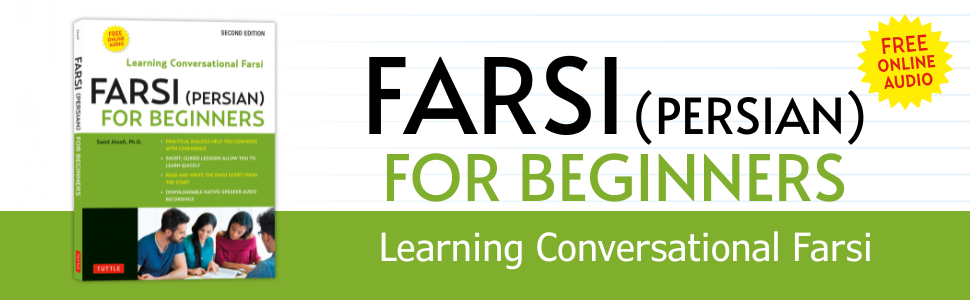
Perfect for self-study or classroom learners, this Farsi language book takes a user-friendly approach. Farsi for Beginners is a complete language course by experienced teacher Dr. Saeid Atoofi, which will help you to speak the language and open doors to Persian culture. This second edition is updated to include IT and social media vocabulary and downloadable audio files. Whether for pleasure, travel or business, language learners will find these lessons clear and easy to follow. By the end of this course, you'll be able to understand short sentences, express your basic needs, and read and write the 32-letter Farsi alphabet. Farsi for Beginners contains the following essential features: Dialogues and stories about a family traveling to contemporary Iran Downloadable native-speaker audio recordings help you to pronounce Farsi accurately Idioms, sayings and poems introducing you to the cultures in which Farsi is used Extensive exercises with answer keys to guide your learning process Photos and insider cultural tips teach you about Persian culture Farsi is the language of Persia (present-day Iran). More than 1.5 million Iranian-Americans live in the U.S. today, and Farsi is considered a "critically needed" language by the U.S. government. Review: Not for the absolute beginner - I found this book went much too quickly into the Persian alphabet, and not enough into words and phrases. For a first time learner, it doesn't make sense to learn the Farsi lettering immediately, because it is a completely different system from the Roman or Latin left-to-write lettering system and instead is more like right-to-left Arabic. I think it is easier to first learn proper grammar and conversational skills using a transliterated Roman alphabet, and then, later on, use the proper Farsi lettering once proper oral fluency is attained. This happens to also be the way most children learn a language. They learn the literacy of the writing system after they already know how to speak. I feel this book does not properly address this issue and as a result, it's very hard to learn from it. Review: Good if you already know Persian and trying to become literate - This was the perfect book for me to become literate in Farsi; I'm already fluent in speaking. However, I can see it being hard for absolute beginners; the book does move pretty fast, and may not accommodate the preferred learning styles and methodologies for everyone.


| Best Sellers Rank | #16,629 in Books ( See Top 100 in Books ) #35 in Grammar Studies in Linguistics #69 in Vocabulary, Slang & Word Lists #233 in Travel & Tourism |
| Customer Reviews | 4.3 out of 5 stars 105 Reviews |
R**5
Not for the absolute beginner
I found this book went much too quickly into the Persian alphabet, and not enough into words and phrases. For a first time learner, it doesn't make sense to learn the Farsi lettering immediately, because it is a completely different system from the Roman or Latin left-to-write lettering system and instead is more like right-to-left Arabic. I think it is easier to first learn proper grammar and conversational skills using a transliterated Roman alphabet, and then, later on, use the proper Farsi lettering once proper oral fluency is attained. This happens to also be the way most children learn a language. They learn the literacy of the writing system after they already know how to speak. I feel this book does not properly address this issue and as a result, it's very hard to learn from it.
B**J
Good if you already know Persian and trying to become literate
This was the perfect book for me to become literate in Farsi; I'm already fluent in speaking. However, I can see it being hard for absolute beginners; the book does move pretty fast, and may not accommodate the preferred learning styles and methodologies for everyone.
Z**0
Bom como material complementar
O livro tem alguns aspectos muito bons, como dar algumas noções culturais e ter muitos exercícios de escrita. Esse é o ponto forte do livro: lições graduais para aprender a escrever. No entanto, para aprender a falar a partir do zero, é necessário ter outro material de apoio (ou um professor). Isso porque o livro não te ensina a conjugar verbos, por exemplo, o que é essencial para você estabelecer um diálogo. O livro tenta fugir um pouco de uma gramática, mas não chega a ser um livro que sozinho vai te fazer falar. Ele é didático nos pontos que se propõe a ensinar, mas acho que falha um pouco em expressões e vocabulário essencial para uma conversa básica. Em todo caso, pelo preço e pela qualidade do que se propõe, vale a pena! Se você, falante de português, tem um bom inglês (não precisa de ser um inglês espetacular), o livro pode ser uma boa ferramenta de apoio.
C**N
Quality
It’s really a good learning book for beginners
P**Y
Intriguing pedagogy
Positives: Nice big format, feels good in your hands, lovely big type faces throughout, beautiful large farsi serif scripts, Plenty of space to scribble around, a book that calls you to work in it, well though-out formatting, visually appealing, plenty of graphics, the little cartoon pages are a delight, you quickly see how the colloquial language varies from the formal, plenty of audio support for all vocab, exercises and dialogues. Lots of cultural side notes and idiomatic expressions. It is a cultural as well as a linguistic learning tool. Negatives: You have to trust the pedagogy of the author, as there is minimum grammar instruction as one might expect from a conventional language book. This might put-off those who just need to first understand why they are saying what they are saying. The audio quality in the vocab and exercises section is fine, but somewhat shaky in some dialogues. They seem to have been recorded independently. My take: I think this is an unusual book that stands out from the typical language course. I find the dialogues difficult, even from the start, but I keep coming back to them and discovering some new twist. It is as if the author has programmed them for the learner to figure things out by himself bit by bit. I have noticed that other reviewers have pointed out numerous transcription 'spelling mistakes' in the romanised farsi transcriptions. I too noticed them immediately and actually think they are deliberate. First of all, there cannot be such a thing as a 'spelling mistake' in romanised Farsi. The only correct way to spell Farsi, is using Farsi script, (obviously) and this also varies between the formal and colloquial version. Manijeh is sometimes written as Manizheh. So what? maybe there is a nuance in the pronounciation in some grammar situations. Some persian letters are pronounced the same, and Mr Atoofi is preparing us by showing us how in 'english' the same sound can also be written differently. I also noticed some of the original farsi spelling varies. The 'ie' is connected to the 'Kheh' in Mikhai but not in Mikhahi. Mr Atoofi gives no explanation. Presumably colloquial Farsi is simply spelt differently, and we are to suss it out by ourselves. Maybe this book is better suited to learners with teacher support? I don't know. In total, I am really pleased with this book and especially like its original idiosyncrasy.
Trustpilot
2 days ago
2 months ago