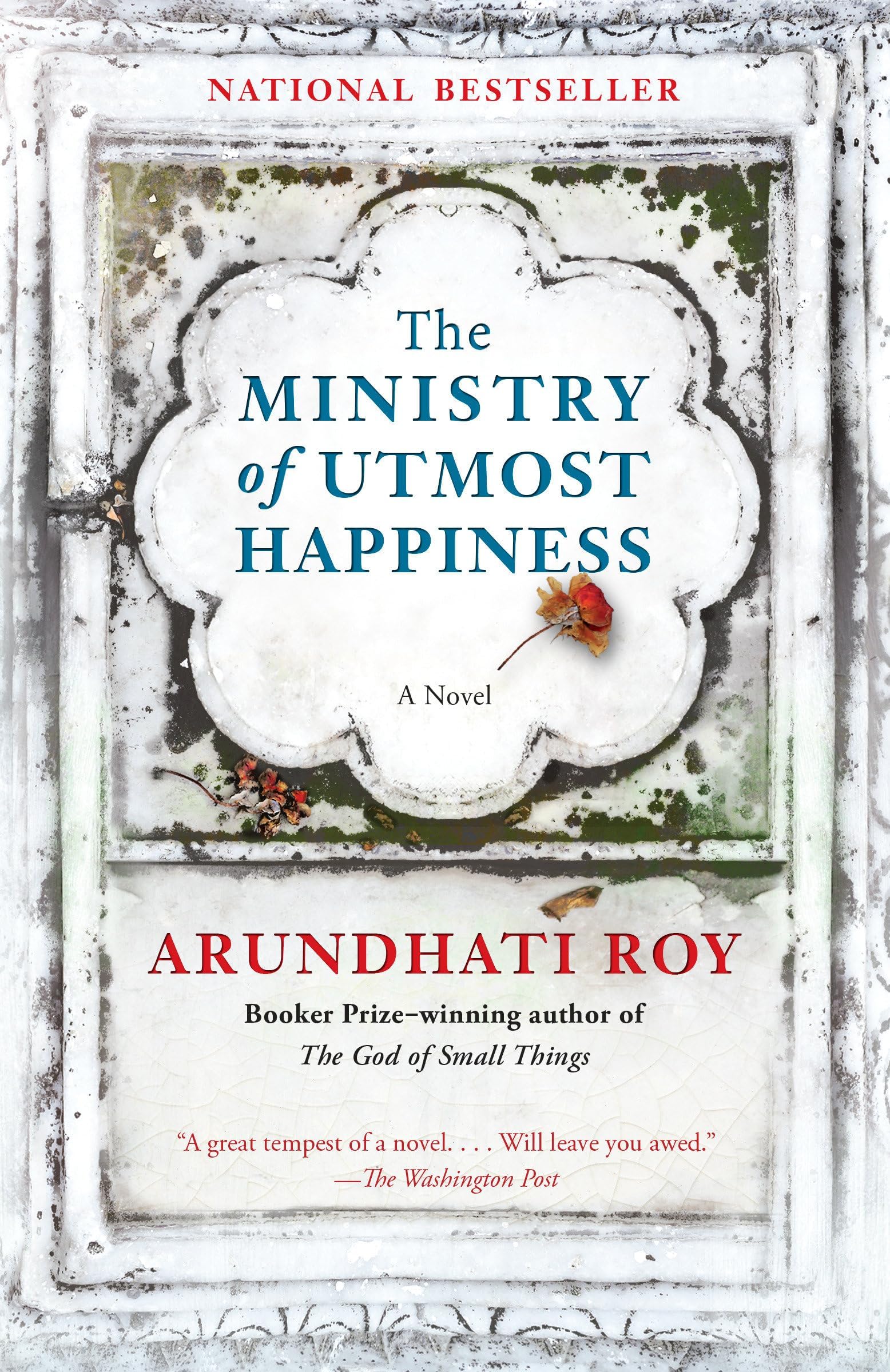
The Ministry of Utmost Happiness
Product ID: 62806957
Buy anything from 5,000+ international stores. One checkout price. No surprise fees. Join 2M+ shoppers on Desertcart.
Desertcart purchases this item on your behalf and handles shipping, customs, and support to Nicaragua.
National Bestseller Longlisted for the Man Booker Prize One of the Best Books of the Year: The Washington Post * The Boston Globe * Minneapolis Star Tribune * NPR * Newsday * The Guardian * Financial Times * The Christian Science Monitor The Ministry of Utmost Happiness takes us on an intimate journey across the Indian subcontinent—from the cramped neighborhoods of Old Delhi and the roads of the new city to the mountains and valleys of Kashmir and beyond, where war is peace and peace is war. Braiding together the lives of a diverse cast of characters who have been broken by the world they live in and then rescued, patched together by acts of love—and by hope, here Arundhati Roy reinvents what a novel can do and can be. Review: The Coming Together of The Outcasts - This novel is about the marginalized people in modern India--people living on the periphery--the transgenders, Dalits (untouchables), Muslims, Kashmiris, people not included in the rising capitalist India. Aftab, who later changes his name to Anjum, is born to Muslim family in old Delhi. His mother notices that there is something not quite right with him, he has both the male and female body parts. Despite family’s best effort Anjum moves out of the house and starts living with other transgenders, called Hijras in Urdu-Hindi. There is a lot of symbolism in the novel how Anjum as a Hijra and as a Muslim is treated by the society at large, and how she perceives herself. Who is she, what is she, and maybe why? In most countries, including India, people have struggled to deal with transgenders. In this novel, Arundhati Roy, tries to show that it is not just transgenders, there are many different types of people who have uncertain role and relation with modern India. Muslim in general but especially muslims in Kashmir are one of those people.The novel describes the riots in Gujarat, and the violence in Kashmir. Musa, a Kashmiri, who is going to college in Delhi, due to a tragedy, in which his wife and daughter are killed, turns to extremism and becomes a Kashmiri separatist. The Chamars, Dalits, or Untouchables are another example of historic outcastes in the society like transgenders. Saddam Hussein, not his real name, who belongs to Dalit caste, is attacked with his father by Hindu extremists, and his father is murdered. There is similar pattern when it comes to his predicament, like Anjum a Hijra, Musa a Kashmiri Muslim, modern India does not quite know how to deal with him. Tilo is another such person, from South India, born out of wedlock, she is searching for destiny. Musa and her have close relationship, she even helps him out with insurgency in Kashmir. All these outcastes eventually start living in a graveyard together. It is in this graveyard, all of them rejected and scarred by the society, come together, share each other’s pain, and find some peace and sense of community. It is a beautifully written novel. It gives this hope that despite shortcomings of India democracy, there is room for protests and debate. All different kinds of protesters who gather at the Jantar Mantar is one example of that. Muslims, Dalits, Hijras, gas leak victims from Bhopal, Earthquake victims, and many other kind of protesters, they all gather there, with hope that they will be heard. Maybe a time will come when they will be. Review: Be prepared to do some research. - One needs to be aware of contemporary and historic Indian mores and, culture and politics. If one is not, the story will be confusing and be very long. It was vivid, Roy has a great voice, however she expects much from a reader and often we Americans who read for pleasure can get lost in in another country's reality.
| Best Sellers Rank | #48,038 in Books ( See Top 100 in Books ) #88 in Cultural Heritage Fiction #835 in Family Life Fiction (Books) #2,423 in Literary Fiction (Books) |
| Customer Reviews | 3.9 out of 5 stars 7,647 Reviews |
U**B
The Coming Together of The Outcasts
This novel is about the marginalized people in modern India--people living on the periphery--the transgenders, Dalits (untouchables), Muslims, Kashmiris, people not included in the rising capitalist India. Aftab, who later changes his name to Anjum, is born to Muslim family in old Delhi. His mother notices that there is something not quite right with him, he has both the male and female body parts. Despite family’s best effort Anjum moves out of the house and starts living with other transgenders, called Hijras in Urdu-Hindi. There is a lot of symbolism in the novel how Anjum as a Hijra and as a Muslim is treated by the society at large, and how she perceives herself. Who is she, what is she, and maybe why? In most countries, including India, people have struggled to deal with transgenders. In this novel, Arundhati Roy, tries to show that it is not just transgenders, there are many different types of people who have uncertain role and relation with modern India. Muslim in general but especially muslims in Kashmir are one of those people.The novel describes the riots in Gujarat, and the violence in Kashmir. Musa, a Kashmiri, who is going to college in Delhi, due to a tragedy, in which his wife and daughter are killed, turns to extremism and becomes a Kashmiri separatist. The Chamars, Dalits, or Untouchables are another example of historic outcastes in the society like transgenders. Saddam Hussein, not his real name, who belongs to Dalit caste, is attacked with his father by Hindu extremists, and his father is murdered. There is similar pattern when it comes to his predicament, like Anjum a Hijra, Musa a Kashmiri Muslim, modern India does not quite know how to deal with him. Tilo is another such person, from South India, born out of wedlock, she is searching for destiny. Musa and her have close relationship, she even helps him out with insurgency in Kashmir. All these outcastes eventually start living in a graveyard together. It is in this graveyard, all of them rejected and scarred by the society, come together, share each other’s pain, and find some peace and sense of community. It is a beautifully written novel. It gives this hope that despite shortcomings of India democracy, there is room for protests and debate. All different kinds of protesters who gather at the Jantar Mantar is one example of that. Muslims, Dalits, Hijras, gas leak victims from Bhopal, Earthquake victims, and many other kind of protesters, they all gather there, with hope that they will be heard. Maybe a time will come when they will be.
S**R
Be prepared to do some research.
One needs to be aware of contemporary and historic Indian mores and, culture and politics. If one is not, the story will be confusing and be very long. It was vivid, Roy has a great voice, however she expects much from a reader and often we Americans who read for pleasure can get lost in in another country's reality.
A**E
unevenly brilliant and messy and frustrating
“He narrowed his blindgreen eyes and asked in a slygreen whisper…” Arundhati Roy’s second novel, The Ministry of Utmost Happiness, published 20 years after her first beloved debut, The God of Small Things, was perhaps one of the most anticipated novels of 2017. It’s had a mixed reception and I can see why. The novel starts off in old Delhi with Anjum, a hijra, along with a colorful cast of characters. One of my favorite things about the novel is how the city’s flora and fauna is as much a part of the story as the humans. “When the bats leave, the crows come home. Not all the din of their homecoming fills the silence left by the sparrows that have gone missing, and the old white-backed vultures, custodians of the dead for more than a hundred, million years, that have been wiped out.” The old city’s centuries long Muslim culture and architecture is nostalgically laid out, and Roy’s ear for language and detail is often sublime: “a small tortoise…with a sprig of clover in one nostril.” I found Anjum compelling if tropeful - an elegant fierce outspoken Urdu poetry-quoting drag queen. It wasn’t obvious to me immediately that her companions and antagonists - and pretty much every other character in the book - are also symbols. They represent the many conflicts that routinely tear India apart and that have occupied Roy’s political, human rights, and environmental concerns and her nonfiction writing for the past 20 years: the Hindu-Muslim divide, the caste system, the Kashmir conflict, the Indo-Pak wars, the 1992 Gujarat massacre, the 1984 Bhopal gas leak, and of course the farmers and fishermen whose lands and livelihoods are variously taken over by capitalism and corruption and other horrors. The second half of the novel turns to the monstrous ongoing civil war tragedy that is Kashmir, following four college friends, a civil servant, a journalist, a Kashmiri activist, and the woman they all love. Again, the tropes and stereotypes abound: the quiet noble freedom fighter, the ambitious journalist, the suave diplomat, the mysterious beautiful woman who doesn’t have to say anything, has no past, but everyone falls anyway. “There was something unleashed about her, something uncalibrated and yet absolutely certain.” Despite this, I was wrecked by the account of the war in Kashmir. There is a scene when a boy is brought in after interrogation (i.e. torture, which is so graphically described at times that I wanted to throw up). “To refuse to show pain was a pact the boy had made with himself. It was a desolate act of defiance that he had conjured up in the teeth of absolute, abject defeat. And that made it majestic. Except that nobody noticed. He stayed very still, a broken bird, half sitting, half lying, propped up on one elbow, his breath shallow, his gaze directed inward, his expression giving nothing away.” Even with the overwriting, the melodrama, I don’t think I’ll ever forget this broken bird of a boy. I didn’t grow up in South Asia, and I’ve never been to Kashmir, but its beauty of landscape and people is legendary. I have long recognized the utter wonder in people’s voices when they speak of the region. And it seems as if there’s no way out now, no light at the end of the bloody tunnel. There are so many militant groups, so many broken families, so many displaced people of different religions, so many armies and guerrilla forces from India and Pakistan, so much sorrow, so much loss. No one wants to let go. No one will and everyone suffers for it. This is not a new story to South Asians (which might explain some of the grim subcontinental reviews of the book), but the novel outlines the longevity, continuity, complexity, and intensity of the conflict, and it is overwhelming and horrifying. That said, there are entire sections of the novel where semi-journalistic/semi-diary reports of violence, political intrigue, and human rights abuses in Kashmir are clumped together without context or explanation. This is a shame because these are real and important stories, but without tying them to characters we’ve grown to know or the places they inhabit, they end up feeling extraneous. I read these awkwardly written sections impatiently, trying to figure out how they tied in, and when they didn’t, waiting for the book to get back to the story. It felt like lazy writing, or lazy editing perhaps. The two halves of the novel are tied clumsily together with a plot point - a baby - that appears magical-realism style. Of course, in addition to connecting the two halves, this baby serves its political purpose, standing in for another conflict, this one from the vicious war the Indian government is waging against its own citizens - Maoist guerrillas in the jungle. “Normality in our part of the world is a bit like a boiled egg: its humdrum surface conceals at its heart a yolk of egregious violence.” If you don’t know much about modern Indian history and politics, Roy’s novel is an education, and an indictment of India Shining. Political figures are tarred and feathered, including the current Prime Minister, Narendra Modi, referred to as Gujarat ka Lalla. The country-wide violence, corruption, and discrimination seem bone deep, systematic, inevitable. Perhaps it’s as the novel itself says, “There’s too much blood for good literature.” But I have faith. Maybe now that Roy has painted the broad strokes in her second novel, her third might go more small things than utmost, deeper than wider. However, I have less faith in the future. If history is indeed a revelation of what’s to come as much as it is a study of the past, as The Ministry of Utmost Happiness claims, then “pretending to be hopeful is the only grace we have…”
J**O
Love your writing
I always look for your writing, your truth of your country helps me to to see the world❤️🔥💢💥💫 better. They always talk about the Holocaust, which was more than tragic, the world doesn't look around this is still going on. And beginning to here. Bless you and yours
J**D
A thousand threads
A book as challenging as it is rewarding. There are a thousand threads interwoven here, but they come together beautifully. Events that faded from the headlines or never registered upon the Western consciousness come to life with passion, intensity, and a sometimes confounding sense of paradox. Re-birth, appropriately enough, is a unifying theme. Transgender individuals re-born or attempting to be re-born. Miss Jabeen the Second offering us a new opportunity to hope for the future. A Kashmiri patriot who operates under dozens of aliases. A brutal military thug who tries to build a new life in the U.S. and fails. Regeneration, metamorphosis, it's all here. Consider it a rich stew, one that succeeds because of all its wildly varied ingredients.
A**R
A deep and intriguing novel by Arundhati Roy
It is a wonderful book about a difficult subject. Although it is not as easy to read as "The God of Small Things" which may be the best book I have ever had the pleasure to read, still it is a worthy novel. Perhaps Ms. Roy took on too much with the situation in India, Afghanistan and Kashmir. Still, the characters are very well-drawn and the story was captivating. War is a tragedy felt most acutely by those who experience it but it has an impact on all of us involved. I wish that our governments would tell the truth that she has so bravely written about. Viva la Resistance!
A**7
Didn't Come Together
I first want to share that I did finish reading all the way to the end, but was the only one in the book club who did so we couldn't discuss the book. This isn't an enjoyable read, so I did feel betrayed by my friends and I remain a little bitter. :-) That being said, I loved the idea of telling a shattered story by shattering it and presenting the pieces. I was intrigued by that premise and really badly wanted the story to work, but its pieces weren't well-presented. As others have noted, there was very little dialogue and strangely little "real time" action, so the author had to tell us what was going on...and tell us...and tell us...and tell us. She also had to tell us, tell us, tell us who the characters were, providing voluminous bios for many of them. Even with all that telling, I had trouble understanding the characters' motivations, had trouble keeping the minor characters sorted out, and certainly couldn't visualize the scenery. In addition, the story takes a big jog in a new direction about a third of the way in and then takes a big job back again near the end to tie everything together. But the string used for tying was a little frayed and I wasn't able to buy the resolution. And I honestly didn't get the title. This is not a happy book. I mean...a kitten was killed. A kitten. I get that the graveyard characters are supposed to be quirky and maaaybe living happily on the fringe, but there was so much trauma and violence in the story that I didn't really feel happiness in them. To leave on a positive note, I am grateful that I'm now aware of the conflict in Kashmir. Conveying that awareness was clearly a goal for the author, and I do feel she was successful in that regard.
P**N
The Ministry of Utmost Happiness by Arundhati Roy: A review
I loved The God of Small Things, Arundhati Roy's first novel, and I fully expected to love this one, her second, that was written twenty years after the first. I was disappointed to realize that I didn't. It was not because the writing was not beautiful. Of course it was beautiful. Roy's prose is poetic and musical. It flows, one sentence leading with the inevitably of rushing water into the next. It was not because there were no sympathetic characters. Indeed, the pages are filled with so many sympathetic characters that at times it is hard to focus. Every single one of these sympathetic characters is at the center of a tragic story. There is so much unrelenting tragedy in this book that I began to feel overwhelmed and oppressed by it. And I think my main problem with the book is related to that. The overarching tragedy here that touches every character's life and becomes the theme of some of them is Kashmir. Bleeding Kashmir. That bit of territory that Pakistan and India have fought over virtually continuously since partition. The appalling atrocities suffered by all sides in the conflict - Sikhs, Muslims, Hindus - pile up unendingly. Most of the action of Roy's novel takes place after 1984, after the assassination of Indira Gandhi by her Sikh bodyguards and the resulting violence that wracked the country afterward. She tells her story primarily through the lives of two characters. The first is Anjum, born Aftab. At birth, the child was a true hermaphrodite, with both male and female sex organs. Raised by her family as a boy, she nevertheless always identified as female and when she had the opportunity to leave home, she became a part of a thriving transgender community in Delhi. The second primary character is Tilo, a former architecture student. In college, she was a part of a group of four friends who continue to be connected in later life. One of them, Musa, was her sometime lover, a Kashmiri freedom fighter. She later marries another of the friends but continues to travel to Kashmir to visit Musa, who is in constant danger and must live his life on the run. If the story had maintained the focus on these two lives, I would have found it easier to follow and to empathize with, but the introduction of so many minor characters kept leading me on unwanted detours away from the two heroines of the tale and at times - particularly in the middle of the book - I felt that there was no glue holding it all together and it threatened to fly off into its constituent parts. In describing one of her characters who kept notes, diaries, and memos, Roy wrote: "She wrote strange things down. She collected scraps of stories and inexplicable memorabilia that appeared to have no purpose. There seemed to be no pattern or theme to her interest." That would almost serve as a description of her book. The strongest part of the book for me was the ending where the writer did manage to bring her various "scraps of stories" together into a well-orchestrated and even hopeful conclusion. It was an ending worth waiting for.
R**A
A Mirror we should all see.
I just finished reading "The Ministry of Utmost Happiness", wasn't an easy read as I expected it to be after reading her first "The God of Small Things" not so long ago. But the first thing I did after finishing the book is to Google it to know which category the book is falling on - Fiction or Non Fiction? Biography? or based on real incidences etc, as fortunately or unfortunately as per me it qualifies for any or all of them and worthy of a superb applaud at least from us Indians. Unfortunately the opinions will differ big time on this as she has made herself a "Queen of Controversies" in last two decades surely for her opinions as well as her political stand. Still this is a perfect book coming out at the right time showing the society a mirror of sorts. There will be three types of opinion on this I believe. First will be those will love it (like me) as it shows us a true picture of our own society and ourselves what we do or how we live in today's time. Second will be those whose conscious will accept it but they will deny it, negate it, shoot it down and will call it crap. But the most interesting opinion will be of those third type of people who wont read it for what Ms. Roy is all about but will base their opinion based on the opinion of the Second category of people and will shun it. I will not be shocked if she not only gets the Booker for this as she just got nominated but if the book gets banned also in our part of the world. Whatever said and done, I will definitely applaud the effort big time and will recommend it very highly to everyone. The entire story revolves around three main characters. A Transgender Anjum (born as Aftab), An Architect Tilottama (Roy herself, may be?) and Musa (Tilo's love interest) a Freedom Fighter for Kashmir. Starts from the galiyan of Old Delhi and goes up-to J&K back and forth through these characters and their intertwined lives with so much happening in India in the background. Starting from early 80's Bhopal Gas Tragedy to Indira Gandhi's assassination by her own security guards, making of the then CM of Gujrat Narendra Modi (Gujrat's Lalla as she calls him throughout), Godhra Tragedy, Anna Hazare movement, Hilarious and equally heart touching scenes at famous "Jantar Matar" in Delhi to the turmoil in Jammu Kashmir, Naxalite movement and of-course a plethora of Rape, Killings, Terrorism, Army brutality and loss of life in general, she hasn't left anything at all. It almost covers everything that we have seen or say ignored in the last three decades of our life. In between all those episodes we have the heart touching story of Anjum who herself leaves her own family to live a life of a recluse in a graveyard where only those are buried who have nowhere else to go. How she lives with a handful of people out there and still they have something to cherish and live about is totally awesome, but the language is on your face (not cringe worthy for sure) but shocking giving it a totally real feel as how it is indeed, you just cant deny that. Tilottama's story, her IB connection, husband that she leaves, a lover that she goes around with, her Kashmir visit and experience, the life that she sees up close and personal is totally terrific. If you have ever visited the valley in last decade or so and lived there even briefly, I found it too close to reality. As I said it is not an easy read, the story keeps going back n forth making it further tough for the reader to keep a track of it. The way it moves from one episode of Anjum's life and times in Delhi to Tilo's life and activities to Musa's life in Kashmir, I kept wondering how it all is going to end and is there going to be a solution offered by the book or will it end on a gloomy note. You've got to read it to know how it ends (not a thriller) but has a perfect open ending with no solution offered. One that made me not only agree but will certainly make everyone think harder where it all is going. The entire book is like Ms. Roy's ranting of so many things going around in the country that she kept taking the notes on various pages of her diary(s) and clubbed them all together to make a book and story, still it works and works big time. Although I haven't read the other books nominated for Booker this year, call me a biased Indian too but I seriously wish she gets it and the book gets a wider International audience too. Not that its going to help us as a country anyways, like she accepts and confirms where we are heading and what will be the final outcome as per her prediction. But its a must must read for all. A perfect eye opener. Do read, criticize later.
L**I
One of the best books I've read for a long time
This is a wonderful book, although it demands investment from the reader – if you like to ‘skim-read’ this is probably not for you. It is also much larger (in all senses) than The God of Small Things, and certainly more confronting – this is modern-day India, warts and all. It is maybe best described as a recent (post-1984) history of India as recounted by a number of inter-connected narrators with a wide variety of backgrounds ranging from trans-gender to security and while Roy describes it as ‘fictionalised’ anyone with an interest in India will not find it difficult to recognise many of the politicians and events involved. Roy is an exceptional writer with a great and unflinching eye for detail – often this is hilarious but occasionally horrific, particularly when she describes the insurgency in Kashmir and its consequences for ordinary people. Her sympathies are clear – the poor, the marginalised – but she rarely resorts to political polemic and her weapon of choice is the stiletto rather than the bludgeon. If you are familiar with India you will (like me) love this book, and if not this is a great introduction to a country where contradictions are the norm rather than the exception, where appalling squalor and incredible wealth live in the same street and where neighbours will celebrate together on one day and turn on each other savagely the next. It’s one of those rare books that I’ll read again, and I suspect that I’ll enjoy it even more the second time round.
H**N
What a Tale! I Enjoyed It
The Ministry of Utmost Happiness takes you on a wild political, social and economic whirlwind. Nothing makes sense, yet everything makes sense. That might sound nonsensical, but it isn’t, not when reading this novel. At first, I was leery of reading this book, the reviews made me think I would have to wade through a hefty volume. But I couldn’t put it down. People and events unravelled at a pace that reflects Asian life. If you have lived in an overcrowded country where prejudices, wars and corruption abound, you will relate to this book. Corruption and marginalisation due to economic, social, gender and religious positions in life are a major part of this novel. Wars are fought over religion or economic status to the point where the point is lost, the truth of the battle is lost. One powerful group is not anymore virtuous than another. The central character of The Ministry of Utmost Happiness is Anjum who was born Aftab. Born a hermaphrodite, she struggled early in life with who she was, but as she matures, we see someone who becomes comfortable with herself. Operating a guesthouse (Jannat Guesthouse & Funeral Services out of a graveyard, she attracts other guests who become long term residents or friends, all others who are on the fringes of society but find a place of belonging under Anjum’s roof. This is a far cry from what is happening in the World (Duniya) where wars, hatred and power struggles are the mayhem of the day. Perhaps Roy could have spent less time on the Kashmiri struggle, it is a major part of the book. Yet without its length, we may never see the senseless or the futility of war where the “dead live and the living are really dead.” Themes of identity (only Tilo and Biplab use their real names) and freedom emerge through the pages, as does community vs. society and the non-existence of a heard voice of the marginalised. Kashmiri women whose sons had died come down from the mountains to weep, cry, lament, but no one heard, “no TV cameraman turned his camera on them, not even by mistake.” If you like a novel that looks at deep issues of power struggles, postcolonialism and the plight of the marginalised in India, then this is a definite read. I enjoyed reading it and I hope you do to.
C**I
The ministry of utmost happiness
If possible I've liked it even more than her first book! I ABSOLUTELY recommend this utterly enjoyable reading to everyone
C**N
Beeindruckendes Werk, dem allerdings ein konsequenteres Lektorat gut bekommen wäre!
Wie wohl viele, die auf dieser Seite nachsehen, hatte ich lange auf einen weiteren Roman von A. Roy gewartet. Ihr Kampf für Umwelt und Menschenrechte hatte in der Zwischenzeit eine Reihe von Reportagen hervorgebracht, deren Engagement berührt, die aber das Niveau des "Gotts der kleinen Dinge" nicht erreichen. Im vorliegenden Werk wird der Leser sofort wieder auf die besondere Stärke Roys aufmerksam: die warmherzige Menschenzeichnung, die oft aus einer kindlich-kritischen Perspektive erfolgt. Das Werk zerfällt in zwei Teile, die eher notdürftig miteinander verbunden sind: Im ersten der beiden, der ca. 30 % des Buches ausmacht, geht es um Anjum, eine Frau in einem Männerkörper (Hijra), die in einer Hijra-Gemeinde Neu Delhis Aufnahme findet, sich später jedoch auf einem Friedhof mit einer Reihe Gleichgesinnter einrichtet. Hier wird nicht nur - wie so häufig in Indienromanen - das "malerische Elend" der indischen Unterschichten ausgebreitet, sondern auch die Unruhen in Gujarat zum Thema, die unter der Verantwortung des heutigen indischen Ministerpräsidenten zu einem von Hindu-Nationalisten begangenen Massenmord an Muslimen geführt hat. Wird dieser Konflikt noch subtil eingeführt – er wird vor allem im Schweigen und der psychischen Zerrüttung Anjums durch die Ereignisse deutlich –, bordet der zweite Teil geradezu mit Reportagen über den Kaschmir-Konflikt über. Die Heldin dieses Teils - Titotama – ist erkennbar ein Selbsportrait der Autorin: Als syrische Christin, ohne Vater aufgewachsen, Einzelgängerin gerät sie in den Kaschmirkonflikt. Die Schilderung der Ereignisse erfolgt aus mehreren Perspektiven: Bevor wir Titotamas Sicht kennen lernen, tritt überraschend ein Ich-Erzähler für kurze Zeit auf und gibt einen Grobüberblick über die Ereignisse. Dieser Ich-Erzähler kommt auf den letzten Seiten des Buches noch einmal kurz als gebrochener Mann vor: das war’s! Über Seiten zitiert er bei seinem ersten Erscheinen die Aufzeichnungen, die Titomama beim Tod ihrer sterbenden Mutter gemacht hat: Als diese bereits delirierte, stenografierte Titotama mit. Über Seiten finden sich so im Buch frei assoziierende, dunkle und nicht sonderlich tiefgehende Äußerungen der sterbenden Mutter: Ich musste hier als Leser deutlich kämpfen. Die Bedeutung dieser Passagen dürfte in einer persönlichen Aufarbeitung liegen, die für den Leser nicht nachvollziehbar ist. Im Einstreuen von Material liegt auch an späteren Stellen eine eindeutige Schwäche des Buches. Die Autorin ist so voller Botschaften, die sie an den Leser bringen muss, dass sie auch ihre Heldin über Seiten Protokolle über die Gewalttätigkeiten im Kaschmir wiedergeben lässt, die mit der Romanhandlung nichts zu tun haben. So bedrückend die Ereignisse sind, so banal und trivial ist auch vieles, was hier geliefert wird, etwa die Bemerkung, man habe Hennen jetzt genetisch so verändert, dass sie sich nicht mehr um Eier und Küken kümmerten, was besser für die Eierproduktion sei. Die Autorin empfiehlt, dieses Verfahren auch auf die Mütter aus Kaschmir anzuwenden, die nach ihren verschollen Männern und Söhnen suchen. Am Schluss des Buches wird dann auch noch der Kampf der dravidischen Maoisten gegen die Landenteignung der südindischen Bevölkerung in einem breiten Bekennerschreiben mit Reportagecharakter ausgebreitet. Die breiten Passagen innerhalb des Buches, in denen ungefiltert Ergreifendes, Passendes, Banales und Unpassendes hintereinander präsentiert werden, hat mich – auch im Impetus – an den Stil Victor Hugos erinnert, der etwa im „Mann mit den Lachen“ über Seiten die disparaten Lebensmaximen seines Helden ausbreitet, die dieser in Form kleiner Zettel in seinem Wohnwagen aufbewahrt. Dass beide Teile des Buches nicht auseinanderbrechen, verdankt sich der meisterhaften psychologischen Menschenzeichnung.Der „Henker von Kaschmir“ ist ebenso meisterhaft gezeichnet, wir der Weg des einzelnen in den Terrorismus und die einfache Volksgläubigkeit: Der Titel des Romans nimmt nämlich Bezug auf die Grablege eines mittelalterlichen Mystikers und Renegaten, der vom Mogul Aurangzeb aufgefordert wird, zur eigenen Entlastung das islamische Glaubensbekenntnis öffentlich auszusprechen: Der Arme kommt nicht über „Aschhadu al la ilah“ (Ich bezeuge, dass es keinen Gott gibt) hinaus und wird deshalb auf der Stelle enthauptet. Seine Grablege ist Wallfahrtsort für die Helden des Romans, die ohne doktrinäre Festlegung selig werden. Vor allem auch die warmherzigen Stimmung, in der alle am Ende vereint sind, versöhnt den Leser, der sich über Seiten durch das pseudodokumentarische Material kämpfen musste. Das Buch ist sicher eine Bereicherung, erreicht aber nicht den dichteren Eindruck des „Gotts der kleinen Dinge“. Man hätte sich als Leser schlicht ein strafferes Lektorat gewünscht, das die ergreifende Geschichte von eigentlich unnötigem Ballast befreit hätte: denn die humane Botschaft kommt beim Leser auch ohne dieses an!
Trustpilot
2 months ago
1 week ago