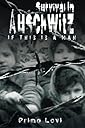

SURVIVAL IN AUSCHWITZ (or If This Is a Man), first published in 1947, is a work by the Italian-Jewish writer, Primo Levi. It describes his arrest as a member of the Italian anti-fascist resistance during the Second World War, and his incarceration in the Auschwitz concentration camp from February 1944 until the camp was liberated on 27 January 1945. Review: What happened almost seems mundane. Everyday life was death. - Levi describes his experience without hyperbole. Without trying to be overly dramatic. In one chapter, he discusses the onset of Winter. He says that in the Spring, only 20 of 70 will be alive. Just fact. and, he says they will be up the chimney. Yup. Hard fact. It is surprising how few interactions he actually has with the Germans, the Germans used non-jewish criminals, who were also prisoners, to run the camp. I knew that, but the extent of it is surprising. Damn. Review: examining human misery - Primo Leviโs Survival in Auschwitz has a high autobiographical component: reflections from his experience in the concentration camp and the experience of evil, because โthere is nothing as violent and inexplicable as evilโ. Upon his arrival at the camp, all his belongings โincluding his clothes, shoes and even his hair- were taken away from him and his fellow Jewish brothers. Then they were placed in an overcrowded empty hut with hardly any food or water. Each day was a struggle to stay alive, living with the permanent inquiry of the reasons behind the humiliation of being a prisoner without conviction. His version is a chronology of horror and destruction of the body and the human soul until โthe man is reduced to nothing away from the survival instinctโ. His story objectively sincere allows us to relive and examine the greatness and misery of human existence. It is a testimony that shows the progressive dehumanization of human beings when their primary needs are limited in a fight for survival. Also outlines the desire to survive, which is above the suicide as an extreme concentration camp situation. He accounts for the facts that speak for themselves with uncompromising emotionality, letting the reader analyze them with proper scientific reasoning. His intention was to leave a testament to the life and survival, but above all an analysis of the dignity of a man when faced with extermination. He features the daily life of the prisoners, the cruelty of the rules, and the process of mental and physical annihilation of the deportees.
| Best Sellers Rank | #116,537 in Books ( See Top 100 in Books ) #35 in Jewish Holocaust History |
| Customer Reviews | 4.6 out of 5 stars 1,850 Reviews |
N**G
What happened almost seems mundane. Everyday life was death.
Levi describes his experience without hyperbole. Without trying to be overly dramatic. In one chapter, he discusses the onset of Winter. He says that in the Spring, only 20 of 70 will be alive. Just fact. and, he says they will be up the chimney. Yup. Hard fact. It is surprising how few interactions he actually has with the Germans, the Germans used non-jewish criminals, who were also prisoners, to run the camp. I knew that, but the extent of it is surprising. Damn.
T**A
examining human misery
Primo Leviโs Survival in Auschwitz has a high autobiographical component: reflections from his experience in the concentration camp and the experience of evil, because โthere is nothing as violent and inexplicable as evilโ. Upon his arrival at the camp, all his belongings โincluding his clothes, shoes and even his hair- were taken away from him and his fellow Jewish brothers. Then they were placed in an overcrowded empty hut with hardly any food or water. Each day was a struggle to stay alive, living with the permanent inquiry of the reasons behind the humiliation of being a prisoner without conviction. His version is a chronology of horror and destruction of the body and the human soul until โthe man is reduced to nothing away from the survival instinctโ. His story objectively sincere allows us to relive and examine the greatness and misery of human existence. It is a testimony that shows the progressive dehumanization of human beings when their primary needs are limited in a fight for survival. Also outlines the desire to survive, which is above the suicide as an extreme concentration camp situation. He accounts for the facts that speak for themselves with uncompromising emotionality, letting the reader analyze them with proper scientific reasoning. His intention was to leave a testament to the life and survival, but above all an analysis of the dignity of a man when faced with extermination. He features the daily life of the prisoners, the cruelty of the rules, and the process of mental and physical annihilation of the deportees.
S**R
How to adapt and survive
What I find more frightening in Levi's description of his experiences in a Nazi concentration camp is not the humiliation, torture, degradation, or senselessness of his situation, but how readily he adapts to the insane conditions in order to survive. Looking back on the events it is difficult to comprehend how such a large-scale, multi-country atrocity was possible. How could a few thousand Nazis exterminate millions without anyone trying to stop them? Levi's first-hand account helps us comprehend. A person is completely uprooted from everything familiar: family, home, friends, work, position, and finances, and reduced to nothing more than a purposeless animal with a number. The unreality of the situation throws people so far off balance that they question the why and how of the situation and are unable to take a more active role, and the stark efficiency of the Germans is in complete contrast with what they are doing. The constant and unpredictable threat of death or worse forces one to make moment-to-moment survival choices, such as trading a ragged shirt stolen from the deceased in order to get a few extra pieces of stale bread. What I prefer in Levi's prose is that it is very straight-forward and natural, he does not overstate his case, nor does he point an accusational finger at the Nazis. He is more journalistic as he documents his experiences with a fair amount of objectivity. A must read for any non-believer in the Holocaust.
W**2
Excellent account by an Italian Jew in Auschwitz
I'm a history buff, and my favorite time period is the World War II era ... both because it occurred recently enough that I can still talk to survivors of the conflict and because of all the changes in the world that happened in just a six year period. But as I've read or own many, if not most, of the worthwhile books about the fighting, I've recently begun reading and learning about what was happening away from the fighting. After reading "Bloodlands: Europe Between Hitler and Stalin" by Timothy Snyder, an outstanding book about the intentional mass murder of over 14 million people between 1930 and 1947, I decided to learn more about the Holocast and related topics. (Many of the books I've read did touch on the Holocast and the murders of other nationalities and ethnicities, but I've only read a bare handful of books dealing specifically about these sad events.) My buying this book is a result of my desire to learn more. "Survival in Auschwitz", by Primo Levi, is an excellent account of Mr Levi's year in Auschwitz. It begins with his train transport to Auschwitz and the separation of the train's passengers into categories of what turned out to be "workers" and "those to be immediately killed", and his subsequent transport into one of the labor subcamps. The book then covers his life and severe struggles for survival in the camp until his eventual liberation by the Soviets. While the book is arranged chronologically, it isn't a straightforward diary of events. The author, as he notes in his introduction, organizes the book into themes and things he feels most strongly about, while the timeline still flows chronolgically. Mr Levi was educated as a chemist, and after the war he worked in and later managed a paint plant until his retirement. As as man somewhat classically educated, he has a keen eye for the human condition of himself, his fellow prisoners, and his guards. His writing is a bit dry, perhaps also reflecting on his education as a chemist (although some of it could be the translation from Italian to English). Mr Levi wrote the book in a matter-of-fact manner about his time as a prisoner. At first, I was relieved that I wouldn't have to read too many more heartrending anecdotes as contained in other, similar books I've read. (I know that such anecdotes are necessary to be read so as to better remember the actions and inhumanity that had occurred, but they're still very hard for me to read.) But then, as the author matter-of-factly descibed the casual brutality, the simple choices that meant the difference between continued life or a trip to the gas chambers, and the things the prisoners had to do (even to other prisoners) just to survive, I began to feel that his non-emotional telling of his story might be even more frightening and unsettling than the other books were. The author states that it was basically a string of good luck and chance that he survived the camp, while most of the others perished. He possibly had a life-long guilt about his survival and likely suffered from long-term depression, as he may have committed suicide in 1987 (the coroner and three later biographers believed so, but others disgreed.) But this and other books he wrote about this time in his life, both factual and fiction, clearly give you a view into what it was like inside a concentration camp was, when death was but a short tap on the shoulder away. Highly recommended.
D**S
indispensable
I first read this in late adolescence and it changed my life. It taught me what it was to bear witness and ponder the human condition with an unrelenting humanity that belies Leviโs own arguments about how he and his fellow slaves survived in that most extreme petri dish of dehumanization. For all that, Levi endlessly conveys the small and huge acts of humanity that he and his friends demonstrated despite their torturers. Some quarter-century later I read it again, in a time of shocking and profound historical and empirical revisionism and new-old murderous hatred of the Jewish people and Leviโs clear, deeply human voice cries out like a clarion from the darkest deep. Wish this were required reading.
A**S
Man's Inhumanity to Man, Scrupulously Reported
Primo Levi was a 24 year old Italian Jew when he was sent to Auschwitz in February of 1944, with 650 other Italian Jews. He survived there for almost a year: in January of 1945, the camp was abandoned by the Germans, and shortly thereafter the Red Army liberated the camp. Only 20 others in his group survived with him. This book records his experiences in Auschwitz in clear, measured, and horrifyingly evocative prose. The camp was designed to grind all self-respect, all morality, all honor and all love out of its inmates. Amazingly, given the constant cruelty and deprivation to which the inmates were subjected, it did not always succeed. Levi survived because another man brought him soup every day, without thought of gain: Levi says of him "This was a man". So too was Levi, who retained the ability to think of others throughout his ordeal. This is a very hard book to read, but it should be read. It shows vividly what is worst about humanity, and also shows how goodness can -- occasionally -- survive that worst.
E**S
Bad production
This is a wonderful book but I think people considering ordering this edition should know that it is substandard and possibly pirated. Survival in Auschwitz was first published in Italian in 1947. The copyright date in this edition of the Stuart Woolf translation is 2011, in the name of the publisher, Wilder Publications. In fact, the Stuart Woolf translation was first published in 1958. There have been various editions. But it cannot be true that the translation was copyrighted in 2011. This is why I am worried that it is pirated. Further, the book was manufactured as a quick Print on Demand book. No designer had a hand in the appearance of the pages, which are hard to read and contain obvious formatting errors. I am sorry that Amazon is selling this edition and urge you to think twice before purchasing it. Even if you do not have ethical reservations about supporting a publisher that would create such a questionable product, I guarantee that reading the book is difficult because of the appearance and the errors. Caveat emptor.
R**E
An accidental read.
Words from inside... Raw with no softening of the horror... The evil practice of dehumanizing another told by one who lived it, survived it, and came back to share it with the world. I came upon this read by accident, or maybe it just found me. Either way I'm moved by it and grateful to have read it.
E**A
A good book on the subject
Well, when I first heard of the Levi book and the praise about it, I immediately wanted to buy one. That's done, I waited when my little kid would allow me some time to read it. And finally I have done it. I am glad I read it. However, I had an impression from the other praises I have heard, that this book should be marvellous. As it really is good and has given me some new insights of the life in lagers, I expected it to be more inspiring. Instead it was a good and honest story of the heartbreaking everyday life in a concentration camp. What limits me to give the book more stars is that some chapters seemed to me odd and repetitous. And the fact that on the subject of sufferings from a totalitarian regime I have read some other books whom I'd give five stars, as for example "The Gulag Archipelago" by Aleksandr Solzhenitsyn or "With Dance Shoes in Siberian Snows" by Sandra Kalniete. Said that, I would still highly recommend this book as it is a must read on the Nazi concentration camps.
B**Z
Primo Levi, my favorite.
Thanks for this wonderful book. The presentations is great. I enjoyed the size of letter and I finished loving again my dear Primo Levi. A wonderful narrator because he writes with his soul and a huge human being.
M**C
Very Good
Brilliant, but buy the Abacus edition which also contains The Truce.
Y**T
Book by Levi
It just arrived yesterday, so not enough time to have read it. Arrived quickly and in perfect condition
I**.
To return this book.
I liked this book very much. The author has written it in a beautiful way which is very engrossing.
Trustpilot
2 weeks ago
2 days ago