Buy anything from 5,000+ international stores. One checkout price. No surprise fees. Join 2M+ shoppers on Desertcart.
Desertcart purchases this item on your behalf and handles shipping, customs, and support to Nicaragua.
☀️ Power your adventures with sleek, foldable solar freedom!
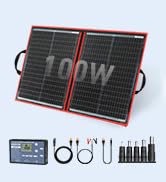
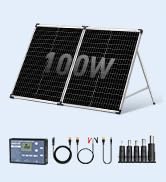
The DOKIO 100W Portable Foldable Solar Panel Kit delivers high-efficiency monocrystalline solar charging in a lightweight, compact form factor. Featuring a 110W max output, a 9.8ft cable for versatile setup, and a separate PWM controller for safe 12V battery charging, it’s designed for RVs, camping, and emergency power needs. Dual USB ports add essential device charging on the go, making it a must-have for millennial professionals seeking reliable, eco-friendly energy anywhere.


| ASIN | B0748FYFSK |
| Amperage Capacity | 6.1 Amps |
| Best Sellers Rank | #25,567 in Patio, Lawn & Garden ( See Top 100 in Patio, Lawn & Garden ) #72 in Solar Panels |
| Brand | DOKIO |
| Brand Name | DOKIO |
| Connector Type | SAE/XT60/DC/Alligator clips |
| Customer Reviews | 4.2 out of 5 stars 3,902 Reviews |
| Efficiency | High Efficiency |
| Folded Size | 18.9*26*0.47in |
| Global Trade Identification Number | 00613852957431 |
| Included Components | Bag |
| Item Dimensions L x W x H | 18.9"L x 0.47"W x 26"H |
| Item Type Name | solarpanel |
| Item Weight | 6 Pounds |
| Manufacturer | DOKIO |
| Manufacturer Part Number | FFSP-110M |
| Manufacturer Warranty Description | 1 year |
| Material | Monocrystalline |
| Material Type | Monocrystalline |
| Maximum Power | 110 Watts |
| Maximum Voltage | 18 Volts |
| Model Number | FFSP110M |
| Product Dimensions | 18.9"L x 0.47"W x 26"H |
| UPC | 613852957431 |
| Unit Count | 1.0 Count |
| Upper Temperature Rating | 50 Degrees Celsius |
B**.
Worked better than I expected.
The Dokio stands are not so great, but the folding solar panel produced more power than I expected. This thing folds up and is can be carried by one person. It is great for keeping the RV battery topped off and as a supplemental input to my Bluetti Apex 300. These only produce 300 Watts under ideal conditions. However, compared to my 400 Watt rigid panels, these actually made more power under the same conditions.
T**D
Compact, powerful, sturdy
Since they arrived, I've been quite cautious with my panels, given the mixed reviews, reports of very little power delivery (both initially and degrading over time). I suspected that the people reporting decreased power production over time may be over-bending and over-flexing their panels, damaging them over time. I've been using my panels for a few weeks now, and so far, my experience has been very pleasant! I also have made sure not to bend or flex them, avoiding leaning them against anything (esp at a harsh angle). So, I've really just placed them on top of my van. I've been very happy with the power delivery. I have been sampling it over different days in different conditions: - Midday, light clouds: 128W-149W @ 16-17V, giving 8-9A. (see images of screenshot for example @ 146.2W, and the partly cloudy sky) - Early morning, full sun: 90W @ 18V, giving 5A - Midmorning, very cloudy: 40-65W @ 16-17V, giving 2.5-3.5A - Summer evening, cloudy, tree coverage: 20-40W @ 16-17V, giving 1-2.5A So, I was shocked. I've seen it get up to 160ish Watts, and never expected to see more than 75% power (150W). So I was happy with that. And I'm also surprised that even with pretty heavy clouds, I was pulling in roughly 3A. Since I'm mainly planning to run my laptop and phones, (and possibly a small fridge), even this 3A is enough power for me if I let the panels run all day. One other location I was curious about was placing panels on my dashboard. I want to try exposing just a single panel, hoping that it can fit on my dash without shadow. 2 unknowns: I don't know how much my windshield will block the light, and I don't know if 1 panel can pull 1/4 of the full power potential. My understanding is the panels are wired in parallel, which is excellent, because they're essentially operating independently, or additively. (If they were wired in series, that would mean whichever panel had the lowest power, that would be the max power possible from every panel.) Still, in practice, I think I'm getting less than 1/4 power from the single panel. My thought is that the full panel covers so much ground, it's more likely that at least 1 panel will receive good light. However, the smaller footprint of the small panel will only pull 1/4 power when it's getting full sun. In other words, in full sun, I suspect the single panel will pull 1/4 of the 4 panels. But with any clouds, having all 4 panels present will actually help maximize power. I have a LiFePo4 battery, so the included charger won't work. Still, I'm happy to have this junky little charger in case I want to drag the panels out to the beach, providing USB power, or for emergencies to trickle power into my car battery. It would be nice to be able to lean these panels against a wall, or the side of my car. I'm just too nervous that I'll damage them with flexing. I'm thinking about creating something out of some old tent poles, but haven't yet landed on a design that I'm excited enough to build out. The other day, I came outside to find the panels had blown off my van and were just laying in the lawn. They seem to be still functioning fine. So, I'm happy that the panels are sturdy enough to withstand a 7 foot fall onto grass. I also need some basic solution to keep 'em strapped down, because I don't want a $200 kite. In terms of the quality, I'm pretty happy with the fabric itself, the quality of the handles, etc. The little metal rings seem pretty flimsy, but I can work with that. And some of the stitching is coming undone, leaving some dangling threads around. Again, I can mend that and deal with it. Overall, with a couple underwhelming features, I'm more than happy with the power output. Nothing in this price ranges is even close, and I can't even find another panel offer this kind of wattage.
C**L
They sent incorrect XT60 connector - Update 6-20-21 - Update 9-28-2022
Final update, July 2024. After having (now a total of three) of these Dokio panels, I need to update my review. I won't change the stars, but really only think they are a 3 star product now. Two issues. The first, and most important, is I'm finding the SAE connectors coming off the panels expand and soften when they get really hot (90 degree day in sunshine), and lose connection. They also pull apart super easily, and you may not immediately notice you've lost that connection. Second issue with the SAE (and XT60) are they are not standard for solar. Virtually every other brand out there uses MC4 connectors. Neither the SAE nor the XT60 allow you to connect panels in series (which you may well want to do if you are using any other controller than the cheap one provided). I ended up cutting the SAE connectors off and wiring directly to the XT60 from the panel, then building an adapter from that to MC4. Second major reason for "downgrading" my review is the amount of power they produce (or don't). I have two "brand x" panels each rated at 200 watts, and they provide about the same amount of power as the three Dokio 220 watt panels (in both cases,panels connected in series - so three Dokios versus two "brand x" and those combinations provide roughly the same power). I'm going to keep the Dokios, as I already have them, and they are lighter weight and more portable than "brand x", so are easy to haul for portable use where I may not need more than what one panel provides. They do work, just not as well as some of the competition. Another update. I do like the portability. Since writing the below review, I can report the absolute highest production I've seen from the panel was about 140 watts. However, this panel is priced comparable to a number of 100 watt panels (and produces more than 100), so I guess it is a reasonable value in that regard. I decided to order a second one of theses so as to have a pair of matching units that I can parallel for higher power, and the second unit arrived today. It works comparable to the first unit, and in parallel they do produce twice the power as either by itself. Today was an overcast day without shadow, so power output was quite low - about 20 to 30 watts per panel. With both in parallel I was getting 40 to 60 watts with full overcast and substantially more with partial clearing (but not direct sunlight). Usable if not ideal, but decent for the portability. Product as described, very brief setup and test late afternoon appears to work well. But one major issue, the XT60 connector for the load connection to the charge controller is not the correct connector. Am ordering correct connector, but that added $10 to overall cost. I had already cut some of the wires to put power pole connectors on, so was past point of returning. Unnecessary hassle if they checked product before shipping this would not have happened. Today I received the correct connector (ordered separately from different vendor), and hooked everything up. On the brightest, sunniest, day of the year (summer solstace), in direct sunlight, I'm pulling an absolute maximum of 8.8 amps @ 12.7 volts, or about 112 watts (from a panel rated at 220 watts). While I am neither surprised, nor disappointed (this is about what I was expecting and hoping for), it is clearly not what the panel is rated/advertised at. This is better than what I was getting from a less expensive, lower quality, panel bought elsewhere. Note, I am at 47.7° N Latitude (WA State), so solar is less effective than say Arizona or Texas. Getting about 1/2 of advertised power seems to be fairly consistent reporting from a variety of users. I have not checked performance in shade or any other condition than direct sunlight - obviously it will be less effective but I don't know how much so.
A**H
This included pwm controller will charge a lifepo4 battery fully.
This kit can charge a lifepo4 battery. Maximum charge current is coming from this cheap pwm charge controller, it's only at around 14.6 volts max voltage from this controller with this solar panel. Which is enought to charge a 12v lifepo4 battery at 14.4 volts charging. The only trick to charge a lifepo4 battery more quickly, is to have full sun day on solar panels. Best to invest in a mppt controller charger, but not totally necessary for a small solar panel setup like this. 14.4 volts in full sunlight on this solar panel to charge your lifepo4 battery fully. Make sure solar panel face is facing sun at 90 degrees to sun for best voltage. These solar panels seem to work, but they are fragile. Do not bend them too much, I heard one making a slight crackling sound when bending slightly. Good to have or make a solar stand that supports this solar panel well so it doesn't bend much. Like make a solar stand out of pvc pipe and carriage bolts to make a folding frame stand. Nice to have this light weight portable solar panel. Does charge a 12v lifepo4 battery 50 ah pretty quickly. But better to buy another solar panel to get more juice to battery for when you have loads on battery, and for charging, topping off your battery much faster. Too bad that all solar panels are only about 23 percent efficient or less. Can you imagine if solar was 100 percent efficient ? You could then run the whole World off of pure sunlight !!! Plenty of power comes from solar if We could get much more efficient panels, controllers and batteries. We need about 50 percent more efficient solar for it to really take off, and for a forever energy source. Solar panels used in space by NASA etc. like on all satellites, work better in the coldness of space, if you chill a solar panel down in temperature you can get much higher charge current. Much More effeciency from freezing temps, on a solar panel.
M**D
worth every penny.
Excellent product, value priced. This is my 2nd panel by Dokia to keep an Anker Solix 800 charged. All attachments need are included as well as the charge controller. I hook up to a 12v, 200Ah, LiFePO4. The other Domia charges a 12v, 150Ah battery that runs the pump from cistern to hot water on demand.
S**.
PLEASE READ ENTIRE REVIEW! I (LIKED) THEM READ MY FULL REVIEW FOR DETAIL
Ok well after thinking portable are the way to go because I want to park in the shade! & not drill holes in my roof. Well folks the massive advantage to doing just that is when your DRIVING! U R in the sun most of the day here in the west, but being stubborn I went with the largest foldable panels available, 300 watt 4 sheet fold. It is easy to carry easy to set up PWM works ok love the simple alligator hook up even though experts like to say they don't like them, 4 geta bout it they work great! So here's the full detail>> After 3 months in asphalt, dirt, rocks, concrete & the roof of my camper the case is holding up really really well they must have improved them because I saw quite a few say it tears & falls apart, my tie down rings still fine & all edges fine, the energy collected is good, they are 300 watt rated with a PWM it comes with the best I've gotten is 175! WHICH I LOVE If I could always get that I would be freaking happy, I have 1 BBorn lithium bat 12/100 amp hour it was at 18% in 4 hours took it to 94% ((I HIGHLY HIGHLY RECOMMEND A BATTERY MONITOR!)) WORTH ITS WEIGHT IN GOLD THE EXPERTS USE (VICTRON WITH BLUETOOTH) I LOVE IT LOVE IT LOVE IT TELLS ME EVERYTHING, GO POWER tells me NOTHING! My average in full sun is (125-140w) 175w was achieved in full sun with a cool breeze, yes it makes a difference heat actually lowers watts on the portable Dokios, this time of year March April they work fantastic California 60 70F with cool breezes. I achieved 40-70w in the shade which again I was happy, Now as for MPPT? I have the Rich MPPT but have not reconfigured the Dokio SAE wires, I believe with an MPPT I could be getting 200-220 watts? (ONLY WHEN THEY WERE BRAND NEW COULD I HAVE ACHIEVED THIS) I think after this much time (7 MONTHS) & different locations, weather & charges no way, All in all I say {DO NOT BUY) if I had 1 less panel (the 3 panel is by far their biggest seller) I don't think I would be as happy, I waited to get the 4 panel monocrystalline & I would say get 4 because they must be better then 3 (I would love 2 test that!) These are easy to store, travel well, set up so easy! & carry is a breeze. Overall 4 stars because (originally because they were new) they are not close to 300, are expensive, & don't have an easy option for an MPPT hook up. UPDATE AFTER 6 MONTHS DAILY USE>> They are diminishing to fast & are now down to about 80w full sun, (50w 9 months!) the rings did all brake so added holes in the frame (very easy & safe) PWM is fine & an MPPT would not make much of a difference with this small amount of power, I will be adding a Rich Solar flex cigs panel (the cigs is JUNK!) HAD MAJOR ISSUES FINALLY GOT A STORE CREDIT) so with the Dokio working as it was the combo would be perfect, sadly these Dokio are dropping FROM 135w new TO 50w 9 MONTHS, was a fantastic collection of power for 1 battery in the beginning. Not sure now about how long I will be able to use & now can not recommend at the price I paid I simply want 'portable' panels to work for 2 years at least. I would say put the money to morepowa Solar 100w solid or portable multi-mount ( u can place mounted or portable) & forget the Rich Solar flex 80w flex 'cigs' panel. with hard frame solid glass portable & 1 solid on roof would then be in real good shape for 2 batteries. I have learned a lot in 9 months on the road & having both portable & fixed I truly believe is the way to go.
B**E
200w Dokio Panels DOA?
11/06/2017 – Review updated to three stars For my full original review, please read below. Would I buy them again? Yes, probably. Only three stars due to the included charge controller. The included controller has the deficiencies described below in my original review. I will likely replace this controller with an MPPT controller. I basically quite like the panels, their fold-ability, the canvas “package” they are mounted in, their light weight (about 11 pounds), and the fact that they fold down to a small 21” x 29” rectangle, less than 1” inch thick. I have determined that the panels are working, thus the upgrade to three stars. When the panels are placed on plywood backing (the panels themselves are semi-flexible, so when tilted towards the sun on their own without the plywood support, they tend to flex, which means that the sun angle is then not optimum), on a cloudless day, I obtained the following readings (all readings using my digital multimeter – not with the included charge controller): 1. About 6 amps short circuit current (panels flat on the ground), then 8.5 amps short circuit current (on plywood backing, tilted towards the sun) out of rated max 11.36 amps short circuit current. Not sure why this is three amps short of the rated max - probably my sun angle tilting was not optimum. Will need to experiment further. 2. 20.6 volts open circuit voltage (out of rated max open circuit voltage of 22.5 volts). 3. 2.9 amps operating current (out of rated max 11.12 amps). I am assuming that this low operating amperage is due to the fact that my battery was nearing capacity. ____________________________ Where to start with this review? I don’t actually hate them (I purchased the 200 watt version) – but I can’t seem to get these panels to work, and wish VERY much that I could. However, I am not (quite) ready to give up, as I really like the idea of folding panels, so (maybe) by posting this review I can get some assistance from Dokio, or maybe someone else who has purchased these panels. If things change, I will definitely come back and update my review. At the moment I am quite disappointed, and am also out quite a few bucks over and above the cost of the panels (for all of the various “bits” that are needed for a solar system). Firstly, the panels came very quickly, about two weeks after placing the order. The information on the packaging indicated that these panels came from China, so the speed of their delivery was quite impressive. So far so good. The package was double bubble wrapped, to the extent that it was even a bit difficult cutting though the bubble wrap to get at the actual box (a good thing!) The actual cardboard package within the bubble wrap was undamaged in any way. In examining the panels, I was very impressed (and had high hopes!) that these panels would really fill the bill. I had spent years waiting, and literally tens of hours scouring the web for something like this. I travel in a converted cargo van, and needed something lightweight (so that I could easily lift them, as I have some age on me) and compact enough to store (the folded size was very attractive – easy to find a place to stow them in the very limited space inside my van). I liked the way the panels were sewn into a kind of heavy-duty canvas fabric, with nice sewn canvas handles, and a convenient pocket to stow the charge controller. Very pleasing to the eye. I also liked the fact that there are small rings sewn around the edges of the panels, I assume that these rings could be used to connect the panels to some kind of tie-down. Especially nice were two usb ports in the charge controller. The entire package seemed a compact and well made product, although there was a small divot in one of the panels that one could not see until the panel was put in direct sunlight, and the wiring that connected the charge controller to the battery is only about 12 or 14 gauge. I travel and camp in my van, and have been wanting solar for many years so that I could run my Dometic ac/dc refrigerator, charge my cell phone and computer, and maybe run a few lights. At last (or so I was hoping) I would be able to boondock and avoid hefty campground fees (the kind that have electric hookups). As I was waiting for the panels to arrive, I acquired three brand-new 75ah deep-cycle batteries ($200/ea - $600 total) that I planned to wire in parallel for 225ah, boxes to put them in, and had a battery isolator installed in my van ($225) so that I could charge the batteries while going down the road as well as when they were actually connected to the solar panels. I decided to hold off on the rest of the bits and pieces of the install (the bits that would be on the load side) until I had the panels in hand and could verify that they worked as advertised. It was when I opened the package, getting ready to whip these babies out into the sun, that I discovered the first problem. The entirety of the “Users Manual” is printed double sided on a 5 ½ inch x 8 inch scrap of paper. About the size of a normal sheet of paper, if that sheet was folded in half. Since one side of this double sided manual is in Chinese, effectively the whole of the English-language owner’s manual is on one side of this tiny scrap of paper. I took a photo of the “manual”, and am including it below. Hopefully this is permissible under Amazon rules. You will notice on the photo that there was some kind of glue on the pages, so that when I opened the pages part of the information was lifted away, stuck to the glue, and thus unreadable. Under the “Technical Parameters” heading there are several “model numbers” listed. I could not find that any of these model numbers corresponded with any similar number on either the charge controller nor on the panels themselves. Under the “Display/Seeting” heading (what is “Seeting”? Darned if I know) there is an icon showing the factory-set start point of each of the settings (seetings?) that one can scroll through (see “LCD Display/Key” heading for scrolling information) but no explanation of how, why, when or even if any of these factory settings should be changed, or what, if any, effect that they will have on the system if they are changed. Nothing. I then spent about four hours in the hot sun trying to understand the extremely minimal information presented on the “manual”, with not a particularly good result. Since my batteries are not yet wired in parallel (was waiting to do the final wiring until I could see that the panels were working) I tried each battery, individually, three separate times. Each time the charge controller appeared to work – somewhat (at least it lit up) – but at no time did the panel icon on the charge controller light, which would/should indicated that the panels were actually charging the batteries. The only icons that would come up was the battery icon pointing at the load icon. The panel icon just never appeared. When clicking on the buttons, sometimes the information on the controller would change, generally it would not. Even clicking on the button of the Main Menu generally it would work – but sometimes it would not. This may be because the holes punched in blue label on the front of the charge controller seemed as though they were offset from where the buttons needed to come through. They would kind of click when pushed, but with part of the blue plastic covering the button holes it may be that the clicking function was impeded by the label, keeping the buttons from fully extending. I thought about getting a razor blade and cutting the label so that the buttons were fully unimpeded (to see if that might help), but decided not to do this. Although my batteries were bought new (directly from a battery retailer), the date of manufacture was May of 2017. Since, as of this writing (October 21, 2017) these batteries should have had some minimal discharge in the five months from May to October, so should have been able to accept some minimal charge. Again, never once did the panel icon ever show, indicating that the panels were actually charging. Only the battery icon and load icon ever showed during my testing. Finally, at a loss of what else to try, I plugged my cell phone into one of the usb ports. My cell phone did indicate that it was charging – but my guess is that the charge was coming from the batteries, as the panel icon still did not light. Thus still no definitive indication that the panels were actually working (charging). Another problem is that the charge controller display only shows volts (i.e., under the heading on the manual “Display/Seeting [sic] – (I have no idea what “Seeting” is supposed to mean. Is it a typo,and actually means “setting”? Who knows), it does not show the flow of the current, i.e. how much current is flowing from the panels to the batteries (amps). I guess I could purchase an additional display of some sort that would show amps, but this is just more money that I am not willing to spend at the moment. Anyway, at one point the controller showed 20v, when the panels were fully opened to the sun. I then folded the panels closed, one by one, and with only one (out of four) of the panels open to the sun, the controller still showed 19v. When I closed the final panel, the charge controller turned off. To sum up, I would again like to say that I would very much like to see if these panels can be made to work. Their size, fold-ability, carrying weight, and wattage are just exactly what I have been searching for. However, I have tried just about everything I can think of to get these to work, and if I have to return them I will also have to (try) to return the batteries ($600) and will be stuck with the battery isolator ($225). Thanks for reading. Comments appreciated. Help welcomed.
F**Z
Works like it should.
It’s doing the job. I expected it too. Perfect for keeping the power bank charge for my Starlink.
B**1
Efficient
Lightweight, thin, effective , what else could I ask Léger ,mince, efficace ,quoi d’autre voudrions nous
よ**よ
はじめてのソーラーチャージャー
折りたたみのソーラーチャージャーが欲しく、値段が安くて軽かったこちらの商品を購入。ポータブルバッテリーの充電に使用しました。 80wということで、容量として足りるのかが不安でしたが、3月の晴天時で30wから40wの発電量で、庭仕事をしている間にしっかり充電できていました。そもそもポータブルバッテリーなので今のところ車中泊で使う程度であり、シガーソケットから充電(15wぐらいでした)もできるため、私としてはこのぐらいの出力で問題ありませんでした。 ちなみに私が使っているのはsu○okiのポータブルバッテリーですが、ソーラーチャージ用の端子がこちらのものと違っていましたので、ワニ口クリップを追加で一つ挟み、DCプラグで充電して使っています。直接繋いだらもっとたくさん充電できるかもしれません。 インジケーターも付いており、大変良い買い物をしたと思っています。耐久性も今のところ不安は感じていません。
C**S
Fonctionne
Rien a redire, c`est pratique qu`il y ai deja le convertisseur.
F**R
Great product
This works so well we’re very happy with this product
A**0
تعدد المنافذ والتركيب بسهولة وتلبية جميع احتياجات التشغيل
المنتج جميل جدا شكرا لتعاملكم الراقي ولكنني الشكوى من شركة التوصيل ايميل ولا أستطيع التواصل معكم لحل الإشكال اتمنى التواصل معي بهذا الشان
Trustpilot
1 week ago
3 weeks ago