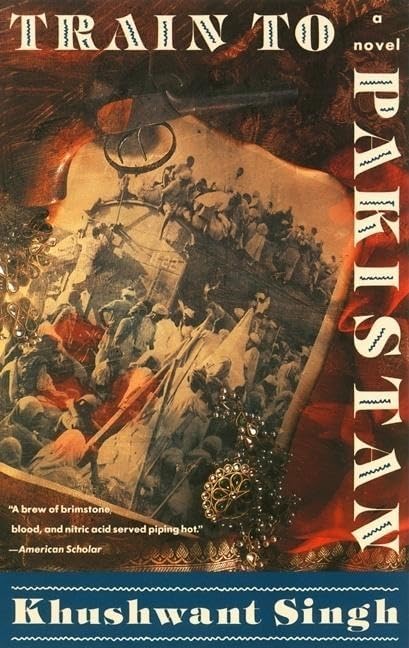
Train to Pakistan
Product ID: 4740408
Buy anything from 5,000+ international stores. One checkout price. No surprise fees. Join 2M+ shoppers on Desertcart.
Desertcart purchases this item on your behalf and handles shipping, customs, and support to Nicaragua.
“In the summer of 1947, when the creation of the state of Pakistan was formally announced, ten million people—Muslims and Hindus and Sikhs—were in flight. By the time the monsoon broke, almost a million of them were dead, and all of northern India was in arms, in terror, or in hiding. The only remaining oases of peace were a scatter of little villages lost in the remote reaches of the frontier. One of these villages was Mano Majra.” It is a place, Khushwant Singh goes on to tell us at the beginning of this classic novel, where Sikhs and Muslims have lived together in peace for hundreds of years. Then one day, at the end of the summer, the “ghost train” arrives, a silent, incredible funeral train loaded with the bodies of thousands of refugees, bringing the village its first taste of the horrors of the civil war. Train to Pakistan is the story of this isolated village that is plunged into the abyss of religious hate. It is also the story of a Sikh boy and a Muslim girl whose love endured and transcends the ravages of war. Review: Excellent Read - This book tells the human side of the partition of India and the impact of migration of a once peaceful border town. The writing is timeless leaving the reader with the sense that what occurred decades ago could have taken place in the present. Review: An artful mix of humor and horror. A powerful little novel. - TRAIN TO PAKISTAN, by Khushwant Singh, first published in 1956, is something of a classic in India, but I ran across it quite by accident. I'm glad I did, as it offers a quick and surprisingly entertaining - and educational - glimpse of the bloody civil war that erupted between the Hindus, Sikhs and Muslims in 1947 during the partition of a newly independent India. During this time distrust, fear and hatred ran rampant, causing formerly peaceful neighbors to betray and even murder each other over religious and political differences. Singh used the tiny, remote village of Mano Majra, situated near the border of the newly created state of Pakistan to illustrate how quickly things could change. The author's famously agnostic views play a prominent part in his story, particularly represented by Iqbal, the "stranger in town," an educated "social worker" whose questionable religious /ethnic identity leads to his arrest following a murder in the town. There is also an understated "love story" between Jugga, a Sikh petty criminal, and the daughter of the local Imam, which figures in. Singh's feelings about organized religion are stated thusly - "India is constipated with a lot of humbug. Take religion. For the Hindu, it means little besides caste and cow-protection. For the Muslim, circumcision and kosher meat. For the Sikh, long hair and hatred of the Muslim." And he has more to say - about Christians, ethics, philosophy ("muddleheadedness"), Yoga, reincarnation, etc. But you get the idea. There are generous helpings of sly humor and sarcasm here too in its portrayals of minor officials and religious clerics. But what takes center stage by story's end is the wholesale butchery and horror of this awful conflict, with its trains full of bodies going both ways across the border in those early days of the partition.I TRAIN TO PAKISTAN is Singh's best known book, and was also successfully adapted to the screen. It is a powerful little novel, no question. Very highly recommended. - Tim Bazzett, author of the memoir, BOOKLOVER
| Best Sellers Rank | #85,769 in Books ( See Top 100 in Books ) #296 in Cultural Heritage Fiction #717 in Contemporary Literature & Fiction #5,605 in Literary Fiction (Books) |
| Customer Reviews | 4.1 out of 5 stars 6,837 Reviews |
L**S
Excellent Read
This book tells the human side of the partition of India and the impact of migration of a once peaceful border town. The writing is timeless leaving the reader with the sense that what occurred decades ago could have taken place in the present.
T**T
An artful mix of humor and horror. A powerful little novel.
TRAIN TO PAKISTAN, by Khushwant Singh, first published in 1956, is something of a classic in India, but I ran across it quite by accident. I'm glad I did, as it offers a quick and surprisingly entertaining - and educational - glimpse of the bloody civil war that erupted between the Hindus, Sikhs and Muslims in 1947 during the partition of a newly independent India. During this time distrust, fear and hatred ran rampant, causing formerly peaceful neighbors to betray and even murder each other over religious and political differences. Singh used the tiny, remote village of Mano Majra, situated near the border of the newly created state of Pakistan to illustrate how quickly things could change. The author's famously agnostic views play a prominent part in his story, particularly represented by Iqbal, the "stranger in town," an educated "social worker" whose questionable religious /ethnic identity leads to his arrest following a murder in the town. There is also an understated "love story" between Jugga, a Sikh petty criminal, and the daughter of the local Imam, which figures in. Singh's feelings about organized religion are stated thusly - "India is constipated with a lot of humbug. Take religion. For the Hindu, it means little besides caste and cow-protection. For the Muslim, circumcision and kosher meat. For the Sikh, long hair and hatred of the Muslim." And he has more to say - about Christians, ethics, philosophy ("muddleheadedness"), Yoga, reincarnation, etc. But you get the idea. There are generous helpings of sly humor and sarcasm here too in its portrayals of minor officials and religious clerics. But what takes center stage by story's end is the wholesale butchery and horror of this awful conflict, with its trains full of bodies going both ways across the border in those early days of the partition.I TRAIN TO PAKISTAN is Singh's best known book, and was also successfully adapted to the screen. It is a powerful little novel, no question. Very highly recommended. - Tim Bazzett, author of the memoir, BOOKLOVER
K**A
A social commentary
This book is set against the background of the greatest tragedy of the modern Indian sub- continent – the partition into India and Pakistan and the Hindu-Moslem riots that caused over a million gruesome murders, countless millions who were physically maimed and two nations that seem scared forever by anger and hatred against each other. The story is set in a small obscure Indian village, Mano Majra, which is noteworthy only because of its small station on the Indo-Pakistan railway link. The good people of this mixed village of Hindus and Muslims have lived in peace for centuries with cordial relations among both religious communities that respected each others religions and customs. They have isolated themselves from the brutality that prevails elsewhere, even despite the arrival of trainloads of dead bodies of Hindus that arrive from Pakistan and are buried here in secrecy on the orders of higher government authorities that seek to contain the violence. But lower level public officials and military officers conspire to instigate violence against the local Muslim community with elaborate plans to create discord. Hukum Chand, the magistrate and the deputy commissioner for the district, is the quintessential Indian government lower-level babu that the author loves to hate. A corrupt, lecherous fellow who has risen in the ranks by toadying to his superiors, he puts together an elaborate plan to create dissension and violence in the village which he could later use to gain commendation by pretending to avert the tragedy. The protagonists are Iqbal Singh, a young foreign educated communist social worker who comes to the village to awaken the poor, and Juggut Singh, a notorious illiterate bandit descended from a family of dacoits. Both of them have been prepared as the fall guys for the violence against the Muslim community that the officialdom has prepared by being arrested and detained by the police on false charges and then freed before the planned mass murder of Muslims which can later be blamed on them. But when the train to Pakistan is loaded with Muslim villagers who are set to be massacred shortly after leaving the train station, the mettle of the two heroes is tested. Iqbal Singh, the communist social worker and idealist who came to save the village is unwilling to intervene in this planned tragedy and finds rational intellectual reasons for his behaviour. It is the fearsome illiterate dacoit, Juggut Singh, outraged by the actions of outsiders creating this violence in his own village, together with his love for a Muslim girl in the train, who bravely executes a desperate plan that foils the murderers and in the process willingly submits to an act of self-sacrifice and a horrible death. It is a novel of suspense and riveting tension. It is a story of the contrived corruption of innocence and the final triumph of simple rural values over urban sophistication.
F**R
Good read but biased narrative
A well-written book documenting the horrors of the partition of India. As a person of Indian origin, I found the book to be biased. Being a Sikh himself, I can understand the narration shows only Hindus and Sikhs are brutally murdered while the Sikh hero saves the Muslims by sacrificing his life. I expected a more objective narration by a distinguished journalist. Regardless, the book gives a good glimpse of the mindset of the people of India and Pakistan, the mistrust that still remain and the hatred among Hindus and Muslims that the partition rekindled. No wonder, lots of older Indians fault the British for initiating the partition (though the other solution offered by the British was not accepted by the Congress).
D**D
The Train to Pakistan
Train to Pakistan Book Review Train to Pakistan is a work of fiction, but events that are subject of this book are not too well known in the West in general and the United States in particular. Therefore, for the benefit of those who may not be familiar with the events and the time period which are the subjects of the book, it must be explained that the book describes events that did happen in real life. Thus the book is a fictionalized version of a certain period of history of the sub-continent of India. Therefore, I believe, that a certain introduction to that period is called for. Lord Louis Mountbatten presided over the departure of the British from India(see "Freedom at Midnight") and, the resulting subdivision into two countries we know today: India and Pakistan. The partition of the country was along geographic religious majority lines, ostensibly, and yet it was somewhat arbitrary. Joseph Stalin said that death of one man is a tragedy but a million deaths were a statistic. The partitions of British India dislocated over ten million people and close to a million were assassinated systematically in one of the worst sectarian violences in human history The author a British-educated lawyer has described the mass killings along religious lines in Train to Pakistan. It is an easy read. The lack of in depth knowledge of culture and history of the subcontinent do not in any way lessen the impact of the events in the book. The characters are true representation of people who could, and did, belong there and events are fictionalized version of real-life events. One is inescapably reminded of Anatoli Kuznetsov's Babi Yar. Both describe events that happened in the same decade, 1940s, except one was in the West and the other halfway around the world in the East; one was political killings, the other religious. Both the books describe genocide and senseless mass killings for the sake of killing. The copy of the book that I received, as my purchase, a Roli Books printing, though, leaves something to be deisred in quality of printing. Black and white photographs are by the late Margaret Bourke-White of Time Life. The photographs enhance the 50-year issue of the book immeasurably in that they destroy any last and lingering skepticism that the reader might harbor that such mass human sectarian atrocities couldn't be true. Both books attest to man's endless capacity for inhumanity to man.
L**S
A harrowing journey to the inevitable...
The summer of the Partition of India in 1947 marked a season of bloodshed that stunned and horrified those living through the nightmare. Entire families were forced to abandon their land for resettlement to Muslim Pakistan and Hindu India. Once that fateful line was drawn in the sand, the threat of destruction became a reality of stunning proportions. Travelers clogged the roads on carts, on foot, but mostly on trains, where they perched precariously on the roofs, clung to the sides, wherever grasping fingers could find purchase. Muslim turned against Hindu, Hindu against Muslim, in their frantic effort to escape the encroaching massacre. But the violence followed the refugees. The farther from the cities they ran, the more the indiscriminate killing infected the countryside, only to collide again and again in a futile attempt to reach safety. Almost ten million people were assigned for relocation and by the end of this bloody chapter, nearly a million were slain. A particular brutality overtook the frenzied mobs, driven frantic by rage and fear. Women were raped before the anguished eyes of their husbands, entire families robbed, dismembered, murdered and thrown aside like garbage until the streets were cluttered with human carnage. The trains kept running. For many remote villages the supply trains were part of the clockwork of daily life, until even those over-burdened trains, off-schedule, pulled into the stations, silent, no lights or signs of humanity, their fateful cargo quiet as the grave. At first the villagers of tiny Mano Majra were unconcerned, complacent in their cooperative lifestyle, Hindu, Sikh, Muslim and quasi-Christian. Lulled by distance and a false sense of security, the villagers depended upon one another to sustain their meager quality of life, a balanced system that served everyone's needs. There had been rumors of the arrival of the silent "ghost trains" that moved quietly along the tracks, grinding slowly to a halt at the end of the line, filled with slaughtered refugees. When the first ghost train came to Mano Majra the villagers were stunned. Abandoning chores, they gathered on rooftops to watch in silent fascination. With the second train, they were ordered to participate in burying the dead before the approaching monsoons made burial impossible. But reality struck fear into their simple hearts when all the Muslims of Mano Majra were ordered to evacuate immediately, stripped of property other than what they could carry. The remaining Hindus and Sikhs were ordered to prepare for an attack on the next train to Pakistan, with few weapons other than clubs and spears. The soldiers controlled the arms supply and would begin the attack with a volley of shots. When the people realized that this particular train would be carrying their own former friends and neighbors, they too were caught, helpless in the iron fist of history, save one disreputable (Hindu) dacoit whose intended (Muslim) wife sat among her fellow refugees. The story builds impressive steam as it lurches toward destiny, begging for the relief of action. In the end, the inevitable collision of conscience and expediency looms like a nacreous cloud above the hearts of these unsophisticated men, a mere slender thread of hope creating unbearable tension. I was impressed with the power of Singh's timeless narrative, as the characters are propelled toward a shattering climax, as potentially devastating as any incomprehensible actions of mankind's penchant for destruction. I was struck also, by the irony: how the proliferation of a rail system that infused previously unknown economic growth potential to formerly remote areas, also became the particular transport of Death. Only a few years earlier, a rail system in another part of the world carried innumerable Jews to Hitler's ovens, another recent barbaric use of Progress, originally intended to further enrich the potential accomplishments of the human race.
D**E
A story as haunting as the ghost trains themselves
The story woven in this novel is well paced and engaging, and haunted me for a bit after I finished it. It was disturbingly realistic as well. The only reason I didn't give it five stars was that the number of typos in the book was a bit distracting. It could use some proofreading/editing. Otherwise a good read.
P**F
good read about partition
A good read about partition in India following independence from the British. Very well written story about a very tragic and sad point in history.
R**R
日本人には理解できない現実
インド・パキスタン分離というのは小説の題材としては一つの定型なのでしょうか。そういえば、 A Division of the Spoils (Raj Quartet 4) の最後にもこの題材が扱われています。1947年の夏という凝縮された時間、通常では考えられない移動の規模、そこで流された流血、残虐行為の非合理性、そこにすべてインド亜大陸の歴史的な矛盾が自然発生的に凝縮されて噴出したかのようです。そういう意味では、いつまでも変わらない小説特に悲劇のイマジネーションを刺激するのでしょうか? 本書は1956年の作品です。まだ悲劇の具体性が消え去っていない時期です。これがもう10年たつと悲劇は歴史的な題材としての抽象性の刻印を帯び始めますが。題材は一般的なものですが、著者の特性が小説のディテールにははっきりと表れています。選択されたパキスタンとの国境沿いの町は、多数のシーク教徒と少数派のイスラム教徒が居住する町なのです。ここにはマスとしてのヒンズー教徒の存在は見当たりません。もっともサブ・プロットは、ヒンズー教徒の金貸しの家への強盗(dacoist)の襲撃に始まるのですが。ヒンズー教徒の存在を消すことによって、悲劇の不可避性のイメージを弱めようとしたのかもしれませんが。 この作品には主人公はいません。複数の中心となる人物が、この町を超えたところで起きる予想外の事態に、翻弄されて行く展開が主題となります。この町自体には、惨劇を引き起こす歴史的、個人的な必然性は存在していないのです。ある者は、状況へ機会主義的に対応することになり、この惨劇の後に来るであろう政治の世界での地位の確保を目的としています。ここには、体制側の人物だけでなく、社会主義革命を夢想する反体制側の者も含まれます。ある者は、過去の継続と暴力の非合理性にこそ、宗教の本質を見出します。 しかしながら、インドの現実は、この凝縮された時間の中では、様々な感情の噴出や思い出の想起や政治的な操作を可能とします。そして現実に、パキスタン側から送られてくる「死の列車」は、生半可な理想の維持を不可能とします。この現実に立脚しない「高尚な理想」の提唱( The Argumentative Indian: Writings on Indian History, Culture And Identity とすさまじい現実の交錯こそが、インドの本質なのです。 小説なので種明かしはできませんが、結末の部分の評価は難しいところです。このような結末のつけ方こそ本質的な問題のintractabilityを如実に示すものなのではないでしょうか。そもそもなぜ同じ村に住む人々の宗教がどうして別れてしまうのか。このような「ノーマル」ではない状況が日常的に存在してしまう歴史的な経緯こそが、インドの現実なのです。
E**A
Bien
Me gustó que llegó en el plazo previsto, tenía partes subrayadas con fosforito y algún post-it, pero todo perfecto relación calidad-precio. Muy buen libro sobre la partición de la India-Pakistán.
K**N
A page turner!
I was about to buy some other book and ended up buying Train To Pakistan. It was my brother's choice. When I read some of the reviews about this book, I became curious and wanted to read this. And yes, it really exceeded my expectations. I just couldn't keep myself away from the book since I started reading. I finished the book in 2 days. The story captures the real life of Hindus, Muslims and Sikhs of India during the partition of India. It doesn't reflect any politician's view but narrates the story of any other Indian. This story gives us a reason to think how we could avoid the cultural discrimination. The plot Mano Majra which is devoid of any political influence and the partition gets itself destroyed by the interference of armed forces. Iqbal who is an educated man comes to Mano Majra for bringing peace and to prevent Mano Majra from getting influenced by the partition. The Sikhs and Muslims in the Mano Majra lives there happily until a train from Pakistan comes along with thousands of dead bodies. It changes the lives of people in Mano Majra too. Though the Sikhs were ready to protect the Muslims of their village, the Muslims were forced to leave the village and their belongings because of the intruders like the magistrate and the police. It show how such forces can affect the life of a whole village. The villagers who always did everything to protect their fellow villagers became each other's enemy. The Sikhs were ready to attack the train carrying Muslims even when they were aware that their Muslim friends were also present in the train. The story ends with the prevention of that attack by the village's bandit Juggut Singh for his lover, a Muslim girl. The story at first tells us how to treat others with equality. The head of both Sikhs and the Muslims were always generous to people. And they were always clear about their views and opinion which proves their leadership. But the bandit gang of nearby village creates problems among people. The other characters like the magistrate, police and the dancer girl etc. too makes the story memorable. The story portrays both the good and bad sides of the partition and its effects on ordinary people. The book is really a page turner. It is a book worth reading and is worth morally too. It tells us how friends can turn into enemies within minutes. The way the author has narrated the story should be appreciated. Every single thing is detailed. Some people may think it's over descriptive but it's not much. The detailing gives us a clear picture of the story. This would be a gift to future generation who won't be aware of the partition of India and its effects in both India and Pakistan. I'll give 5 stars to it. The narrative style and the description is to be appreciated. The book is just awesome. This would be a treasure to anyone who likes to read historical events.
A**N
Great read
Really interesting book, loved the insights and perspective on Indian and Pakistani history.
D**G
The horrors of partition in the Punjab.....
What a superb,concise account of the partition of India in 1947. Every page of this novel was almost perfect, the balance,the narrative,the message. Khushwant Singh has managed to convey the horror of 1947 in the Punjab with clarity and venom as the communal violence spreads along the borders of the new states. He uses the voices of his characters to give some account of the bloodletting and violence that caused peaceful communities to implode. The trains in the novel are at the centre of the message as they carry refugees back and forwards past a little Punjabi village by the banks of the Sutlej river. New Delhi seems a world away from the chaos enveloping the region, the neat incisions of the political cartographers are revealed as gaping wounds. The Sikhs and Muslims in this novel are the victims of the horror,Singh portrays the inter-faith traditions of the village and the difficulties that result as their awareness of the horror in Pakistan is revealed. The stories of the local bad boy Juggat Singh and a party worker back from england are woven into the fabric of tragedy and terror. The martial Sikhs facing daily murder and violence,the muslims who don't want to go to Pakistan,there are many confused people here as the new order comes into being. A lot of the blame for this horror lies with the unhealthy speed at which the British pulled out of India and the obvious danger of splitting a religiously mixed region (the Punjab) into two different nations. The Sikhs possibly suffered worst during that summer of 1947 but nobody living along that border will ever forget the communal hatred and massacres that burst upon them and scarred the creation of Pakistan for ever. 5 stars.
Trustpilot
3 weeks ago
3 days ago