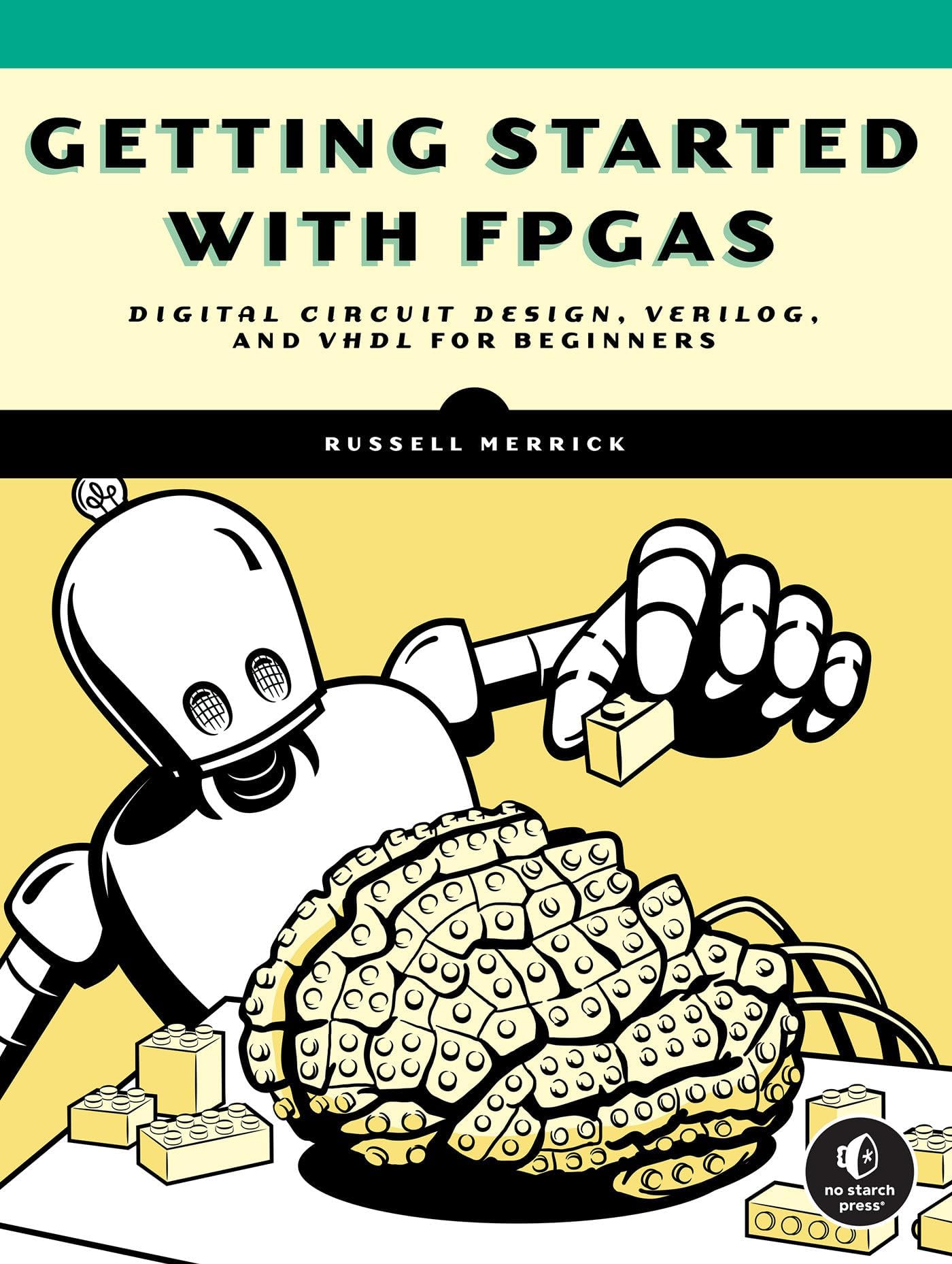

Getting Started with FPGAs: Digital Circuit Design, Verilog, and VHDL for Beginners
Product ID: 473796240
💻Hands-on FPGA programming
📊Step-by-step digital circuit design
⚙️Verilog & VHDL dual-language code
Buy anything from 5,000+ international stores. One checkout price. No surprise fees. Join 2M+ shoppers on Desertcart.
Desertcart purchases this item on your behalf and handles shipping, customs, and support to Nicaragua.
🚀 Unlock FPGA mastery and future-proof your tech career!
Getting Started with FPGAs is a beginner-friendly guide that demystifies digital circuit design using Verilog and VHDL. Authored by FPGA expert Russell Merrick, this book offers hands-on projects, detailed code examples, and clear explanations of core concepts like state machines, timing, and FPGA build processes. Perfect for aspiring FPGA engineers, it equips readers to confidently create reliable, high-performance FPGA designs.



| Best Sellers Rank | 215,740 in Books ( See Top 100 in Books ) 91 in Computer Architecture & Microprocessors 113 in Electronics & Telecommunications Engineering 236 in Computer Hardware (Books) |
| Customer Reviews | 4.6 out of 5 stars 85 Reviews |
J**S
Great book for beginners
An extremely well written book that provides a great introduction to programming FPGAs. Lots of worked examples and nice explanations to guide those who are new to the area.
O**A
Great learning tool
An exceptional, accessible introduction to low-level programming fundamentals. The author resolves the iCEcube2 licensing issues clearly—simply email Lattice requesting a free hobbyist license. With abundant online supplementary materials, the concepts are explained in a professional yet engaging manner that makes complex topics approachable. Highly recommended for anyone looking to dive into hardware programming without getting overwhelmed by technical jargon.
M**N
Licence is now available!
Thanks to the author and the generosity of the software manufacturer, the free licence is now available.
T**Y
Damaged and Dirty
Disappointed at the condition the book arrived in. It was damaged along the spine, the cover bent and was very grubby.
D**A
top
top
E**.
Great for starting FPGA/digital circuits.
Really well written and examples are easy to follow :) I am matching it with an Alchitry Cu with Io board and goes well :)
D**R
livre sans interet pour plusieurs raison
1/ ce livre est plus ou moins lié au FPGA lattice la politique des license de lattice fait que c'est un trés mauvais choix... du jour au lendemain lattice peut rendre la license payant... il l'ont déja fait avec ISP lever classic que j'utilisais pour programmer des GAL 2/ le logiciel icecube n'est plus supporté par lattice et est laissé a l'abandon il est remplacé la radiant 3/ les documentation pour le ice40up5k sont mal faite plein d'info sont manquantes et il faut plonger dans la doc icecube et essayer d'extrapoler... un cauchemar 4/ les exemples sont trop limité si on prend par exemple l'afficheur 7 segment généralement il n'y en a pas un mais plusieurs et souvent multiplexé (aucune info la dessus) il y a meme des afficheurs 7 segments qui sont charlieplexé je retourne ce livre trop cher pour le peu d'information interessante
A**G
An incredible resource for both beginners and professionals needing a refresh
I have a Bachelor's in Electrical Engineering and took a class on FPGA programming in college, and I did a little bit of FPGA work early on in my professional career, but haven't touched them in about a decade. In the intervening years I've become an avid hobby electronics tinkerer doing home projects with Arduino, Raspberry Pi, BeagleBone Black, etc. It wasn't long ago that I found myself wanting to play around with FPGAs again, and I pretty quickly stumbled upon the Nandland YouTube channel and the accompanying blog. I was thrilled to learn that Russell Merrick, Nandland's creator, was writing a book, so I happily preordered it. As soon as it arrived, I dived right in and have been very pleased. Mr. Merrick has taken a really complex subject and made it extremely accessible for beginners, but without making it so simple that people like me lose interest. He has a great writing style that is approachable, with easy to follow practical examples and tons of wisdom gained from years of experience doing this work and sharing his passion with others. I think the best thing about this book is that it's not just a collection of coding exercises with little to no context; instead, the focus is on building a solid foundational understanding of FPGAs, how they work, and what they are (and are not) good for. And he has done all that extremely well. I highly recommend this book, whether you're a hobbyist looking to expand your horizons, a student looking to get an edge or go deeper than a surface-level course will take you, or someone like me - a rusty practitioner looking for a refresher.
A**R
Fantastic entry point into the world of FPGAs
As an introduction to digital circuits and how FPGAs work and are programmed, this book is approachable and well-written. The book is best coupled with the author's low-cost FPGA board that they designed along with the lessons offered on their website. The author's website goes a few steps deeper than the book with the working design of a UART serial communicator (terminal and keyboard I/O) and a VGA driver, which really opens doors to fun projects. The most difficult part of the coursework is getting the development software licensed and understanding esoteric editor UIs. After going through that, designing digital integrated circuit logic is a walk in the park. As of the writing of this review, there really isn't an easy entry point into the world of FPGAs with clear advice or tutorials. This book offers better information than my local big Computer Engineering university 300-level FPGA course. I now have skills to be able to dig into deeper, specialized concepts on more complicated boards, along with further fun development with the UART/VGA combo on the Go board.
Trustpilot
1 month ago
2 weeks ago