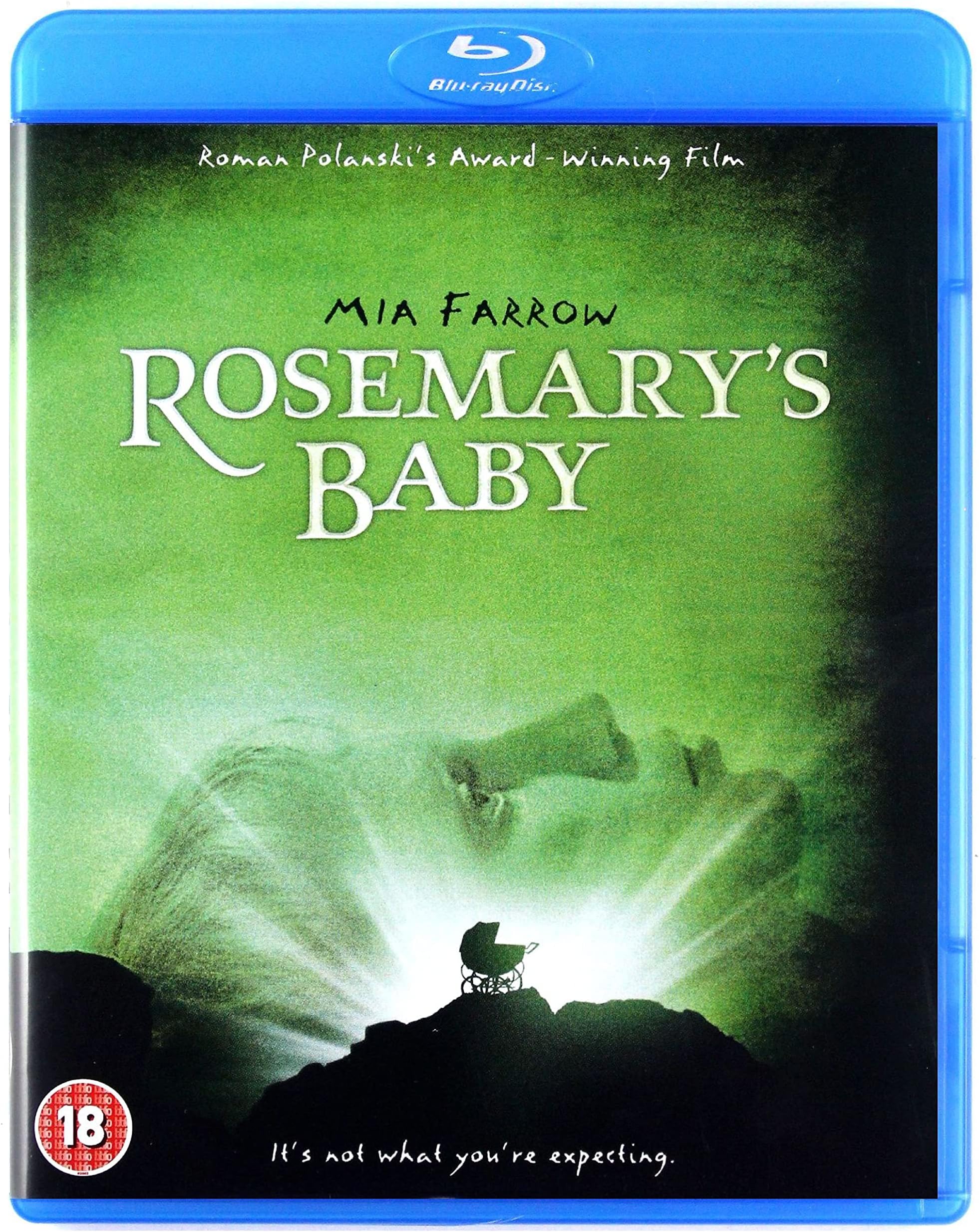

Rosemary's Baby
Product ID: 46354094
Details
- GenreDrama
- FormatImport
- ContributorAlmira Angela
- LanguageEnglish
- ColorColor
Buy anything from 5,000+ international stores. One checkout price. No surprise fees. Join 2M+ shoppers on Desertcart.
Desertcart purchases this item on your behalf and handles shipping, customs, and support to Nicaragua.
Directed by Roman Polanski. Starring Maurice Evans, Ruth Gordon, John Cassavetes. Review: A remarkable film - The Criterion Blu-Ray has the image quality and special features you would expect from them. Particularly interesting are the interviews with Roman Poklanski and Mia Farrow, a radio interview with author Ira Levin, and an hour documentary on film score composer Krysztof Komeda, who died in an accident shortly after finishing the music for the film. You see the word masterpiece in almost any article or review of Roman Polansky’s “Rosemary’s Baby” and in this case you can trust that assessment. Rarely has a film in the horror genre succeeded so well in creating a feeling of terror and entrapment and even more rarely has it also been simply a great film. The combination of the source material, director and actors set you on an inexorable journey from everyday life to a paranoid world in which for once the paranoia is valid. One of the main ways it accomplishes this is to present everything as matter of fact and normal as possible, rejecting all the over the top aspects in which most horror films revel. Everyone smiles and acts in the way average people would and none of the actors seem particularly evil or ominous. Sure, the Castevets are certainly eccentric, but it seems to be mostly in their choice of clothes and Minnie’s nosy neighbor ways. Emphasizing the everyday ordinariness of the setting of many scenes, there’s a reminder of a real world outside going about its business such as the traffic sounds in the background when Rosemary uses Scrabble letters to try to solve an anagram. Creepy music is used only in important moments as are special effects which are almost entirely absent and there are no jump scares. The cast is impeccable as well, none more so than Mia Farrow whose characterization of Rosemary Woodhouse is so total that you don’t even feel you’re watching a performance. She simply is Rosemary. It’s an involving performance that makes you feel for her situation. It’s a moment of great pathos when she apologizes to “Andy or Jessica”, her potential newborn, for the terrible situation they are in. No matter how many times I see the film, I always feel devastated by the end. John Cassavetes is able to come off as a good and loving husband but is believable as a career-obsessed man who might do anything to get ahead. He feels totally duplicitous when he tries to keep Rosemary in line over wearing an amulet, drinking an herbal concoction and sticking with a particular doctor . Yet his facial expressions show how torn he is inside as a man who has overthrown all decency after his desire for success wins over all other considerations. Neither of them were first choices. Polansky had at first wanted a more All-American, almost athletic couple of Tuesday Weld or Jane Fonda, both of whom turned the role down. Robert Redford was having a contractual dispute with Paramount and said no. Farrow had been a huge television hit in the prime time soap opera, “Peyton Place”, playing the innocent Allison Mackenzie so successfully that when she left the show (at new husband Frank Sinatra’s urging) it had to be cut from three nights a week to two. Her waiflike appearance is a real asset to the film. Robert Redford, this early in his career, mostly played good guys and I wonder if he would have been able to appear as conniving as Cassavetes. Ruth Gordon and Sidney Blackmer play Minnie and Roman Castevets, who live in the adjoining apartment. Gordon, who appeared in her first film in 1915 and won an Oscar for this role, gave the only over-the-top performance which perfectly personified a New York type. She’s your sweet, solicitous grandmother, always bringing you something to eat. Sidney Blackmer, whose film career went as far back as Gordon’s is warm and friendly and knowledgeable about the history of Broadway, regaling Guy with stories of Victorian era actress Helena Modjeska and a few other things. Shakespearean actor Maurice Evans is Edward “Hutch” Hutcherson, a bookish, erudite friend of the Woodhouses (he probably would have appreciated their Austen-shared name) who warns them about the dark and mysterious happenings at the Bramford, a building whose literary-inspired name would have been known to fewer people then than now. Ralph Bellamy, a major actor in Hollywood films of the 30s and 40s is Dr. Abraham Sapirstein, an authoritative obstetrician into whose care Rosemary is placed. In the basement laundry room scene Rosemary comments to a neighbor a few machines down that she looks like the actress Victoria Vetri. This is an inside joke as the actress is Victoria Vetri (though she was using her modeling name Angela Dorian in the credits). The Bramford is played by the Dakota on Central Park West, a famous Gothic Revival building since its construction in what was the boondocks in the 1880s and later from the many celebrities who have lived there. After the pink opening credits (in fluorid script like an announcement or invitation), the camera swoops above from the Majestic Apartment Building’s tall Deco towers to the roof of the Dakota with its gabled roofs and seeming infinity of tiny dormers. This Gothic delight is the only concession to the more traditional tropes of horror and because it’s never made to be overly creepy, is just right for the setting. Rosemary and Guy take a vast, high-ceilinged apartment on the seventh floor and Rosemary at once sets about completely painting it in a lighter, more airy color scheme with sunshine yellow in the kitchen and bedroom and adding new furniture for a 60s modern look. The set was based on the apartment owned by Lauren Bacall in the Dakota and Polanski told the production designer that it should look like Doris Day lived there. The interior always seems to envelop Rosemary, not in a cheap, spooky way with gargoyles or frightening taxidermy, but it can turn from sanctuary to prison in an instant. The genesis of the film was strange in its own right. Based on Ira Levin’s best-seller, the film begins with, of all people, William Castle optioning the rights before the book actually came out. This is the same William Castle who was kind of a schlockmeister in the 50s and 60s making films promoted by gimmicks like “The Tingler” with electric buzzers affixed to some seats, “13 Ghosts” with special glasses to see the ghosts and insurance policies should you die from fright. He was now making B-movies for Paramount. He has a cameo playing the man waiting outside the phone booth. Paramount itself was in a crisis. 9th of 9 studios and recently bought by Gulf + Western, Robert Evans was chosen as the new head of production. He knew he didn’t want Castle directing the picture. He needed a big, A-list film and feared what Castle might do to it. Polanski was not well known to the public but had made a big splash with critics and arthouse fans with “Knife In the Water” and “Repulsion”. Evans would have known about him. Anyone who had made “Repulsion”, in which Jacqueline Deneuve, the youthful star of “The Umbrellas of Cherbourg,” played a mentally disturbed murderer., was the man to make “Rosemary’s Baby”. The films had a similarity: in “Repulsion” the central figure is descending into madness while everyone around her is sane - in “Rosemary’s Baby” it’s the central character who is sane and those around her are in a sense, mad. Evans got Polansky to Hollywood ostensibly to direct “Downhill Racer”, knowing the director to be a ski enthusiast. He then handed him the novel, asking him if it was filmable. Polanski devoured it in one evening and wrote the screenplay in the coming months. He had a talent for depicting isolation and paranoia, perhaps helped by his childhood in Poland where he saw both parents taken away to concentration camps. He then spent years living with a Catholic family who had promised his father to take him in, constantly having to pretend he was Catholic himself during the Nazi occupation of Poland. Many thought it was too much of a gamble, bringing in someone who had never directed an American film, but the result speaks for itself. It was Polanski who brought in film school friend and major jazz musician in Poland, Krysztof Komeda to compose the score and gave it the haunting, mournful lullaby which you never forget once you hear it. Review: MIA'S HAIRCUT and other ENIGMAS - The five stars are for the movie, a practically perfect film in every respect: gripping story, colorful casting, great acting, memorable music score, precise photography, iconic locations, a central character we genuinely care about and, of course, the sure hand of Maestro Polanski conducting this Satanic celluloid symphony. ROSEMARY'S BABY is a must-see for all lovers of, not just horror or suspense films, but for lovers of film, period. The film thankfully has no CGI effects, nor over-the-top, carnival-esque nonsense like Linda Blair's head doing a 360 or her running down the stairs in a backward push-up position in the blatant, overrated THE EXORCIST. ROSEMARY'S BABY has no graphic kill catalog like THE OMEN, no overdone action set-pieces, no blood and gore or green vomit. This movie is literate, subtle, filled with irony and nuance. It is what more movies should be - and so seldom are. It was, and remains, a money-making blockbuster - but it was and is also a genuine work of art, on every conceivable level. On this release the film transfer and audio are excellent. The extras on disc two are good enough - but could have been much more. The Criterion crew sat down with Polanski, Mia Farrow and Bob Evans and it is great to see them up-to-the-minute and anything they might have to say is of interest. The trouble is, they say virtually the same things they said in the 2006 Paramount DVD release. Well, Polanski and Evans do. Mia Farrow was not interviewed for the prior release. The point is, watching the two men talk in Criterion's release was like deja vu all over again! It is also a pity that in the interviews - both those in 2006 and now in 2012 - nobody has anything to really say about the vital importance of both the story's author Ira Levin or the movie's composer Christopher Komeda. Without the contribution of Ira Levin ROSEMARY'S BABY would never have been born! And without the weirdly unique musical score of Christophjer Komeda, the final film might very well have been stillborn. Who can forget the truly haunting lullaby main theme, hummed by Rosemary Woodhouse herself? Yet no where is the music mentioned - nor the fact that Ms. Farrow is the La-La voice for the song. Yes, there is a separate documentary from Poland on the composer in the Criterion release - as well as a radio interview with the book's author. But in the comments made by Polanski and Evans and Mia Farrow - as well as Production Designer Richard Sylbert on the Paramount DVD - the contribution of those two integral artists is not trumpeted in the least. Sad. I was going to give my Paramount DVD to a friend, seeing as I now had the two disc Criterion release. But since the earlier DVD has its own interesting "Making of" featurette in addition to the 2006 interviews, I will hold onto it - as I would urge anyone else who has that earlier release. Truth-be-told, Criterion's second disc could have fit onto the main disc of the movie - but having two discs has a psychological effect on prospective buyers. And since Criterion went to the trouble of sitting down with Polanski, Evans and Ms. Farrow, too bad they didn't extend the effort to include a retrospective of comments from film critics and historians, other directors, analysis of the film's cultural and historic impact then and now, etc. A very good model to follow for these featurettes are the ones included on the Universal releases of the major monster movies in their pantheon: FRANKENSTEIN, DRACULA, THE WOLFMAN, etc. Those extras are truly superlative! One other note: in all of the commentary, I have yet to learn how it was - and by who's suggestion - Mia Farrow returns from Vidal Sassoon halfway through ROSEMARY'S BABY with her iconic, cropped hairstyle. And back to the extras for a last time: as wonderful as is the documentary on composer Komeda, I have just seen elsewhere a wonderful study of William Castle - the producer of RB - and a legendary horror film producer and director of many memorable movies - and his story could have added lustre to this release as well. Bottom line, it just seems like there isn't enough to warrant the necessity of a second disc. Further bottom line: Criterion still-and-all does bang-up jobs on most of their releases. ROSEMARY'S BABY rocks! At the very least, it certainly does rock its cradle. A belated Happy Halloween to all of you witches! Maniacs, too.
| Contributor | Almira Sessions, Angela Dorian, Bill Baldwin, Bruno Sidar, Carol Brewster, Charles Grodin, Charlotte Boerner, Clay Tanner, D'Urville Martin, Elisha Cook, Elisha Cook Jr., Elisha Cook, Jr., Elmer Modlin, Emmaline Henry, Ernest Harada, Floyd Mutrux, Frank White, Gail Bonney, George Savalas, Gordon Connell, Hanna Landy, Hope Summers, Jean Innes, Joan Reilly, Joan T. Reilly, John Cassavetes, John Halloran, Josh Peine, Joyce Davis, Marianne Gordon, Marilyn Harvey, Maurice Evans, Mia Farrow, Michaél Shillo, Mona Knox, Natalie Masters, Patricia Ann Conway, Patricia O'Neal, Patsy Kelly, Paul Denton, Phil Leeds, Philip Leeds, Ralph Bellamy, Robert Osterloh, Roman Polanski, Roy Barcroft, Ruth Gordon, Sebastian Brook, Sebastian Brooks, Sidney Blackmer, Sidney Blackmer Sr., Sidney Blackmer, Sr., Tony Curtis, Victoria Vetri, Walter Baldwin, Walter S. Baldwin, Wende Wagner, William Castle Contributor Almira Sessions, Angela Dorian, Bill Baldwin, Bruno Sidar, Carol Brewster, Charles Grodin, Charlotte Boerner, Clay Tanner, D'Urville Martin, Elisha Cook, Elisha Cook Jr., Elisha Cook, Jr., Elmer Modlin, Emmaline Henry, Ernest Harada, Floyd Mutrux, Frank White, Gail Bonney, George Savalas, Gordon Connell, Hanna Landy, Hope Summers, Jean Innes, Joan Reilly, Joan T. Reilly, John Cassavetes, John Halloran, Josh Peine, Joyce Davis, Marianne Gordon, Marilyn Harvey, Maurice Evans, Mia Farrow, Michaél Shillo, Mona Knox, Natalie Masters, Patricia Ann Conway, Patricia O'Neal, Patsy Kelly, Paul Denton, Phil Leeds, Philip Leeds, Ralph Bellamy, Robert Osterloh, Roman Polanski, Roy Barcroft, Ruth Gordon, Sebastian Brook, Sebastian Brooks, Sidney Blackmer, Sidney Blackmer Sr., Sidney Blackmer, Sr., Tony Curtis, Victoria Vetri, Walter Baldwin, Walter S. Baldwin, Wende Wagner, William Castle See more |
| Customer Reviews | 4.8 out of 5 stars 1,893 Reviews |
| Format | Import |
| Genre | Drama |
| Language | English |
J**F
A remarkable film
The Criterion Blu-Ray has the image quality and special features you would expect from them. Particularly interesting are the interviews with Roman Poklanski and Mia Farrow, a radio interview with author Ira Levin, and an hour documentary on film score composer Krysztof Komeda, who died in an accident shortly after finishing the music for the film. You see the word masterpiece in almost any article or review of Roman Polansky’s “Rosemary’s Baby” and in this case you can trust that assessment. Rarely has a film in the horror genre succeeded so well in creating a feeling of terror and entrapment and even more rarely has it also been simply a great film. The combination of the source material, director and actors set you on an inexorable journey from everyday life to a paranoid world in which for once the paranoia is valid. One of the main ways it accomplishes this is to present everything as matter of fact and normal as possible, rejecting all the over the top aspects in which most horror films revel. Everyone smiles and acts in the way average people would and none of the actors seem particularly evil or ominous. Sure, the Castevets are certainly eccentric, but it seems to be mostly in their choice of clothes and Minnie’s nosy neighbor ways. Emphasizing the everyday ordinariness of the setting of many scenes, there’s a reminder of a real world outside going about its business such as the traffic sounds in the background when Rosemary uses Scrabble letters to try to solve an anagram. Creepy music is used only in important moments as are special effects which are almost entirely absent and there are no jump scares. The cast is impeccable as well, none more so than Mia Farrow whose characterization of Rosemary Woodhouse is so total that you don’t even feel you’re watching a performance. She simply is Rosemary. It’s an involving performance that makes you feel for her situation. It’s a moment of great pathos when she apologizes to “Andy or Jessica”, her potential newborn, for the terrible situation they are in. No matter how many times I see the film, I always feel devastated by the end. John Cassavetes is able to come off as a good and loving husband but is believable as a career-obsessed man who might do anything to get ahead. He feels totally duplicitous when he tries to keep Rosemary in line over wearing an amulet, drinking an herbal concoction and sticking with a particular doctor . Yet his facial expressions show how torn he is inside as a man who has overthrown all decency after his desire for success wins over all other considerations. Neither of them were first choices. Polansky had at first wanted a more All-American, almost athletic couple of Tuesday Weld or Jane Fonda, both of whom turned the role down. Robert Redford was having a contractual dispute with Paramount and said no. Farrow had been a huge television hit in the prime time soap opera, “Peyton Place”, playing the innocent Allison Mackenzie so successfully that when she left the show (at new husband Frank Sinatra’s urging) it had to be cut from three nights a week to two. Her waiflike appearance is a real asset to the film. Robert Redford, this early in his career, mostly played good guys and I wonder if he would have been able to appear as conniving as Cassavetes. Ruth Gordon and Sidney Blackmer play Minnie and Roman Castevets, who live in the adjoining apartment. Gordon, who appeared in her first film in 1915 and won an Oscar for this role, gave the only over-the-top performance which perfectly personified a New York type. She’s your sweet, solicitous grandmother, always bringing you something to eat. Sidney Blackmer, whose film career went as far back as Gordon’s is warm and friendly and knowledgeable about the history of Broadway, regaling Guy with stories of Victorian era actress Helena Modjeska and a few other things. Shakespearean actor Maurice Evans is Edward “Hutch” Hutcherson, a bookish, erudite friend of the Woodhouses (he probably would have appreciated their Austen-shared name) who warns them about the dark and mysterious happenings at the Bramford, a building whose literary-inspired name would have been known to fewer people then than now. Ralph Bellamy, a major actor in Hollywood films of the 30s and 40s is Dr. Abraham Sapirstein, an authoritative obstetrician into whose care Rosemary is placed. In the basement laundry room scene Rosemary comments to a neighbor a few machines down that she looks like the actress Victoria Vetri. This is an inside joke as the actress is Victoria Vetri (though she was using her modeling name Angela Dorian in the credits). The Bramford is played by the Dakota on Central Park West, a famous Gothic Revival building since its construction in what was the boondocks in the 1880s and later from the many celebrities who have lived there. After the pink opening credits (in fluorid script like an announcement or invitation), the camera swoops above from the Majestic Apartment Building’s tall Deco towers to the roof of the Dakota with its gabled roofs and seeming infinity of tiny dormers. This Gothic delight is the only concession to the more traditional tropes of horror and because it’s never made to be overly creepy, is just right for the setting. Rosemary and Guy take a vast, high-ceilinged apartment on the seventh floor and Rosemary at once sets about completely painting it in a lighter, more airy color scheme with sunshine yellow in the kitchen and bedroom and adding new furniture for a 60s modern look. The set was based on the apartment owned by Lauren Bacall in the Dakota and Polanski told the production designer that it should look like Doris Day lived there. The interior always seems to envelop Rosemary, not in a cheap, spooky way with gargoyles or frightening taxidermy, but it can turn from sanctuary to prison in an instant. The genesis of the film was strange in its own right. Based on Ira Levin’s best-seller, the film begins with, of all people, William Castle optioning the rights before the book actually came out. This is the same William Castle who was kind of a schlockmeister in the 50s and 60s making films promoted by gimmicks like “The Tingler” with electric buzzers affixed to some seats, “13 Ghosts” with special glasses to see the ghosts and insurance policies should you die from fright. He was now making B-movies for Paramount. He has a cameo playing the man waiting outside the phone booth. Paramount itself was in a crisis. 9th of 9 studios and recently bought by Gulf + Western, Robert Evans was chosen as the new head of production. He knew he didn’t want Castle directing the picture. He needed a big, A-list film and feared what Castle might do to it. Polanski was not well known to the public but had made a big splash with critics and arthouse fans with “Knife In the Water” and “Repulsion”. Evans would have known about him. Anyone who had made “Repulsion”, in which Jacqueline Deneuve, the youthful star of “The Umbrellas of Cherbourg,” played a mentally disturbed murderer., was the man to make “Rosemary’s Baby”. The films had a similarity: in “Repulsion” the central figure is descending into madness while everyone around her is sane - in “Rosemary’s Baby” it’s the central character who is sane and those around her are in a sense, mad. Evans got Polansky to Hollywood ostensibly to direct “Downhill Racer”, knowing the director to be a ski enthusiast. He then handed him the novel, asking him if it was filmable. Polanski devoured it in one evening and wrote the screenplay in the coming months. He had a talent for depicting isolation and paranoia, perhaps helped by his childhood in Poland where he saw both parents taken away to concentration camps. He then spent years living with a Catholic family who had promised his father to take him in, constantly having to pretend he was Catholic himself during the Nazi occupation of Poland. Many thought it was too much of a gamble, bringing in someone who had never directed an American film, but the result speaks for itself. It was Polanski who brought in film school friend and major jazz musician in Poland, Krysztof Komeda to compose the score and gave it the haunting, mournful lullaby which you never forget once you hear it.
R**I
MIA'S HAIRCUT and other ENIGMAS
The five stars are for the movie, a practically perfect film in every respect: gripping story, colorful casting, great acting, memorable music score, precise photography, iconic locations, a central character we genuinely care about and, of course, the sure hand of Maestro Polanski conducting this Satanic celluloid symphony. ROSEMARY'S BABY is a must-see for all lovers of, not just horror or suspense films, but for lovers of film, period. The film thankfully has no CGI effects, nor over-the-top, carnival-esque nonsense like Linda Blair's head doing a 360 or her running down the stairs in a backward push-up position in the blatant, overrated THE EXORCIST. ROSEMARY'S BABY has no graphic kill catalog like THE OMEN, no overdone action set-pieces, no blood and gore or green vomit. This movie is literate, subtle, filled with irony and nuance. It is what more movies should be - and so seldom are. It was, and remains, a money-making blockbuster - but it was and is also a genuine work of art, on every conceivable level. On this release the film transfer and audio are excellent. The extras on disc two are good enough - but could have been much more. The Criterion crew sat down with Polanski, Mia Farrow and Bob Evans and it is great to see them up-to-the-minute and anything they might have to say is of interest. The trouble is, they say virtually the same things they said in the 2006 Paramount DVD release. Well, Polanski and Evans do. Mia Farrow was not interviewed for the prior release. The point is, watching the two men talk in Criterion's release was like deja vu all over again! It is also a pity that in the interviews - both those in 2006 and now in 2012 - nobody has anything to really say about the vital importance of both the story's author Ira Levin or the movie's composer Christopher Komeda. Without the contribution of Ira Levin ROSEMARY'S BABY would never have been born! And without the weirdly unique musical score of Christophjer Komeda, the final film might very well have been stillborn. Who can forget the truly haunting lullaby main theme, hummed by Rosemary Woodhouse herself? Yet no where is the music mentioned - nor the fact that Ms. Farrow is the La-La voice for the song. Yes, there is a separate documentary from Poland on the composer in the Criterion release - as well as a radio interview with the book's author. But in the comments made by Polanski and Evans and Mia Farrow - as well as Production Designer Richard Sylbert on the Paramount DVD - the contribution of those two integral artists is not trumpeted in the least. Sad. I was going to give my Paramount DVD to a friend, seeing as I now had the two disc Criterion release. But since the earlier DVD has its own interesting "Making of" featurette in addition to the 2006 interviews, I will hold onto it - as I would urge anyone else who has that earlier release. Truth-be-told, Criterion's second disc could have fit onto the main disc of the movie - but having two discs has a psychological effect on prospective buyers. And since Criterion went to the trouble of sitting down with Polanski, Evans and Ms. Farrow, too bad they didn't extend the effort to include a retrospective of comments from film critics and historians, other directors, analysis of the film's cultural and historic impact then and now, etc. A very good model to follow for these featurettes are the ones included on the Universal releases of the major monster movies in their pantheon: FRANKENSTEIN, DRACULA, THE WOLFMAN, etc. Those extras are truly superlative! One other note: in all of the commentary, I have yet to learn how it was - and by who's suggestion - Mia Farrow returns from Vidal Sassoon halfway through ROSEMARY'S BABY with her iconic, cropped hairstyle. And back to the extras for a last time: as wonderful as is the documentary on composer Komeda, I have just seen elsewhere a wonderful study of William Castle - the producer of RB - and a legendary horror film producer and director of many memorable movies - and his story could have added lustre to this release as well. Bottom line, it just seems like there isn't enough to warrant the necessity of a second disc. Further bottom line: Criterion still-and-all does bang-up jobs on most of their releases. ROSEMARY'S BABY rocks! At the very least, it certainly does rock its cradle. A belated Happy Halloween to all of you witches! Maniacs, too.
C**L
A Seriously Underrated Masterpiece
I have been watching a lot of Roman Polanski films lately. So far I have watched Chinatown, Rosemary's Baby, Repulsion, The Fearless Vampire Killers, and The Pianist. I have got to say that the stand out film of those five for me was most definitely Rosemary's Baby. Yes, they are all amazing films (Yes, I think that The Fearless Vampire Killers was great because of the fantastic camera work and the beautiful sets) but I have my reasons for favoring Rosemary's Baby. I will start with the acting. Mia Farrow is stellar in her portrayal of a girl whose trust in everyone around her slowly deteriates. John Cassavettes as her hubby who favores his acting career over his wife is also chilling. His character is set up at the beginning to be this funny easy-to-like fella but the viewer along with Rosemary start to get the feeling that there is something more sinister underneath his nice-guy facade as some clues start to arise. They work together perfectly as a young playful couple and they both do a fantastic job of playing there respective parts later on in the film. I believe that Roman Polanski was at the top of his form during the making of this film. He had used long takes to his advantage in the two films I've seen by him made before RB (Repulsion and Vampire Killers) and I think his use of the long takes in this film are particularly effective. Sometimes, I feel like the constant cutting between two different faces talking to each other can be distracting whereas in a long take where all characters are in the frame, It just seems more like you are watching a scene. I love near the end when the camera continiously follows a frazzled Rosemary through the halls of the apartment building. The camera work plus the jumpy music in that scene really put you in her shoes. Another favorite scene, right after her running through the halls of her apartment building I think, is when she is in her apartment with a knife and she hears Guy enter. She quickly runs into a closet, bumping her unborn childs creeky rockabye crib on her way. You see Guy searching through the fridge and then you see Rosemary's petite hand creep out of the closet with a massive knife and pokes the crib so it will stop rocking. Genius! I think the main thing I appreciate about this film though is it's spot-on pacing. This is long compared to most other horror films (a bit over two hours) but it's pacing and suspense is what makes this film perfect. This along with Stanley Kubrick's The Shining both have the perfect pacing that shows someone on the screen slowly delve in to madness, the viewer going with them. I actually don't know if I would consider this a horror film. It's more of a thriller or a suspense film. Horror is usually associated with blood and guts and murder, all of which this film does not possess. It does however possess some things that most horror films do not. A great director, great script, and great actors. I highly recommend this for someone not looking for a scare-a-minute horror film, but a masterfully done slower thriller. Thanks for reading.
D**.
One of Polanski's Best
This is one of my favorite movies that I never tire of watching. Mia Farrow's performance is her best by far. She is totally natural and believable. Sidney Blackmer gives an amazing performance as Roman Castevet, the leader of the cult. Ruth Gordon is superb as his wife. John Cassavetes plays Guy Woodhouse, Rosemary's husband who arranges for the unwitting Rosemary to bear a child for the cult in exchange for the cult's help in advancing his acting career. All the other performances are first rate -Maurice Evans as Hutch, Ralph Bellamy as the obstetrician, Elisha Cook as the eccentric and somewhat creepy superintendent who shows them the apartment, D'Urville Martin as Diego, the elevator operator, Angela Dorian as the young woman who was rescued off the streets by the Castavets and who later commits suicide. Each character stands out and fits perfectly into the fabric of the story. I would not classify this movie as a horror film despite its subject matter involving a satanic cult. There is just something mesmerizing about it. It begins with a long panning shot of the Manhattan skyline that continues into an aerial shot of the gothic apartment building where the story transpires and then one can see an aerial shot of Guy and Rosemary Woodhouse walking into the entrance of the building and then it seamlessly switches to the ground camera following them into the courtyard of the building where they meet the deliciously creepy superintendant showing them the apartment. The apartment building (called the Bramford in the movie) is actually the Dakota, where John Lennon later lived and was killed in front of. This entire initial scene is very evocative to anyone who experienced Manhattan during the sixties. You just feel like you are there. The music at the beginning also pulls you in which is Mia Farrow singing a childish but somewhat eerie tune (no words, just "la, la, la") that just sets the mood perfectly. The movie is brilliantly done with perfect pacing and building of suspense, all seen from Rosemary's point of view and growing alarm until the shocking truth is finally revealed to her. But the movie isn't really about the horror or a shock ending. It seems psychologically real and seamless.
C**W
Must watch for any fan of classic horror.
A great classic.
G**I
VISCERAL
Rosemary's Baby is a hands down good film. I loved the almost psychedelic scenes where she's drugged into a kind of half-sleep whereupon she's prepared and then served up to the devil. Great cinematography here if you can pull yourself out of the content enough to notice the shots. Rosemary's Baby has a great feel - it just keeps wratcheting up the tension, and meanwhile you get to check out the 60s fashions and little touches (her craving for meat - her reflection in the toaster as she munches a chicken heart). The music was good too. The sound track almost makes you nausious as she staggers around in the elevator as she tries to escape those she feels threaten her baby. But what made this film effective for me was her paranoia. As the movie continues, as do her suspicions, you know she sounds crazy - and yet she's right! You know she's right (cause you can just tell those guys are up to no good), and yet by any sane person's standards, her story sounds like that of a paranoid schizophrenic! Of course the plot is somewhat preposterous, and for a moment near the end there, it almost went over the top. But then it pulls itself back together and leaves you with a realistic dilemma (realistic for this movie) - what do you do if you've just given birth to the son of Satan? Even the devil's son needs a mother, and Rosemary, sensitive soul that she is... can her knowledge of who, what, she's given birth to overcome the strength of her maternal instinct? Incidentally, the retrospective interviews and 'making of rosemary's baby' featurette are fantastic! you get a really in-depth look at Roman and Mia around the time of the film. you can really feel that 67 summer of love vibe in the background. mia farrow comes off as quite the hippie - but an intelligent and talented one at that - an interesting contrast to the movie you've just seen.
T**.
At Last! Thank You, Criterion!
Roman Polanski's 1968 film version of Ira Levin's bestseller is one of the finest horror films ever made. Polanski adapted Levin's terrifying novel of ancient evil in a modern setting with every thrill intact. He filmed on location in NYC, and he somehow managed to convey a sense of claustrophobia and quiet panic on busy streets and sidewalks. To create suspense is very difficult; to sustain that suspense for 2 hours and 16 minutes is all but impossible. But he did it, with the help of excellent photography and production design, a wonderfully creepy musical score, and a terrific cast. Mia Farrow is simply magnificent as Rosemary, and she's matched by John Cassavetes, Sidney Blackmer, Maurice Evans, Oscar-winner Ruth Gordon, and an A-list of Broadway veterans. From start to finish, it is a perfect film. Like so many other great movies, ROSEMARY'S BABY was suffering the ravages of time, and earlier VHS and DVD releases prove it. The print was fuzzy, the colors were faded, and the sound had a muffled, indistinct quality. Now, the wonderful folks at the Criterion Collection have done something about it. The picture and sound have been newly remastered from original materials, and they've added a lot of extras as well. I'm very grateful for the Criterion Collection--they've already rescued and improved hundreds of classic titles, and they're still going strong. ROSEMARY'S BABY is the latest addition to an impressive list of Criterion gems on DVD and BluRay. On behalf of film fans and collectors everywhere, I thank them. PS: Polanski is still going strong, too. If you haven't seen The Ghost Writer yet, check it out. It's another perfect thriller.
T**R
This is no dream. This is really happening!!
Today, "Rosemary's Baby" is considered a classic and with good reason. All aspects of this film are top-notch, from the screenplay, to the directing, acting, score, cinematography, and so on. Roman Polanski weaves a highly suspenseful tale of a young pregnant woman who slowly comes to the realization that those around her are plotting against her for the possesion of her unborn child. Although usually classified as a horror film, "Rosemary's Baby" is much more of a psychological thriller than a true horror film. Rosemary and Guy Woodhouse (perfectly played by Mia Farrow and John Cassavetes) move into their new apartment and soon discover that they are about to become parents. Things quickly begin to unravel for Rosemary as she begins to suspect that her overly nosey neighbors (Sidney Blackmer and Oscar winner Ruth Gordon)are showing far to much of an interest in her health and the health of her unborn child. As the months pass and Rosemary comes closer to giving birth, her fears are heightened and she becomes suspicious of everyone, including her husband. Is she losing her mind or is everyone involved in a conspiracy against her and her baby? Polanski brilliantly sets up a sense of building paranoia and fear in Rosemary, creating an almost claustrophobic environment around her in which she is powerless to escape from. Polanski creates a wonderfully foreboding mood throughout the film, always keeping the audience from being able to tell the good guys from the bad. The decision not to actually show the baby and leave it's appearance up to the audience's imagination is pure genius. The acting is exceptional with Mia Farrow giving one of her best perfomances ever and Ruth Gordon winning an Oscar for her spot-on portrayal of an overly annoying neighbor hiding a terrifying secret. The film also contains one of the most haunting themes ever put on celluloid. Ms. Farrow's lilting lullabye over the film's opening credits is simplicity itself, yet manages to create a wonderful sense of dread and trepidation and sets the perfect tone for the movie to come. The DVD version is quite good, with great audio and visual clarity. In addition to the usual DVD features (widescreen, subtitles, interactive menus) it contains a "making of" featurette and retropsective interviews with Polanski, Robert Evans (Executive Producer), and Richard Sylbert (Production Designer) This DVD is definitely for anyone who prefers their horror films to be suspenseful rather than bloody.
G**.
Un classico
Film indispensabile in ogni videoteca che si rispetti. Ottimo il restauro in 4K.
J**L
Un des plus grands films d'horreur
Très belle qualité d'image pour un film des années 60
A**U
Classic movie...
Although the film is 50 years old, it is still a classic and has not lost the qualities that have made it famous.
C**Y
A VERY SINISTER. CLAUSTROPHOBIC THRILLER
This film is based on Ira Levin's chilling novel and remains very true to the original story. Mia Farrow is perfectly cast as the young, beautiful newlywed Rosemary Woodhouse. At the beginning of the film she appears to be simply glowing with health and happiness but by the time she is three months into her pregnancy she is a shadow of her former self. This is down to Farrow's acting as much as to hair and make up. She is suffering dreadfully from terrible pains but all around her tell her that she will "feel better in a day or two". When her old friends see her they are horrified by her "stick of chalk" appearance and urge her to seek help. Rosemary is married to Guy who, to put it simply, is a selfish pig. He tells her she can't get another doctor to give her a second opinion and seems unconcerned about his wife's wellbeing. He is desperate to make a success of his acting career and doesn't care who gets hurt on his way to the top. He gets his lucky brreak at the expense of another aspiring actor. The creepiest character in the film is Minnie, played by the marvellous Ruth Gordon. Whenever Rosemary manages to leave her apartment or is just about to spend five minutes with an old friend either Minnie or her husband, Roman, turn up. Rosemary's world seems to get smaller and smaller and she becomes paranoid. Do her kindly neighbours have an ulterior motive in befriending her? It seems that there is no one she can trust. She is determined to keep her unborn child safe but there is noone who she can turn to. I think that this film would probably be given a 15 certificate now. It is an excellent,chilling thriller but I wouldn't class it as horror. It is a film that will stay with you long after you have finished watching it. I will be checking out more of Roman Polanski's and Ira Levin's work.
R**W
I fell in in love with Rosemary !!!
The movie is excellent with a perfect print from Criterion. It's got options for English subtitles which is great if you are hard of hearing or deaf or enjoy reading subtitles !!! The acting, especially by Mia Farrow (who plays "Rosemary") is superb !!! WOW !!! To be honest, I'm guilty of falling in love with Mia (or with "Rosemary"). She looked fantastic...in spite of that awful (shortly cropped) haircut she got... after "Rosemary" became pregnant. Who was her barber...the Marquis de Sade ??? Anyhow, Mia Farrow makes the movie and not wanting to sound perverted, I would have loved to see more "nude" scenes involving "Rosemary". There's a couple of scenes here and there....and Mia Farrow manages to show some skin....especially her beautiful and haunting (pardon the pun) bare back....but truth be told, I could never get enough of Mia !!! Frank Sinatra and Woody Allen sure knew how to pick women, eh? (hahaha) OK - bottom line, this is a great movie to watch, loaded with suspense (a la "Hitchcock")....and I promise, "Rosemary" is a feast for the eyes !!! I Again, I apologize for focusing on Mia's nudity or wanting to see more sex scenes. The devil made me do it !!! - RBW
Trustpilot
1 week ago
1 month ago