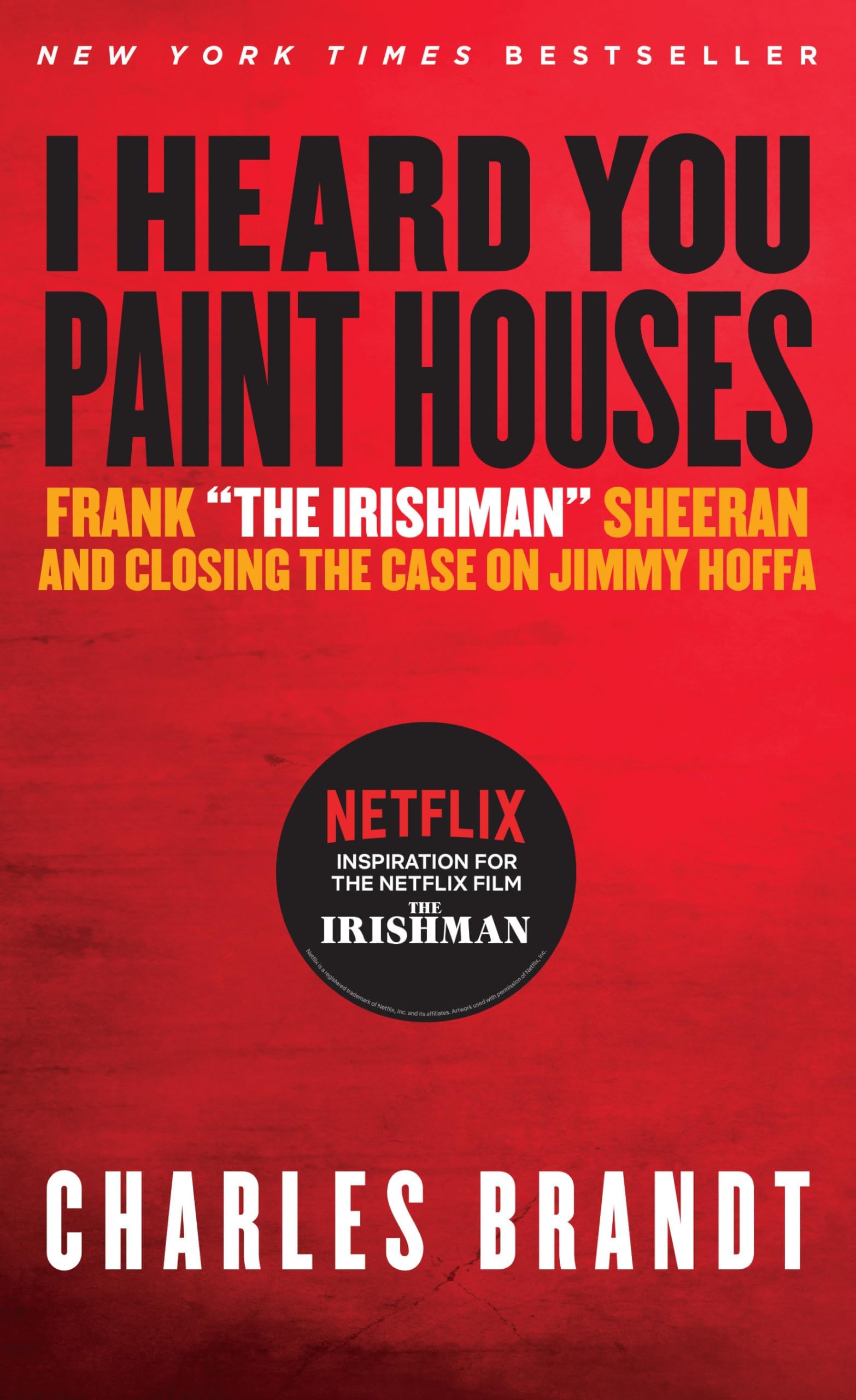
I Heard You Paint Houses: Frank "The Irishman" Sheeran & Closing the Case on Jimmy Hoffa
Product ID: 31453313
Buy anything from 5,000+ international stores. One checkout price. No surprise fees. Join 2M+ shoppers on Desertcart.
Desertcart purchases this item on your behalf and handles shipping, customs, and support to Nicaragua.
July 30, 2025 marks the 50th anniversary of Jimmy Hoffa's disappearance... "Back then, there wasn't nobody in this country who didn't know who Jimmy Hoffa was." — Frank Sheeran (played by Robert DeNiro) in Martin Scoresese’s film The Irishman - New York Times Bestseller — #1 True Crime Bestseller The inspiration for the major motion picture, THE IRISHMAN. “The best Mafia book I ever read, and believe me, I read them all.” — Steven Van Zandt “Charles Brandt has solved the Hoffa mystery.” — Professor Arthur Sloane, author of Hoffa “Sheeran’s confession that he killed Hoffa in the manner described in the book is supported by the forensic evidence, is entirely credible, and solves the Hoffa mystery.” — Michael Baden M.D., former Chief Medical Examiner of the City of New York “It’s all true.” — New York Police Department organized crime homicide detective Joe Coffey “Gives new meaning to the term ‘guilty pleasure.’’’ — The New York Times Book Review **Includes an Epilogue and a Conclusion that detail substantial post-publication corroboration of Frank Sheeran's confessions to the killings of Jimmy Hoffa and Joey Gallo. "I heard you paint houses" are the first words Jimmy Hoffa ever spoke to Frank "the Irishman" Sheeran. To paint a house is to kill a man. The paint is the blood that splatters on the walls and floors. In the course of nearly five years of recorded interviews, Frank Sheeran confessed to Charles Brandt that he handled more than twenty-five hits for the mob, and for his friend Hoffa. He also provided intriguing information about the Mafia's role in the murder of JFK. Sheeran learned to kill in the US Army, where he saw an astonishing 411 days of active combat duty in Italy during World War II. After returning home he became a hustler and hit man, working for legendary crime boss Russell Bufalino. Eventually Sheeran would rise to a position of such prominence that in a RICO suit the US government would name him as one of only two non-Italians in conspiracy with the Commission of La Cosa Nostra, alongside the likes of Anthony "Tony Pro" Provenzano and Anthony "Fat Tony" Salerno. When Bufalino ordered Sheeran to kill Hoffa, the Irishman did the deed, knowing that if he had refused he would have been killed himself. Charles Brandt's page-turner has become a true crime classic. Review: A PAGE TURNER - If you think your work is killing you, what would you think if killing was your work? Nothing, if you were Frank Sheeran and had sent 25 to 30 men "to Australia". I Heard You Paint Houses is a taped narration by 83-year-old Frank Sheeran of his life as a hit man, thief, thug, bagman, and corrupt Teamster official, to all of which he had taken like a fish to water. Against daunting evidence of his having a conscience, he asks from his grave that we believe his narrative. Still, one warms to him, a 6 foot 4 good-looking "stand up" guy known as "The Irishman", who looks like a crooked, friendly cop on the take, likable for his rough candour, boozing, and ball room dancing, noted for his cold eyed stare above a half smile look, and his stammer under stress. Hearing him in one's mind is like listening to the voice heard in darkness by a priest in a confessional box, the face of the speaker unseen. The irony that Sheeran is speaking in an assisted living facility does not escape you. Sheeran, an aged, much-used assassin, optimistically speaks of a "shot" at heaven by confessing to a priest who will grant him absolution. If Sheeran can make it, the whole neighborhood can make it. Who can say that Sheeran the pentitent did not shake hands with Sheeran the predator who was waiting outside the confessional, sniffing the air for money for his estate? If Sheeran were the reader, would Sheeran believe someone with his history? Is Mayor Bloomberg 6 feet four? The book is the work of Charles Brandt, former Chief Deputy Attorney General of Delaware, who oversaw the tapings after dogging Sheeran for several years to make them. The narrations are enhanced by Brandt's factual commentaries that provide useful contexts of time, people, and events. When shown the book, Sheeran, hunched over, appraised it. "The title sucks", he said. Indeed, the title does "suck", but don't let the title fool you. The book is an artful work crafted by Brandt so intensely that one is not surprised that Brandt as pall bearer carried Sheeran to the very lip of his grave, perhaps out of an impulse to learn at the last moment whether Sheeran had conned heaven out of God. As one closes the book, one imagines its array of characters and events. Sheeran in front and center, and around him, the warriors Jimmy Hoffa and Robert Kennedy, Russell Bufalino, the most powerful godfather in the United States who had a hand in the Bay of Pigs tragedy ("These Kennedys could louse up a one-car funeral", said Sheeran.), Sam Giancana, who sent his mistress to a grateful President in Camelot, Crazy Joe Gallo, whacked by Sheeran in Umberto's Clam House, Frank Fitzsimmons, the Teamsters president annointed by the imprisoned Hoffa and corrupted by the mob, the liberation of Dachau by US soldiers, Sheeran among them, Sam Giancana's associate, Jack Ruby (remember him?), known socially to Hoffa and Sheeran, Joe Colombo whacked by a "cowboy" who was promptly shot, "Bugs" Briguglio, a hit man shot twice in the head by Sheeran while greeting him heartily, prison guards who for years watched Sheeran, more mean in prison than on the street, the men Sheeran had whacked all of whom presumably had a last roll call in Sheeran's confession, the Cosa Nostra commission of which Sheeran was one of the only two non-Italian members, Attorney General John Mitchell as bagman to whom Sheeran delivered large sums of green stamps, Nixon signing the commutation of Hoffa's sentence, the Teamster Pension Fund used by Hoffa and Cosa Nostra as a private bank, crooked Teamster officials, goons and hit men of competing unions, even E. Howard Hunt accepting a truckload of weapons from Sheeran in Florida. All these and many more from central casting loiter in your memory. No stumble bum hitman this Sheeran who speaks of the killing of President Kennedy to whom the mob gave Illinois as an electoral gift after a chat with Kennedy's former bootlegger father, a Sheeran who speaks with ease of the mob's attempt to poison Castro, the mob who with the warrior Hoffa hated Robert Kennedy for his drive against organized crime. What did Bufalino mean when, having trouble with a recalcitrant Hoffa, he said to Hoffa that Hoffa was not showing "appreciation for Dallas"? Sheeran was born in 1920 in Philadelphia in a poor Irish-Catholic family that solved its rent problems by flights from one to another unsuspecting landlord. Grey was the color of his childhood, his father an unloving, feisty, common type, bitter in occasional jobs during the Depression. He took little Sheeran to farms where they would steal vegetables, flee steps ahead of gunshot pellets, and spread their takings on the table for the family's meal. His father, however, showed a spark of economic promise. He would enter bars and wage a quarter matching the 10 year old Sheeran against the 15 year old son of any customer. If Sheeran lost, his head would feel the cuff of his father's hand. In his first and last year at high school, an incautious principal unjustly cuffed Sheeran's 16 year old head and promptly received Sheeran's personal broken jaw award. Years of drifting in the bottomlands of Depression work followed: carnival work as a laborer, sex lessons from carnie dancers remembered by the aged but still grateful Sheeran as " Little Egypt" and "Neptune", work as a logger and talented dance instructor, winding it all up in August 1941 in his Army enlistment at 20. World War II drew Sheeran into an horrific 411 days in unrelenting combat in which he learned to kill the enemy and especially the captured enemy. "The lieutenant gave me a lot of prisoners to handle and I did what I had to do". He killed them routinely, the way you and I comb our hair. He particpated in the massacre of more than 500 German army prisoners of war at Dachau after it had been liberated. "And no body batted an eye when it was done", he said. "Somewhere overseas", Sheeran said in an unusual reflective mood, " I had tightened up inside, and I never loosened up again. You get used to death. You get used to killing." Discharged at 25, he did hard labor, was a bouncer, taught dancing, married, had children, worked and repeatedly stole from his employer, drove trucks, and then "at some point, I just joined that other culture" in which he met the godfather, Russell [Rosario] Bufalino, who "changed my life". He became Bufalino's driver. Sheeran loved, revered and respected Bufalino, a lowkeyed, quiet man. Even the reader develops a liking for Bufalino's equanimity. "Russell", said Sheeran, "treated me like a son." Sheeran handled "certain matters" for him. One day, Bufalino handed the phone to Sheeran. It was Hoffa. He said, "I heard you paint houses", an oblique reference to blood that strikes the wall or floor where someone has been shot. Sheeran answered, "I do carpentry work, too", meaning that he disposed of bodies as well. Hoffa thereupon employed Sheeran at the International Teamsters office where Sheeran handled "certain matters" for Hoffa the way "I did for [Bufalino]." Indeed, Sheeran performed well. For example, in a 24 hour period Sheeran at Hoffa's order flew to Puerto Rico, whacked two, emplaned for Chicago, whacked one, and then flew to San Francisco to report to Hoffa who complained that Sheeran was late. Hoffa became the president of the Teamsters in 1957. By 1969 he had been sentenced to terms totalling 13 years. After the green stamps were delivered to Attorney General Mitchell, the terms were commuted in 1971 by a thoughtful "I am not a crook" President Nixon. Hoffa immediately went into high gear to regain the Teamster presidency. In 1974, Bufalino told Hoffa that the mob leaders were content with Fitzsimmons, Hoffa's successor. Fitzsimmons was weak and from him the mob leaders could obtain favorable loans from the Teamsters Pension Fund. Hoffa, however, refused to stop his campaign. Bufalino told Sheeran to tell Hoffa that if he did not stop, Hoffa would be killed. Hoffa said, "They wouldn't dare", a sign that Hoffa wasn't playing with a full deck. The mob would dare anything and he was only a 5 foot 5 tough talker who could be snuffed out like a cigarette. On July 27, 1975, following Hoffa's public threats to drive the mob from the Teamsters, Sheeran told Hoffa that Bufalino was agreeable to a settlement meeting on July 30th. Like a starved lion, Hoffa went for the meat, so much so that he asked Sheeran to be his back up man at the meeting and to be sure to take his gun with him. In the afternoon of July 30th, Sheeran, Hoffa, and others, drove to a one-family ordinary home in Michigan. There were two "cleaners" hiding in the kitchen as Hoffa, with Sheeran behind him, walked into the hallway. Hoffa, seeing no one, panicked and went for the door knob. Sheeran immediately pointed his gun under Hoffa's right ear and blasted him twice. Sheeran, knowing that a hit man sometimes has his own house painted on the spot, dropped his gun, drove to a waiting private plane, and flew out of Michigan. "My friend didn't suffer", said sentimental Sheeran into the recorder. As for those vexed with the question of the location of Hoffa's body, Sheeran states that it was taken to a Detroit funeral parlor for cremation. "Anybody who says they know more than this - except for the cleaner who is still alive - is making a sick joke", said Sheeran. I like that, a touch of class at the end. Review: Frank Sheeran's life of killing everything he touches... - My review contains spoilers about this non-fiction title. BEWARE. I read this book for two reasons: The first is because I'm always drawn to mafia-related tales, especially true ones, and secondly, since Martin Scorsese is turning it into a Netflix film with Robert De Niro, Joe Pesci, and Al Pacino all starring in the three main roles. The story of Frank Sheeran is an interesting, dark, and sometimes brutal thing. This man killed everything from Nazis to gangsters, and in large quantities. The book starts with a riveting chapter that sets Frank up the night before Jimmy Hoffa is killed. It had me thinking that Frank knew who did it, but had nothing to do with the actual murder, and boy was I wrong. The book cuts away from Hoffa's murder, and takes us into Frank's childhood, and then into his 411 days of combat service during World War II. The days Frank learned how to carry out the order to murder without hesitation, and the days where Frank learned how to outlive everyone around him. I found Frank's tour of duty to be some of the most thought-provoking stuff, but I can understand why it was hard for him to discuss, especially since he was in combat for longer than the majority of humans ever in war. There's a lot of Teamsters Union talk, and while some of it would boil down to violence, it was mostly just a bunch of names being thrown around, and elections of local unions being discussed. These parts of the book are probably the least interesting, but Frank Sheeran loved The Teamsters, and was a proud member. It was probably the thing he was most proud of in his entire life. Hoffa's trials against Bobby Kennedy take up a large portion of the book, but Frank didn't have much of a perspective other than repeating some of Jimmy Hoffa's quotes from that time. It's a shame we'll never get to read a new book with interviews from Jimmy on this subject. His rivalry with Bobby Kennedy was an epic American tale in itself. Things started to get truly griping around the time Jimmy Hoffa went to "school", as Frank Sheeran referred to prison. Hoffa's hatred for being inside, and how he lost his grip on The Teamsters, which eventually led to him losing his grip on reality setup the climax, as Frank finally returned to his story from the start of the book. Frank made it to Detroit the day Jimmy Hoffa was killed... I think I was pulling for Frank more before I knew about him being in on Jimmy Hoffa's death, despite knowing he'd killed dozens of other people. Something about killing the man he claims to have respected so much, and been such close friends with, makes it hard to relate to the man. You always hear things about the mafia sending your closest friend to whack you, and in Frank's version of the Hoffa hit, that's how it went down. Frank mentioned Giants' Stadium, which was a place you'd always hear rumored to be Hoffa's burial ground when you grew up a Giants fan. He squashed that rumor, like a few others over the years, but the details of Jimmy Hoffa's last moments were a lot less extravagant. There's stuff to be taken away from those moments, but "I Heard You Paint Houses" really left an impression on me concerning Russell Buffalino. You hear a lot of old gangster names thrown around over the years, but I don't think I've ever had a conversation with a person that involved them dropping Russell Buffalino's name. According to the book, he was the closest living representation of Vito Corleone from "The Godfather", and Russell had final say on "The Godfather" film's script all the way back in the 70's. Another tidbit from this book about Godfather, Al Martino, who plays Johnny Fontane in the film, was actually the basis for the character, and not Frank Sinatra. Not only that, but Francis Ford Coppola didn't want Al Martino for the role, but Russell Buffalino made some calls, and it was so. Frank Sheeran went out by starving himself to death in a nursing home. Robert De Niro is going to be playing him in the movie, and while I hear there's going to be a lot of de-aging going on, I honestly think this flick would've worked better as a Marty/Leo team-up, but what do I know? Charles Brandt goes on to talk about how his book was well received, and most of Frank's tales were proven true, despite common beliefs before the book was published in the early 2000's (I.E.: Crazy Joey Gallo hit). Apparently, he even became friends with the actual "Donnie Brasco", and they have worked together on other stuff. If you're interested in the true crimes of the American Mafia than "I Heard You Paint Houses" is the exact book you need to add to your reading list. Frank Sheeran interacted with everyone who was anyone during the beginning of the end of "This Thing of Ours", and all as an outsider, so it's a rare perspective. VERDICT: READ


| Best Sellers Rank | #28,801 in Books ( See Top 100 in Books ) #24 in Organized Crime True Accounts #39 in Criminology (Books) #79 in Murder & Mayhem True Accounts |
| Customer Reviews | 4.6 out of 5 stars 13,343 Reviews |
H**S
A PAGE TURNER
If you think your work is killing you, what would you think if killing was your work? Nothing, if you were Frank Sheeran and had sent 25 to 30 men "to Australia". I Heard You Paint Houses is a taped narration by 83-year-old Frank Sheeran of his life as a hit man, thief, thug, bagman, and corrupt Teamster official, to all of which he had taken like a fish to water. Against daunting evidence of his having a conscience, he asks from his grave that we believe his narrative. Still, one warms to him, a 6 foot 4 good-looking "stand up" guy known as "The Irishman", who looks like a crooked, friendly cop on the take, likable for his rough candour, boozing, and ball room dancing, noted for his cold eyed stare above a half smile look, and his stammer under stress. Hearing him in one's mind is like listening to the voice heard in darkness by a priest in a confessional box, the face of the speaker unseen. The irony that Sheeran is speaking in an assisted living facility does not escape you. Sheeran, an aged, much-used assassin, optimistically speaks of a "shot" at heaven by confessing to a priest who will grant him absolution. If Sheeran can make it, the whole neighborhood can make it. Who can say that Sheeran the pentitent did not shake hands with Sheeran the predator who was waiting outside the confessional, sniffing the air for money for his estate? If Sheeran were the reader, would Sheeran believe someone with his history? Is Mayor Bloomberg 6 feet four? The book is the work of Charles Brandt, former Chief Deputy Attorney General of Delaware, who oversaw the tapings after dogging Sheeran for several years to make them. The narrations are enhanced by Brandt's factual commentaries that provide useful contexts of time, people, and events. When shown the book, Sheeran, hunched over, appraised it. "The title sucks", he said. Indeed, the title does "suck", but don't let the title fool you. The book is an artful work crafted by Brandt so intensely that one is not surprised that Brandt as pall bearer carried Sheeran to the very lip of his grave, perhaps out of an impulse to learn at the last moment whether Sheeran had conned heaven out of God. As one closes the book, one imagines its array of characters and events. Sheeran in front and center, and around him, the warriors Jimmy Hoffa and Robert Kennedy, Russell Bufalino, the most powerful godfather in the United States who had a hand in the Bay of Pigs tragedy ("These Kennedys could louse up a one-car funeral", said Sheeran.), Sam Giancana, who sent his mistress to a grateful President in Camelot, Crazy Joe Gallo, whacked by Sheeran in Umberto's Clam House, Frank Fitzsimmons, the Teamsters president annointed by the imprisoned Hoffa and corrupted by the mob, the liberation of Dachau by US soldiers, Sheeran among them, Sam Giancana's associate, Jack Ruby (remember him?), known socially to Hoffa and Sheeran, Joe Colombo whacked by a "cowboy" who was promptly shot, "Bugs" Briguglio, a hit man shot twice in the head by Sheeran while greeting him heartily, prison guards who for years watched Sheeran, more mean in prison than on the street, the men Sheeran had whacked all of whom presumably had a last roll call in Sheeran's confession, the Cosa Nostra commission of which Sheeran was one of the only two non-Italian members, Attorney General John Mitchell as bagman to whom Sheeran delivered large sums of green stamps, Nixon signing the commutation of Hoffa's sentence, the Teamster Pension Fund used by Hoffa and Cosa Nostra as a private bank, crooked Teamster officials, goons and hit men of competing unions, even E. Howard Hunt accepting a truckload of weapons from Sheeran in Florida. All these and many more from central casting loiter in your memory. No stumble bum hitman this Sheeran who speaks of the killing of President Kennedy to whom the mob gave Illinois as an electoral gift after a chat with Kennedy's former bootlegger father, a Sheeran who speaks with ease of the mob's attempt to poison Castro, the mob who with the warrior Hoffa hated Robert Kennedy for his drive against organized crime. What did Bufalino mean when, having trouble with a recalcitrant Hoffa, he said to Hoffa that Hoffa was not showing "appreciation for Dallas"? Sheeran was born in 1920 in Philadelphia in a poor Irish-Catholic family that solved its rent problems by flights from one to another unsuspecting landlord. Grey was the color of his childhood, his father an unloving, feisty, common type, bitter in occasional jobs during the Depression. He took little Sheeran to farms where they would steal vegetables, flee steps ahead of gunshot pellets, and spread their takings on the table for the family's meal. His father, however, showed a spark of economic promise. He would enter bars and wage a quarter matching the 10 year old Sheeran against the 15 year old son of any customer. If Sheeran lost, his head would feel the cuff of his father's hand. In his first and last year at high school, an incautious principal unjustly cuffed Sheeran's 16 year old head and promptly received Sheeran's personal broken jaw award. Years of drifting in the bottomlands of Depression work followed: carnival work as a laborer, sex lessons from carnie dancers remembered by the aged but still grateful Sheeran as " Little Egypt" and "Neptune", work as a logger and talented dance instructor, winding it all up in August 1941 in his Army enlistment at 20. World War II drew Sheeran into an horrific 411 days in unrelenting combat in which he learned to kill the enemy and especially the captured enemy. "The lieutenant gave me a lot of prisoners to handle and I did what I had to do". He killed them routinely, the way you and I comb our hair. He particpated in the massacre of more than 500 German army prisoners of war at Dachau after it had been liberated. "And no body batted an eye when it was done", he said. "Somewhere overseas", Sheeran said in an unusual reflective mood, " I had tightened up inside, and I never loosened up again. You get used to death. You get used to killing." Discharged at 25, he did hard labor, was a bouncer, taught dancing, married, had children, worked and repeatedly stole from his employer, drove trucks, and then "at some point, I just joined that other culture" in which he met the godfather, Russell [Rosario] Bufalino, who "changed my life". He became Bufalino's driver. Sheeran loved, revered and respected Bufalino, a lowkeyed, quiet man. Even the reader develops a liking for Bufalino's equanimity. "Russell", said Sheeran, "treated me like a son." Sheeran handled "certain matters" for him. One day, Bufalino handed the phone to Sheeran. It was Hoffa. He said, "I heard you paint houses", an oblique reference to blood that strikes the wall or floor where someone has been shot. Sheeran answered, "I do carpentry work, too", meaning that he disposed of bodies as well. Hoffa thereupon employed Sheeran at the International Teamsters office where Sheeran handled "certain matters" for Hoffa the way "I did for [Bufalino]." Indeed, Sheeran performed well. For example, in a 24 hour period Sheeran at Hoffa's order flew to Puerto Rico, whacked two, emplaned for Chicago, whacked one, and then flew to San Francisco to report to Hoffa who complained that Sheeran was late. Hoffa became the president of the Teamsters in 1957. By 1969 he had been sentenced to terms totalling 13 years. After the green stamps were delivered to Attorney General Mitchell, the terms were commuted in 1971 by a thoughtful "I am not a crook" President Nixon. Hoffa immediately went into high gear to regain the Teamster presidency. In 1974, Bufalino told Hoffa that the mob leaders were content with Fitzsimmons, Hoffa's successor. Fitzsimmons was weak and from him the mob leaders could obtain favorable loans from the Teamsters Pension Fund. Hoffa, however, refused to stop his campaign. Bufalino told Sheeran to tell Hoffa that if he did not stop, Hoffa would be killed. Hoffa said, "They wouldn't dare", a sign that Hoffa wasn't playing with a full deck. The mob would dare anything and he was only a 5 foot 5 tough talker who could be snuffed out like a cigarette. On July 27, 1975, following Hoffa's public threats to drive the mob from the Teamsters, Sheeran told Hoffa that Bufalino was agreeable to a settlement meeting on July 30th. Like a starved lion, Hoffa went for the meat, so much so that he asked Sheeran to be his back up man at the meeting and to be sure to take his gun with him. In the afternoon of July 30th, Sheeran, Hoffa, and others, drove to a one-family ordinary home in Michigan. There were two "cleaners" hiding in the kitchen as Hoffa, with Sheeran behind him, walked into the hallway. Hoffa, seeing no one, panicked and went for the door knob. Sheeran immediately pointed his gun under Hoffa's right ear and blasted him twice. Sheeran, knowing that a hit man sometimes has his own house painted on the spot, dropped his gun, drove to a waiting private plane, and flew out of Michigan. "My friend didn't suffer", said sentimental Sheeran into the recorder. As for those vexed with the question of the location of Hoffa's body, Sheeran states that it was taken to a Detroit funeral parlor for cremation. "Anybody who says they know more than this - except for the cleaner who is still alive - is making a sick joke", said Sheeran. I like that, a touch of class at the end.
J**R
Frank Sheeran's life of killing everything he touches...
My review contains spoilers about this non-fiction title. BEWARE. I read this book for two reasons: The first is because I'm always drawn to mafia-related tales, especially true ones, and secondly, since Martin Scorsese is turning it into a Netflix film with Robert De Niro, Joe Pesci, and Al Pacino all starring in the three main roles. The story of Frank Sheeran is an interesting, dark, and sometimes brutal thing. This man killed everything from Nazis to gangsters, and in large quantities. The book starts with a riveting chapter that sets Frank up the night before Jimmy Hoffa is killed. It had me thinking that Frank knew who did it, but had nothing to do with the actual murder, and boy was I wrong. The book cuts away from Hoffa's murder, and takes us into Frank's childhood, and then into his 411 days of combat service during World War II. The days Frank learned how to carry out the order to murder without hesitation, and the days where Frank learned how to outlive everyone around him. I found Frank's tour of duty to be some of the most thought-provoking stuff, but I can understand why it was hard for him to discuss, especially since he was in combat for longer than the majority of humans ever in war. There's a lot of Teamsters Union talk, and while some of it would boil down to violence, it was mostly just a bunch of names being thrown around, and elections of local unions being discussed. These parts of the book are probably the least interesting, but Frank Sheeran loved The Teamsters, and was a proud member. It was probably the thing he was most proud of in his entire life. Hoffa's trials against Bobby Kennedy take up a large portion of the book, but Frank didn't have much of a perspective other than repeating some of Jimmy Hoffa's quotes from that time. It's a shame we'll never get to read a new book with interviews from Jimmy on this subject. His rivalry with Bobby Kennedy was an epic American tale in itself. Things started to get truly griping around the time Jimmy Hoffa went to "school", as Frank Sheeran referred to prison. Hoffa's hatred for being inside, and how he lost his grip on The Teamsters, which eventually led to him losing his grip on reality setup the climax, as Frank finally returned to his story from the start of the book. Frank made it to Detroit the day Jimmy Hoffa was killed... I think I was pulling for Frank more before I knew about him being in on Jimmy Hoffa's death, despite knowing he'd killed dozens of other people. Something about killing the man he claims to have respected so much, and been such close friends with, makes it hard to relate to the man. You always hear things about the mafia sending your closest friend to whack you, and in Frank's version of the Hoffa hit, that's how it went down. Frank mentioned Giants' Stadium, which was a place you'd always hear rumored to be Hoffa's burial ground when you grew up a Giants fan. He squashed that rumor, like a few others over the years, but the details of Jimmy Hoffa's last moments were a lot less extravagant. There's stuff to be taken away from those moments, but "I Heard You Paint Houses" really left an impression on me concerning Russell Buffalino. You hear a lot of old gangster names thrown around over the years, but I don't think I've ever had a conversation with a person that involved them dropping Russell Buffalino's name. According to the book, he was the closest living representation of Vito Corleone from "The Godfather", and Russell had final say on "The Godfather" film's script all the way back in the 70's. Another tidbit from this book about Godfather, Al Martino, who plays Johnny Fontane in the film, was actually the basis for the character, and not Frank Sinatra. Not only that, but Francis Ford Coppola didn't want Al Martino for the role, but Russell Buffalino made some calls, and it was so. Frank Sheeran went out by starving himself to death in a nursing home. Robert De Niro is going to be playing him in the movie, and while I hear there's going to be a lot of de-aging going on, I honestly think this flick would've worked better as a Marty/Leo team-up, but what do I know? Charles Brandt goes on to talk about how his book was well received, and most of Frank's tales were proven true, despite common beliefs before the book was published in the early 2000's (I.E.: Crazy Joey Gallo hit). Apparently, he even became friends with the actual "Donnie Brasco", and they have worked together on other stuff. If you're interested in the true crimes of the American Mafia than "I Heard You Paint Houses" is the exact book you need to add to your reading list. Frank Sheeran interacted with everyone who was anyone during the beginning of the end of "This Thing of Ours", and all as an outsider, so it's a rare perspective. VERDICT: READ
M**L
WHICH "End Zone"?
"I Heard You Paint Houses" is a solid true crime biography of Frank "The Irishman" Sheeran. Plenty of fascinating mob history and lore is included. Sheeran was a hood who rose to prominence in Philadelphia, working under capo Russell Bufalino. Sheeran caught the eye of Teamster Boss Jimmy Hoffa and did over 25 hits for his two bosses. Author Charles Brandt does an excellent job of catching the almost casual mayhem in the life of a hardcore criminal. And if one term describes Sheeran, it is certainly "hardcore criminal". The text darts back between Brandt's historical relating of the investigations of the Teamsters in the Eisenhower Administration, by Attorney General Robert F. Kennedy in the JFK Administration and the Irishman's other "activities". The reader will learn of Sheeran's incredible 400+ days on the line in WW2. IHYPH makes it crystal clear that the mob was vehemently upset with Cuban Premier Fidel Castro for closing down their operations in Havana. The Bosses were likewise bristling at President Kennedy for what can only be termed ingratitude after "arranging" his critical Illinois victory in the 1960 Presidential election. (The returns from Chicago were somewhat "tainted".) Their payback was investigations and pressure from the President's little brother. The text hints very strongly that the mob arranged JFKs assassination and that Sheeran may have helped deliver the murder weapons. The plural-"weapons"- might indicate more than one shooter was in Dallas on the fateful day. NO mention is made of any CIA role in that event. There is more! Sheeran states outrightly that he delivered cash to former Attorney General John Mitchell. He also claims to be one of the hitmen in the infamous 1972 rubout of Crazy Joey Gallo at Umberto's Clam House in New York City. That was an enormous local event! This reviewer is one of thousands of nosy New Yorkers who dined at Umbertos just to gaze at the spot were Gallo met his demise. (It was a serious restaurant with good food). The reader is also given lessons in crime: We are advised to always carry a new weapon in case stopped and frisked by the law. If the pistol has never been fired what can they charge you with? Sheeran also intimates that friends usually do mob hits. The trusting target will let his buddy get close, lure him to an isolated spot or let down his guard. Chicago Boss Sam Giancana was rubbed out in his own kitchen while frying sausages and peppers! Another trueism is that a hood never declines a murder contract. If he does, he will soon be "taking a trip to Austrailia". There is indeed the matter of Jimmy Hoffa's demise. Sheeran takes credit for that hit as well, claiming that he helped guide Jimmy-Giancana style-to a lonely rented house in suburban Detroit. The Irishman makes the very valid point that it made no sense to transport a corpse to an "end zone" in East Rutherford, New Jersey-halfway across the country. A friendly local undertaker disposed of Jimmy. Sheeran's version of events makes infinitely more sense than the convoluted scene in the movie "Hoffa", notwithstanding strong performances by Jack Nicholson and Danny de Vito. The only element in question concerning IHYPH is credibility. Is this guy telling the complete truth or has author Brandt been conned by a con man? This reviewer believes that Sheeran is on the level. The author obviously does as well. In case Sheeran is fudging slightly, a reduction in rank from 5 stars to 4 seems appropriate. IHYPH is fun reading and highly recommended to true crime aficionados.
A**E
Can’t stop reading
Very very good
T**T
No spoilers in this review
The non-fiction book I Heard You paint Houses by Charles Brandt follows the story of Frank “The Irishman” Sheeran from his time before the mob all the way up to when he kills Jimmy Hoffa. Charles Brandt got first hand information directly from interviewing Sheeran himself and was the first person Sheeran ever told about killing Jimmy Hoffa. The book starts off with Frank Sheeran's childhood growing up in Philadelphia in the 1920s and 30s and then later progresses to his time in World War II in which he spent 411 days of combat duty. After he got out of the war he got married and had three daughters. Sheeran started hanging out in bars and loan sharking which eventually led him to meeting Russell Bufalino and becoming good friends with him. In the book Frank Sheeran confesses to many many mafia hits that he was associated with and eventually the hit on Jimmy Hoffa. In my opinion this book is a thrill from cover to cover as Frank Sheeran recounts his thrilling tale. Throughout the book the reader really connects with Sheeran, Hoffa, and Bufalino and many more interesting people. Unlike most non-fiction books it's not just a collection of facts spewed onto the page its an intoxicating first hand account told about both the secret and not so secret dealings of the mafia. I would 100% recommend this book to anyone even if it is not their typical genre that they read. In addition to the book there is now a movie adaptation of this book out on Netflix which is extremely accurate to the book.
L**X
Best book
Amazing book and there is so much info in it.
R**M
Frightening and believable
I read this book twice, each time over a year apart. And in coming back to the book a second time, I found it to be even more chilling how the author provides clear and believable confession to a series of murders, including the murder of one the men he most admires in life, the late (and not very great) James P. "Jimmy" Hoffa, Sr. Read this work slowly and carefully. Pay particular attention to what is said to Sheeran by Russell Buffalino about the death of John Kennedy. I am a skeptic where these types of books are concerned, but this book resonates with candor. I'm convinced that Sheeran, who had spent half of his life denying the murder, wanted to come clean before he died. Half of him wanted to continue to deny it all. But the other half of him wanted to help the family of the man he loved very much to bring closure to the disappearance. The author of this book (who interviewed Sheeran over a two-year period) does not write sensational accounts, nor does he write from conjecture or theory in this or his other works. The author did his homework and conducted a series of highly detailed interviews with a man who knew how to kill, and did so when called upon by his bosses to do so. I always knew that Jimmy Hoffa was tied to the Mafia, but I had no idea that Jimmy Hoffa WAS the mafia. "Dirty" would put it mildly, but at the same time, he was a man who did a tremendous amount of good for those he served. Get this book. Read it. Draw your own conclusions. Write your own review.
S**S
Interesting and credible
For the most part, this book succeeds in keeping the reader interested and engaged - I read it in a few hours. It sets out a credible version of Jimmy Hoffa's demise and ultimate and effective disappearance. The book, however, is not really about Hoffa - it is a rambling, oddly constructed but sad story of the life of Frank Sheeran - a Mafia killer. Written by a lawyer, its somewhat contrived style is intended to prevent Sheeran from incriminating himself during the interviews which, completed over a period of some years, comprise the background material for the book. Sprinkled throughout, the author injects some historical background, not in Sheeran's voice, to fill out information about the various Mafiosa, union leaders, and politicians (is that list redundant?) who appear in the narrative which covers the late 50s to the disappearance of Hoffa. Most of the stories are interesting and appear reasonably believable - some seem a little far-fetched. The inevitable links to Dallas in 1963 and the Bay of Pigs in 1961 are a bit much. In general, though, Sheeran's stories of plots and murders, including some committed by him, have a ring of truth. And it has to be said, the tale that emerges in teasing fragments on Hoffa's death seems to fit the existing evidence. Most likely, it is an accurate account of his murder and the disposition of his body. What leads to the "3" rating is the uneven and uninspired writing of the book, combined with the ultimately loathsome character of Frank Sheeran. In fact, all the figures portrayed, including Hoffa, are depicted as treacherous low-lifes, ready to murder at the slightest excuse. Maybe that is an accurate account, but it is not a pleasant one. Of course, what can you expect with Hoffa and the criminal thugs who surrounded him? In any case, if you are interested in how Jimmy Hoffa actually checked out of this vale of tears, this book probably tells the story. When you are done, you may wonder why you ever cared.
P**O
A great journalistic endeavor spanning through decades
A testament to patience and persistence in investigative journalism. I Heard You Paint Houses (a much better title than The Irishman, by the way) is a great journalistic endeavor spanning through decades, and one that gives us the fabric for the last great gangster movie. With his obsessive quest to figure out the complicated relationship between Frank Sheeran and Jimmy Hoffa, Charles Brandt's trained mind gives us insight of the last death throes of the mafia's 'golden era' if you so wish by someone who was there to witness it (although Sheeran is very careful in admitting so). This is not a book that reads like a novel, so don't expect a Scorcese script. This is a historical and factual investigation which will give a lot more insight into the mind of Frank Sheeran and his alleged involvement in Hoffa's disappearance that can, and should, be appreciated by its own merits.
T**G
A Plausible Chain Of Events
The story as told is believable, the writing style very readable, and I will admit to being completely drawn in and reading far later into the night than I should have on more than one evening. An entirely plausible chain of events, can anyone besides those intimately involved in the tale ever be 100% sure of what really happened? No, but having said that, I did enjoy the book and would recommend it just on the basis of being a good read.
M**S
Muito boa a leitura. O livro prende a atenção do leitor
Muito boa a leitura. O livro prende a atenção. Para as pessoas que gostam de histórias policiais será muito proveitoso.
G**O
Highly Entertaining Read about Cosa Nostra
This book provides great insight on the Eastern Coast mafia culture in a satisfying narrative through the scopes of wise-guy Frank Sheeran, who details his real-life relationships with Philly boss Russell Buffalino and the Teamster union Jimmy Hoffa. If you liked Scorsese's Irishman, you'll love it.
C**A
Everything the movie didn’t cover.
This book follows so closely to the timeline of the movie with De Niro and Pacino and the fact that we have real quotes and a deathbed confession to prove Frank Sheeran’s story correct with his involvement with the disappearance of Jimmy Hoffa is great. It’s no longer a mystery to the Hoffa family about what happened in 1975. One thing entered my mind as the quote, “I still wear the watch Jimmy gave me and the ring Russ gave me on my hand in the assisted living home.” Something faint started playing as I read the words, a harmonic and beautiful tune from the 1950s. It was the Five Satins singing, “in the stillll off the nightt, I held you- held you tighttt, because I love- lovee you soo, promise I’ll never-let you gooo, in the still of the nighttt- in the still of the night.” This book made the words come alive, like you were there, like you were Frank, Russ, god forbid even Pro or Sally Bugs. Little do we know and understand how much true effort went into making this book. From searching through thousands of FBI records, to literal dead ends, the author was forced to wait until Frank was on the brink of death before he revealed the truth.
Trustpilot
1 day ago
2 weeks ago