We remain fully operational. Our teams are working around the clock to ensure your deliveries continue safely.

DOWNLOAD THE APP


Copyright © 2025 Desertcart Holdings Limited
DOWNLOAD THE APP
Buy anything from 5,000+ international stores. One checkout price. No surprise fees. Join 2M+ shoppers on Desertcart.
Desertcart purchases this item on your behalf and handles shipping, customs, and support to Nicaragua.
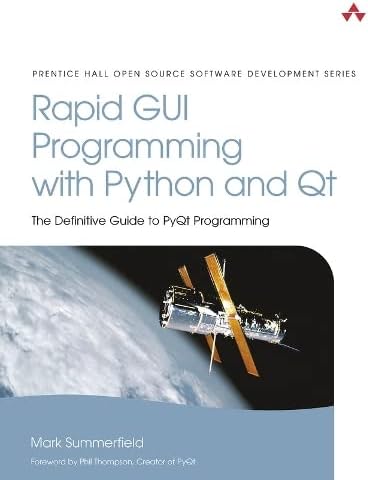
Rapid GUI Programming with Python and Qt: The Definitive Guide to PyQt Programming [Summerfield, Mark] on desertcart.com. *FREE* shipping on qualifying offers. Rapid GUI Programming with Python and Qt: The Definitive Guide to PyQt Programming Review: An absolute must-have for PyQt users - I am an experienced amateur with Python. This is the book I used to learn the basics of GUI programming using PyQt. I had some previous experience with using wxPython, but I needed to learn PyQt specifically for a project. I chose this book based on some reviews and it was a home run. It contains very clear explanations of the basics of PyQt as well as some great examples of advanced techniques. The book is almost worth the price just for the source code to his tree model/view example. One of my favorite things about this book are the exercises at the end of each chapter. There are only a few, but each one involves extending that chapter's examples in some manner, to better illustrate the concepts. I found these to be a tremendous learning opportunity. You can download the answers to the examples from the author's website, and it was very informative to compare my code to that of a professional programmer. On a similar note, I expected to skip over the first three chapters introducing you to Python programming. As I skimmed through them, I realized that those chapters were, in fact, very illuminating. I think they are one of the best general introductions to Python out there. In short, if you are anything other than an expert PyQt programmer, you need this book. I had it open continually at my workstation for months, and I still keep it close and refer to it often. Review: Worth having when time is money - For any open source programming tool, there are always those who are quick to point out that free online documentation is of excellent quality and that a commercially published book adds questionable value. Indeed, the open process by which open source tools are made, which reveals the why's & wherefore's of the internal workings to anyone who looks, leads directly to the production of excellent online documentation; this is one of the great strengths of open source software. But everyone's needs are different. A college student or free software volunteer often has looser deadlines, less budget, and a more perfectionist attitude than, for example, a non-expert programmer, working in industry, trying to expeditiously solve a specific problem. A book of this genre is intended mainly for the latter audience, whereas the former may be disappointed at spending $50 when a web browser could have done the job. Cash-strapped college students, I know your pain; I used to be one. This book is not a particularly cost-effective study aid. If you live and breathe GUI progamming and can type out GTK2 and wxwidget classes by heart, then this book is probably a waste of time for you. Having said that, I review this book with a view toward its value to its intended audience: Does buying this book and using it get the job done $50 cheaper, including the value of your own professional time, compared to the best available alternative? My experience is yes. I am an electrical engineer, but not a programming expert. I have, at various times in my career, flipped bits in assembly language, suffered the rigors of Fortran, and slapped together contraptions in Matlab, VEE, Labview, etc. I have also had the misfortune of programming production test automation in Visual Basic, because that is what commercial instruments natively support. It is the shortcomings of VB that bring me to PyQT. I need to write test code that is portable, maintainable, and reliable. To give just one example, I don't want to fly across the Pacific Ocean to program workarounds for bugs in VB, because machines in the Chinese factory run Win98, and my development system in the US runs Win2k, and VB doesn't behave the same. But this is a book review, not a place to extol the virtues of PyQT nor criticize VB. I have programmed in Python before, though for me Python has always been a language for one-off numerical or string processing tasks, where a spreadsheet is too limited and my bash script-fu is short of the task. I found the first three chapters on Python a helpful review, though it is not a complete instruction in Python. Compete beginners to Python will probably want to buy a separate book or work through the python.org tutorials. The author glosses over things that could trip up beginners; tellingly, he uses the term 'pythonic' without introduction. He is, however, careful to point out pitfalls that can waylay real-world production code, or would be of interest to experienced Perl/Ruby/VB programmers, like how Python handles the distinctions regarding {im}mutable types and {deep|shallow} copying. I have never programmed QT before, and this book is indeed a complete introduction to QT. You don't need to know anything about QT nor how to program in C++ (QT's native language). Being able to read C++ syntax helps, though, because this book is not a QT reference, so you will probably have to look things up in the online QT references, which are written in C++. It is something of a truism that the best way to learn a language is to read & understand someone else's well-written code, and then use that to write a program of your own. That is the approach used here, and the printed book format permits interleaving fragments of code with explanatory material in a way that doesn't work well on a computer screen. As such the text complements rather than duplicates the online documentation. Regarding the book as a physical object, the quality is good but some extra features would have been nice. No CD is included, which I consider an oversight for a book at this price. Even the shortest examples lack source code listings, except as snippets woven into the text. You have to download the example code from a URL buried in the introduction, which is odd considering how important the example code is to this style of instruction. Occasional sidebar topics, icons, and cross-references help to organize the material, though not to the spoon-feeding level of "For {Dummies|Idiots}" books. The index is a bit above average for a book of this type, better than pure machine-generated grep output that sometimes passes for an index these days, but not as good as the best manual indices of decades past. The cover, binding, & paper stock are of decent quality. The book will stay open to just about any page when laid on a table, and the glue looks like it will, well probably, hold the sheaves in for many years. No color is used, nor edge printing to help find the chapters, which would have been helpful for a book this long.
| Best Sellers Rank | #2,086,357 in Books ( See Top 100 in Books ) #1,577 in Python Programming #1,773 in Computer Programming Languages |
| Customer Reviews | 4.2 4.2 out of 5 stars (108) |
| Dimensions | 7.05 x 1.5 x 9 inches |
| Edition | 1st |
| ISBN-10 | 0134393333 |
| ISBN-13 | 978-0134393339 |
| Item Weight | 2.15 pounds |
| Language | English |
| Part of series | Pearson Open Source Software Development |
| Print length | 648 pages |
| Publication date | September 28, 2015 |
| Publisher | Pearson |
S**Y
An absolute must-have for PyQt users
I am an experienced amateur with Python. This is the book I used to learn the basics of GUI programming using PyQt. I had some previous experience with using wxPython, but I needed to learn PyQt specifically for a project. I chose this book based on some reviews and it was a home run. It contains very clear explanations of the basics of PyQt as well as some great examples of advanced techniques. The book is almost worth the price just for the source code to his tree model/view example. One of my favorite things about this book are the exercises at the end of each chapter. There are only a few, but each one involves extending that chapter's examples in some manner, to better illustrate the concepts. I found these to be a tremendous learning opportunity. You can download the answers to the examples from the author's website, and it was very informative to compare my code to that of a professional programmer. On a similar note, I expected to skip over the first three chapters introducing you to Python programming. As I skimmed through them, I realized that those chapters were, in fact, very illuminating. I think they are one of the best general introductions to Python out there. In short, if you are anything other than an expert PyQt programmer, you need this book. I had it open continually at my workstation for months, and I still keep it close and refer to it often.
T**R
Worth having when time is money
For any open source programming tool, there are always those who are quick to point out that free online documentation is of excellent quality and that a commercially published book adds questionable value. Indeed, the open process by which open source tools are made, which reveals the why's & wherefore's of the internal workings to anyone who looks, leads directly to the production of excellent online documentation; this is one of the great strengths of open source software. But everyone's needs are different. A college student or free software volunteer often has looser deadlines, less budget, and a more perfectionist attitude than, for example, a non-expert programmer, working in industry, trying to expeditiously solve a specific problem. A book of this genre is intended mainly for the latter audience, whereas the former may be disappointed at spending $50 when a web browser could have done the job. Cash-strapped college students, I know your pain; I used to be one. This book is not a particularly cost-effective study aid. If you live and breathe GUI progamming and can type out GTK2 and wxwidget classes by heart, then this book is probably a waste of time for you. Having said that, I review this book with a view toward its value to its intended audience: Does buying this book and using it get the job done $50 cheaper, including the value of your own professional time, compared to the best available alternative? My experience is yes. I am an electrical engineer, but not a programming expert. I have, at various times in my career, flipped bits in assembly language, suffered the rigors of Fortran, and slapped together contraptions in Matlab, VEE, Labview, etc. I have also had the misfortune of programming production test automation in Visual Basic, because that is what commercial instruments natively support. It is the shortcomings of VB that bring me to PyQT. I need to write test code that is portable, maintainable, and reliable. To give just one example, I don't want to fly across the Pacific Ocean to program workarounds for bugs in VB, because machines in the Chinese factory run Win98, and my development system in the US runs Win2k, and VB doesn't behave the same. But this is a book review, not a place to extol the virtues of PyQT nor criticize VB. I have programmed in Python before, though for me Python has always been a language for one-off numerical or string processing tasks, where a spreadsheet is too limited and my bash script-fu is short of the task. I found the first three chapters on Python a helpful review, though it is not a complete instruction in Python. Compete beginners to Python will probably want to buy a separate book or work through the python.org tutorials. The author glosses over things that could trip up beginners; tellingly, he uses the term 'pythonic' without introduction. He is, however, careful to point out pitfalls that can waylay real-world production code, or would be of interest to experienced Perl/Ruby/VB programmers, like how Python handles the distinctions regarding {im}mutable types and {deep|shallow} copying. I have never programmed QT before, and this book is indeed a complete introduction to QT. You don't need to know anything about QT nor how to program in C++ (QT's native language). Being able to read C++ syntax helps, though, because this book is not a QT reference, so you will probably have to look things up in the online QT references, which are written in C++. It is something of a truism that the best way to learn a language is to read & understand someone else's well-written code, and then use that to write a program of your own. That is the approach used here, and the printed book format permits interleaving fragments of code with explanatory material in a way that doesn't work well on a computer screen. As such the text complements rather than duplicates the online documentation. Regarding the book as a physical object, the quality is good but some extra features would have been nice. No CD is included, which I consider an oversight for a book at this price. Even the shortest examples lack source code listings, except as snippets woven into the text. You have to download the example code from a URL buried in the introduction, which is odd considering how important the example code is to this style of instruction. Occasional sidebar topics, icons, and cross-references help to organize the material, though not to the spoon-feeding level of "For {Dummies|Idiots}" books. The index is a bit above average for a book of this type, better than pure machine-generated grep output that sometimes passes for an index these days, but not as good as the best manual indices of decades past. The cover, binding, & paper stock are of decent quality. The book will stay open to just about any page when laid on a table, and the glue looks like it will, well probably, hold the sheaves in for many years. No color is used, nor edge printing to help find the chapters, which would have been helpful for a book this long.
P**O
Really Good Book (even if you are using Python 3)
What I like most about this book is that it weaves the theory of Python programming into the practice of writing efficient code. The author has gone to great lengths to keep the reader out of the forests and swamps of Python language features to focus her/him on writing interesting code. The learn-by-doing approach is a really good angle. I am studying this book with Python 3 (reason: the guys at Riverbank Computing (authors of PyQt) decided to support Python 3, I couldn't wait for wxPython to get here). That said, the hurdle anyone who takes this path must go through is developing GUIs from a Python 3 perspective while referencing Python 2.x(warts and all), given that the book covers only Python 2.x code. That's not as hard as it seems since the author has taken the time to port all of the code examples to Python 3.x. Also, given the availability of excellent Python 3 references (like Python Essential Reference (4th Edition) ) you'll be hopping and skipping pretty quickly. If you are new to Python, don't hurt your brain. First study an introductory book on Python 3(like Programming in Python 3: A Complete Introduction to the Python Language (2nd Edition) ). This should make you mentally stable enough to charge down this path without crashing into trees. Everyone else, get the book as soon as you can and get busy. You won't regret it!
C**Z
Está muy bien estructurado y toca practicamente todos los temas. Muchas explicaciones que son eseciales conocer. Es fácil de entender. Para mi lo mejor que he tenido para aprender a usar eficientemente las PyQt.
V**O
Il libro (del quale sono tuttora a metà) è veramente un'ottima guida alle Qt in ambito Python. Copre una grande vastità di argomenti con chiarezza e facendo esempi validi di codice. Ad ogni capitolo è inoltre presente un esercizio (Su internet tutti i codici del libro, sia esercizi sia quelli usati per la spiegazione). Non credo ci sia un libro altrettanto valido per l'ambiente python. Consigliato!
C**N
Das Buch ist sehr gut, gut zu verstehendes Englisch. Der Pythonteil ist kurz und knapp, aber es ist ja kein Buch zur Sprache; der Fokus liegt sinnigerweise deutlich auf PyQt. Mittlerweile ist Qt 4.6 raus und Python 2.7 steht in den Startlöchern (3.1 ist auch schon raus), trotzdem ist das Buch aktuell, denn es fehlt nur ein Teil der API, die Inhalte stimmen heute immernoch. Ich würde mich über eine Neuauflage zu PyQt 4.7 und Python 2.7 freuen und 2014 oder so dann zu Python 3.2 oder 3.3, bis dahin bleibt das Buch ganz oben auf meinem Schreibtisch liegen.
Y**1
PyQtを学習するには必須といってもよい参考書。 明確にPyQtを学習しようという人でなくとも、本のタイトルのように、単純にPythonでGUIを作ってみたい、という人にもおすすめできる。 一般的な入門書ではHello Worldから入り、少しずつステップアップし、「結局何が作れるんだっけ??」と いつの間にかモチベーションが下がっていることが多いだろう。 しかしこの本は、そうではない。 「こういうものがこんな少ない行数で書けるんだ!」から始まる。 続く章でも、 「前回の章ではこういうことができなかった、だからこの章ではこういうことをやる」というように 体系的にステップアップする構成となっている。 Pythonを軽く学習した人が、GUIを作ってみたいなと思った時には、ぜひこの本を手に取るとよいだろう。 ※MacOSユーザはPyQt環境構築で手こずるかもしれない。Linux推奨。
C**N
Have been working on a number of fairly complex projects using PySide. Already had a fair amount of experience before picking this book up, and I still learned a ton. Goes through a lot of Python introductions which is great, as a few small things I picked up. Lots of example projects throughout to show you various features. If you're doing PySide/PyQt projects, you need this book.
Trustpilot
1 month ago
2 months ago