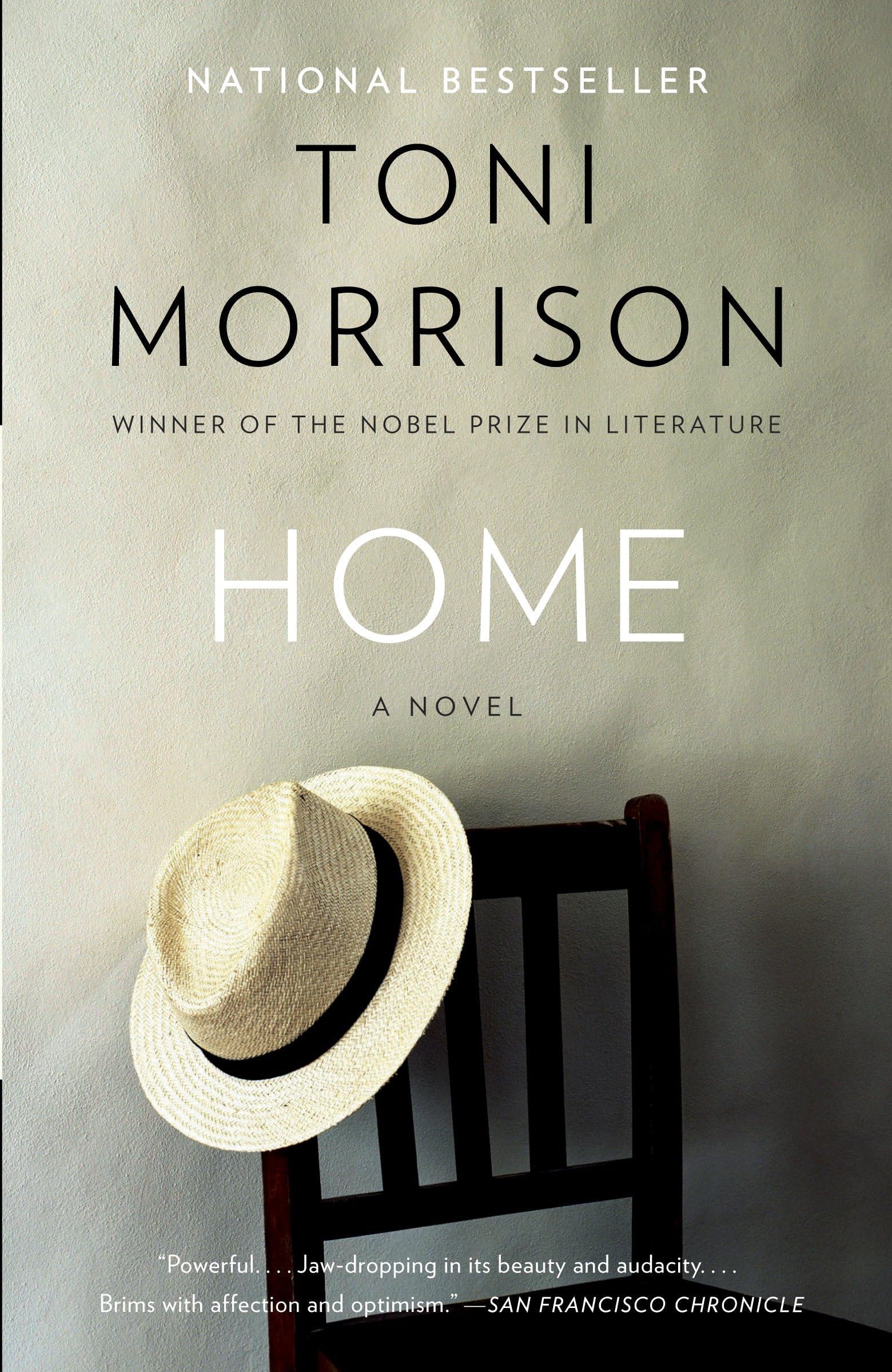
Home (Vintage International)
Product ID: 2682728
Buy anything from 5,000+ international stores. One checkout price. No surprise fees. Join 2M+ shoppers on Desertcart.
Desertcart purchases this item on your behalf and handles shipping, customs, and support to Nicaragua.
NATIONAL BESTSELLER • A New York Times Notable Book • From the acclaimed Nobel Prize winner: an emotional powerhouse of a novel about a modern Odysseus returning to a 1950s America mined with lethal pitfalls for an unwary Black man "Powerful. . . . Jaw-dropping in its beauty and audacity. . . . Brims with affection and optimism." — San Francisco Chronicle When Frank Money joined the army to escape his too-small world, he left behind his cherished and fragile little sister, Cee. After the war, he journeys to his native Georgia with a renewed sense of purpose in search of his sister, but it becomes clear that their troubles began well before their wartime separation. Together, they return to their rural hometown of Lotus, where buried secrets are unearthed and where Frank learns at last what it means to be a man, what it takes to heal, and—above all—what it means to come home. Review: A haven for the forgotten - Frank Money is the only one of three childhood friends to survive their battles in Korea. Back in the States, Frank is battling demons and survivor guilt. He's always been the strong one, taking care of his little sister Cee. Now he needs help from others to try to make it back to her when he hears that she is near death and needs to be rescued. His journey back to being the kind of man who can rescue his sister is both physical and spiritual. Frank travels a reverse Underground Railroad, finding refuge at a church after waking up in a mental hospital and escaping. As he travels home, the reader learns of how he and Cee grew up, how she got out of a backwoods place smaller than a town and where she ended up. Also revealed is how Frank has been fighting to hold on and not give up, but his war was hardly a good one. He is the only one who survived. And for what? Morrison's short novel is tightly written, weaving in and out of points along the plot, themes, tropes and characters. It is a marvel to be studied and wondered at. But it also is a moving story of how African-Americans have been treated in their own country and how these individual characters react to what other people do to them. Frank and Cee have been victimized but are not victims. After serving his country, Frank doesn't have anything except a medal. It's the only thing that keeps him from being arrested for the crime of being on the street and black. Cee thinks she has found the most wonderful employer in the world, but the white doctor she works for is killing her with his eugenics study. That the horror of what this "big-hearted doctor" named Beauregard is doing to Cee is not spelled out does not make it any less terrifying. The realization that the kind of thinking demonstrated by this ultimately cowardly man flourishes still today is even more terrifying, just as knowing the casual bigotry Frank encounters from white cops is seen is today's "stop and frisk" is, at best, disheartening. Frank drank and found a strong woman to use as an anchor for a time. She is both similar to and the opposite of the grandmother who took in Frank, Cee, their parents and an uncle when they were forced to flee Texas (Cee was born on the road). That grandmother, Lenore, is cold and cruel. Her active dislike of Cee is one of the reasons they both fled Lotus, Georgia, as soon as they could -- Frank to the Army and Cee running off with the first half-way grown man who wanted her. Lenore is like Miss Havisham without an Estrella to control and mentally abuse. She resents that she was able to use the money raised from selling her late husband's filling station (he was murdered, guilty of the crime of being black) but, instead of enjoying her life, she had to open her home to the family of her second husband. In contrast, Frank seeks shelter for a spell with Lily, a woman who has scrimped and saved enough to dream of owning a home and a business. When Frank leaves, she doesn't regret his going but there is not the sense that she resented the time she spent opening her heart and home to him. She just has other, better things to do now. Many small actions reveal the true nature of the characters involved in the lives of Frank and Cee. These moments are powerful, and far more revealing, than the work of many authors who take pages and pages of tell, not show, to portray characters. The portraits work as individual portrayals, but they also combine to show the scope of what people can be capable of doing. And, as with much of Morrison's work, there are ghosts. The first is one Frank sees on the train while trying to get home to Cee. It's a man in a zoot suit. A later appearance tells the reader that Frank is truly starting to heal. His physical journey has ended, but there is the implication his spiritual journey will continue. The quiet healing that takes place after the climax of the plot's action may leave some readers expecting more. But I thought it wasn't needed. Morrison was interviewed by Charlie Rose on the CBS morning program earlier this year and acknowledged she is stripping her fiction down as much as she can. A revelation late in the novel, and the way the last sections fit in tightly with the beginning, make more unnecessary. Another ghostly figure that appears is Frank himself. Most of the novel is told in third-person omniscient. Frank at one point addresses that narrator. So when the revelation occurs, it's could be considered a surprise or, instead, the harvest of a seed planted in that passage. Frank, addressing the narrator, puts a different spin on an event that happened when the train stopped. A couple got off the train and came back bloodied. According to the narrative, the woman will be beat up by the man later because she shamed him for coming to his rescue. But Frank says differently: "Earlier you wrote about how sure I was that the beat-up man on the train to Chicago would turn around when they got home and whip the wife who tried to help him. Not true. I didn't think any such thing. What I thought was how he was proud of her but didn't want to show how proud he was to the other men on the train. I don't think you know much about love. "Or me." As an example of how Morrison weaves so many things together, at another stage of his train journey Frank gets off the train for a walk and sees two women fighting while a man, presumably a pimp, watches them. He attacks the man and the women are angry about that. A person in power forcing others to fight comes up again in the story, and is tied to the way that Frank has always tried to protect Cee. Throughout this tight story, Morrison remembers the forgotten. There are vets like Frank, himself a decorated veteran of that most forgotten of wars, Korea. There are victims of eugenics and other experiments undertaken on African-Americans without their knowledge or informed consent. There are domestic workers. There are ignored children. There are women alone. There are tiny, tiny towns where work is the only thing that matters. Morrison gives all of them a voice. And it's one that often is poetic. Frank's description of Lotus (a name with its own conotations of time spent outside regular time), does more in two pages to bring to life the dull hopelessness of a dead-end existence. The contrast in attitude about work between Frank as a young boy and the women of Lotus is markedly different. This underlying belief is the foundation of what will heal Frank and Cee. The search for home in this novel shows there is the potential to do some good in the world, even by those who have been broken and who have been ignored or forgotten. Morrison does not have to spell out what that good will be, but showing the first steps Cee and Frank take toward doing their good as they heal makes for a strong argument that the wise woman of Lotus is right. Review: Morrison's Most Approachable Novel & One of her Best - I've read six Toni Morrison novels and this is by far her most approachable and "easiest" read. She has always been a master of prose, turning about some of the most eloquent sentences in the English language. "Home" is no exception exemplified by one of my favorite sentences in the novel :"From the windows, through the fur of snow, the landscape became more melancholy when the sun successfully brightened the quiet trees, unable to speak without their leaves". At the same time, Morrison often challenges the reader with her less than straight-forward style. I've often found myself reading pages several times to ensure I really understood both the substance and context of what is written. In most cases, the effort is well worth it as the larger themes and beauty of the language makes the investment worthwhile. "Home" doesn't follow the usual Morrison conventions but doesn't suffer at all from the simpler and more direct storytelling. The novel centers around Frank Money, African-American veteran of the Korean War (although Morrison doesn't directly note characters race, it is up to the discerning reader to decipher through context), returning home from the war after losing his two best friends in battle. Frank suffers from what today would be diagnosed as PTSD, struggling to come to grips with the impact of war on his psyche, often resorting to alcohol to numb the effects. Frank eventually makes his way to back to the small Georgia town he grew up in and never thought he'd return to help his sister Cee. Morrison covers a lot of ground and themes in a relatively spare set of pages -- a largely forgotten American conflict, the Jim Crow South right on the precipice of the Civil Rights movement, the lingering mental toll on veterans before conditions like PTSD were examined and even treated, unethical medicine like eugenics, conjuring memories of experiments conducted on African-Americans, just to name a few. Tucked inside these broader societal themes are those of family and home, the impact of childhood memories and the deeper call of a need by a family member that brings those back together. I've felt that Toni Morrison wasn't on top of her extraordinarily high game the last several novels, but "Home" marks a return to the work of a master. This is a novel that only someone as gifted and talented as Ms. Morrison could achieve and is worthy the highest of accolades.
| Best Sellers Rank | #56,315 in Books ( See Top 100 in Books ) #70 in Black & African American Historical Fiction (Books) #809 in War Fiction (Books) #3,098 in Literary Fiction (Books) |
| Customer Reviews | 4.5 out of 5 stars 1,893 Reviews |
L**A
A haven for the forgotten
Frank Money is the only one of three childhood friends to survive their battles in Korea. Back in the States, Frank is battling demons and survivor guilt. He's always been the strong one, taking care of his little sister Cee. Now he needs help from others to try to make it back to her when he hears that she is near death and needs to be rescued. His journey back to being the kind of man who can rescue his sister is both physical and spiritual. Frank travels a reverse Underground Railroad, finding refuge at a church after waking up in a mental hospital and escaping. As he travels home, the reader learns of how he and Cee grew up, how she got out of a backwoods place smaller than a town and where she ended up. Also revealed is how Frank has been fighting to hold on and not give up, but his war was hardly a good one. He is the only one who survived. And for what? Morrison's short novel is tightly written, weaving in and out of points along the plot, themes, tropes and characters. It is a marvel to be studied and wondered at. But it also is a moving story of how African-Americans have been treated in their own country and how these individual characters react to what other people do to them. Frank and Cee have been victimized but are not victims. After serving his country, Frank doesn't have anything except a medal. It's the only thing that keeps him from being arrested for the crime of being on the street and black. Cee thinks she has found the most wonderful employer in the world, but the white doctor she works for is killing her with his eugenics study. That the horror of what this "big-hearted doctor" named Beauregard is doing to Cee is not spelled out does not make it any less terrifying. The realization that the kind of thinking demonstrated by this ultimately cowardly man flourishes still today is even more terrifying, just as knowing the casual bigotry Frank encounters from white cops is seen is today's "stop and frisk" is, at best, disheartening. Frank drank and found a strong woman to use as an anchor for a time. She is both similar to and the opposite of the grandmother who took in Frank, Cee, their parents and an uncle when they were forced to flee Texas (Cee was born on the road). That grandmother, Lenore, is cold and cruel. Her active dislike of Cee is one of the reasons they both fled Lotus, Georgia, as soon as they could -- Frank to the Army and Cee running off with the first half-way grown man who wanted her. Lenore is like Miss Havisham without an Estrella to control and mentally abuse. She resents that she was able to use the money raised from selling her late husband's filling station (he was murdered, guilty of the crime of being black) but, instead of enjoying her life, she had to open her home to the family of her second husband. In contrast, Frank seeks shelter for a spell with Lily, a woman who has scrimped and saved enough to dream of owning a home and a business. When Frank leaves, she doesn't regret his going but there is not the sense that she resented the time she spent opening her heart and home to him. She just has other, better things to do now. Many small actions reveal the true nature of the characters involved in the lives of Frank and Cee. These moments are powerful, and far more revealing, than the work of many authors who take pages and pages of tell, not show, to portray characters. The portraits work as individual portrayals, but they also combine to show the scope of what people can be capable of doing. And, as with much of Morrison's work, there are ghosts. The first is one Frank sees on the train while trying to get home to Cee. It's a man in a zoot suit. A later appearance tells the reader that Frank is truly starting to heal. His physical journey has ended, but there is the implication his spiritual journey will continue. The quiet healing that takes place after the climax of the plot's action may leave some readers expecting more. But I thought it wasn't needed. Morrison was interviewed by Charlie Rose on the CBS morning program earlier this year and acknowledged she is stripping her fiction down as much as she can. A revelation late in the novel, and the way the last sections fit in tightly with the beginning, make more unnecessary. Another ghostly figure that appears is Frank himself. Most of the novel is told in third-person omniscient. Frank at one point addresses that narrator. So when the revelation occurs, it's could be considered a surprise or, instead, the harvest of a seed planted in that passage. Frank, addressing the narrator, puts a different spin on an event that happened when the train stopped. A couple got off the train and came back bloodied. According to the narrative, the woman will be beat up by the man later because she shamed him for coming to his rescue. But Frank says differently: "Earlier you wrote about how sure I was that the beat-up man on the train to Chicago would turn around when they got home and whip the wife who tried to help him. Not true. I didn't think any such thing. What I thought was how he was proud of her but didn't want to show how proud he was to the other men on the train. I don't think you know much about love. "Or me." As an example of how Morrison weaves so many things together, at another stage of his train journey Frank gets off the train for a walk and sees two women fighting while a man, presumably a pimp, watches them. He attacks the man and the women are angry about that. A person in power forcing others to fight comes up again in the story, and is tied to the way that Frank has always tried to protect Cee. Throughout this tight story, Morrison remembers the forgotten. There are vets like Frank, himself a decorated veteran of that most forgotten of wars, Korea. There are victims of eugenics and other experiments undertaken on African-Americans without their knowledge or informed consent. There are domestic workers. There are ignored children. There are women alone. There are tiny, tiny towns where work is the only thing that matters. Morrison gives all of them a voice. And it's one that often is poetic. Frank's description of Lotus (a name with its own conotations of time spent outside regular time), does more in two pages to bring to life the dull hopelessness of a dead-end existence. The contrast in attitude about work between Frank as a young boy and the women of Lotus is markedly different. This underlying belief is the foundation of what will heal Frank and Cee. The search for home in this novel shows there is the potential to do some good in the world, even by those who have been broken and who have been ignored or forgotten. Morrison does not have to spell out what that good will be, but showing the first steps Cee and Frank take toward doing their good as they heal makes for a strong argument that the wise woman of Lotus is right.
W**O
Morrison's Most Approachable Novel & One of her Best
I've read six Toni Morrison novels and this is by far her most approachable and "easiest" read. She has always been a master of prose, turning about some of the most eloquent sentences in the English language. "Home" is no exception exemplified by one of my favorite sentences in the novel :"From the windows, through the fur of snow, the landscape became more melancholy when the sun successfully brightened the quiet trees, unable to speak without their leaves". At the same time, Morrison often challenges the reader with her less than straight-forward style. I've often found myself reading pages several times to ensure I really understood both the substance and context of what is written. In most cases, the effort is well worth it as the larger themes and beauty of the language makes the investment worthwhile. "Home" doesn't follow the usual Morrison conventions but doesn't suffer at all from the simpler and more direct storytelling. The novel centers around Frank Money, African-American veteran of the Korean War (although Morrison doesn't directly note characters race, it is up to the discerning reader to decipher through context), returning home from the war after losing his two best friends in battle. Frank suffers from what today would be diagnosed as PTSD, struggling to come to grips with the impact of war on his psyche, often resorting to alcohol to numb the effects. Frank eventually makes his way to back to the small Georgia town he grew up in and never thought he'd return to help his sister Cee. Morrison covers a lot of ground and themes in a relatively spare set of pages -- a largely forgotten American conflict, the Jim Crow South right on the precipice of the Civil Rights movement, the lingering mental toll on veterans before conditions like PTSD were examined and even treated, unethical medicine like eugenics, conjuring memories of experiments conducted on African-Americans, just to name a few. Tucked inside these broader societal themes are those of family and home, the impact of childhood memories and the deeper call of a need by a family member that brings those back together. I've felt that Toni Morrison wasn't on top of her extraordinarily high game the last several novels, but "Home" marks a return to the work of a master. This is a novel that only someone as gifted and talented as Ms. Morrison could achieve and is worthy the highest of accolades.
R**E
An Easy Introduction
When I heard that Toni Morrison was coming out with a new novel, I was absolutely excited. I loved Paradise and Beloved (so much so that I've never written a review of either of them) so I pre-ordered a copy of Home as soon as I could. I got my copy yesterday (the release day) and I finished it this morning. I'm not entirely sure what I was expecting, but this novella was different altogether from any of my expectations. This novella was very different from other Morrison books that I've read. It was, first and foremost, easy to read. Beloved took me over a month to get through because it was so dense and so difficult; Home took me only a few hours. I was, I have to admit, a little surprised and even disappointed at how easy the prose was. Though the chapters switch between narrators, with a majority of the chapters being from Frank's perspective, the narrators of each chapter are always characters that have been previously introduce and are always identified in the first few sentences of their chapter. The reader never has to figure out who is talking or what is going on, so long as they can remember names. The chapters alternate between the story itself, told by the various narrators, and chapters in which Frank addresses the author directly, telling them what really happened, how he really felt, and occasionally correcting things that the author previously wrote. I really enjoyed those chapters, because they called attention to the act of storytelling itself, to the fact that someone who is not the characters is writing these things, to the idea that sometimes the author messes things up. I thought that technique was very cool, and it isn't something I've seen Morrison do before. Possibly because the book was so short, I had a hard time connecting to the characters the way I have with her other novels. While they are good round characters, they aren't nearly as fleshed out as Sethe or the women from Paradise. I feel like this was more a novel of setting and theme than of characters, which is usually ok by me, but since this book was about Frank finding his sense of home, I wanted to connect with him a bit more. While it let me down in character development, it was great in setting. You get a good sense from the writing of what life was like for poor black people in the South, the way that injustice and violence from whites and the police was normal, an everyday hazard to be avoided rather than something surprising or unusual. Home includes a lot of the things that were happening at the time, segregation, eugenics, bebop, and obviously the Korean war. Mostly these elements are woven into the story seamlessly and organically. To balance out the injustice and sadness there were always communities, churches, and helpful strangers who supported each other where law and prejudice let them down. I loved that this book showed the ways that black people rallied and helped each other. So often we think of blacks before the civil rights movement as being poor downtrodden helpless people, but the reality is that they were often very strong, supporting each other and getting through with hard work, community, and a refusal to let poverty and hate grind them down. I think this book did a great job showing that without watering down the real pain of injustice and violence that comes with war and segregation. It's a delicate balance, but for the most part I think it's a balance that Home strikes very well. As I mentioned earlier, the writing in Home is much easier and simpler than in the other Morrison novels I've read. The themes were generally just as subtle and nuanced as I expect from her, with the situations, problems, and solutions feeling real and honest rather than contrived or pedantic. That said, some parts of the last few chapters felt a little too obvious for me. Unlike in Beloved, in Home Morrison basically hands the reader the solution or moral that Cee and Frank have to find, explaining it to us in clear language. While this isn't always a bad thing, and in some novels those revelations are often the most beautiful parts, in Home it felt a little too easy. Maybe it's because I was expecting something more like her other novels, but the simplicity of those last few chapters left me a bit disappointed. They were beautiful, thematic, and they structurally balanced out the novel, but they just felt too easy. So, after all this, what did I think of Home? It was good, definitely, but it certainly wasn't her best novel. I think it would be a perfect introduction to Toni Morrison for people who haven't read her books and don't want to start with anything too difficult. It has all of her usual themes, her lovely use of setting, and her realistic characters, but it's shorter in length and has much easier prose. For people who don't usually read difficult literary fiction, this is the perfect introduction to Toni Morrison. For those of us who love her partially because of her difficulty, this probably won't stand out as one of her best novels. The writing was much more mature than in The Bluest Eye, but it wasn't as complex or as moving as Paradise or Beloved. I would definitely recommend it, but it isn't going to join her other works on the list of my favorite novels of all time. Rating: 4 stars Recommendations: Readable prose, realistic setting, ok character development. A quick, enjoyable, and contemplative read from a wonderful author. Not as substantial as some of her other works.
M**S
Wasn't Wowed but informed
While I wasn't wowed by this story, as is usually the case with a Morrison read, I was informed and at times inspired. The novel opens with young brother and sister - Frank and Cee - witnessing two groups of animals; one engaged in a fight for dominance, the other in the destruction of life in an effort to reinforce it. As the story unfolds, we learn more about Frank, a Korean War veteran, struggling with post traumatic stress from his experiences as a soldier in the war and a black man in America. Through Frank, Morrison is able to reveal the vulnerabilities of veterans, regardless of race, returning home to a system ill-equipped to deal with them; the fact of Frank's race only compounds the mistreatment. The one thing that the author has consistently demonstrated in her work is that where racially hostile government institutions fail, family and/or community must prevail. When a mental institution drugged and tied Frank down it was the church, the kindness of strangers and the love of his girl that freed him. When at death's threshold due to unethical, immoral medical experiments, it was the love of her brother and the support of the community that rescued Cee. Although the smallest and most straight forward of Morrison's novels it is no less important. "Home" speaks to veteran's affairs; medical experimentation and the intrinsic human need for a place in the world. I don't recall who said it but "Home" clearly reinforces the statement that most of us spend the first half of our lives trying to flee home and the second half trying to return to it. Future readers should not mistake the story's brevity for lack of creative stamina on the author's part (those of us who've read it know better). Morrison's writing remains as deft, lyrical, and immediate as always; only more accessible to those less tolerant of more challenging reads. In "Home", Morrisonian themes of loss, love, family, community and the supernatural remain at the forefront. This is another very well done work that provided this reader with just enough information to arouse curiosity - (what was that Korean War all about? I've heard a story or two of medical experiments being performed on African Americans, how prevalent was this practice? I really do need to read " The Immortal Life of Henrietta Lacks ") - and to inspire a deeper investigation into my own family's connection to the Korean War - (exactly what was my father's role in that war, he served but doing what? It certainly had to contribute to his problems with liquor.) The novel closes where it opened with a wizened brother and sister - tried by the evils of life and proven fit for the challenge, better for the experience. "Home" is time well spent; I only wish it were longer. Highly Recommended. Enjoy!
R**K
Powerful and Unforgettable
A new novel from Toni Morrison is an event to relish. With a literary career spanning into its fifth decade, she continues to produce work as powerful and unforgettable as any fiction published in this day and age. In her most slender work of fiction to date, Home lacks none of the storytelling ingenuity and character depth that are hallmarks of every one of her works. A veteran of the Korean War, Frank Money returns to the states fortunate enough to have escaped physical wounds. More distressingly, though, he suffers from flashback moments of nightmarish anguish over the atrocities he committed as a soldier. He is also distressed over any thought of returning to his god-forsaken hometown of Lotus, Georgia. When a letter arrives from a resident of his childhood town telling him that his younger sister, Ycidra ("Cee"), has fallen victim to a crime, Frank bolts back to the place he despises in order to save her. The central story of Frank and Cee is compelling and tender, a recounting of life's struggle to survive and find ways to forgive and move on. Morrison packs surprises and shocks, and the ending is tremendously arresting, sad, and beautiful in its power to explore how any transgression can be faced with dignity and how solace can be found in a redeeming act of grace. The main plot is supplemented with side stories, full of their own intrigue. Even in such a short novel like Home, Morrison's range of narrative is extraordinary, how everything feels so authentic and every character, no matter how minor, feels so real. Her novels are never one straightforward story; they are canvases of insight, interwoven tableaus of places and people. Every detail is fascinating, her prose vibrant and fresh, reminding us how incredibly brilliant Toni Morrison is. In its brevity, Home is another testament that with each work Toni Morrison breaks new ground as an artist and re-establishes the measure of what every writer should do: challenge their self and continue to produce work that bristles with emotion, packs a punch, and evokes admiration.
B**E
Short but packed with emotion
More of a novella than novel Short but packed with emotion I liked it but wasn't blown away by it. It was finely written. It is detailed and descriptive. It was emotive. But it was maybe a little too lean and sparse to be lyrical or poetic. It wasn't overly complex, making it an easy read, but I also didn't feel that connected with the characters. The way the story switched narrators (almost The Done Thing in current writing!) was well done. I am trying hard not to compare it to Mudbound by Hillary Jordan but there is a similarity in themes (black poverty in the South, injustice for returned black soldiers) and brevity and I found that Mudbound resonated far more deeply.
J**S
She's Done It Again
Toni Morrison has done it again- written a deceptively simple, short but nevertheless, full freighted book. I just read Home twice back-to-back. At first it didn't move me until I came to the end and then it moved me so much I immediately read it again (this is often my pattern with TM; I need the first reading to get into her rhythm and poetry and discern the plot and the 2nd to do the necessary close reading). In this novella there are really only two main characters: Frank Money and his sister Cee, supported and/or wounded by a cast of living and dead Samaritans and evil doers. It takes place during or just after the Korean War and "home" is Lotus, Georgia- first described as a mind- numbing town to be fled and last as a soul soothing refuge. Frank, a none too well young war veteran, is trying to return cross country to save his sister from an unknown dire situation. On this journey (which has a sense of the Underground Railroad about it), TM examines the concept of "home'. Within Lotus and on the way back to it, we meet different kinds of homes: ones that are open; ones that are closed; ones that beg to be left or returned to; ones not owned or ones full of possessiveness, ones overflowing with abuse and ones overflowing with love. Home is an everyman kind of book in the sense that it is about the deep emptiness that comes from not having a " home"- a place where one can be loved or accepted, nurtured or forgiven. This is so much the central metaphor that if one does not read carefully or is not familiar with author Toni Morrison's evocation of the black experience, one may overlook its ascription of racial identity or racial discrimination. For instance, the color of a character's skin is never mentioned and there is little dialect. Still that experience pervades and underpins the action. On my 2nd reading, instances of racial discrimination, glossed over the first time, popped out (like in a tour through a Halloween haunted house) and then were quickly reabsorbed into the background as the story and the characters moved on while the hurt and sometimes savagery rumbled beneath the surface. And then there are the violent scenes- two of the most horrific since Beloved, and manageable only because both are referenced obliquely, i.e. neither happens in present time. One is an act of cowardice fueled by fear and anger that we've come to recognize during the unwinnable wars that we wage and the other is an act of bravery and love in an unwinnable situation fueled by cruelty and racial hatred. This latter is a "Sophie's Choice" but the telling of it allows the slowly healing protagonist, Frank Money, to confess his own past to the author he has been resisting and to perform an act of contrition that one senses will be his saving grace. It also brings the book back to its beginning. Home is an excellent book in which the brave people are buried beneath beloved trees and guardian angels wear zoot suits and men and women can stand tall again. Since it will probably be 4 more years till her next book, I will read it a 3rd and 4th time. Jennifer Williams
F**N
A Beloved Author's Latest Novel
In Toni Morrison's latest short novel of 147 pages, HOME, Frank and Ycidra (Cee), brother and sister, like so many Toni Morrison characters, are ones you cannot get away from. Frank has recently returned from the Korean War only to face a Jim Crow South, although the character Lowe reminds him: "Listen here, you from Georgia and you been in a desegregated army and maybe you think up North is way different from down South. Don't believe it and don't count on it. Custom is just as real as law. . ." Frank is very protective of his baby sister nicknamed Cee who faces unspeakable violence of the worst kind that cannot be discussed in a review without giving too much of the plot away. I'm convinced that no contemporary American novelist writes better first lines than Ms. Morrison. (For example, although I read JAZZ and PARADISE years ago, the first lines of both those novels remain printed on my brain.) The first line here that begins a horrific short first chapter is "They rose up like men." The other characteristics of a Morrison novel are here: one-word titles, complex characters totally convincing as people, a nonlinear story line, powerful statements about racism in America without being didactic and, finally, beautiful language, often about love, hope, endurance. "Their parents [Frank and Cee's] were so beat by the time they came home from work, any affection they showed was like a razor--sharp, short, and thin. Lenore [their step-grandmother] was the wicked witch. Frank and Cee, like some forgotten Hansel and Gretel, locked hands as they navigated the silence and tried to imagine a future." Unlike many who left the South during this period, their migration so well documented in THE WARMTH OF OTHER SUNS, these characters return to their home in fictional Lotus, Georgia. Of course Ms. Morrison captures this return in page after page of exquisite prose as these two, as Andrew Young would say, make a way out of no way: "So he [Frank] busted himself cleaning and repairing his parents' house that had been empty since his father died. . . He rummaged a hole next to the cook stove and found the matchbox. Cee's two baby teeth were so small next to his winning marbles. . . The Bulova watch was still there. No stem, no hands--the way time functioned in Lotus, pure and subject to anybody's interpretation." Then Frank returns to the cotton field he had hated so much as a child and remembers a time when "he and Cee were free to invent ways to occupy that timeless time when the world was fresh." (Reynolds Price, a great fan of Ms. Morrison's, is the only modern American author who comes to mind who wrote prose as beautiful and evocative as this.) Ms. Morrison uses the literary device of pathetic fallacy over and over in this book that often reads like a prose poem: roots fight back, the sun sashays and does her best, cornstalks sleep, etc. How does this short novel rank with her previous fiction? Does it matter? It is enough to know that you are always in the hands of a great writer as Ms. Morrison delivers the truth. HOME of course is something to read in one sitting and not to be missed.
T**-
ずしりと胸の奥に響きました・・・黒人作家による黒人の物語
全章が、すこしずつ、前章の予兆を受けて、連なって進行し、最後に霧が晴れるように、全貌が明らかになる。各章が、互いにつながりのある人々の物語として進行する。 第一章の、不可解な、夢か幻覚でも見たのか?というおぼろげな少年の記憶が、最終章まで、なにかの余韻をともなってつながっていき、最後に、夕闇の中の幻想のような光景の正体がわかる。過去に封じ込めた恐ろしい記憶がよみがえり、謎が解ける。 第二次大戦ののちの、朝鮮戦争、東西冷戦の数々・・それらに転属された黒人兵士の処遇。その時代の黒人の生き方、強い迫害と人種差別の現実、黒人どうしの共感と友情、反目と苦悩、貧しさと無教養・・・ごく普通の黒人たちの日常を描いているが、根底には黒人の哀しみがあり、魂の鎮魂歌が漂っているような余韻がある。先に望みの見えない日々。朝鮮戦争で背負った心の傷を癒す場所のなさ、つかみどころのない生への恐怖。 劇のシナリオみたいでもあり・・・ 悲哀に満ちた人生。 ずしりと重い感触の小説です。 この時代の空気を表現しつくしている、巧い。黒人差別のなかで、それぞれの黒人の生き方と心情を文学的に表現して、かつ抒情詩のような余韻があるのは、作家が黒人で1950年代を体験したからだろう・・・構成が巧い。お勧めです。
C**O
Great
Amazing history. In my opinion this Home is the best of the the autor. Maybe it is the shortest one but it's full of content
C**A
Very good book
I still haven't finished to read the book, anyway I found it very deep in the plot and in the portrait of the main charachters, in particular their emotional side and their thoughts! At the same time the book is simple also for no native english speaker, as me!
A**E
Où l'on retrouve tous les thèmes chers à Toni Morrison
Le dernier livre de Toni Morrison nous conduit à travers une Amérique des années 60 moins connue que celle qu'il nous été donnée de voir habituellement. Comme toujours chez l'auteur, c'est un portrait douloureux de la vie de la communauté noire aux États-Unis, mais dénuée de haine, qui fait la trame du livre. Le héros après une enfance de misère et une participation à la guerre de Corée qui l'a complètement perturbé, comme beaucoup, retourne sur les lieux de son enfance pour venir au secours de sa sœur maltraitée. La langue est très poétique et si l'on est pas bilingue mais que l'on connait un peu l'anglais cela vaut la peine de faire l'effort de lire le livre en V.O.pour savourer le style, quitte à vérifier dans la traduction française quant l'on n'est pas sûr de ne pas faire de contresens.
P**U
Wunderbar
Schöne Sprache, ganz gut verständlich. Eine dichte, anschaulich eingefangene Atmosphäre. Die Schilderung der Erlebnisse des Koreakrieg Veteranen gibt einen kleinen Einblick in die Gesellschaft der USA. Ich habe große Lust auf mehr von Toni Morrison bekommen.
Trustpilot
4 days ago
1 day ago