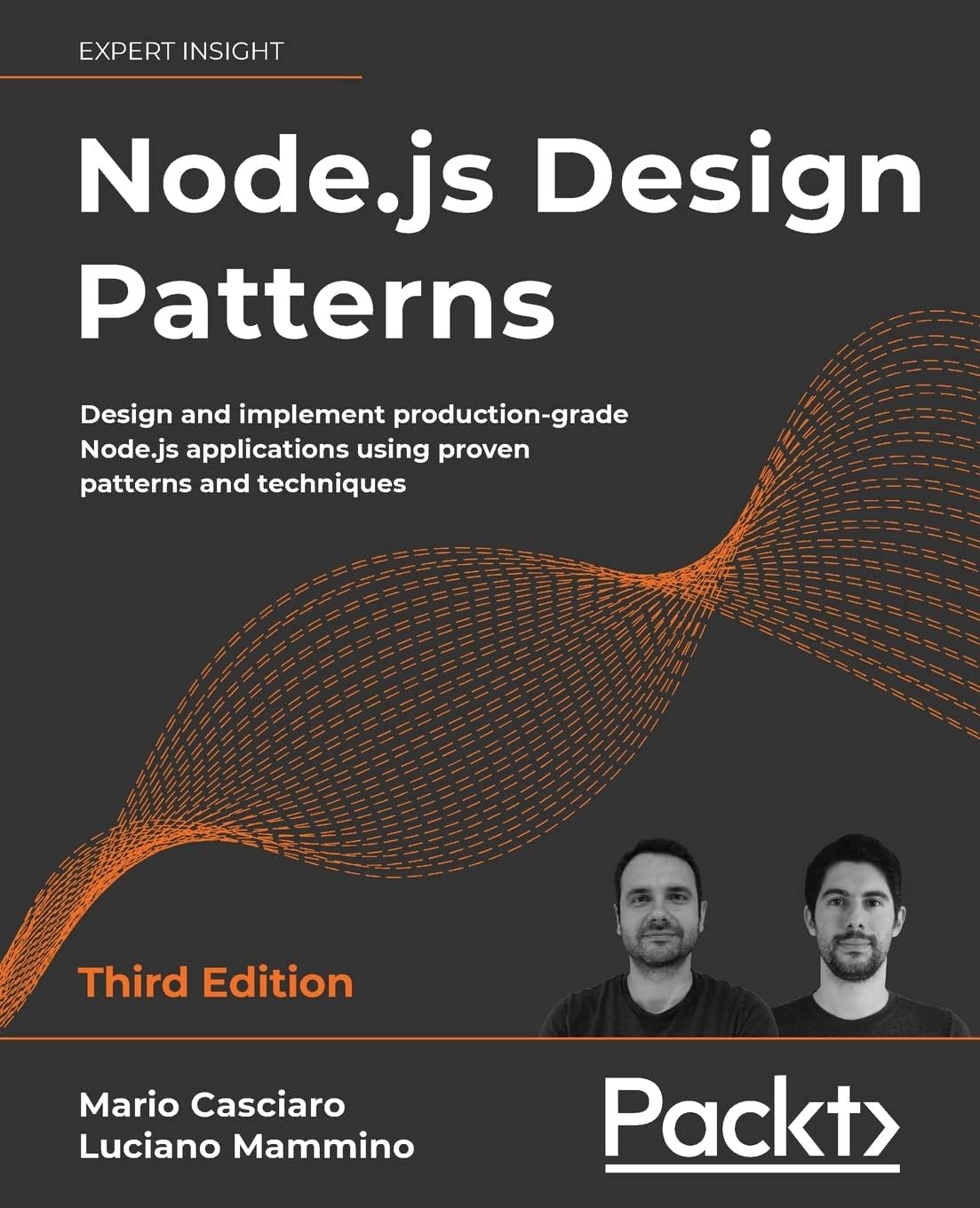
Node.js Design Patterns: Design and implement production-grade Node.js applications using proven patterns and techniques
Product ID: 226261222
Buy anything from 5,000+ international stores. One checkout price. No surprise fees. Join 2M+ shoppers on Desertcart.
Desertcart purchases this item on your behalf and handles shipping, customs, and support to Nicaragua.
THIS BOOK IS OUTDATED AND THERE IS A NEW EDITION AVAILABLE. Learn proven patterns, techniques, and tricks to take full advantage of the Node.js platform. Master well-known design principles to create applications that are readable, extensible, and that can grow big. Key Features Learn how to create solid server-side applications by leveraging the full power of Node.js Understand how Node.js works and learn how to take full advantage of its core components as well as the solutions offered by its ecosystem Avoid common mistakes and use proven patterns to create production grade Node.js applications Book Description THIS BOOK IS OUTDATED AND THERE IS A NEW EDITION AVAILABLE. In this book, we will show you how to implement a series of best practices and design patterns to help you create efficient and robust Node.js applications with ease. We kick off by exploring the basics of Node.js, analyzing its asynchronous event driven architecture and its fundamental design patterns. We then show you how to build asynchronous control flow patterns with callbacks, promises and async/await. Next, we dive into Node.js streams, unveiling their power and showing you how to use them at their full capacity. Following streams is an analysis of different creational, structural, and behavioral design patterns that take full advantage of JavaScript and Node.js. Lastly, the book dives into more advanced concepts such as Universal JavaScript, scalability and messaging patterns to help you build enterprise-grade distributed applications. Throughout the book, you’ll see Node.js in action with the help of several real-life examples leveraging technologies such as LevelDB, Redis, RabbitMQ, ZeroMQ, and many others. They will be used to demonstrate a pattern or technique, but they will also give you a great introduction to the Node.js ecosystem and its set of solutions. What you will learn Become comfortable with writing asynchronous code by leveraging callbacks, promises, and the async/await syntax Leverage Node.js streams to create data-driven asynchronous processing pipelines Implement well-known software design patterns to create production grade applications Share code between Node.js and the browser and take advantage of full-stack JavaScript Build and scale microservices and distributed systems powered by Node.js Use Node.js in conjunction with other powerful technologies such as Redis, RabbitMQ, ZeroMQ, and LevelDB Who this book is for This book is for developers and software architects who have some prior basic knowledge of JavaScript and Node.js and now want to get the most out of these technologies in terms of productivity, design quality, and scalability. Software professionals with intermediate experience in Node.js and JavaScript will also find valuable the more advanced patterns and techniques presented in this book. This book assumes that you have an intermediate understanding of web application development, databases, and software design principles. Table of Contents The Node.js Platform The Module System Callbacks and Events Asynchronous Control Flow Patterns with Callbacks Asynchronous Control Flow Patterns with Promises and Async/Await Coding with Streams Creational Design Patterns Structural Design Patterns Behavioral Design Patterns Universal JavaScript for Web Applications Advanced Recipes Scalability and Architectural Patterns Messaging and Integration Patterns Review: Practical design patterns for anyone serious about writing production-ready Node.js code - If you've ever been curious about how Node.js operates under the covers, in particular how asynchronous code runs, this is the book for you. The book is full of clear explanations and concise examples that help the reader understand the differences between synchronous and asynchronous code execution, when to use each, and how to avoid engineering in bugs that will be hard to reproduce and fix. It offers a collection of useful design patterns tailored to different use cases -- don't reinvent the wheel when you need to solve a Node design problem -- read this book! The direct and conversational tone of the book makes it a joy to read, so much better than many tech books that are the reading equivalent of eating dryer lint. The authors clearly know their subject matter well, and have a gift for sharing that knowledge through clear writing and a cornucopia of examples. The downloadable code examples are a must-have for anyone serious about writing production-ready Node.js code. This book is the first programming non e-book I've purchased in years, and I'm thrilled to have found it. Review: Very well written. Took my code to another level. - This is a really good book. If you use NodeJS, I would highly suggest it. Especially if you’re not already a senior developer. It introduced me new concepts but it really helped me get my code more organized and strategic through using proven design patterns . The author, Luciano is VERY good with NodeJS and is really a top tier developer and great teacher! We’ll worth the small price!!!


| Best Sellers Rank | #1,053,900 in Books ( See Top 100 in Books ) #129 in JavaScript Programming (Books) #153 in Web Services #2,117 in Programming Languages (Books) |
| Customer Reviews | 4.7 out of 5 stars 332 Reviews |
C**N
Practical design patterns for anyone serious about writing production-ready Node.js code
If you've ever been curious about how Node.js operates under the covers, in particular how asynchronous code runs, this is the book for you. The book is full of clear explanations and concise examples that help the reader understand the differences between synchronous and asynchronous code execution, when to use each, and how to avoid engineering in bugs that will be hard to reproduce and fix. It offers a collection of useful design patterns tailored to different use cases -- don't reinvent the wheel when you need to solve a Node design problem -- read this book! The direct and conversational tone of the book makes it a joy to read, so much better than many tech books that are the reading equivalent of eating dryer lint. The authors clearly know their subject matter well, and have a gift for sharing that knowledge through clear writing and a cornucopia of examples. The downloadable code examples are a must-have for anyone serious about writing production-ready Node.js code. This book is the first programming non e-book I've purchased in years, and I'm thrilled to have found it.
D**R
Very well written. Took my code to another level.
This is a really good book. If you use NodeJS, I would highly suggest it. Especially if you’re not already a senior developer. It introduced me new concepts but it really helped me get my code more organized and strategic through using proven design patterns . The author, Luciano is VERY good with NodeJS and is really a top tier developer and great teacher! We’ll worth the small price!!!
O**E
Node.js reference
This a great book as far as Node.js is concerned. It helped in upgrading my skills. Shout out to the authors. The book was delivered in great condition by Amazon.
M**E
Professional level, well written
This book is amazing, in depth and super informative. If you really into nodejs you have to grab this book as soon as possible. The only complain I have is that the book is not loosely coupled. Every chapter is building on the previous one, which I find unnecessary. For example the last chapter, Messaging techniques shouldn't be coupled with the rest of the book.
N**S
Deep dive into Node.js, JavaScript style
An excellent book that covers many topics, including design patterns, with every example in JavaScript. The author does a great job of explaining each subject with multiple examples refactoring each into the optimal solution.
V**O
Clean and well structured
This book gets straight to the point, and there are many practical examples. You can find fundamentals and more advanced notions. Each chapter is well designed and the presentation of topics follows a well-structured logic.
N**V
Great content
If you are working with Node.js, do yourself a favor and make sure you get this. This book is OK can take you from bdgginer level to intermediate. It is amazing book, because it shows you the problem and the solution with a reference code. Tha. The authors ask a question and revile another problem with the implementation, and once again explain with a refeecode the solution.
D**L
Muy buen libro para aprender de temas avanzados.
Te enseña temas avanzados de Node.js y de programación en general. Los patrones de diseño se pueden utilizar en otros lenguajes por que este libro te enseña las bases para no estancarte en un solo lenguaje o framework.
Z**V
Great book!
This book is really good. When you read the title you think it might be GoF "Design Patterns" in Javascript and it will still be worth it. But it is so much more! * History and philosophy of NodeJS * Extensive deep dive of callbacks and promises and JS in general * You even make an universal app with NodeJS and React (which might cure your NextJS/Vercel fanboism and reduce your cloud bill) * Distributed systems * You also learn many state of the art npm modules for different tasks
A**N
Ce livre vous dira vraiment tout sur Node.js
Le livre couvre vraiment tous les sujets un peu compliqué sur Node.js, et possède systématiquement des exemples téléchargeables. Très pédagogique, grâce à ce livre, j'ai pu doubler mon niveau technique sur node.js !
A**R
The best book for Node.js
Wonderful book for learning one of the most crucial aspects of programming Luciano Mammino and Mario Casciaro made the idea of Design Patterns simple with Node.js. Simple and intuitive. From today I have two new idols 😊 👍🏻 .
J**N
Imprescindible
Libro que siempre recomiendo a los desarrolladores junior o a los que quieran mejorar sus habilidades con Node. Bien estructurado y con el contenido necesario para entender como trabajar de forma profesional con este lenguaje.
J**Y
The MUST-READ Book for ALL Serious JavaScript Developers
If you are a serious Node developer (or hope to be), you must read this book. That's all there is to it. First off, the book's title seriously _undersells_ this book. It covers way, _way_ more than design patterns. Now, given how central Node is to ALL JavaScript development workflows these days (ie. anyone using Webpack/React, etc.), I'd strongly suggest anyone who writes JS in any serious way should read this book. For Node devs, again, it's a must. I had read the 2nd edition, and even so this 3rd edition was worth the read (they've updated everything for ES6, reorganized, and added a bunch of new material). The authors start at the fundamentals of how Node itself works (single thread, non-blocking I/O, etc.), then take a bottom-up approach to teach you not just Node, but the very fundamentals of asynchronous JS coding - going into great detail on each of the 4 core pillars of async JS code (events, callbacks, promises, and async/await). They completely explain the JS Module systems used in Node, explaining both CommonJS and ES6 modules, as well as the key similarities/differences of how they are loaded and execute at runtime (or bundle-time), where each type can/can't be used, how to use each type in Node, and so on. Even tho most Node devs may not use Streams much, this book does a whole chapter in fantastic detail to explain how they work, why they are so central to Node, and why that's such a strength of the platform. Of course they then explain a variety of example uses/patterns built on Streams, to drive the points home. The rest of the book is mostly design patterns from there. Each pattern is well explained, with ample example code and diagrams to clarify all you need to know. You may know all of them already (unlikely), but even if you do there are tips and tricks you can pick up along the way. Lastly, the final chapter is a rewrite (as I recall) of their prior coverage of messaging patterns, completely updated to reflect the growth and prominence of microservices. They give 75 pages to cover all the essential messaging patterns you'll probably need, and include numerous really solid (tho not prod-ready) examples using ZeroMQ, RabbitMQ, and even Redis Streams (which could apply to Kafka, etc. conceptually as well). OK, I'll stop gushing. I'll just close to say that coming in at over 600 pages, this book is a commitment, for sure. Once you start reading it, though, it flies by (I read it in a week). The writing is clear, the diagrams and code examples are great, and the value is self-evident. Buy it. Read it. Thank me later. ...You're welcome. ;-)
Trustpilot
1 month ago
3 weeks ago