Desperate Characters
Product ID: 19813766
Desertcart purchases this item on your behalf and handles shipping, customs, and support to Nicaragua.
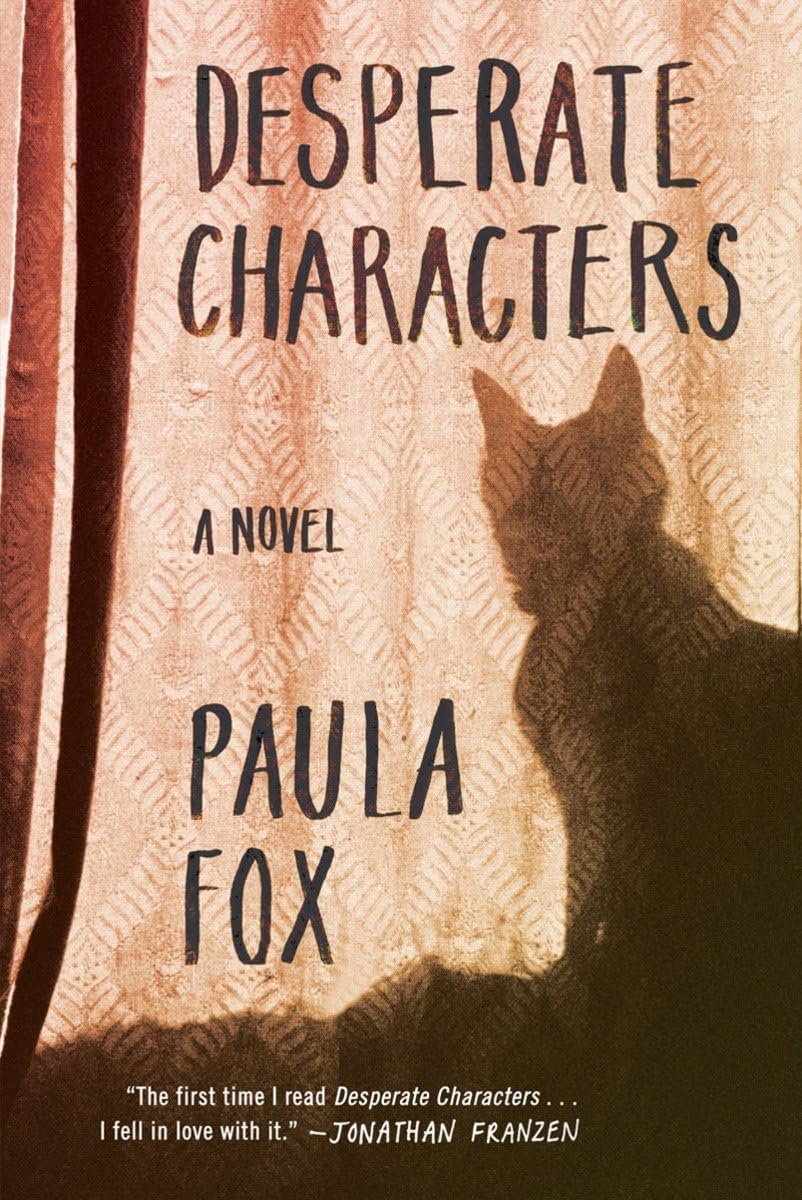
One of The Atlantic 's Great American Novels One of the New York Times ' 25 Most Significant New York City Novels From the Last 100 Years "A towering landmark of postwar Realism…A sustained work of prose so lucid and fine it seems less written than carved." ―David Foster Wallace Otto and Sophie Bentwood live in a changing neighborhood in Brooklyn. Their stainless-steel kitchen is newly installed, and their Mercedes is parked curbside. After Sophie is bitten on the hand while trying to feed a stray, perhaps rabies-infected cat, a series of small and ominous disasters begin to plague the Bentwoods' lives, revealing the fault lines and fractures in a marriage―and a society―wrenching itself apart. First published in 1970 to wide acclaim, Desperate Characters stands as one of the most dazzling and rigorous examples of the storyteller's craft in postwar American literature ― a novel that, according to Irving Howe, ranks with " Billy Budd, The Great Gatsby, Miss Lonelyhearts , and Seize the Day ." Review: Great Novel - Paula Fox is a master storyteller. Desperate Characters is a great novel. Review: Fine Writing, if Only Something Would Happen - I can’t tell if I’m missing something, or the book is. It reads easy, with a lot of dialogue. It almost reads like a play—I could see it easily being transferred to the theater. The prose, while quality, often feels sketchy. I suppose it is “economical,” per one of the glowing blurbs. It is also a barrier between the reader and the story. Transitions happen very quickly—new rooms, new people, new conversations. It can be hard to get a sense of place, or a feel characters, given everything is so fleeting. The book’s brevity, however, is a plus, in my opinion, as I never considered not finishing. In this sense, I suppose the novel is a success.
| Best Sellers Rank | #116,812 in Books ( See Top 100 in Books ) #310 in City Life Fiction (Books) #4,347 in Family Life Fiction (Books) #5,299 in Literary Fiction (Books) |
| Customer Reviews | 3.7 out of 5 stars 1,572 Reviews |
M**A
Great Novel
Paula Fox is a master storyteller. Desperate Characters is a great novel.
D**Y
Fine Writing, if Only Something Would Happen
I can’t tell if I’m missing something, or the book is. It reads easy, with a lot of dialogue. It almost reads like a play—I could see it easily being transferred to the theater. The prose, while quality, often feels sketchy. I suppose it is “economical,” per one of the glowing blurbs. It is also a barrier between the reader and the story. Transitions happen very quickly—new rooms, new people, new conversations. It can be hard to get a sense of place, or a feel characters, given everything is so fleeting. The book’s brevity, however, is a plus, in my opinion, as I never considered not finishing. In this sense, I suppose the novel is a success.
C**S
A slice of life, glimpse of relationships, that evokes time and place
This is a well crafted novel with economic and precise descriptions and dialogue. It also evokes a place (New York City) and a time (late 1960s) with well selected details that ring true and give the reader a glimpse into that time in American culture. The scope of the novel is small, so as to better analyze the complexity of human relationships, which is the over-riding quality of the novel. It is a short novel which corresponds well to its concentrated scope in terms of time, place, and situation as well as Fox's ability to select the single word or detail to explain or illustrate larger meaning to the reader. However, I could not give the novel a score of 5, despite its many good qualities. I found the Bentwoods, both Sophie and Otto, to be highly privileged and spoiled. Otto Bentwoods' `know-it-all' responses to almost everything his wife says was irritating. The novel is limited in time, a single weekend, and focuses primarily on the break between Otto and his legal partner, Charlie. These two men appeared to have different styles that complimented each other in both their friendship and legal practice, however I got the impression that after many years, they were somewhat sick of each other. The Bentwoods are highly-educated, wealthy, liberal, and Fox does a good job of showing the intrusion of the real world into their existence. As Fox describes it, the upper class can use their wealth to isolate them from the messiness of poverty but it creeps back in, much like the nasty tom cat that bites Sophie in the first pages of the novel. I once read a quote by Dawn Powell, that youth float on the illusion of luxury. Fox would expand that sensibility to indicate that the upper classes also wish to float on that same illusion but for those over 40 the illusion is about more than luxury, it is about life's consistent and nagging barriers, irritations, complications. The cat bite brings all this messy reality back into Sophie's life. The book is very well written and is admirable in its ability to limit time, place, person, situation for an examination of a situation that generalizes beyond the limitations Fox has created for her art.
B**M
Why Can't Everyone Be Civilized?
Sophie and Otto live quite securely; they have money, position, a renovated brownstone, and a Mercedes. Unfortunately the world around them is not behaving in a civilized manner. A cat bites Sophie; a neighbor relieves himself out of his bedroom window; drunks vomit on the sidewalk. Otto and his law partner break up, and their Long Island farmhouse is vandalized. At one point Otto laments "I wish someone could tell me how I can live." These are people viewed at a distance. They are cardboard characters, not because of any ineptness on behalf of the author, but because they truly are made of cardboard. There is no "there" there when we search for the inner beings of Sophie and Otto. One can categorize this novel as a story of a failing marriage, but I don't think that's the case. What we are viewing is a stagnant marriage, but stagnation seems normal for this couple; it is a life for which they are especially suited. Sophie makes sporadic, impulsive attempts to loosen her bondage to this existence: she has an affair; in a sudden rage she calls a friend a "dumb old collapsed bag"; she goes out for drinks with Otto's former partner at 3AM. Yet throughout the book we feel no sympathy for anyone who makes an appearance. Well almost anyone. The guy who empties his bladder out of his bedroom window does seem to be an independent cuss. Maybe we should get to know him better. Oh, and the word pictures, the metaphors, the similes: "her glance rested on Leon and Sophie with remote interest, like someone who does not particularly like fish, but finds herself imprisoned in an aquarium." This is one of many 1970's novels that portray the vacuous nature of the new, spiritually dead, materialistic society (see Richard Yates's Revolutionary Road, for example). It's an amazing book. Now I'm off to buy her other novels.
B**D
Unappealing characters
Paula Fox's Desperate Characters is another novel rescued from obscurity by a popular contemporary author, Jonathan Franzen, who mentioned it in a magazine piece and contributed an introduction to this 1999 reissue. The novel tells the story of a trying weekend for Sophie and Otto Bentwood, pioneer gentrifiers of a Brooklyn slum in the 1960s. The action begins at dinner on Friday evening and ends just before noon on the following Monday. In restoring their home, the Bentwoods have constructed a plush cocoon in the midst of squalor that they find distasteful, and on this weekend Otto especially is irked by the trash in the streets, a drunk vomiting on the sidewalk, and the stray cats haunting their back yard. Adding to Otto's unhappiness is the fact that his longtime law partner and one-time friend left their shared office for the last time on Friday to embark on a new solo practice, taking some of Otto's clients with him. Otto finds himself out of step with the times as many of his middle-aged contemporaries embrace the social values of 1960s. Fox tells her story from the point of view of Sophie, a full-time homemaker who once worked in publishing and still occasionally translates a French book, but for the most part is a passive onlooker who muses regretfully about an affair that ended when her lover returned to his wife. The plot hinges on a stray cat's biting of Sophie's hand when she feeds it on her back doorstep and if she'll have to endure a tedious and gruesome treatment if the animal is found to be rabid. That cat bite is the first and most serious of a series of small assaults Sophie and Otto witness or endure every time they leave their safe cocoon. This is slight novel, just 156 pages, and those who read for character are more likely to enjoy it than those who prefer plot-driven fiction. Although Fox is certainly an excellent writer, I found both Sophie and Otto unappealing and, therefore, I didn't really enjoy this novel.
J**L
A Masterpiece of Social Realism
If it were possible to give a book six stars, this would be the book. Each time I reread Fox's masterpiece, which is receiving increasing yet still insufficient attention, I am struck by its remarkable balance of depth and breadth. If there are a handful of works of literature that are deserving of their own college course -- maybe Anna Karenina or Invisible Man or Ulysses -- then one could structure an entire college education around this compact and easily-accessible novel. On the surface, we are introduced to Sophie and Otto Bentwood of Brooklyn Heights, a forty-something couple in a desiccated marriage, on the day Sophie receives a potentially lethal cat bite. But the novel transcends this domestic pas-de-deux to grapple with complex, unsettling questions of social order and justice, race and religion, freedom and obligation. It is a book as relevant today -- maybe more so -- than at at the height of the social protest and disorder of the late 1960s, when it takes place. Not a book to be read for plot or diversion, but to be savored for its penetrating insights into marriage, friendship and civilization. I recognize that art reflects taste, but the presence of one-star reviews of this book leaves me genuinely concerned for the future of literature.
P**D
Arranging matches
Comedian Susan Eddie Izard once observed that there are no British blockbuster movies because nothing ever happens in British movies. She joked that, unlike American movies full of explosions,murders and noise - British films all consist of people standing still in rooms saying things like “I’m arranging these matches.” Paula Fox’s much-ballyhooed novel felt a lot like that for me -watching two people staring silently at each other in a series of rooms where nothing really happens and no one really does anything except arrange matches. Circling a few days in the lives of two middle-aged dilettantes I kept waiting desperately (get it? “Desperately”) for something (anything!) to actually happen. But nothing does- Sophie gets bitten by a stray cat and worries obsessively she will die from her wound - but won’t go the doctor...and when she finally does she worries obsessively she has rabies. She doesn’t have rabies and nothing happens. The bite gets better. Her husband is dissolving his law practice with a partner who had been a dear friend for years but now these two men can barely stand the sight of each other. Why? Who knows? Nothing really happens there either. His partner behaves badly and yells a bit. And - oh my - the continuous casual racism is hard to stomach. Forty years later, endless references to “Negroes” - their “smell” and their “quaint” ways are tough to read. Ouch. What Fox has an impeccable eye for are the settings these very dull people move through. Her descriptions of the foods people eat, the homes they live in and the clothes they wear are a delight - if only the people in these intricately described spaces ever actually did anything or even interacted with them! Instead it’s like paper dolls - in which static, lifeless figures are just placed in different settings to see how they look. Then they are moved to a different setting to see how they look over here. Everyone at the beginning of this tale is the exact same as they are at the end - no one grows or changes or seems to learn anything at all from their interactions - they just blandly continue moving through landscapes - arranging matches.
C**.
Avoid
I got it because it was recommended by the NYT, what a phenomenal waste of time. The writing is good, but there is no plot and you read on and on about a desperately dull, over-privileged couple.
B**E
This book is a rare treat.
I know I am coming late to this party, but this is easily one of the most stunning novels I have ever read. The story is interesting and cohesive, the characters feel recognisable and real, the writing is masterful. So far, so good. Then, in addition, the issues that throw modern life into relief and test all of us are held up and examined before our eyes: a partnership is dissolved, a lovely neighbourhood is positioned flat up against an area of poverty and disorder, a traumatic animal bite repays an act of kindness, a much loved home is invaded and senselessly vandalised. All these things taint "the good life" we work so hard to achieve. Just how fragile is the life we want for ourselves? Everyone should read this book. It is a rare treat.
E**E
Lovely, timeless piece, while the bar was still set high.
Though fifty years plus in age, the book is quite possibly more relevant than it was then, reminding us that the Western human condition hasn’t budged an inch, in fact, it’s become far more desperate. So, in many ways this book is snapshot not of stasis, but of strangled aspiration. Even that doesn’t really exist anymore. Worth reading again and again.
M**I
Extremely bad print quality
Looks like jpg file
E**H
Bad photocopy
This is the worst printing I've ever seen. It's unreadable - unless I want to spend the remains of my eyesight straining.The publisher should be ashamed to send this out and the writer must be embarrassed. I really wanted to read this book but I'll have to wait until I find a copy I can read.
S**L
Very bad print quality.
On the one by publisher Flamingo there's very bad print quality, looks like a print of a photo. Blurry text. I'm sending it back.
Trustpilot
2 weeks ago
1 month ago