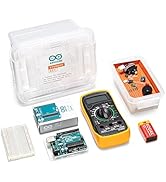
![Arduino Due with Headers [A000062] - 32-bit ARM Cortex-M3, 84MHz, 54 Digital I/O Pins, 12 Analog Inputs, 512KB Flash, USB Host, Pre-Soldered Headers, Compatible with Arduino IDE for Advanced Projects](https://m.media-amazon.com/images/I/61qbd6n7sDL._AC_SL3840_.jpg)

Desertcart purchases this item on your behalf and handles shipping, customs, and support to Nicaragua.
🚀 Elevate your embedded projects with the ultimate 32-bit Arduino powerhouse!
The Arduino Due is a genuine 32-bit ARM Cortex-M3 development board running at 84MHz, featuring 54 digital I/O pins, 12 analog inputs, 512KB flash memory, and native USB host/device support. Pre-soldered headers and full Arduino IDE compatibility make it ideal for advanced prototyping and complex sensor networks, empowering professionals to build sophisticated real-time and embedded systems with ease.


| ASIN | B00A6C3JN2 |
| Best Sellers Rank | #489 in Single Board Computers (Computers & Accessories) |
| Brand | Arduino Org |
| Built-In Media | microprocessor |
| Chipset Family | ARM Cortex-M3 |
| Compatible Devices | Personal Computer |
| Customer Reviews | 4.6 out of 5 stars 605 Reviews |
| Global Trade Identification Number | 07640152110498 |
| Item Dimensions L x W x H | 4"L x 2"W x 1"H |
| Manufacturer | ARDUINO |
| Memory Clock Speed | 84 MHz |
| Memory Storage Capacity | 512 KB |
| Mfr Part Number | A000062 |
| Model Name | Arduino Due |
| Model Number | A000062 |
| Number of Items | 1 |
| Platform | Android |
| Ram Memory Maximum Size | 96 KB |
| System Bus Standard Supported | SATA 3 |
| Total Usb Ports | 2 |
| UPC | 610098743989 |
| USB 2.0 | 2 |
| Unit Count | 1 Count |
| Warranty Description | as described on the official website |
K**A
Works Perfectly
A real Arduino, no clone. I obtained this for a project that employs several external 3.3V sensors. The Due is native 3.3V, so a number of bidirectional level converters that were required for a Mega 2650 were eliminated. The board is fully supported by the Arduino IDE with no surprises. Recommended if one is locked into 3.3V peripherals.
T**)
Awesome! Bought this for UDemy RTOS Class
This is a great ATSAM-based Arduino board! I bought this for the UDemy online class: "Mastering RTOS: Hands on with FreeRTOS, Arduino and STM32Fx". I've wanted to learn more about embedded real-time operating systems and this is a great, low-cost way to do just that! This board does not come with an embedded hardware debugger like some other boards (e.g. STM32F4xx based Nucleo-F446RE boards used in class such as STMICROELECTRONICS NUCLEO-F410RB DEV BOARD, STM32F410RB NUCLEO-64 MCU or NUCLEO-F446RE with MCU STM32F446RET6 supports Arduino STM32 Nucleo mbed development board integrates ST-LINK/V2-1 @XYG-Study ) so for hardware debugging something like SEGGER - 8.08.90 J-LINK EDU - JTAG EMULATOR, J-LINK, EDU, USB or In-Circuit Debuggers Atmel-ICE debugger with accessories will be needed. Note that the JTAG connector on this Due is the tiny 0.05" spacing connector! (and as far as I know, only the Atmel ICE kit has this size, most others use the 2.54 mm standard connectors). As far as I can tell, this is a "genuine", made-in-Italy, arduino.org board from the great folks at mp3car store (I'm really glad .cc and .org worked out their differences!). The box came with the little Arduino hologram on the back. The board itself is really quite nice: Well soldered, clean and crisp silkscreen printing, and as a completely unexpected bonus, arrived with a nice little protective "half-case" base to keep it protected below. So ya, I paid a few bucks more to buy this original: in part to support the Arduino efforts, but also to get an exacting board with no quirks. If you've ever had JTAG problems, you know what I mean. I'm completely happy with this Due and would definitely recommend it!
J**P
Arduino Due + Arduino Yun shield: great combination!
The Due from arduino.cc (the original Arduino group) has been discontinued, but Arduino.org (you can read up on the issues between the .cc and .org groups) made this Due board. That would be the only difference. The number of pins and amount of memory make this board especially useful. And as an added plus, it works with the Arduino Yun Shield (see the arduino.cc website) which allows the Due to communicate via Bridge.h to the Yun (which runs Linux and includes wifi and ethernet connectivity). Just add this to your Due sketch: #include <BridgeClient.h> // Arduino Due to Yun Shield communication BridgeClient client; You can also access Linux processes by including: #include <Process.h> which, for example, will allow the Due to get the current system date and time from the Yun. Over-the-air programming is the nicest feature of the Due-Yun combination which allows programs to be upload to the Due when it is connected to wifi. To enable this functionality, you first upload a sketch to the Due via USB with the setup() containing the line 'checkForRemoteSketchUpdate()' as shown below: void setup() { checkForRemoteSketchUpdate(); // use for Due when programming over Yun Shield } void loop() { // put your main code here, to run repeatedly: } After that, sketches can be uploaded by just including 'checkForRemoteSketchUpdate();' as the first line in the setup. From [...] DUE boards special note This board can be programmed remotely, but the way it interacts with the Yún shield requires a specific procedure that it is initialized by the checkForRemoteSketchUpdate() function. As suggested by the name this instruction is responsible to check if there is a new sketch to upload on the board. This is required only on the Due because you need to erase the flash before uploading a new sketch. The same action is performed automatically when you upload a sketch using any of the USB ports. Check the example called RemoteDueBlink includedin the Bridge library (Example -> Bridge -> RemoteDueBlink), which introduces you on how to use the checkForRemoteSketchUpdate() function. You must first load such a sketch via USB and also remember that any remotely loaded sketch must have that instruction to maintain the remote upload functionality. In order to enable the remote upload feature you need to install the SAM core version 1.6.8 or greater. To ensure that remote upload works you need to power the DUE from the barrel jack or using the Native USB port.
M**O
Terrible oversight, awesome rescue!
Whoever assembled this board inverted the connector for pins 22-53, I connected a ground to 5v because of this and thought I had killed the board as it stopped working for a while... It seems to be back in order. I love Arduino boards, I have 5 of them, this one is my least favorite :( so, as an update, after more testing it seems the boards uart ports have died :( I will test some more to make sure, sadly i hadn't used the board much until now, and my return period is over. will try direct support with Arduino. After contacting the factory and sending them pics of the inverted connector, they sent me a replacement board! Excellent support!
B**N
Powerful, easy, and compatible.
I bought this to run some neopixel light strips. Being a modern software developer, I'm not very used to being concerned with memory. However, it turns out that it's pretty important when dealing with limited hardware like arduino. I didn't memorize the exact numbers, but using the FastLED library you can only control ~300-500 LEDs with an UNO. Around that number, depending on the way you use the FastLED library, you run out of memory and all kinds of strange things start happening - the most obvious of which is that your app will crash and not do anything at all. The solution for me was the DUE, which is an ARM chip and has more available memory to work with. The drawback is that you need to jump through a few hoops to get the core installed in your IDE since it doesn't come with it by default. After that, it's just another arduino with lots of extra available IO. I'm running 658 neopixels, and using a CRBG struct array to hold and work with them. At one point, I had as many as 900 running along with all of the rest of my code which has multiple classes to handle the various things I'm making my lights do, and had no issues at all. This appears to be a completely authentic Arduino device, and has all of the correct markings and box. Mine also came with a protective bottom plastic mount. I'm not sure if that comes with all of these, but if it does - that's pretty awesome too. It makes it much less likely that I'll accidently short it out on something on my desk while I'm playing with it, and makes it pretty easy to mount.
A**M
Good board with a big caveat.
I have used it for about 1 week. Have programmed to use Bluetooth, serial ports, LED's, Analog inputs, i2c, and PWM. All seems to work just fine. However, there is on big caveat of this new Due board. First the good, it is fast compared to UNO, even Mega 2560. The programming of this ARM based board is almost identical to the Mega 2560. You do have to use the 1.5 ARDUINO IDE which is still in beta as of now. So, if you are comfortable with the previous offerings of the Arduino, you will be able to program this realtively easy. Now, the caveat. The board is 3.3 volt, and can easily be damaged by applying higher voltage to the inputs. Another critical aspect of this new fast board is teh compatibility issues with the existing shields. Most of the boards that I have from 2560 are probably not safe to use with this board. I have not tried some of the shields due to the possibility of ending up with scrap Due. For most development, I will stay with 2560. And if I need more power, I will move up to BeagelBone Black or other offerings that are now being introduced. The shields that Ialready have by and large cannot be used with this Due. Maybe at later time, this board will be more widely used and more shields designed for it. But, for now it is not ready for the prime time.
B**R
Excellent prototyping board
Lots of DIO, USB, All possible lines brought out. The board comes in a nice clear plastic footing frame. It's an ARM so it is a super Core to use. Native USB plus debug programming USB. I'm using the USB MIDI library.
E**Z
Buen producto Recomendado.
Buen producto Recomendado. Pero las entrega de amazon tardada.
E**B
Guten Produkt für Fortgeschrittene
Insgesamt ist es ein solides Arduino Board mit vielen Funktionen fürs schnelle Protoyping. Beispielsweise die beiden DAC Kanäle sind sehr vom Vorteil, wenn man analoge Schaltungen ansteuern möchte. Auch Funktionen, wie natives High-Speed USB, eine (relativ) hohe Taktfrequenz, mehrere Serielle Schnittstellen, usw. Somit ist es ein ideales Board für jeden Maker, Hobbyist, etc. im Bereich des Prototypenbaus. Jedoch ist der Preis sehr happig mit um die 42 Euro. Dafür gibt es schon von anderen Herstellern bessere Boards für kleineres Geld, welche dann bestimmte Funktionen des Due drauf haben. Der Due hat sie aber alle. Somit kann dieses Board ein absoluter Schatz im Prototypenbau sein, würde aber von einer Serienfertigung mit diesem Board abraten, da der Preis ja wie beschrieben doch etwas höher liegt...
D**.
Fonctionne bien
D'abord vous devrez installer l'Arduino IDE et télécharger le paquet pour supporter les contrôleur en SAM (donc celui-ci inclus). Il suffit ensuite de brancher l'arduino en micro/mini-usb et choisir l'arduino dans l'IDE (native ou programming port et le port COM). Fonctionne très bien, pléthore de pins comparés au raspberry pi. Il y a beaucoup plus de ressources que sur les modèles précédents même si cela ne reste pas glorieux (n'imaginez pas faire tourner linux ou autre dessus, pour cela il faut voir le yùn). Attention les pins ne supporteront pas plus de 3.3V, auquel cas vous risqueriez de détruire un pin voir le processeur entier.
V**.
Un bel “gioco didattico”
Preso “per sbaglio” (non avevo ancora capito la differenza tra il Due e il Mega) senza neppure conoscerne pregi, difetti, caratteristiche, funzioni… Arduino Due non è esattamente “compatibile” con le librerie utilizzate da Uno (Nano, Mega…) e in rete non è semplice trovare “la pappa pronta” (sempre non si chieda a ChatGPT :P ) e il fatto che i suoi pin supportino solo tensioni inferiori o uguali a 3,3volt (a differenza degli altri Arduino che accettano fino si 5volt) lo rende “meno compatibile” alle “periferiche” (shield) che si possono collegare. Prodotto ottimo per chi ha voglia di apprendere nuove cose e si accinga alla prototipazione di un suo progetto elettronico, meccanico, motive, di domotica… (siamo circondati ed utilizziamo ogni giorno un prodotto che contiene una scheda simil Arduino). Le potenzialità sono davvero incredibili soprattutto perché, essendo open source, crescono assieme alle persone che utilizzano questo sistema. Ogni scheda Arduino ha i suoi pregi e i suoi difetti ed è più o meno indicata per le proprie finalità (esattamente come accade per i computer). Contentissimo del mio acquisto arrivato nei tempi prestabiliti ed abbandonato sul vialetto di casa da un corriere troppo sbrigativo (poteva almeno suonare il campanello)
B**E
Good price, authentic Arduino
I needed a Due very specifically for a project. I didn't want a clone, or something "close". This was a very good price, and bonus - came with a clear 'case back' that protects the back of the board when you use it without the rest of a case getting in the way. Perfect for shield-based projects.
T**O
やりたかったことが実現できる
Arduinoはuno、mini everyと試しましたが、今回はdueを購入しました! 性能が良いだけあり、やりたかったことが出来ました。これからどんどん活用していこうと思います!
Trustpilot
1 month ago
2 weeks ago