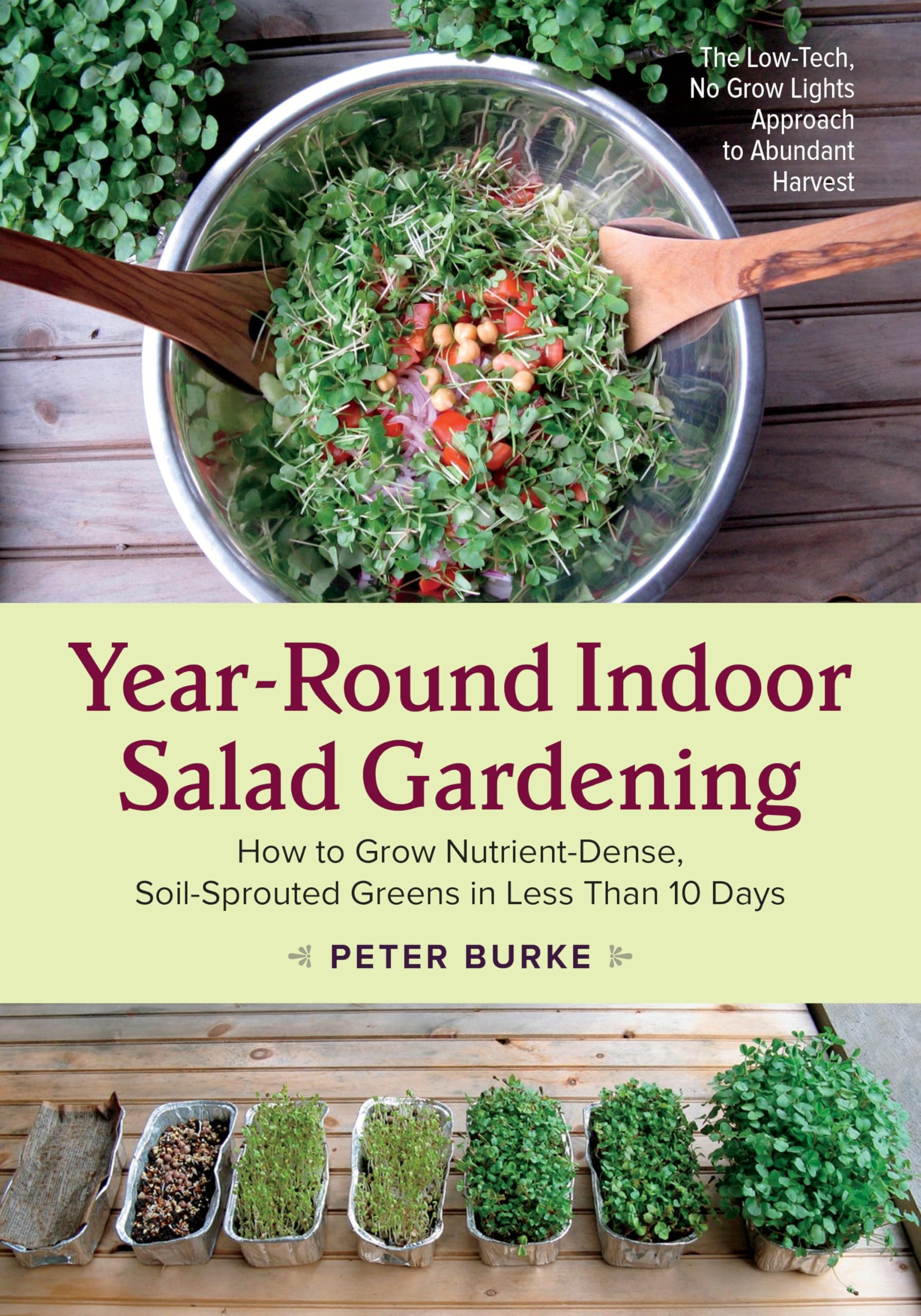
Year-Round Indoor Salad Gardening: How to Grow Nutrient-Dense, Soil-Sprouted Greens in Less Than 10 days
Product ID: 18188521
Buy anything from 5,000+ international stores. One checkout price. No surprise fees. Join 2M+ shoppers on Desertcart.
Desertcart purchases this item on your behalf and handles shipping, customs, and support to Nicaragua.
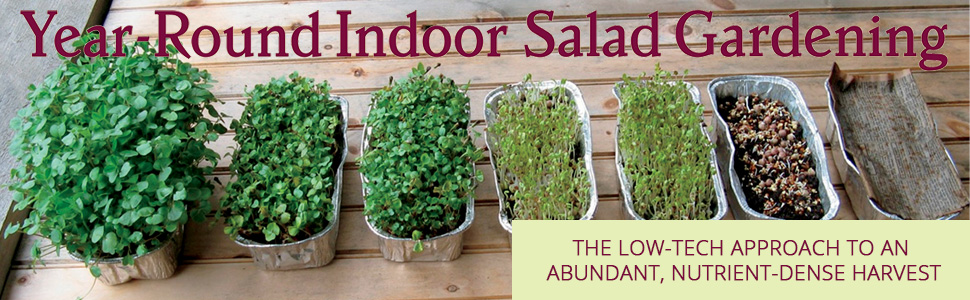
The Low-Tech, No-Grow-Lights Approach to Abundant Harvest Year-Round Indoor Salad Gardening offers good news: with nothing more than a cupboard and a windowsill, you can grow all the fresh salad greens you need for the winter months (or throughout the entire year) with no lights, no pumps, and no greenhouse. Longtime gardener Peter Burke was tired of the growing season ending with the first frost, but due to his busy work schedule and family life, didn’t have the time or interest in high-input grow lights or greenhouses. Most techniques for growing what are commonly referred to as “microgreens” left him feeling overwhelmed and uninterested. There had to be a simpler way to grow greens for his family indoors. After some research and diligent experimenting, Burke discovered he was right—there was a way! And it was even easier than he ever could have hoped, and the greens more nutrient packed. He didn’t even need a south-facing window, and he already had most of the needed supplies just sitting in his pantry. The result: healthy, homegrown salad greens at a fraction of the cost of buying them at the market. The secret: start them in the dark. Growing “Soil Sprouts”—Burke’s own descriptive term for sprouted seeds grown in soil as opposed to in jars—employs a method that encourages a long stem without expansive roots, and provides delicious salad greens in just seven to ten days, way earlier than any other method, with much less work. Indeed, of all the ways to grow immature greens, this is the easiest and most productive technique. Forget about grow lights and heat lamps! This book is a revolutionary and inviting guide for both first-time and experienced gardeners in rural or urban environments. All you need is a windowsill or two. In fact, Burke has grown up to six pounds of greens per day using just the windowsills in his kitchen! Year-Round Indoor Salad Gardening offers detailed step-by-step instructions to mastering this method (hint: it’s impossible not to succeed, it’s so easy!), tools and accessories to have on hand, seeds and greens varieties, soil and compost, trays and planters, shelving, harvest and storage, recipes, scaling up to serve local markets, and much more. Review: Delivers what is promised. One of the best micro green/ soil sprout books. - I got several other books on growing micro greens at the same time I got this one. If you want to grow micro greens or as the author calls them "soil sprouts", this book is by far the easiest to understand and to follow, and highly recommended for beginners. There are detailed instructions and photos. For some reason I can not get my sun flower sprouts to grow with out mold, (I am still trying. It's not the book's fault), so I moved on to trying some other seeds with great success. I tried the wheat grass (foolproof), pak choy (great), and the buckwheat "lettuce" (delicious). I was afraid the pak choy would taste too strong in my salads, but that is not the case. I do not use the aluminum foil pans that the author recommends, as I am too afraid the aluminum will leach into the food, so I recycle the clear plastic bins that my spinach and lettuce come in from the supermarket. I just cut down the box a little. No need to put in drainage holes, as he explains. Since my house thermostat is set on a pretty cool setting, and it is winter here in the Midwest, I have been using some heating mats specifically made for starting seedlings during the incubation period. Other than that, no growing lights have been necessary. I did not have confidence that I could grow soil sprouts even though I have been highly successful growing alfalfa sprouts without soil. I felt very intimidated by growing soil sprouts, but I wanted a way to grow my own food in the cold winter months. This book definitely delivers. I am now adding many handfuls of luscious sprouts to my salads, and the hubby likes them too. Today I am planted my first batch of lettuce mix. We will see how it goes. I definitely will be branching out and trying lots of different types of seeds. I grow trays of the wheat grass for me to juice, and a special little tray of wheat grass for my cat, who loves to stick his nose in the grass and sniff. Seeing green things growing in my house makes my heart happy, and it sure is great that I can eat them too! Review: Great Book! - In addition to being an outdoor organic gardener for over 40 years from Central America to Alaska, I have done sprouts in jars using a rinsing method, and I have grown micro greens in winter in standard seed flat trays. Peter Burke's soil sprouting method is infinitely superior to the jars, and it is faster in terms of usable veggies than micro greens. I suspect the result is not as nutrient dense as the micro greens, but it is clearly a very valuable growing technique since it requires much less time, space and light. I purchased and read the book about three weeks ago. It is well written and reflects the author's long term thought and experimentation with his subject. The illustrations are great. I determined to bow to his obvious wisdom and follow his instructions exactly as written. As a result we have enjoyed large quantities of kale, sunflower, and broccoli sprouts in salads and smoothies for not quite two weeks. What will I change? I am not going to use the aluminum baking pans long term because of concerns of toxicity and cost of replacement. But the SIZE of the pans is perfect. The soil depth is needed to keep things from drying out, and the quantity of one variety produced in the pans is just right for two of us. Also, since I have a soil heating mat, I'm trying some bottom heat to get more uniform sprouting, but the sprouts are fine without the heat mat. One reason I believe the microgreens are more nutrient dense is they grow longer, about three weeks total, and have more time to begin taking up nutrients in my soil mix. I did add the thin layer of compost and kelp meal under the peat moss and vermiculite as Peter directed, but I'm wondering is the soil sprouts are metabolizing any of those nutrients or just utilizing the seed resources. If the latter is the case, the quality of the seed alone would determine the nutrient density of the soil sprouts. I'm going to grow some controls without the kelp and compost and see if there is any visible difference. Perhaps the author is aware of some chemical analysis done of sprouts that would answer the question? Eliot Coleman describes somewhere the French market gardeners who placed a clump of inverted sod under cucumbers to rot and enhance fertility. I will save the root mass, soil, compost and kelp "brick" left over after harvest for that same purpose. Finally, I think the method is a wonderful addition to our personal resiliency. A bag of sunflower seeds in storage could yield enormous quantities of fresh vegetables any time of the year in a pinch. Thanks Peter Burke!






| Best Sellers Rank | #60,407 in Books ( See Top 100 in Books ) #20 in Container Gardening (Books) #23 in House Plant Gardening #64 in Vegetable Gardening |
| Customer Reviews | 4.7 out of 5 stars 475 Reviews |
P**E
Delivers what is promised. One of the best micro green/ soil sprout books.
I got several other books on growing micro greens at the same time I got this one. If you want to grow micro greens or as the author calls them "soil sprouts", this book is by far the easiest to understand and to follow, and highly recommended for beginners. There are detailed instructions and photos. For some reason I can not get my sun flower sprouts to grow with out mold, (I am still trying. It's not the book's fault), so I moved on to trying some other seeds with great success. I tried the wheat grass (foolproof), pak choy (great), and the buckwheat "lettuce" (delicious). I was afraid the pak choy would taste too strong in my salads, but that is not the case. I do not use the aluminum foil pans that the author recommends, as I am too afraid the aluminum will leach into the food, so I recycle the clear plastic bins that my spinach and lettuce come in from the supermarket. I just cut down the box a little. No need to put in drainage holes, as he explains. Since my house thermostat is set on a pretty cool setting, and it is winter here in the Midwest, I have been using some heating mats specifically made for starting seedlings during the incubation period. Other than that, no growing lights have been necessary. I did not have confidence that I could grow soil sprouts even though I have been highly successful growing alfalfa sprouts without soil. I felt very intimidated by growing soil sprouts, but I wanted a way to grow my own food in the cold winter months. This book definitely delivers. I am now adding many handfuls of luscious sprouts to my salads, and the hubby likes them too. Today I am planted my first batch of lettuce mix. We will see how it goes. I definitely will be branching out and trying lots of different types of seeds. I grow trays of the wheat grass for me to juice, and a special little tray of wheat grass for my cat, who loves to stick his nose in the grass and sniff. Seeing green things growing in my house makes my heart happy, and it sure is great that I can eat them too!
J**H
Great Book!
In addition to being an outdoor organic gardener for over 40 years from Central America to Alaska, I have done sprouts in jars using a rinsing method, and I have grown micro greens in winter in standard seed flat trays. Peter Burke's soil sprouting method is infinitely superior to the jars, and it is faster in terms of usable veggies than micro greens. I suspect the result is not as nutrient dense as the micro greens, but it is clearly a very valuable growing technique since it requires much less time, space and light. I purchased and read the book about three weeks ago. It is well written and reflects the author's long term thought and experimentation with his subject. The illustrations are great. I determined to bow to his obvious wisdom and follow his instructions exactly as written. As a result we have enjoyed large quantities of kale, sunflower, and broccoli sprouts in salads and smoothies for not quite two weeks. What will I change? I am not going to use the aluminum baking pans long term because of concerns of toxicity and cost of replacement. But the SIZE of the pans is perfect. The soil depth is needed to keep things from drying out, and the quantity of one variety produced in the pans is just right for two of us. Also, since I have a soil heating mat, I'm trying some bottom heat to get more uniform sprouting, but the sprouts are fine without the heat mat. One reason I believe the microgreens are more nutrient dense is they grow longer, about three weeks total, and have more time to begin taking up nutrients in my soil mix. I did add the thin layer of compost and kelp meal under the peat moss and vermiculite as Peter directed, but I'm wondering is the soil sprouts are metabolizing any of those nutrients or just utilizing the seed resources. If the latter is the case, the quality of the seed alone would determine the nutrient density of the soil sprouts. I'm going to grow some controls without the kelp and compost and see if there is any visible difference. Perhaps the author is aware of some chemical analysis done of sprouts that would answer the question? Eliot Coleman describes somewhere the French market gardeners who placed a clump of inverted sod under cucumbers to rot and enhance fertility. I will save the root mass, soil, compost and kelp "brick" left over after harvest for that same purpose. Finally, I think the method is a wonderful addition to our personal resiliency. A bag of sunflower seeds in storage could yield enormous quantities of fresh vegetables any time of the year in a pinch. Thanks Peter Burke!
M**E
Wish I had thought of this...but since I didn't, I am glad Peter Burke did.
Having grown my share of sprouts in mason jars (lots of rinsing; very little output + associated health risks with e.coli and salmonella) and experimented with indoor micro greens (complicated and expensive) I was delighted to discover Peter Burke's simple soil sprout method. Follow the directions outlined in the book and you can't go wrong; you will be harvesting ultra-fresh, delicious organic greens from your windowsill in less than 10 days. For me it is 7 or 8 days, which I think is impressive. The author clearly knows his subject and has thought through every aspect. The book is comprehensive, well-organized, and generously and helpfully illustrated. The author's tone is friendly and encouraging. Getting started is simple, just gather up a short list of supplies -I had almost everything at home. If aluminum foil pans don't appeal to you, visit your local thrift store or a yard sale and pick up a couple dozen cereal bowls to use for planters. Book includes contingency plans for when your schedule goes off course and your indoor garden gets neglected. Nice recipe section inspires reader to use soil sprouts in salads, stir fries, soups, dip, tempura, sandwiches, wraps, and the workday lunchbox. Seed by Seed index is a goldmine of info for 25+ types of greens you can grow. The author recommends beginning with buckwheat, pea, sunflower, daikon, and broccoli, which I did. I have since added popcorn, Chinese cabbage, adzuki beans, Tuscan black kale, garnet amaranth, purple kohlrabi, and a French Garden mixture which includes clover, cress, arugula and lentils. Without exception every bowl I have planted has yielded a beautiful "head" of greens...and yellows, reds, pinks and even purples and I am shocked at how easy and enjoyable it is! I wish I had thought of this method! But since I did not, I am glad Peter Burke did.
W**.
Great book
Love, love, love……
S**W
Good information under a load of filler
Short version: not worth the price. There is a fair amount of good to truly excellent information here, but also a lot of unnecessary self-congratulation and fluff. I’ve read through this book twice and find my opinion unchanged from my first impression. Lots of nice pictures. If the author wanted to do himself and us a favor, a far less expensive and condensed version of this information would fly off the shelves. I’d buy it, but this one is probably going back.
A**R
It works
I love the microgreen salads! I didn't have much of a use for sprouts until this book said you can make salads out of them. I LOVE salads. I'm waiting for my hydro lettuce to finally get big enough to use and need something else right now. After reading this, now I'm planting tons of seeds every day and driving my husband crazy. Lol. But I'm a happy wife. I decided to use bootstrap farmer's trays instead of what he uses simply because they are convenient (8 of the 5x5s to a 10x20 tray and no lugging around tons of individual small trays.... and you can use the humidity dome too). I also got myself a rolling shelf that is 3ft wide to hold 3 trays a shelf. Will add lights later to save the counter space in the kitchen. Buy this book. It's pretty simple and you can get most information in a couple of sittings. But it's practical information. Buy the seeds or use old garden seeds to use them up. Get growing. You only have to wait a little over a week to get something out of this. Happy Growing!
S**N
Thank you! Thank you! Thank you!!
Thank you! Thank you! Thank you! For writing your book “Year-Round Indoor Salad Gardening: How to grow nutrient dense, soil sprouted greens in less than 10 days. “ I bought the book on Kindle and ordered a hard copy. I purchased two versions of the book because I knew that I wanted to read the book and highlight immediately AND have a copy for quick reference While enjoying the photos. I read the Kindle version completely upon receipt. As soon as I received tpaperback version, I knew exactly which pages I wanted to highlight, underline, and affix post-its to. The next day after completing the Kindle version of the book, I went to the dollar tree and spent $23 on supplies. I already had the soil mix, compost, and liquid nutrients due to having planted a patio garden this year. I enjoyed my patio garden even though the yield was relatively low. The flowers did great! I had an upright 50 count plant container that I used this year for the first time. While it did produce a lot of greens, kale, collards, onions etc., the bugs were a problem! Lots of cabbage white moths, eggs, and caterpillars had to be picked off daily. I next ordered a Vegepod which is a planting container set up from a company in Australia. I just now set it up. It is November in California and we just had our first rain yesterday. Unfortunately, the seedlings arrived before the perlite so I wasn’t able to completely set the Vegepod up before the first rain. You know what I WAS able to do? Discover your book on Amazon, download a Kindle version immediately, read it that night completely through, receive a paperback version the next day, go to the dollar store to buy all of the recommended supplies, AND plant my first four trays of seeds all within 72 hours of having seen your book. INCREDIBLE!!!!! And in 7-10 days I will have my first harvest while the Vegepod is still waiting to be set up with soil, seeds planted and hardiest harvest WEEKS from now! I sort of wish that I had seen your book months ago before I bought the Vegepod. It’s OK because I have two expensive outdoor patio small space saving container garden set ups, as well as, traditional terra-cotta pottery and I will compare the yield, cost, time, effort, and yield of those two containers with the indoor gardening techniques you teach. I just woke up at 4 AM because my little dog had to go outside. Of course I am fully awake so I re-read your book. And I just now realized that I can buy seeds from thedailyGardner.com! I’ve already bought all the seeds I can use it this time from an alternate source and I look forward to my next purchase being from your site. If you would like to follow my progress, I am posting on Instagram, @teamsnewman . I am currently developing a health and cooking website that will start to feature soil sprouting as soon as I get through my first ten days of soil sprouting! Thank you for reawakening my love of gardening and keeping costs low and yields high! Stay tuned!
L**S
It really works
I thought it would be a good idea to find out how to grow some of our own food year-round. I read every word in this book and followed the instructions to the letter. Still, I was skeptical that anything would grow. I held my breath (figuratively) for 4 days while my trays spent their time in the dark. For my first try I planted only 3 types-- sunflower, pea and broccoli. I put the 3 foil pans in a box with a lid and placed it on top of the freezer, where it was quite warm. On the 4th day when I took off the lid I found that all my seeds had sprouted and the sprouts were 3" tall! (Not one inch like the author said they would be.) Today, one week after the planting, I harvested the sunflower sprouts. They were getting so tall that they would not stand up, and they were all tangled up. Also, I could see the beginning of another leaf between the original leaves. The author said that this is the signal to harvest, so I did. I am excited about this new gardening adventure. I am so in love with my sprouts. Update-- March 2023. I've been growing sprouts using the method in this book for 7 months. I've found that the 5 basics recommended by the author are still the best. That would be sunflower, buckwheat, pea, broccoli and radish. I also tried lentils with some success, and adzuki beans with no results. Maybe the seeds were bad. My favorites to grow are sunflower, buckwheat and pea because the hulls fall off on their own. The radish sprouts need to be de-hulled but aren't too bad. The broccoli sprouts are difficult to de-hull, but because they are so tiny I end up eating some of them. I've found buckwheat to be the fastest growing and most productive, and also delicious. During the winter it took the seeds of all the sprouts longer to germinate (usually 5 days) and they grew slower when placed in the sun. I usually plant a new crop every 5 days. As soon as the pans come out of the dark, a new set goes into the dark. It's a very rewarding activity!
P**R
Very useful
This is what I was looking for: practical and clear information. I am going to start growing sprouts the way it is explained. Looking forward to harvesting!
D**K
Very clever little book
Thanks this is a great book ,lots of info on gardening and cultivating sprouts .
A**R
Amazing
Amazing book. I was looking for a source that I could follow to grow indoor greens this winter and this book is the answer. I purchased the book 3 weeks ago and already I have harvested pea shoots and broccoli shoots. It is very clearly written and the instructions are super easy to follow. A great and easy way to grow greens over the winter. I am still doing some experimentation with seeds to see which shoots I really love but I know that I will continue to follow this fun and easy way to grow greens.
K**N
If you want to eat organic salads this is the book for you
I bought this book as a gift for a friend having previously bought it for myself. It is quite simply the best book available on growing organic salads year-round regardless of the weather.
A**W
Great for beginners
Excellent little book. Easy tyo follow. Thank you
Trustpilot
3 weeks ago
2 months ago