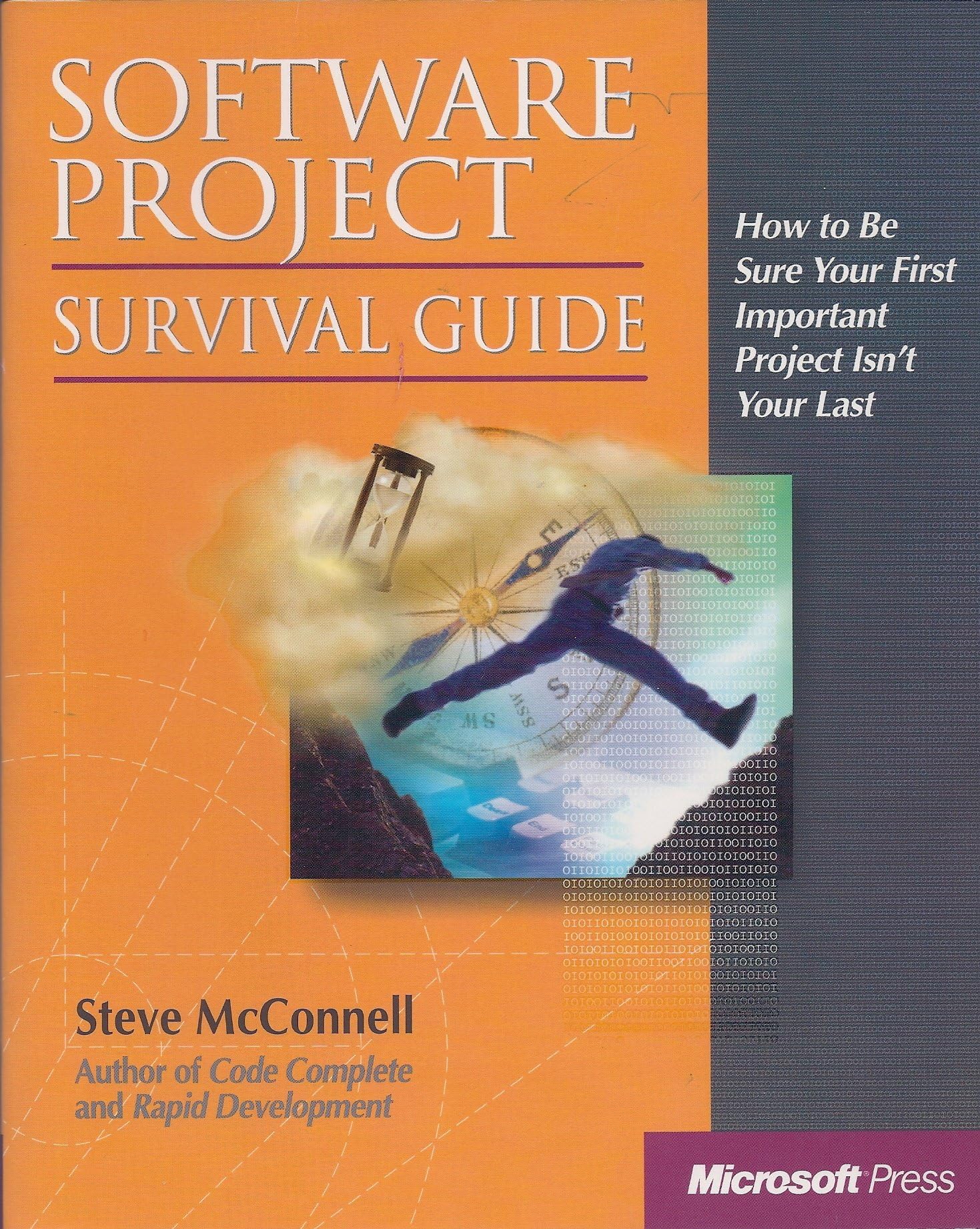
Software Project Survival Guide (Pro -- Best Practices)
Product ID: 16910971
Software Project Survival Guide (Pro - Best Practices) [McConnell, Steve] on desertcart.com. *FREE* shipping on qualifying offers. Software Project Survival Guide (Pro - Best Practices) Review: well-researched - I'm a one-man database development shop at a nonprofit with a shoestring budget. Without the benefit of senior level programmers, I've had to learn most of my software engineering lessons the hard way- by experience. I picked up this book seven years into the job, which in retrospect was about seven years too late. In some respects, this book repeats lessons that that have already become obvious through experience (e.g., software testing needs to be performed separately from development). But, this lends credibility to my judgment, and provides new insights substantiated by software engineering research studies. Non-technical management and funders are responsive to the hard figures I often find myself citing from this book. For example: 1) Programmers are 2.5 times more productive in a quiet office vs. a cubicle- so, I need to be allowed to work from home 2) The most efficient programmers are 10 times more productive than the least efficient programmers- really, you would think this would be obvious, but when work needs to be contracted, the low bidder is not necessarily the best choice over the long haul Currently faced with my most substantial and challenging programming project yet, I'm essentially using this book as a cookbook to process. Upfront I was a bit overwhelmed with the scope of the project. Having finished the book, I have a well-defined process in place, am confident this will get done, and feel I am much more articulate describing the stages of software development to management and contracted vendors. Some presumably industry-standard strategies are proving invaluable- implementing a Top Ten Risk list to ensure that major barriers are addressed upfront rather than deferred, creating specific milestones, etc. This book (or an equivalent) should absolutely be mandatory for anyone about to take on their first major software project. It is most useful because it reads like a cookbook- guiding you through all the phases of software development, one after the other. Review: Good theory on project management - This book is a strong theoretical background every software project manager should understand. The author provides deep analysis why such a big number of software projects fail. The author offers a set of reality-testing tools (software project survival test) that helps to understand chances of a project to success or to fail, from the very beginning. An intriguing idea is that "software project need hierarchy" is essentially the same as Maslow's "human need hierarchy": human beings respond to a hierarchy of needs that involve a natural progression from lower motives to higher ones. Lower motives such as food, air and water must be satisfied before we can be motivated by the need for belongingness, love, self-esteem or self-actualization. Similar hierarchy of needs applies to software projects. The author clearly shows that the outcome of any project depends equally on both the customer and the project team, and on the way of their communication and cooperation. Showing the power of process and distinguishing "process" from "thrashing" and "productive work", the author doesn't decline that the people are always important. Another cunning idea presented by the author is "The Cone of Uncertainty" which means "early in the project you can have firm cost and schedule target, or a firm feature set, but not both". While by no doubt the first part of the book "The Survival Mind-Set" is an excellent theoretic inspection, the remaining, practical parts of the book are questionable. I'd recommend you to take them skeptically, and, before taking decisive action, getting the full picture by reading "Agile Software Development" by Alistair Cockburn to get the overview of the modern methodologies, "Extreme Programming Explained" by Kent Beck as an example of such methodoloty, "Peopleware" by Tom Demarco & Timothy Lister to make sure that the good workplace and the jelled team is a major factor, "Quality is Free" by Philip B. Crosby to understand what really the quality is and "Leadership Without Easy Answers" by Ronald A. Heifetz to assure that nothing will succeed without a leader.
| Best Sellers Rank | #1,092,199 in Books ( See Top 100 in Books ) #109 in PMP Exam #1,441 in Software Development (Books) #8,922 in Mathematics (Books) |
| Customer Reviews | 4.3 4.3 out of 5 stars (96) |
| Dimensions | 7.38 x 0.88 x 9.25 inches |
| Edition | 1st |
| ISBN-10 | 1572316217 |
| ISBN-13 | 978-1572316218 |
| Item Weight | 1.4 pounds |
| Language | English |
| Part of series | Developer Best Practices |
| Print length | 304 pages |
| Publication date | November 14, 1997 |
| Publisher | Microsoft Press |
R**D
well-researched
I'm a one-man database development shop at a nonprofit with a shoestring budget. Without the benefit of senior level programmers, I've had to learn most of my software engineering lessons the hard way- by experience. I picked up this book seven years into the job, which in retrospect was about seven years too late. In some respects, this book repeats lessons that that have already become obvious through experience (e.g., software testing needs to be performed separately from development). But, this lends credibility to my judgment, and provides new insights substantiated by software engineering research studies. Non-technical management and funders are responsive to the hard figures I often find myself citing from this book. For example: 1) Programmers are 2.5 times more productive in a quiet office vs. a cubicle- so, I need to be allowed to work from home 2) The most efficient programmers are 10 times more productive than the least efficient programmers- really, you would think this would be obvious, but when work needs to be contracted, the low bidder is not necessarily the best choice over the long haul Currently faced with my most substantial and challenging programming project yet, I'm essentially using this book as a cookbook to process. Upfront I was a bit overwhelmed with the scope of the project. Having finished the book, I have a well-defined process in place, am confident this will get done, and feel I am much more articulate describing the stages of software development to management and contracted vendors. Some presumably industry-standard strategies are proving invaluable- implementing a Top Ten Risk list to ensure that major barriers are addressed upfront rather than deferred, creating specific milestones, etc. This book (or an equivalent) should absolutely be mandatory for anyone about to take on their first major software project. It is most useful because it reads like a cookbook- guiding you through all the phases of software development, one after the other.
M**N
Good theory on project management
This book is a strong theoretical background every software project manager should understand. The author provides deep analysis why such a big number of software projects fail. The author offers a set of reality-testing tools (software project survival test) that helps to understand chances of a project to success or to fail, from the very beginning. An intriguing idea is that "software project need hierarchy" is essentially the same as Maslow's "human need hierarchy": human beings respond to a hierarchy of needs that involve a natural progression from lower motives to higher ones. Lower motives such as food, air and water must be satisfied before we can be motivated by the need for belongingness, love, self-esteem or self-actualization. Similar hierarchy of needs applies to software projects. The author clearly shows that the outcome of any project depends equally on both the customer and the project team, and on the way of their communication and cooperation. Showing the power of process and distinguishing "process" from "thrashing" and "productive work", the author doesn't decline that the people are always important. Another cunning idea presented by the author is "The Cone of Uncertainty" which means "early in the project you can have firm cost and schedule target, or a firm feature set, but not both". While by no doubt the first part of the book "The Survival Mind-Set" is an excellent theoretic inspection, the remaining, practical parts of the book are questionable. I'd recommend you to take them skeptically, and, before taking decisive action, getting the full picture by reading "Agile Software Development" by Alistair Cockburn to get the overview of the modern methodologies, "Extreme Programming Explained" by Kent Beck as an example of such methodoloty, "Peopleware" by Tom Demarco & Timothy Lister to make sure that the good workplace and the jelled team is a major factor, "Quality is Free" by Philip B. Crosby to understand what really the quality is and "Leadership Without Easy Answers" by Ronald A. Heifetz to assure that nothing will succeed without a leader.
C**I
Excellent, down to earth, practical
I found the lessons and practical writing in this book to be fantastic. It spoke plainly about project management, not in academic terms as many other project planning materials that are out there. It covers the basics of the lifestyle that I already knew but overlays so great ideas and practices that I find myself nodding, pondering how I can apply these practices to my projects. Great read
A**N
Great Resource
One of many that PMs could use to validate/organize their workload. McConnell is a very well versed author that exposes many areas of opportunities for those willing to take part.
D**D
I liked the book, but if you don't know 90% of this stuff already, you aren't in software.
There's a caliber of people called "project managers" that haven't taken more than a semester's worth of computer programming and software engineering, that this book is the most valuable for. If you're becoming a project manager as a computer science graduate or basement-life coder, for the first time on a project, then this book is also for you. It's good to have this information written out somewhere to see that it's not just one guy being a weenie when he suggests having a process and a revision control system-there is a science to software engineering. However, through some experience that most everyone gets as a 'grunt', this is 90% of what people already know as common sense in 2007. Get a version control system for everyone. Come-up with a realistic deadline. Build-and-test so your customer can see the results, correcting you as you go. I liked the book, it read easy-enough, it just wasn't the sage advice about things I didn't know that I didn't know, that I was hoping it would be. It did deal with things like having 4 different "bosses/customers" and the need to basically contract-out who dictates what features-unfortunately that was less than 10% of the book.
B**O
The book is very easy to read. In most subjects I get surprised how the method is so obvious and yet I had never thought about it in that way. It's a "must read" for anyone getting into software project management.
Z**D
I bought this book many moons ago, and it fundamentally changed the way I looked at Software Engineering, and gave me a start down the path of project management. Years later, working on my Project Management Professional cert the lessons are still useful. I bought this book again for some up and coming software developer in my group who was a wizard coder, but sometimes had trouble balancing and prioritizing features/projects. Ever the skeptic on things that would slow him down and prevent him from coding, he still read it and had to admit that there was "some pretty useful stuff in there." Steve McConnell's Code Complete and Rapid Development are two other books I peg as must reads.
S**L
Eins gleich vorweg: Ich bin McConnellist. Als Code Monkey lernte ich Ende 2000 sein Code Complete kennen, und es war eines der Bücher, die mir, was professionelle Programmierkunst angeht, die Augen geöffnet haben. Viele seiner Ratschläge konnte (und kann) ich aus Erfahrung bestätigen, und die anderen klangen absolut einleuchtend. Vor kurzem erwarb ich dann Rapid Development . Der Buzzword-verdächtige Titel machte mich zwar etwas skeptisch, aber das Buch stellte sich als umfassende, fundierte Einführung in Management und technische Leitung von effizienter (als notwendiger Vorstufe von schneller) Softwareentwicklung heraus und konnte mich mehr noch als der Erstling begeistern -- dort geht es vor allem um vernünftiges Management und Leitung von Softwareprojekten, und auch da hatte ich Dutzende "A-haaa!"- wie auch "Kenn ich nur zu gut"-Erlebnisse. Die lohnendste Investition meines Lebens (2€ gebraucht, hehe). Als ich nun vor meiner ersten Projektleitung stand, versuchte ich, das Buch in einen praktischen Leitfaden zur Projektleitung zu komprimieren -- und scheiterte kläglich, dazu war es einfach zu umfangreich und gehaltvoll. Dann erfuhr ich, dass McConnell diesen Schritt-für-Schritt-Leitfaden in Form dieses Buch hier schon selbst geschrieben hatte, also flugs das Buch bestellt (fuffzich Cent gebraucht, hehe) und -- auch diesmal hält McConnell, was er verspricht. Er schlägt hier einen relativ schlanken, flexiblen Softwareprozess vor, der auf einem Staged Delivery-Prozessmodell basiert und die meines Erachtens wichtigsten Aspekte der Softwareentwicklung (Teamwork, Planung, Messung und Schätzung, Qualitätssicherung, Risikomanagement) abdeckt. Das Buch ist nach Projektphasen und Milestones gegliedert, so dass man es ausgezeichnet zur Vorbereitung und Durchführung bestimmter Phasen nutzen kann und nicht lang suchen muss, sondern kurz und griffig die wichtigsten relevanten Informationen findet. Im Vergleich zu "Rapid Development" werden hier weniger Grundlagen erklärt, sondern eher ihre pragmatische Folgerungen und deren Umsetzung beschrieben -- all das in einer lesbaren, sachlichen und knappen Art. Jeder Abschnitt enthält auch eine Checkliste der wichtigsten zu beachtenden Punkte und Risiken. Diese scheinen mir etwas knapp, eignen sich dadurch aber wohl auch um so besser, eigene Checklisten zu erstellen. Allein ist das Buch wohl nicht wirklich geeignet, ein Softwareprojekt effizient zu leiten. Aufgrund seiner Knappheit wirkt der Schreibstil manchmal etwas dogmatisch und angeberisch ("Durch diese Technik werden Sie so-und-so-viel schneller sein") und verführt zum altbekannten "Silver Bullet"-Glaube. Im Verbund mit "Rapid Development" aber halte ich dieses Buch für das Beste, was unerfahrenen Softwareprojektleitern passieren kann. Es eignet sich wesentlich beser, in kleinen und mittleren Firmen nachhaltig erfolgreiche Softwareproduktion durchzuführen, als sich durch ellenlange, sperrige Standards wie CMM zu ackern. McConnells Methode scheint mir schlank und einfach genug, um in der Realität tatsächlich durchführbar zu sein und sich leicht anpassen und erweitern zu lassen. Ich habe mit diesem Buch jedenfalls das gute Gefühl gewonnen, dass ich bei meinem Projekt nicht mehr wie Ochs vorm Berg stehe, sondern das Wichtigste einigermaßen richtig machen, dies andern gegenüber einleuchtend begründen können, und nicht allzuviel übersehen werde -- wer kann das schon vor seinem ersten Projekt behaupten? FAZIT: Wieder mal ein Volltreffer des Herrn McConnell. Uneingeschränkt kann ich es zwar nicht empfehlen, da die praktischen Richtlinien dieses Buchs zwar an sich schon gut und richtig sind, aber ohne den Hintergrund von "Rapid Development" wohl nur schwer richtig anzuwenden sind. Im Verbund mit dem genannten Buch ist dieser kleine Überlebensführer dagegen einfach nur Gold wert.
J**R
I would love to get everyone who I work with to read this book. I lost my other copy and could not do without it. It is so good, I bought it twice.
P**I
Es stehen ein paar nützliche Infos in dem Buch, aber es ist extrem langweilig geschrieben. Alles wird irgendwie doppelt und dreifach erzählt. Mein Tipp: Wenn man sich das Buch auf englisch kauft, gibt es preiswerte gebrauchte bei amerikanischen Händlern im Amazon Marketplace. Dauert ca. einen Monat bis das Buch dann ankommt ...
Trustpilot
3 weeks ago
1 week ago