We remain fully operational. Our teams are working around the clock to ensure your deliveries continue safely.

DOWNLOAD THE APP


Customer Services
Copyright © 2025 Desertcart Holdings Limited
DOWNLOAD THE APP
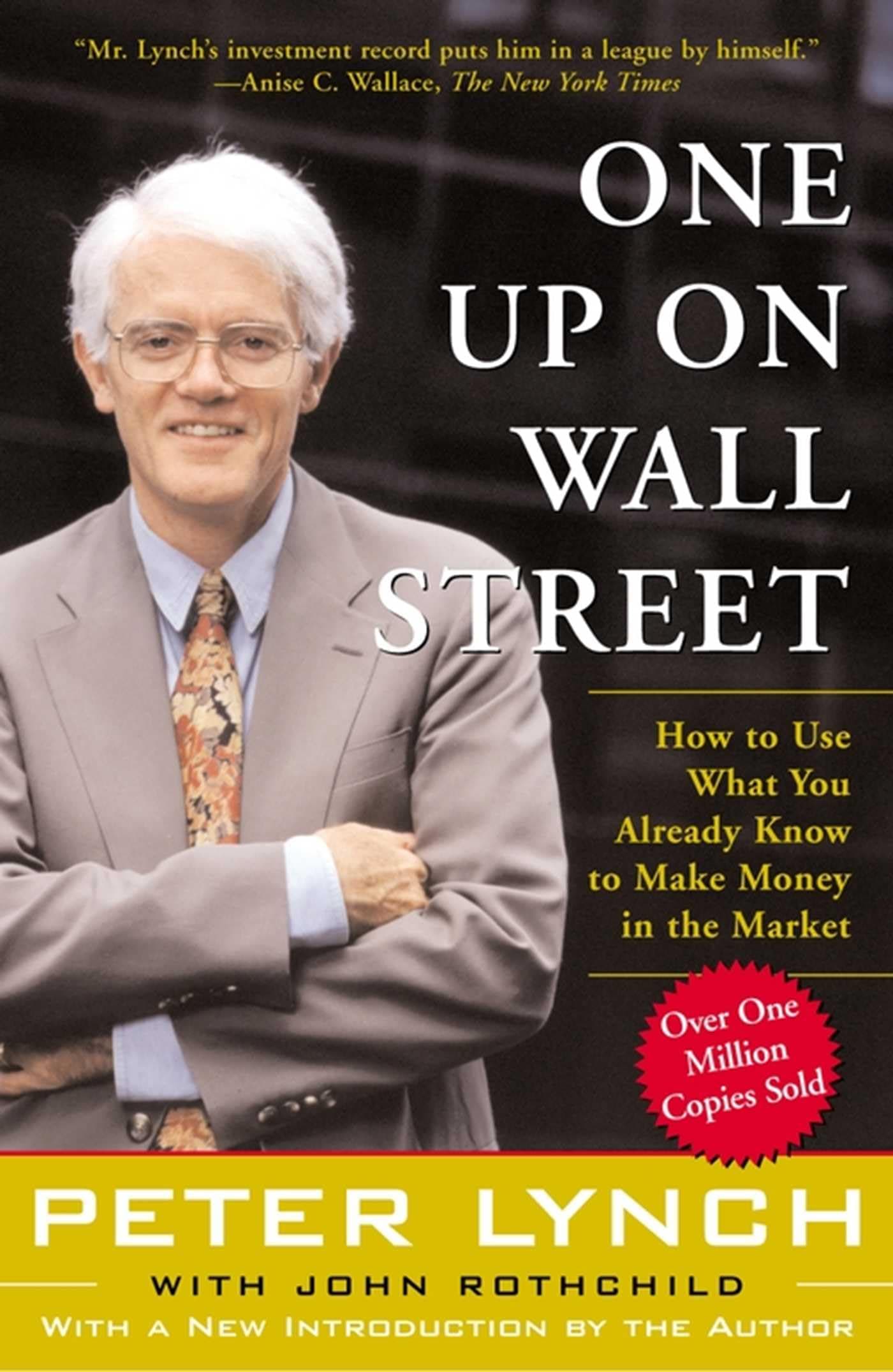
📊 Unlock your investing edge with Lynch’s timeless market secrets!
One Up On Wall Street by Peter Lynch is a bestselling investment guide that empowers individual investors to outperform professional fund managers by leveraging everyday knowledge and thorough research. Praised for its clear, story-driven style and practical advice, this compact, well-packaged book is ideal for millennials seeking to build long-term wealth with confidence and savvy.
| Best Sellers Rank | #7,119 in Books ( See Top 100 in Books ) #25 in Biographies of Business & Industrial Professionals #34 in Introduction to Investing #40 in Economics (Books) |
| Customer Reviews | 4.6 out of 5 stars 12,773 Reviews |
R**N
Great book for long-term investors....
Decided to pick up this book after reading Kiyosaki's bestseller, Rich Dad, Poor Dad. I've lost a bit of money in the market (2001 - 2004, but who hasn't?) and resolved to myself that I would learn more about investing. Kiyosaki's recommendation was for Lynch's other book, "Beating the Street" but "One Up on Wall Street" looked more interesting and timely. Given that I'm from the Boston area, I was already familiar with Peter Lynch and Fidelity Investments. Lynch's claim to fame was managing Fidelity's flagship mutual fund, Magellan, to stellar returns over many years. Lynch's advice in this book is based around the premise that most mutual fund managers while professionals, are often conservative in nature as compared to individual investors. They are bound to rules and regulations within their industry and trying to move a billion dollars worth of equities can be slow and tedious. Also their tendency to protect their capital and follow the pack means that most fund managers only perform adequately and don't really earn their pay. According to Lynch, an informed and educated individual investor can match or beat most fund managers. He has a much better chance of beating these professionals if he looks for undervalued stocks and stays in for the long-haul. Not that much different from Warren Buffet's investing mantra, it's all about assets and earnings. Lynch recommends going for the smaller growth stocks with strong fundamentals to really impact your portfolio since they are typically under most fund managers' radar screens. Once they are discovered, you can ride the stock up as they take positions. Finding these diamonds in the rough requires a bit of screening and research but all the tools and information are now available to the average investor on the internet. Oftentimes, these diamonds are right under your nose, businesses that you are familiar with as an every-day consumer. I really enjoyed Lynch's writing style, he mixes substantive graphs and real-life examples with self-deprecating wit and personal stories. It's comforting to know that even a investment guru like himself is capable of making (and learning from) mistakes. There are a handful of chapters and pages that are particularly useful providing broad guidelines and metrics that one should use when analyzing stocks. The bottom line is if you want to make money investing, you need to identify what type of investor you are, do your research and homework on companies, invest in stocks that meet your criteria/goals and keep an eye on things. The work required is not insignificant but if you don't do your homework, you're better off going to Las Vegas and betting on red. Overall, Beating the Street is not only an enjoyable read but a really wonderful overview of how to create a personal investment strategy. I tip my hat to Mr. Lynch for this great primer, all beginner investors should have this book on their bookshelf...
Y**O
A timeless book for stock investment: Very interesting with light humor
It is a very useful book for novices who want to gain some basic knowledge and concepts about how stocks work in the financial market and how to select the best portfolio of securities. Peter Lynch made many seemingly difficult concepts easier to understand and to highlight their practical significance. He shared his valuable experiences and told us how he felt or how he dealt with losses and success when investing. This is one of my favorite financial advice books ever. I am still applying the tips I found in here. Pros: * The book is well-written and structure so that even laymen can easy to understand * Reads like a story book, goes over some of Peter's personal successes and losses * Provides many examples based on Peter's experience * Describes his failures and lesson learnt, giving a balanced view * Uses common sense and explains things in ways that are logical. (For instance: He points out many investors try to time the market, rather than to focus on researching companies or using knowledge that they have which gives them a personal edge.) * Timeless book. Cons: * Some of the tips do require you to actually have some financial networks or resources to apply. Any book will only be as valuable as what you personally take out of it. If you are already a savvy financial guru, then maybe you don't need to read this book. If you have read 10,000 financial books, maybe this is too easy or basic for you. If you are intimately connected with the financial sector, again, why are you reading books that are intended for the ordinary masses? This book is stellar!
T**T
Good for a historical perspective
This is a good read for beginner and experienced investors because it gives you a historical perspective of the stock market and sets a good ground work for diving deeper into learning about investing. The main issue here is the fact that the book was written in 1989 which makes it somewhat irrelevant to today's market in certain instances. There is a new foreword written in the late 90s but it's still a far cry from being an in depth look at modern markets. The good news is that most of the advice in the book is relatively timeless and can still be applied to stock analysis today. The first part of the book goes into detail about Lynch's investing career and his best and worst stock moves. The idea behind this is interesting but it didn't work for me sometimes in execution. It's quite easy to look back at an investment five years later and say this is why it was a good or bad idea in hindsight but it doesn't tell us much about what we can do to make sure we're making the right choices in the future. Still this part of the book is good because it gives you a good look at how people reacted to stock market news back in the 80s and it's quite similar to how the markets react to news now. It was interesting to read about the paranoia around stock market crashes and how expensive securities were thought to be back and how that compares to current market conditions. The second part of the book goes into more detail on Lynch's personal investing philosophy which is relatively simple but a good start for someone new to investing. It's a relatively easy process to follow and it all makes sense and can certainly give individual investors a slight advantage over those who don't do the same type of research but for me this book was just a starting point and that's what makes it good. It's a good introduction to investing - giving historical insights to the market conditions in the 80s and 90s as well as a way for individual investors to evaluate the prospects of a stock. I'm not sure I cared for all the analysis of Lynch's personal trades as I feel like they were cherry picked to look good or bad in hindsight but I don't see how that adds any value to the individual investors as they naturally weren't so obvious when the investments were made or Lynch wouldn't have made them. The type of 'of course stock A went down 50% because of A,B,C now that I look back on it' and 'of course stock B was a good investment and went up 5x because of D,E,F' just didn't work for me because it felt like fluff to pad the length of the book. Still, I think learning about the viewpoints others had about the market in the 90s and how it mirrors how we look at our markets now was interesting and the investing theory presented in the 2nd part of the book had value too.
H**S
Great Read for Anyone Interested in Investments
Peter Lynch’s One Up on Wall Street is great read for someone starting a stock portfolio, a financial analyst looking to move up in her career, or a senior hedge manager at a major corporation. Lynch breaks down the mystery surrounding investing and writes with a heartfelt and humorous tone that makes the stock market seem understandable. He speaks honestly about the companies he missed out on and the ones he did well in. His message throughout the book is that anyone can be successful in the stock market if they do their research, distance themselves from “insider tips” or noise, and are patient. Lynch argues that every person already has an insider advantage for investing based on the area they work in. For example, a dentist may notice that a certain brand of floss works much better and is much more prevalent than competing brands. Once these products are recognized, people should conduct research based on what they know, and continue to keep their eyes and ears open for potential investments. However, it’s important not to get caught up in the recommendations or local gossip about a company; this is simply noise, and more often than not will lead you astray. Lynch also recommends investing in companies that are boring and predictable; if you can’t explain what a company does in 2 minutes to a 10 year old, you don’t understand enough about the business to invest in it. Furthermore, it’s important to stay away from the hot and exciting companies, because these ones are more likely to fail than niche businesses in a specific industry. Categorizing stocks (stalwarts, slow growers, fast growers, asset plays, cyclicals and turnarounds) can help you to determine what metrics to looks for. Finally, plan to invest in the long term, and don’t get concerned about panics in the market. Even if you decide to invest later in a company’s life, you can still make a ten-bagger or better. My only criticism is that One Up on Wall Street was written in the 1980s, so the events and companies mentioned in the book are pretty dated. There were also fewer analysts and less information on companies in the 1980s, so it was easier to find businesses the stock market had over-looked. Still, the book is a great beginner’s guide to investing and has some timeless advice that anyone in the finance industry could find helpful.
E**O
A Blast of Wisdom
So, here we have an artisan unveiling the secrets about his craft. I really could not provide enough praise to this piece. I guess all I can say is that this book made it to my car...and stayed! Many books have taken a couple of rides with me in my car just to return to the shelf. I just happen to have two little kids (4 and 2) so I have spent a lot of time in my car during the last 4 years (you know, to get them to nap). So, as they nap, I read. And the read better be good, because I don’t have a lot of time for it. Now, back to the book. This book is known for emphasizing some of the advantages that individual investors have (say, over institutional ones) when it comes to finding investment opportunities. One of these advantages relates to the fact that -due to mandate or sheer size- institutional managers cannot even start considering investing in small caps. This leads to a second advantage, which is that individual investors can find very attractive opportunities by just looking around them. This advantage is even more true today considering the easy access everybody has to stock and company related data. This is one of those books where, If you randomly pick a paragraph on any page, it will find a way to keep you engaged. The writing style is just too good. And I think it is that good because this man is pure wisdom. He could sit in front of me for the rest of my life and that probably would not be enough time for him to pass on all his knowledge. He was an investor, a trader, an equity analyst, a portfolio manager, and a businessman all in one. Incredible! The three sections I found most valuable are these: 1- company/stock classification (slow/fast growers, stalwarts, turnarounds, etc) 2- description of the characteristics of a fast grower or 10-bagger. 3- details of the effect of interest rates on the markets’ historical P/E ratio. Do yourself a favor a read this book. You won’t regret it.
A**Y
It's a Classic
I enjoyed reading it and learned a great deal from it. Although the book was written over 25 years ago, the fundamentals should not change. Peter Lynch did an excellent job of explaining the basics of investing in stock market. I particularly liked the point he makes, that one does not have to a professional or even listen to pros to be successful in the market. According to him, odds may be in your favor, because you may have an edge from your personal experience in a certain field, or simply from your daily life. Professional fund managers, on the other hand, have too many restrictions and limits which make it difficult to maximize the gains. Furthermore, you can identify winners even before a stock gets overpriced because of its recommendations by analysts. One of the most important things is to have a good understanding of the business of the company that you want to invest in. As he puts it, he would invest in pantyhose rather than communication satellites, or in motel chains than in fiber optics. The simpler the business, better it is, because those companies are perhaps easier to run and follow. According to him, some of the desirable attributes may be that it sounds dull or even better, ridiculous or has something depressing about it. Just to be ridiculous about it. If that is the case, the chances are that many stock analysts may not be following. Other attributes that can be of particular interest are following: it’s a spin-off; institutions don’t own it, and analysts don’t follow it, it has got a niche, people have to keep buying it, insiders are buyers, or the company is buying back shares. I think there is a lot of wisdom right there. Equally interesting is the chapter on stocks to avoid. He would avoid one that is hottest in the hottest industry or touted as the next big thing or those whispered in your ears. They usually don’t pan out. His examples and illustrations are bit outdated because of the time the book was originally written, but the points are well driven. Then he goes on say that it is important to classify the company that you have picked in one of the following six general categories: slow growers, stalwarts, fast grower, cyclical, assets play and turnaround. It would not only allow you to set your expectations, but also help you to make decisions along the way by bench marking other companies in the same category. The second step after picking a company is to check the company fundamentals such as, earnings, cash flow and fact-checking the story. He also described in detail how to get most out of company’s annual reports. This book has a wealth of valuable information that is presented with simplicity and humor. The thing I liked about Peter Lynch is that he highlights his mistake, not his successes. I guess being a stalwart of the industry; he does not need to beat his own drums. I would recommend this book highly. It’s a classic.
A**R
Best Investing book of all time
The 1% of people who don't like this book consist of 1. Some printing problems. 2 The majority don't like the book because it is too "outdated, not current information, won't work today." Blasphemy! "This time it's different," the most dangerous words in investing. I am 40 years as an investor and advisor. This book is the most accessible, very fun to read, more-so if you golf. I use his original formulas as do many hundreds of money managers. He is a national treasure. Those 1% are mostly new investors that are "mistaking a bull market for brains," as Buffett says. They fancy themselves as "traders." They will change, or fail. They want to know where technical analysis is in the book. Well, Lynch has a famous quote about that. It doesn't work. The proof is that of 10's of thousand of managed funds, not one uses technical analysis day to day for choosing stock. Technical Analysis is for magical thinkers and pattern seekers. Buy it! You will make money and have fun doing it.
B**T
Don't bother investing in stocks EVER if you haven't read this book!!
How do I contribute any unique thoughts to the many reviews that have already been posted about this book? I'll simply state that this is the first book devoted to stock investing I've ever read and I've been an active investor since 2006. I so much wish that I had known about and read this book before I started investing!! I'd probably be several times ahead of where I am right now. Though I've had great success the past couple of years through subscribing to a couple of online investing advice services, this book helps to fill in gaps in my knowledge, plus give me more details about the most important issues related to stock investing. Most importantly, I'm now able to look at a company's balance sheet and find the most important and relevant information regarding a company's financial position that I did not know or frankly care to know about before. Lynch has a way of explaining things like this that make sense to me. I really appreciate the candor of the author, not only telling how he found some of his biggest successes but also admitting how he failed or simply missed out on fantastic opportunities. He writes in a style that keeps me easily engaged, making it quite easy for me to have read through the nearly 300 pages much faster than I do with other books (less than two weeks!). I also appreciate his humor, which also struck a chord with me. Some might think that the content being over 25 years old now might make this book outdated. However, I find that he writes about market tendencies and human nature that transcend time. And frankly, any student of investing should know about the Chrysler turnaround of the 1980s or the Oil Crisis of the early 1970s, for example, as they contain similarities and lessons that can be applied today.
Trustpilot
5 days ago
2 weeks ago