
Buy anything from 5,000+ international stores. One checkout price. No surprise fees. Join 2M+ shoppers on Desertcart.
Desertcart purchases this item on your behalf and handles shipping, customs, and support to Nicaragua.
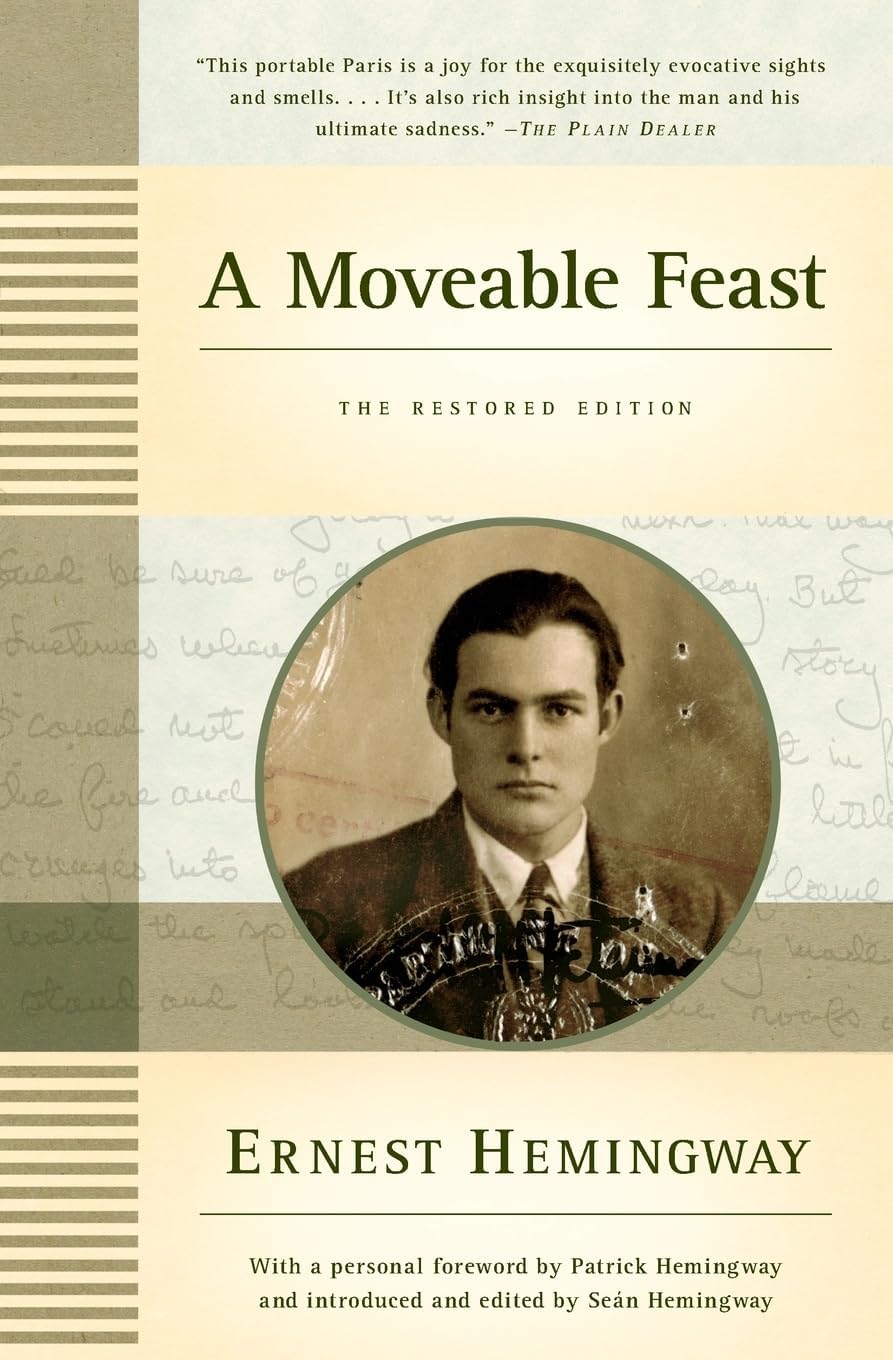
Ernest Hemingway’s classic memoir of Paris in the 1920s, now available in a restored edition, includes the original manuscript along with insightful recollections and unfinished sketches. Published posthumously in 1964, A Moveable Feast remains one of Ernest Hemingway’s most enduring works. Since Hemingway’s personal papers were released in 1979, scholars have examined the changes made to the text before publication. Now, this special restored edition presents the original manuscript as the author prepared it to be published. Featuring a personal foreword by Patrick Hemingway, Ernest’s sole surviving son, and an introduction by grandson of the author, Seán Hemingway, editor of this edition, the book also includes a number of unfinished, never-before-published Paris sketches revealing experiences that Hemingway had with his son, Jack, and his first wife Hadley. Also included are irreverent portraits of literary luminaries, such as F. Scott Fitzgerald and Ford Maddox Ford, and insightful recollections of Hemingway’s own early experiments with his craft. Widely celebrated and debated by critics and readers everywhere, the restored edition of A Moveable Feast brilliantly evokes the exuberant mood of Paris after World War I and the unbridled creativity and unquenchable enthusiasm that Hemingway himself epitomized. Review: Time Spent Reading this Book Is Time that will be Savored - "If you are lucky enough to have lived in Paris as a young man, then wherever you go for the rest of your life, it stays with you, for Paris is a moveable feast." Ernest Hemingway American novelist Ernest Hemingway cloaked himself in a life that was every bit as exciting and colorful as those lived by the characters who populated his novels. Hemingway was born in Oak Park, Illinois. in 1899, the son of a country doctor who was an outdoorsman and a culturally refined mother who pushed her son toward the arts. Young Hemingway tried to join the US military as an infantry "foot soldier" in World War I, but was turned down because of poor eyesight. He ended up volunteering as an ambulance driver for the Red Cross on the Italian front, and after serving heroically and suffering multiple shrapnel wounds, he went on to enlist in the Italian infantry and saw service on the Austrian front. Hemingway and his first wife, Hadley Richardson, moved to Paris in 1921 - a century ago this year - where he wrote dispatches for a newspaper in Toronto and did freelance work for other newspapers and journals while honing his skills as a professional writer of stories and novels. Ernest spent his days holed up in the cafe's of Paris where he did much of his writing, while Hadley explored the city and pursued her own interests. Together they traversed the Paris cultural scene and managed to see and experience much of Europe. Ernest Hemingway spent the better part of seven years in Paris (1921-1928) and kept the experiences that he and Hadley had while living there in a series of notebooks. He had always intended to eventually write about those early years in Paris. Sometime during the course of the 1920's and 1930's, the author lost track of his notebooks. Then one afternoon in 1956 while sitting in the lobby of the Ritz Hotel in Paris and enjoying a drink with the manager, a friend from the old days in Paris, the manager suddenly mentioned that he still had the two small steamer trunks that Hemingway had asked him t safeguard before World War II. Hemingway retrieved the wayward trunks, and as he was digging through the remains of his youth in Paris, he found his long-lost notebooks. The last writing project that Ernest Hemingway undertook was the editing and organizing of those notebooks into a book format. He had not completed the project when he died of his own hand in Idaho in 1961 as he avoided the final ravages of cancer. Hemingway's third wife, Mary, completed the project. Not satisfied with her effort, Hemingway's son, Patrick, and his grandson, Sean, reworked the project again after Mary's death. This is a review of what is now referred to as the "Restored Edition" of Ernest Hemingway's final work. Hemingway's Paris is alive with the people who were the pillars of twentieth century literature and the arts. He talks of visits to Gertrude's Stein's apartment and her enthusiasm for his writing. Stein also encouraged him to spend his money - which was very limited - on "pictures" (art) rather than on clothing. At one point he confided to Hadley that Miss Stein could be quite a bore, and Hadley replied that she would not know because she was just a wife and she was relegated to only speaking with Miss Stein's friend (Alice B. Toklas). Hemingway's bent toward snobbishness is hinted at in his recollections of visits at the Stein apartment. He never refers to Toklas by name - only as Miss Stein's friend - and although he talks of several encounters with Miss Stein's maidservant - and mentions her personal kindnesses to him - he openly admits that he could not even remember her name. Hemingway in A Moveable Feast focuses on F. Scott Fitzgerald and his wife, Zelda, more than any of his other Paris literary contemporaries. He tells a wonderful tale about him and Scott, not long after they first met, going to Leon to retrieve Fitzgerald's automobile - which had broken down - to drive it back to Paris. It turns out that the trip to Leon was the first time Scott had spent a night separated from Zelda since their marriage. The car they retrieved was a small Renault that had suffered damage to its top, and instead of having the damage repaired, Zelda had ordered that the top be removed. Right-on-cue as the two young authors began their road trip back to Paris, the skies opened up and it began raining. They spent several hours driving in and out of rain before deciding to get a room for the night. As soon as they settled into a room for the evening, Scott decided that he was sick - and he wanted his temperature taken. F. Scott Fitzgerald put his neurotic character on full display as he demanded that Hemingway or a member of the hotel staff produce a thermometer - of which there was not one to be had. Eventually after much complaining by the author of The Great Gatsby, a staff member showed up with a bath thermometer - with a wooden back and "enough metal to sink in a bath." Hemingway joked that Fitzgerald was fortunate because it was not a rectal thermometer, and the clueless Scott then asked where it did go. His quick thinking friend told him that it was for an under-arm reading and proceeded to take his temperature and then announced that it was normal. But Scott did not trust the doctor's son who had at one time been an ambulance driver for the Red Cross, and he demanded that Hemingway take his own temperature as well so that they could compare the readings. Hemingway complied and then announced that his numbers were the same and that he was fine - so F. Scott Fitzgerald decided that he must have recuperated. And then there was the issues surrounding Zelda Fitzgerald. Scott was totally besotted with Zelda, and Hemingway figured out quickly that Zelda was trying to sabotage her husband's writing through alcohol and a lifestyle centering on partying. At a point not too long after their first meeting, Hemingway also experienced the sudden realization that Zelda actually was insane. Ernest Hemingway seemed to show disdain for many of the characters with whom he interacted in the Paris of the 1920's. A pair of notable exceptions were poets Ezra Pound and Evan Shipman. Every mention of Pound was almost reverential, and he described in glowing terms Pound's efforts at setting up a charitable foundation to free poet T.S. Eliot from the soul-depleting drudgery of having to work in a London bank to support himself. Young Evan Shipman was an unpublished poet who earned Hemingway's respect and lifelong friendship by doing things of a practical nature like actually digging in the soil to produce gardens to feed others. Ernest and Hadley's only son, Jack (later the father of Margaux, Mariel, and Joan), was born during the Paris years while they were home in Canada in 1923. He returned to Paris with his parents as a tiny infant who had to be barricaded into his ship's bunk during a hard trans-Atlantic winter crossing. The new parents nicknamed their son "Bumby" and raised him in an unconventional manner. According to the father's recollection, Bumby, who was a good baby who seldom fussed or cried, was sometimes left in the care of F. Puss, the family cat, while father wrote in the local cafes and mother ran errands. Bumby and the cat would curl up together and sleep on the apartment floor. Later, as Bubmy began becoming more mobile, he would accompany his father to the cafes where he knew to sit silently and observe others while his father wrote. Hemingway and Hadley split up in their sixth year of marriage as he began having an affair with a friend of Hadley's who was living with them. He describes that slow and very painful transition from one lover to another in a chapter in The Moveable Feast entitled "The Pilot Fish and the Rich." It is the best writing in the book. Hemingway's breakup with Hadley clearly impacted him deeply and reached across the decades. In several "fragments" of his writing that he had penned especially for this effort and that his heirs chose to include at the end of the book, he referred to Hadley as the "heroine" of the stories. Clearly he never got over her. And there is so much more to this fine memoir. Time spent reading it is time that will be savored. The feast moves onward and continues to nourish. Review: Portrait of a Failing Artist - This was one of Hemingway’s last works in process when he committed suicide, appearing in print three years later. It provides a series of annotated snapshots of his days in Paris and about Europe while he was a hungry (often literally) expatriate author, sure of his gifts, and impatient for the world to reach a similar appreciation. Brief, only novella length, it provides, in addition to the author’s own account of his and his first wife’s early years, descriptions of several seminal literary figures in the inter-war period, principally Ezra Pound (laudatory), Gertrude Stein and F. Scott Fitzgerald (relatively sympathetic) and Ford Maddox Ford (cruelly derogatory, despite the great assistance Ford gave to Hemingway’s career). As such, it provides tantalizingly provocative insights into how the larger than life, lionized, ever image-conscious author wished his literary origins to be understood. And, just occasionally, wonderful flashes of his early, by then largely extinguished gifts. Here is one example: “I remember all the kinds of snow that the wind could make and their different treacheries when you were on skis. Then there were the blizzards when you were in the high Alpine hut and the strange world that they would make where we had to make our route as carefully as though we had never seen the country. We had not, either, as it all was new. Finally towards spring there was the great glacier run, smooth and straight, forever straight if our legs could hold it, our ankles locked, we running so low, leaning into the speed, dropping forever and forever in the silent hiss of the crisp powder. It was better than any flying or anything else, and we built the ability to do it and to have it with the long climbs carrying the heavy rucksacks. We could not buy the trip up nor take a ticket to the top. It was the end we worked for all winter, and all the winter built to make it possible. During our last year in the mountains new people came deep into our lives and nothing was ever the same again. The winter of the avalanches was like a happy and innocent winter in childhood compared to the next winter, a nightmare winter disguised as the greatest fun of all, and the murderous summer that was to follow. It was that year that the rich showed up.”


| Best Sellers Rank | #16,068 in Books ( See Top 100 in Books ) #14 in Author Biographies #60 in Traveler & Explorer Biographies #204 in Memoirs (Books) |
| Customer Reviews | 4.3 out of 5 stars 8,713 Reviews |
R**Y
Time Spent Reading this Book Is Time that will be Savored
"If you are lucky enough to have lived in Paris as a young man, then wherever you go for the rest of your life, it stays with you, for Paris is a moveable feast." Ernest Hemingway American novelist Ernest Hemingway cloaked himself in a life that was every bit as exciting and colorful as those lived by the characters who populated his novels. Hemingway was born in Oak Park, Illinois. in 1899, the son of a country doctor who was an outdoorsman and a culturally refined mother who pushed her son toward the arts. Young Hemingway tried to join the US military as an infantry "foot soldier" in World War I, but was turned down because of poor eyesight. He ended up volunteering as an ambulance driver for the Red Cross on the Italian front, and after serving heroically and suffering multiple shrapnel wounds, he went on to enlist in the Italian infantry and saw service on the Austrian front. Hemingway and his first wife, Hadley Richardson, moved to Paris in 1921 - a century ago this year - where he wrote dispatches for a newspaper in Toronto and did freelance work for other newspapers and journals while honing his skills as a professional writer of stories and novels. Ernest spent his days holed up in the cafe's of Paris where he did much of his writing, while Hadley explored the city and pursued her own interests. Together they traversed the Paris cultural scene and managed to see and experience much of Europe. Ernest Hemingway spent the better part of seven years in Paris (1921-1928) and kept the experiences that he and Hadley had while living there in a series of notebooks. He had always intended to eventually write about those early years in Paris. Sometime during the course of the 1920's and 1930's, the author lost track of his notebooks. Then one afternoon in 1956 while sitting in the lobby of the Ritz Hotel in Paris and enjoying a drink with the manager, a friend from the old days in Paris, the manager suddenly mentioned that he still had the two small steamer trunks that Hemingway had asked him t safeguard before World War II. Hemingway retrieved the wayward trunks, and as he was digging through the remains of his youth in Paris, he found his long-lost notebooks. The last writing project that Ernest Hemingway undertook was the editing and organizing of those notebooks into a book format. He had not completed the project when he died of his own hand in Idaho in 1961 as he avoided the final ravages of cancer. Hemingway's third wife, Mary, completed the project. Not satisfied with her effort, Hemingway's son, Patrick, and his grandson, Sean, reworked the project again after Mary's death. This is a review of what is now referred to as the "Restored Edition" of Ernest Hemingway's final work. Hemingway's Paris is alive with the people who were the pillars of twentieth century literature and the arts. He talks of visits to Gertrude's Stein's apartment and her enthusiasm for his writing. Stein also encouraged him to spend his money - which was very limited - on "pictures" (art) rather than on clothing. At one point he confided to Hadley that Miss Stein could be quite a bore, and Hadley replied that she would not know because she was just a wife and she was relegated to only speaking with Miss Stein's friend (Alice B. Toklas). Hemingway's bent toward snobbishness is hinted at in his recollections of visits at the Stein apartment. He never refers to Toklas by name - only as Miss Stein's friend - and although he talks of several encounters with Miss Stein's maidservant - and mentions her personal kindnesses to him - he openly admits that he could not even remember her name. Hemingway in A Moveable Feast focuses on F. Scott Fitzgerald and his wife, Zelda, more than any of his other Paris literary contemporaries. He tells a wonderful tale about him and Scott, not long after they first met, going to Leon to retrieve Fitzgerald's automobile - which had broken down - to drive it back to Paris. It turns out that the trip to Leon was the first time Scott had spent a night separated from Zelda since their marriage. The car they retrieved was a small Renault that had suffered damage to its top, and instead of having the damage repaired, Zelda had ordered that the top be removed. Right-on-cue as the two young authors began their road trip back to Paris, the skies opened up and it began raining. They spent several hours driving in and out of rain before deciding to get a room for the night. As soon as they settled into a room for the evening, Scott decided that he was sick - and he wanted his temperature taken. F. Scott Fitzgerald put his neurotic character on full display as he demanded that Hemingway or a member of the hotel staff produce a thermometer - of which there was not one to be had. Eventually after much complaining by the author of The Great Gatsby, a staff member showed up with a bath thermometer - with a wooden back and "enough metal to sink in a bath." Hemingway joked that Fitzgerald was fortunate because it was not a rectal thermometer, and the clueless Scott then asked where it did go. His quick thinking friend told him that it was for an under-arm reading and proceeded to take his temperature and then announced that it was normal. But Scott did not trust the doctor's son who had at one time been an ambulance driver for the Red Cross, and he demanded that Hemingway take his own temperature as well so that they could compare the readings. Hemingway complied and then announced that his numbers were the same and that he was fine - so F. Scott Fitzgerald decided that he must have recuperated. And then there was the issues surrounding Zelda Fitzgerald. Scott was totally besotted with Zelda, and Hemingway figured out quickly that Zelda was trying to sabotage her husband's writing through alcohol and a lifestyle centering on partying. At a point not too long after their first meeting, Hemingway also experienced the sudden realization that Zelda actually was insane. Ernest Hemingway seemed to show disdain for many of the characters with whom he interacted in the Paris of the 1920's. A pair of notable exceptions were poets Ezra Pound and Evan Shipman. Every mention of Pound was almost reverential, and he described in glowing terms Pound's efforts at setting up a charitable foundation to free poet T.S. Eliot from the soul-depleting drudgery of having to work in a London bank to support himself. Young Evan Shipman was an unpublished poet who earned Hemingway's respect and lifelong friendship by doing things of a practical nature like actually digging in the soil to produce gardens to feed others. Ernest and Hadley's only son, Jack (later the father of Margaux, Mariel, and Joan), was born during the Paris years while they were home in Canada in 1923. He returned to Paris with his parents as a tiny infant who had to be barricaded into his ship's bunk during a hard trans-Atlantic winter crossing. The new parents nicknamed their son "Bumby" and raised him in an unconventional manner. According to the father's recollection, Bumby, who was a good baby who seldom fussed or cried, was sometimes left in the care of F. Puss, the family cat, while father wrote in the local cafes and mother ran errands. Bumby and the cat would curl up together and sleep on the apartment floor. Later, as Bubmy began becoming more mobile, he would accompany his father to the cafes where he knew to sit silently and observe others while his father wrote. Hemingway and Hadley split up in their sixth year of marriage as he began having an affair with a friend of Hadley's who was living with them. He describes that slow and very painful transition from one lover to another in a chapter in The Moveable Feast entitled "The Pilot Fish and the Rich." It is the best writing in the book. Hemingway's breakup with Hadley clearly impacted him deeply and reached across the decades. In several "fragments" of his writing that he had penned especially for this effort and that his heirs chose to include at the end of the book, he referred to Hadley as the "heroine" of the stories. Clearly he never got over her. And there is so much more to this fine memoir. Time spent reading it is time that will be savored. The feast moves onward and continues to nourish.
A**E
Portrait of a Failing Artist
This was one of Hemingway’s last works in process when he committed suicide, appearing in print three years later. It provides a series of annotated snapshots of his days in Paris and about Europe while he was a hungry (often literally) expatriate author, sure of his gifts, and impatient for the world to reach a similar appreciation. Brief, only novella length, it provides, in addition to the author’s own account of his and his first wife’s early years, descriptions of several seminal literary figures in the inter-war period, principally Ezra Pound (laudatory), Gertrude Stein and F. Scott Fitzgerald (relatively sympathetic) and Ford Maddox Ford (cruelly derogatory, despite the great assistance Ford gave to Hemingway’s career). As such, it provides tantalizingly provocative insights into how the larger than life, lionized, ever image-conscious author wished his literary origins to be understood. And, just occasionally, wonderful flashes of his early, by then largely extinguished gifts. Here is one example: “I remember all the kinds of snow that the wind could make and their different treacheries when you were on skis. Then there were the blizzards when you were in the high Alpine hut and the strange world that they would make where we had to make our route as carefully as though we had never seen the country. We had not, either, as it all was new. Finally towards spring there was the great glacier run, smooth and straight, forever straight if our legs could hold it, our ankles locked, we running so low, leaning into the speed, dropping forever and forever in the silent hiss of the crisp powder. It was better than any flying or anything else, and we built the ability to do it and to have it with the long climbs carrying the heavy rucksacks. We could not buy the trip up nor take a ticket to the top. It was the end we worked for all winter, and all the winter built to make it possible. During our last year in the mountains new people came deep into our lives and nothing was ever the same again. The winter of the avalanches was like a happy and innocent winter in childhood compared to the next winter, a nightmare winter disguised as the greatest fun of all, and the murderous summer that was to follow. It was that year that the rich showed up.”
D**.
Delightful read about Hemingway’s time in Paris during his 1st marriage
Really enjoyable book about his experiences in Paris during his first marriage. He was quite insightful at the time, and formed a number of important friendships with strong women including Gertrude Stein, and the owner of the Shakespeare Company bookstore which still exists and is a delightful place near Notre Dame Cathedral.
S**7
A wonderful if controversial Hemingway book for new or veteran readers of Hemingway
This is a memoir of Hemingway's time in Paris during the 1920's. This is written by Hemingway at his best. These are stories from an aging man looking back on one of the best times of his life. When you read this book you can hear Hemingway speak to you as openly as if he were sitting in your living room having tea (-or rum). He recalls when he was a struggling writer: he was both very poor and very happy at the same time. During that time he and his first wife, Hadley, would have lived on about $5.00 a day. This is a very different time and the people he relates to are contemporaries who are not all caught up in their own ego and self-importance. They were more focused on being good at their craft and did not worry as much about success as most people are today. Some of the people he meets and writes about are Gertrude Stein, Scott and Zelda Fitzgerald, Ezra Pound, Ford Maddox Ford, and T.S. Eliot. Nobody writes with more preciseness and power than Hemingway. This book wasn't published till after Hemingway's death, and was put together from various notes and chapters that he had written at earlier times. Although he won both Nobel Prizes and the Pulitzer Prize and was a bestselling author in his lifetime, he has sold more books since his death in 1961 than he did during his life. Few authors have had this happen especially nearly 50 years after their death. But that is the way things worked out in the posthumous life of Ernest Hemingway. There has been quite a controversy among readers, family, friends and literary scholars about the old and new version of this book. I will not go into that now. You either like the old version or the new version, and some people, as myself, like both. The really great thing about the new version is that it has brought a new generation of readers to the wonderful world of Hemingway. I would recommend either version to new readers of Hemingway and the old veterans who want to touch back on life in those times.
L**E
You can learn from this.
It was recommended to me by an online writer’s masterclass I attended in January 2020. I need to add that I have never read any of Mr Hemingway’s books though I know him through the many quotes that frequent the writer’s world. I have learned to have respect for what he had achieved and the legacy he had left behind. So, I went in with great expectation but… there is always a but, correct. My expectation quickly turned to confusion. Since I had done the writer’s masterclass in January, I cannot remember why it was recommended. It could be that we talked about memoirs and how to write it… Maybe it has to do with the time difference, though I love a beautifully written historical. So, it cannot be the reason. On the plus side, Paris became alive through his telling and though he considered himself poor his life was not poor. Just imagine sitting at a café while you enjoy a glass of wine with equally skilled writers and poets; it would be a dream come true. Today we don’t have the privilege to mix with other writers like he did. With that said, here are the things I didn’t like. Too clunky, too many sticky words and too long sentences. Writing from then to now definitely had changed. Then all the throat clearing. Pages of dialogue-soaked throat-clearing that you skip just to get to what he tries to say. In the end, I stopped with the book and thought if he could write and become famous, I can as well. Did my respect for the older writers diminish? No, it didn’t. If not for them we would not have the writer’s community, we have today. They laid the foundation for us and for that they deserve our admiration. The book will leave you with a mixture of admiration, awe, and confusion but it is still worth the time. Even if just for what you can learn from it.
D**.
A Classic of the 1920s
A true classic, poignant, moving, and utterly wonderful. Hemingway tells not only his own story but that of all the expats who knew and loved Paris a century ago.
R**S
Inspired by visit to Hemingway's Key West home.....
Ever since I toured Hemingway's home in Key West (as a stop on my February, 2011, Caribbean cruise), I've been intrigued with the idea of learning more about Hemingway. I'm sure I read a couple of his books in college, but can't seem to remember all the details, since that was a few decades ago. The docent on our house tour piqued my interest, though, as she described his life with four wives and a number of mistresses, and the various places he lived throughout the world. So, I decided to start with "A Moveable Feast," which kicks off his marriage career with his first wife, Hadley. In the book, they get along very well and live both in poverty and in total love. Although Hemingway says he thought his love for Hadley would never end, he doesn't explain in this book how that love did end, even though his second wife is mentioned toward the end. This is Paris 1921-1926, but the various chapters aren't in chronological order. Part of the book is a rather pedestrian review of meals and outings in Paris and surrounding areas, but the rest is filled with delicious facts about his contemporaries - Gertrude Stein, Scott and Zelda Fitzgerald, Ezra Pound, Ford Madox Ford, T.S. Eliot, et al. This version is called "the restored edition," and I take it that various chapters have been added or deleted. This book wasn't published till after Hemingway's death, and was more or less cobbled together from various notes and chapters that he had written from time to time. Hemingway apparently had a rather strange (strained?) relationship with Scott Fitzgerald. The book describes a trip they took from Switzerland to Paris, via Fitzgerald's car (which had no top), and Scott was acting very strangely. Nevertheless, Ernest seemed to cope with this behavior. At one point, Scott tells Ernest that Zelda says his penis is too small, so Ernest takes Scott into the bathroom and shows him that it's not inadequate. Also, he recommends that Scott view his penis in profile rather than from above, and reminds Scott that it does get bigger under certain circumstances. Hemingway had a close relationship with Gertrude Stein for a while, but the book implies that ended rather suddenly. I thought the reasons for the rupture would be revealed, but the chapter on this was rather vague. All in all, I enjoyed reading about the peccadilloes of some of the great literary figures of the post WW I period, and am inspired to do further readings of Hemingway's work, as well as works of some of his contemporaries.
J**S
Portrait of the Writer as a Young Man
Hemingway, late 1920’s: “I learned one thing.” Hadley (Hem’s first wife): “What?” Hem: “Never go on a trip with anyone you do not love.” Said right after Hem had spent ten days on a road trip to Italy with his new friend Scott Fitzgerald, who was what we now call ‘high maintenance.’ (Actually, it’s good advice for going on life’s journey.) In 1956, at the Hotel Ritz restaurant after a long hiatus from Paris, Hemingway was told by the maître ‘d that they had two trunks of his they had been keeping for him since 1928. In it were his notebooks from that period, containing Hemingway’s early efforts to aspire to the status of a writer, and they show his recognition that a writer must adopt a writer’s discipline to write every day, even if only in a journal. A Moveable Feast, published posthumously in 1964, reflects that discipline. More importantly, it contains his unvarnished observations of some of the key American expatriate writers living in Paris who he befriended. Gertrude Stein and Scott Fitzgerald are prominently featured. The Restored Edition, published in 2009, is the premier version of this charming window into the mind of the artist as a young man at the beginning of his career as a professional writer, with all the ups and downs that dedication to this unforgiving art form entails. There are even photos of his handwritten notes, complete with his corrections. A great writer is also a great reader, and at that period Hem read everything he could get his hands on. Sylvia Beach’s bookstore, Shakespeare & Company, was basically a lending library to the English-speaking expatriate writers in Paris. James Joyce and Ezra Pound were regulars. Hem was forever grateful to Ms. Beach for her encouragement. This is one of the great diaries of an American writer, with a constant flow of insights into the art of writing and the personalities that inhabit that world. It’s an easy read, and you won’t be disappointed.
S**A
Love it
Just amazing and arrived in great condition!
E**O
Perfetto (come sempre)
Solo con Amazon è possibile acquistare libri in lingua inglese in perfette condizioni,com’è questo di Hemingway
L**G
Maestro Hemingway
Para mi uno de los mejores libros de Ernest Hemingway, en los que habla de su vida en Paris de los años 20. La película Midnight in Paris de Woody Allen, está inspirada en este libro, que en castellano se traduce a “París era una fiesta”. Con eso se dice todo.
A**Z
Increíble
Excelente libro, lo recomiendo ampliamente
P**7
Hemingway On the Verge
Hemingway in Paris before The Sun Also Rises brought him celebrity up to the beginning of the end of his first marriage. The tone is gentler than most Hemingway books. He was young and in love with his wife Hadley, he was writing his first stories in cafes, he was surrounded by other writers, F. Scott Fitzgerald fresh from his triumph with The Great Gatsby, James Joyce, Gertrude Stein, among others. I first read this book when it was released in the mid 1960's and advertised as the first of his posthumous works; it was so different from the usual Hemingway material. His adventures/misadventures include skiing trips with Hadley, the loss of his early manuscripts by Hadley, a motor trip with Fitzgerald, collecting funds for an English writer apparently trapped as a banker, Ford Madox Ford discoursing on various other writers, part of a disturbing conversation overheard including Gertrude Stein, and visiting Sylvia Beach's Shakespeare and Company. This is a different Hemingway and very enjoyable.
Trustpilot
4 days ago
1 month ago