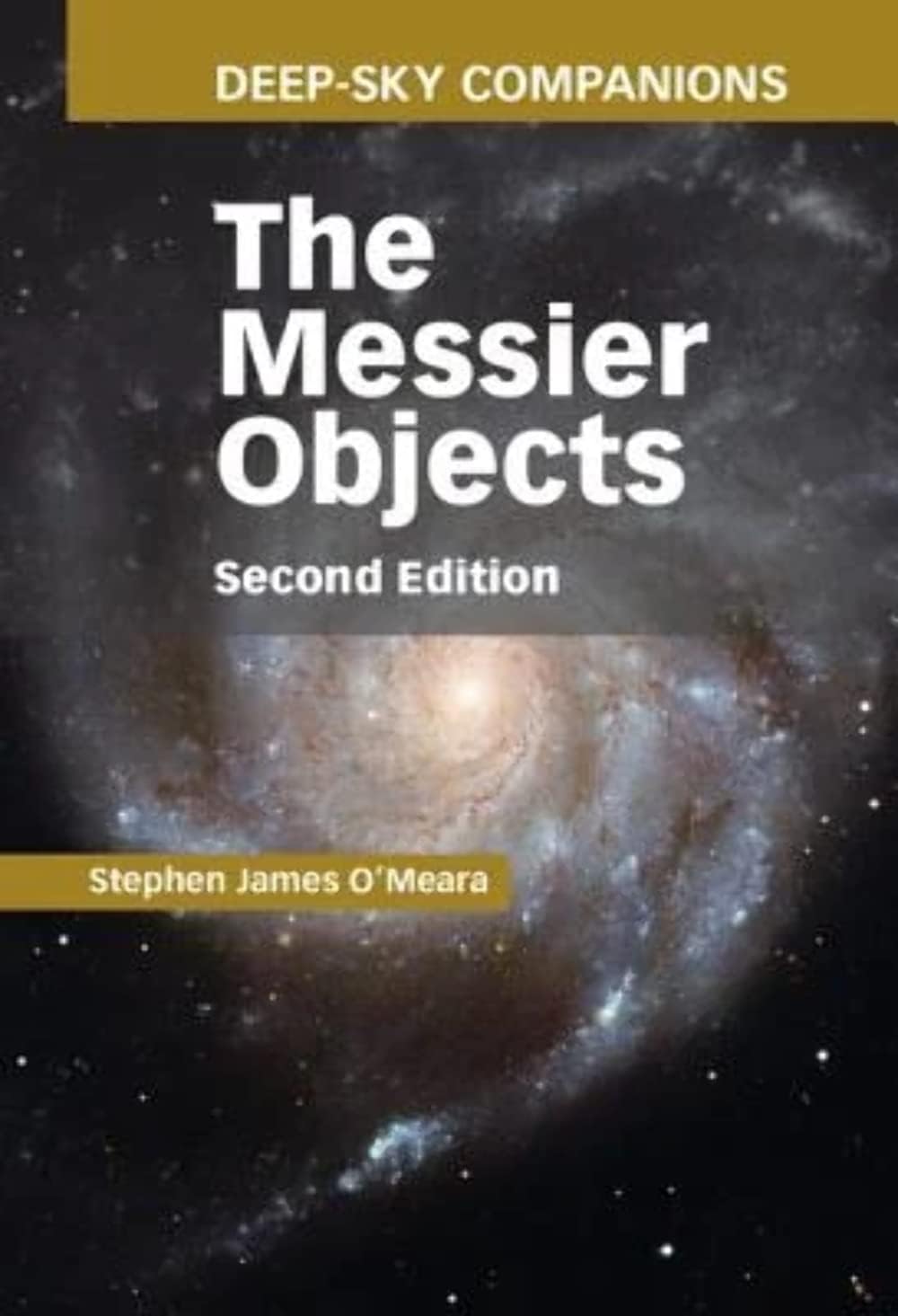
Deep-Sky Companions: The Messier Objects
Product ID: 12918423
Buy anything from 5,000+ international stores. One checkout price. No surprise fees. Join 2M+ shoppers on Desertcart.
Desertcart purchases this item on your behalf and handles shipping, customs, and support to Nicaragua.
The bright galaxies, star clusters, and nebulae catalogued in the late 1700s by the famous comet hunter Charles Messier are still the most widely observed celestial wonders in the sky. The second edition of Stephen James O'Meara's acclaimed observing guide to the Messier Objects features improved star charts for helping you find the objects, a much more robust telling of the history behind their discovery – including a glimpse into Messier's fascinating life – and updated astrophysical facts to put it all into context. These additions, along with new photos taken with the most advanced amateur telescopes, bring O'Meara's first edition more than a decade into the twenty-first century. Expand your universe and test your viewing skills with this truly modern Messier guide. It is a must for all budding night watchers. Review: Great, with one glaring flaw. - An excellent resource, with vivid descriptions of the Messier objects, as well as useful finder charts. O'Meara's writing style is a joy, and his sketches of the objects are charming. The book is a treasure trove of useful information. I wish I could deduct half a star though, for one noticeable flaw in this product. This is the Second Edition. The First Edition presumably included a complete star chart showing all the Messier objects dispersed among the various constellations, with said chart at the back of the book. The Second Edition repeatedly tells the reader to first locate an object "at the star chart in the back of the book", then use the detailed finder chart for the particular object (one chart provided per object, under the entry for the object), in order to hone in on it. However, there is no star chart at the back of the book in the Second Edition - only the detailed finder charts as given in the entry for each object! Not a fatal flaw, but a serious and annoying one. The book contains much useful history and information, and is certainly worth any stargazer's time and money, however. Almost perfect, except for the flaw described. Still, highly recommended. Review: A must have! - I recently completed with installation of East Africa's first dedicated, astronomical observatory and telescope with Astronomers Without Borders. As such, we brought a number of books to add to the growing library. The "Deep-Sky Companions" series is exactly what we needed to engage the budding amateur astronomers in Tanzania. Once the basics of RA, Dec, and magnitude were understood, they were able to use these books as guides much as we would an atlas for Earth-based geography, scanning the pages for those objects they can see from the equator at this time of year. When combined with Stellarium, these books are unbeatable as rapid references with ample information to bring the night sky to life.
| Best Sellers Rank | #288,782 in Books ( See Top 100 in Books ) #22 in Astronomy & Astrophysics #378 in Astronomy (Books) |
| Customer Reviews | 4.6 out of 5 stars 106 Reviews |
R**T
Great, with one glaring flaw.
An excellent resource, with vivid descriptions of the Messier objects, as well as useful finder charts. O'Meara's writing style is a joy, and his sketches of the objects are charming. The book is a treasure trove of useful information. I wish I could deduct half a star though, for one noticeable flaw in this product. This is the Second Edition. The First Edition presumably included a complete star chart showing all the Messier objects dispersed among the various constellations, with said chart at the back of the book. The Second Edition repeatedly tells the reader to first locate an object "at the star chart in the back of the book", then use the detailed finder chart for the particular object (one chart provided per object, under the entry for the object), in order to hone in on it. However, there is no star chart at the back of the book in the Second Edition - only the detailed finder charts as given in the entry for each object! Not a fatal flaw, but a serious and annoying one. The book contains much useful history and information, and is certainly worth any stargazer's time and money, however. Almost perfect, except for the flaw described. Still, highly recommended.
K**S
A must have!
I recently completed with installation of East Africa's first dedicated, astronomical observatory and telescope with Astronomers Without Borders. As such, we brought a number of books to add to the growing library. The "Deep-Sky Companions" series is exactly what we needed to engage the budding amateur astronomers in Tanzania. Once the basics of RA, Dec, and magnitude were understood, they were able to use these books as guides much as we would an atlas for Earth-based geography, scanning the pages for those objects they can see from the equator at this time of year. When combined with Stellarium, these books are unbeatable as rapid references with ample information to bring the night sky to life.
J**N
Awesome and splendid astronomical book ! Highly recommended.
A very comprehensive and well-written book about the 110 Deep-Sky objects identified by the French astronomer Messier. Very Good illustration ! This book is an excellent guidebook for the amateur astronomers and Skywatcher who is looking for these objects from the Sky. This is one of the best astronomical books which I have been read. Highly tecommeded !
A**R
Like it!
Useful reference. I plan to buy more in this set. Could be improved with sky maps.
J**M
O'Meara is an expert observer
I had the privilege of having dinner with him and his wife last month. As I expected, I found James O'Meara to be a world-class observer and author. His insights and abilities are extraordinary. He is able to convey the nuances of celestial observing in a manner that is easy to understand. I have several of his books. They are all excellent. He is a regular columnist with Astronomy Magazine.
A**R
An excellent book on the Messier objects
I use this book for reference when out looking at deep space objects such as the Messier 110. It is well written and has great photos and diagrams. I would recommend this predominantly for those individuals just starting out in astronomy who want to learn about, and participate in, one of the most fun things around, a Messier Marathon.
L**Z
Good writing and excellent resource.
Book received is brand new. Great writing and this will be an excellent resource book. Just getting into astronomy with an intent to actually remember something, and this book will help me along. Good luck and all the best to all of you, LL
R**S
Very useful
Comprehensive guide
D**N
Gute Zusammenstellung und interessantes Nachschlagewerk
Ich habe beide dieser Serie, also auch die Caldwell Objekte - vom Text und von der Information her, sehr gut gemacht. Etwas enttäuschend, dass alle Fotos nur in SW sind...
A**Y
Messier Objects.
This is a comprehensive account of all of the objects you can view in the sky, which were mostly Catalogued by Charles Messier, in the 1780s. This book is a well written account and with binoculars and a telescope it will encourage you to go outside and view these objects. The catalogue consists of 110 different objects you can spot in the night sky. A few of them are more challenging from the British Isles, because they remain very low down on the horizon, but can be seen with perseverance. We often term these objects as the faint fussy objects. Most of them when you view them through a telescope don't appear sharply focused to a point of light like a star, but look more like an extended smudge. For Charles Messier, the story goes that a catalogue was needed to be compiled fir these fuzzy objects, so that they could not be confused as comets. Comets move against the background stars from night to night, but the Messier objects do not. The objects consist of, Galactic open clusters, emission nebulae, planetary nebulae, globular clusters, and distant galaxies. as well as some curious entries, like double stars. The first object in the catalogue is none of these. It is the famous Crab Nebula; Messier 1, which is what remains of a Supernova, that was observed by the ancient Chinese in 1054. It actually exploded 6000 years before this, as it took this long for the light to reach us. The book is an excellent guide to these objects and really well illustrated. I recommend the purchase of this book if you are interested in tracking down these objects.
R**C
Great book
It is a very nice book, lots of details on each object, works well as a reference book, well written.
D**.
One star away from the sky...
...yes 4 stars, not 5. The book is really completed and well written, it is a really useful for stargazing and it is a really nice book to keep in your bookshelf! Every Messier object is described together with its "technical data", a picture and a small star map to help you locate the object in a specific sub-area of the sky. Then why 4 stars? For 2 main reasons: 1) there is no full star map of the sky, and the ironically the author often refers to full star map "in the back cover of the book", but it's not there! 2) all the images are black & wait , I would have preferred colored images I suggest this book, but buy also a good complete star map.
A**A
Objetos Messier
Excelente referencial para o estudo científico dos objetos Messier.
Trustpilot
1 month ago
3 days ago