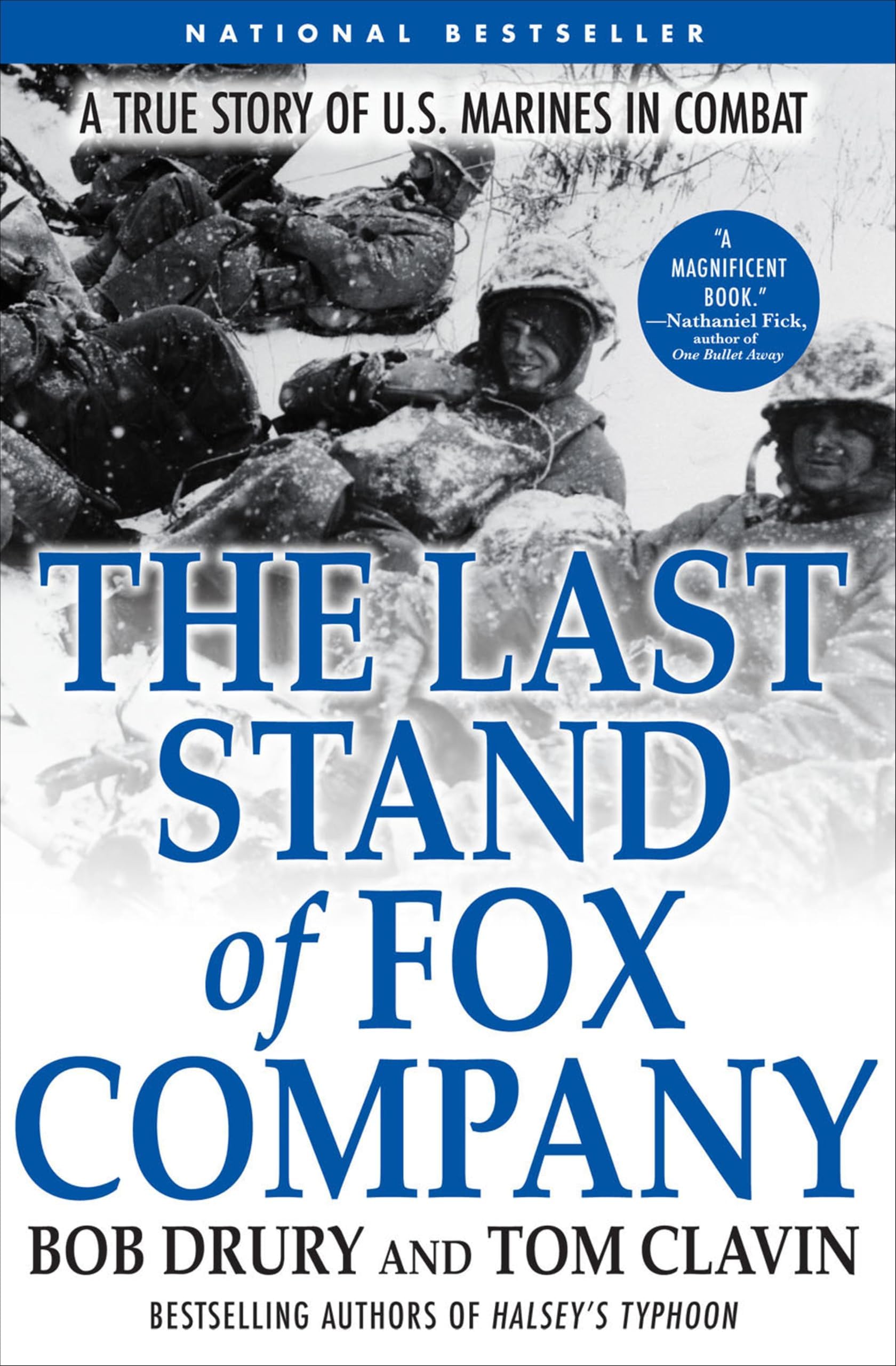
The Last Stand of Fox Company: A True Story of U.S. Marines in Combat
Product ID: 124091618
"The authors of the bestselling Halsey's Typhoon do a fine job recounting one brutal, small-unit action during the Korean War's darkest moment." — Publishers Weekly November 1950, the Korean Peninsula. After General MacArthur ignores Mao's warnings and pushes his UN forces deeper into North Korea, his 10,000 First Division Marines find themselves surrounded and hopelessly outnumbered by 100,000 Chinese soldiers near the Chosin Reservoir. Their only chance for survival is to fight their way south through the Toktong Pass, a narrow gorge that will need to be held open at all costs. The mission is handed to Captain William Barber and the 234 Marines of Fox Company, a courageous but undermanned unit of the First Marines. Barber and his men climb seven miles of frozen terrain to a rocky promontory overlooking the pass, where they will endure four days and five nights of nearly continuous Chinese attempts to take Fox Hill. Amid the relentless violence, three-quarters of Fox's Marines are killed, wounded, or captured. Just when it looks like they will be overrun, Lt. Colonel Raymond Davis, a fearless Marine officer who is fighting south from Chosin, volunteers to lead a daring mission that will seek to cut a hole in the Chinese lines and relieve the men of Fox. This is a fast-paced and gripping account of heroism in the face of impossible odds. Review: Excellent book about the challenges of the Korean War. - This is an excellent book about one of the most important battles of the Korean War in 1950. This book is well researched and well written. The book presents a clear story of the realities of fighting in mountainous terrain and in exceptionally cold weather. Review: Riveting and Visceral - Of all the accounts of specific battles of the Korean War, none are more vivid, riveting, and intense as the one described in The Last Stand of Fox Company: A True Story of US Marines in Combat. The authors place you right there with the Marines on Fox Hill in one of the most gallant, heroic stands of the Korean War. Although there have been numerous firsthand accounts of the war, specifically Martin Russ's The Last Parallel: A Marine's War Journal and Joe Owen's Colder than Hell, The Last Stand of Fox Company: A True Story of US Marines in Combat deserves a place among these classic accounts of the conflict. To be sure, the authors describe the horrors of those days and nights on Fox Hill from the perspective of the men who fought, survived, and died there. You shiver when you read how cold it was for the men; you almost can hear the bullets whizzing overhead, smell the cordite in the air and breathe a sigh of relief when the men of Fox Company survive another night. The authors excel in their detailed accounts of battle that allows readers to have some basic understanding of what it was like for the Marines on the hill as they fought to stay alive, surviving one attack after another, until help arrived. In 2000, as a feature writer for the Korea Times, the oldest English language newspaper in Korea, I had the honor to meet two of the men who survived that ordeal: General (ret.) Raymond Davis, who led the rescue mission from Yudam-ni, and Henry Danilowski, who was a member of Fox Company. I was covering one of the Korean War commemorative events, which just happened to fall on a frigid Veteran's Day, in the Yongsan Garrison in Seoul. Davis talked about how treacherous it was for him to lead his men, the ridgerunners, over those frozen, craggy ridges to rescue Fox Company. The soft-spoken Davis, stopped a few times as he recalled that mission and that night, his voice filled with emotion when he described how the sudden appearance of a star in the sky on that very dark night was a sign that he and his men would reach the beleaguered men of Fox Company and survive that night as well as how he hoped he could return to Hagaru-ri one day and bring back the Marines still buried there. If you want to remember and honor those men who fought in this so-called "forgotten war" this is one book that should be at the top of your list. Jeffrey Miller, Author of the Korean War novel, War Remains
| Best Sellers Rank | #192,598 in Kindle Store ( See Top 100 in Kindle Store ) #4 in Korean War History (Books) #13 in Korean War History (Kindle Store) #210 in American Military History |
J**N
Excellent book about the challenges of the Korean War.
This is an excellent book about one of the most important battles of the Korean War in 1950. This book is well researched and well written. The book presents a clear story of the realities of fighting in mountainous terrain and in exceptionally cold weather.
J**R
Riveting and Visceral
Of all the accounts of specific battles of the Korean War, none are more vivid, riveting, and intense as the one described in The Last Stand of Fox Company: A True Story of US Marines in Combat. The authors place you right there with the Marines on Fox Hill in one of the most gallant, heroic stands of the Korean War. Although there have been numerous firsthand accounts of the war, specifically Martin Russ's The Last Parallel: A Marine's War Journal and Joe Owen's Colder than Hell, The Last Stand of Fox Company: A True Story of US Marines in Combat deserves a place among these classic accounts of the conflict. To be sure, the authors describe the horrors of those days and nights on Fox Hill from the perspective of the men who fought, survived, and died there. You shiver when you read how cold it was for the men; you almost can hear the bullets whizzing overhead, smell the cordite in the air and breathe a sigh of relief when the men of Fox Company survive another night. The authors excel in their detailed accounts of battle that allows readers to have some basic understanding of what it was like for the Marines on the hill as they fought to stay alive, surviving one attack after another, until help arrived. In 2000, as a feature writer for the Korea Times, the oldest English language newspaper in Korea, I had the honor to meet two of the men who survived that ordeal: General (ret.) Raymond Davis, who led the rescue mission from Yudam-ni, and Henry Danilowski, who was a member of Fox Company. I was covering one of the Korean War commemorative events, which just happened to fall on a frigid Veteran's Day, in the Yongsan Garrison in Seoul. Davis talked about how treacherous it was for him to lead his men, the ridgerunners, over those frozen, craggy ridges to rescue Fox Company. The soft-spoken Davis, stopped a few times as he recalled that mission and that night, his voice filled with emotion when he described how the sudden appearance of a star in the sky on that very dark night was a sign that he and his men would reach the beleaguered men of Fox Company and survive that night as well as how he hoped he could return to Hagaru-ri one day and bring back the Marines still buried there. If you want to remember and honor those men who fought in this so-called "forgotten war" this is one book that should be at the top of your list. Jeffrey Miller, Author of the Korean War novel, War Remains
H**V
The Best Account of the Chosin Reservoir Breakout I have read yet. A must read. :0)
With the proliferation of first person, common-soldier accounts it is easy to assume this style of history is becoming a bit worn. Fortunately, this book which was first published in 2008 breathes new life into this genre. While it is full of action and memorable characters, the authors' ability to develop these characters while keeping track of the local situation and putting the conflict in its global Cold War context is outstanding. In a very crisp, flowing narrative you come to know these characters backgrounds, their individual and group struggles during some of the war's most brutal fighting, and then are treated with excellent summaries of each men's lives (very much in Paul Harvey's "and that's the rest of the story" style). The American military's breakout from encirclement by Chinese Communist Forces in the Chosin Reservoir area was a mixed bag at best with Army units disintegrating into small groups of armed men and the Marines succeeding to remain in cohesive units albeit suffering great casualties as well. I have previously read accounts of both Army and Marine Corps units in this action, but I must say this book is the best written of them all. I highly recommend The Last Stand of Fox Company to anyone interested in people's reactions to extreme situations, the Korean War, United States Marine Corps history, or just military history in general.
R**Z
There's no way, no how they should have won. But they did!
t was a last stand for more than one side in World War II. On one side of the equation was the last of the Imperial Japanese Navy. But what a group of lasts. It included the mightiest battleship in the world, the Yamamoto, several other battleships, cruisers, and destroyers. Their mission, to catch transports loaded with supplies and troops and sink them, and then to blast the beachhead the American Marines had in the Philippines. Through brilliant tactics and deception, they lured away the American aircraft carriers and heavy warships so that when their task force of battleships, cruisers, and destroyers arrived, only a few small ships stood between them and the transports and Marines. On the other side of the equation, a handful of destroyers, destroyer escorts, and escort carriers. They called these small ships “Tin Cans” since they had minimal armor, and small guns. They were ships that were never built with the idea of going up against battleships. Horribly outgunned, outnumbered, and with no prospect except death, this handful of men and machines began a fight they couldn’t win, and fought it to the death. Based upon interviews, and official records, Hornfischer paints a picture of courage under fire. Of men somehow snatching victory from defeat, and those same victors spending two hellish days in the water clinging to hope and survival in a situation where there is no hope except death. This is easily one of my favorite books, and I recall vividly the first time I read it. I had a friend at Denver Seminary who was a history buff. I told her about it, and she looks at me with wide eyes, and says, “My father was on the USS Johnston.” The Johnston was one of the destroyers at that fight, and she it was at the center of it. Her father never spoke of the battle, she said, but now that he was gone, she might learn something about what he went through. All I could do was put out my hand and say, “It’s a pleasure to shake the hand of the daughter of one of those men.” A perfectly awesome book for the history buff, filled cover to cover with humanity at it’s very best.
R**S
The Fox Company-Braver than the 300
Robert Drury and Tom Clavin's "The Last Stand of Fox Company" is a superb account of a forgotten battle during the Korean War, at which 246 men held off thousands of Chinese Communist troops. Fighting in thirty below zero temperature, the vastly outnumbered Americans, using every manner of weapon at hand, stood their ground until a force of 500 cut a hole in Chinese lines, releaving the surviving members of Fox Company. As in their excellent, but somewhat derivative "Halsey's Typhoon." the authors list the names of the men of Fox Company, a painstaking effort that gives life to the men who fought in what is now known as American's "forgotten war." At the famous battle of Thermopylae, at which the vastly outnumbered Greeks held off the Persians, the famous "300" Spartans were, in actualty, joined by several thousand other Greek soldiers, whereas at "Fox Hill," there were no other troops besides the 246 Marine and Navy men against the Chinese hoards. We know now that these Chinese troops were originally members of the defeated Nationalist army who were used by Mao Tse Tung to fight in Korea. He didn't care how may of them died. Mao was determined for China to be a world power and for his Communist Party to be on an equal terms with Stalin's. Meanwhile, Stalin, who encouraged the invasion by the North Koreans and China's intervention, wanted to assert himself as the undisputed ruler of the Communist world. Most people don't remember, but it was Stalin's mistake of boycotting the Security Council, that led it to adopt a resolution calling for a United Nations force to repel the invasion of South Korean by North Korea. When the Soviets finally returned to veto any further support for the troops, Truman outmanoevered them by getting the General Assembly to adopt a "uniting for peace" resolution that enabled the United Nations force to fight on. The American forces were part of this United Nations effort to stop the Communist aggression and they fought under the United Nations banner. As Drury and Clavin so brilliantly illustrate, the American troops fought valiantly, without regard to themselves, as most of them were cut down. Any military history of America would be incomplete without this magnificent book. How America has managed to produce such anonymous heroes in time of war is one of the great success stories of the country, and it is to Drury and Clavin's great credit that they recount this story of a battle that helped turn the tide in Korea, giving a face to each of those who fought. I would suggest that after reading this outstanding book, one should visit the Korean War Memorial in Washington. It is unlike any other memorial in the nation's capital. What you will see is a battlefield, with American troops, realistic statues, in combat mode in the mist. It is positively eerie, but also appropriate, as it reminds us of the conditions in which they fought. War is indeed hell, as Sherman told us, and nowhere is this reality more accurately portrayed than in "The Last Stand at Fox Hill."
F**R
Excellent account of an important marine battle of Korean War
This is one of the best historical war books I’ve read (and I’ve read many). The book is quite limited in scope as it covers the fighting by about 240 marines as they try to hold a hill for about a week. Why bother to hold one lousy hill for just a week? Because China’s sudden, surprising entry into the war threatened to cut off the fighting retreat of thousands of marines away from the Chosin Reservoir. So the book provides some historical background, but the book’s focus is on the marines themselves and their tenuous efforts to hold out against the Chinese’s vastly numerically-superior forces. The conditions they were fighting under were horrendous. Temperatures as low as -20 deg F. Some guns were too frozen to fire. Some grenades were too frozen to explode. Frostbite was a constant concern. The only positive was that some wounded didn’t bleed to death because their bleeding wounds froze closed. It’s hard to imagine more inhospitable conditions. But most important, this book focused on the individual marines doing the fighting. For some of the marines, there was a small but personal bit of background so that each of those marines could be seen as an individual rather than just a name. But many died. And many were wounded. Still, some survived. And it seemed like the reader learns the fate of nearly every one of those marines. So this book is one of the most personal war histories I’ve read (that isn’t a one-man account such as “With the Old Breed”). Bottom line: One of the most personal war histories I’ve read.
D**R
An Amazing account of the exploits of Fox Co during the battle of the Chosin Reservoir
Simply an incredible book, of the valor of the Marines of Fox Co, in the Korean War during the battle of the Chosen Reservoir. I'd heard and had become marginally familiar with what happened during the Korean War, when MacArthur disregarded intelligence and warnings that the Chinese would enter the war on behalf of the then defeated North Koreans, should the USA got near/to the Yalu River. The Chinese did and swarmed the American lines, outnumbering them by what 10, 25, 100 to one? Who knows for sure. What is for certain is the valor, bravery, fighting spirit, the esprit de corps of Fox Company and others that fought in spite of overwhelming numerical odds, in weather fit for the South Pole - who can live yet alone fight in actual temperatures of -25 to - 35 below zero?! If you read no other book on the Korean War, I suggest you choose this one. At the end I was simply in tears and even now as I type this, thinking about the accounts of the haggard, frostbitten and in many cases also walking wounded marines, that, having defended the escape route for the Americans around the Chosin Reservoir, when "marching" into the Hagaru-ri Supply Station/Airfield, "throats dry and raw, the entire company picked up the Marine Corps tune with each man singing" as best they could : "From he halls of Montezuma to the shores of Tripoli"...." Simply Amazing.
J**N
An excellent tribute to the men who fought and died for their country
When two writers combine to write a historical work, you know they’ve succeeded when a reader only wants to start the book and finds themselves fully immersed and 33% completed in the first sitting, only interrupted because one has to awaken the next day to pay the bills. Bob Drury and Tom Clavin have done an excellent job in introducing readers to the one of the calamitous and hair-raising battles of the Marine Corps in the Forgotten War. For many, including the show MASH, which I enjoyed until Alan Alda took it over, Korea was dubbed a Police Action. Ask the men who fought there if it was a Police Action or a full-blown war? In the Grand Strategy sense and the weapons allocated it was not on the scale of WWI or WWII but for the ground solider it was just as vicious and nasty as Peleliu, Iwo Jima, Belleau Wood and Tarawa. Rather than spend time introducing us to the actual men who fought and the strategies to be incorporated, the authors throw the reader right into the fight and are relentless in the delivery which is an excellent approach. As the story un-folds we are introduced to the heroes who lived and died on the western shores of the Chosin Resevoir in the most inhospitable weather imaginable. That’s right, even worse than Stalingrad. It is amazing that any of the men walked out of their alive to recant their experiences in this desolate plain in Northern Korea. I cannot recommend this book enough to those who want a taste of what Korea was like and the men who represented the United States Marine Corps in one if its most trying battles. Without a doubt, FIVE STARS!
M**S
En anglais mais un concentré de combat en Corée.
Puissant ! Le récit le plus détaillé, le plus puissant concernant le combat Marines contre chinois en Corée, 1950. Les témoignages multiplient l'impression d'oppression du combat que l'on touche du doigt. Attention, ce livre se concentre exclusivement sur les combats menés par la Fox company sur la colline de Toktong pass du 27 au 4 décembre. Il illustre presque charnellement et avec force les combats ultra violents ayant eu lieu entre les innombrables soldats chinois et une compagnie de Marines américains gonflés de jeunes réservistes envoyés brutalement à la guerre. En résumé : Une position qui doit être tenue à tout prix pour sauver leurs camarades. (pour les forces de l'ONU) Une position qui doit être conquise à tout prix pour liquider la 1 division de Marines (pour l'armée populaire chinoise). Le froid, l'absence de soutien (au début s'entend), l'impact de l'attaque (des attaques), la trivialité de la guerre, la mort et les blessures, les gelures, les armes enrayées, les hommes qui ronflent écrasés de fatigue en pleine bataille, les conduites héroïques banales tellement elles sont constantes. Les membres de l'USMC ont pour eux une résistance aux privations, au froid, une combativité surprenante pour ces jeunes soldats, civils 4 mois auparavant. A méditer pour ceux qui doutent des capacités des militaires de réserve ... A lire - en anglais - par ceux qui s'intéressent à la "forgotten war" et à la capacité de résistance, de résignation, d'abnégation, de combativité du soldat chinois, digne d'admiration.
M**N
Hard to put down
Great reading. True courage and resilience.
S**S
An incredible true story of the bravest of the brave.
Outstanding book, an amazing recollection of heroics that almost seem impossible to believe that it really happened. An honour to read.
Y**S
Five Stars
Excellent book
Trustpilot
3 weeks ago
1 month ago