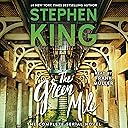

Masterfully told and as suspenseful as it is haunting, The Green Mile is Stephen King’s classic #1 New York Times bestselling dramatic serial novel and inspiration for the Oscar-nominated film starring Tom Hanks. Welcome to Cold Mountain Penitentiary, home to the Depression-worn men of E Block. Convicted killers all, each awaits his turn to walk “the Green Mile,” the lime-colored linoleum corridor leading to a final meeting with Old Sparky, Cold Mountain’s electric chair. Prison guard Paul Edgecombe has seen his share of oddities over the years working the Mile, but he’s never seen anything like John Coffey—a man with the body of a giant and the mind of a child, condemned for a crime terrifying in its violence and shocking in its depravity. And in this place of ultimate retribution, Edgecombe is about to discover the terrible, wondrous truth about John Coffey—a truth that will challenge his most cherished beliefs… Review: Walking the Green Mile After Mockingbird - After finishing To Kill a Mockingbird, I decided to read The Green Mile because both stories take place around the same time period. I wanted to continue exploring that world and see how different writers depict justice and humanity in the 1930s. My first challenge was the language. Stephen King’s style included strong Southern dialects and expressions I wasn’t familiar with, which slowed me down. I switched to the Russian translation, but it felt dull and lifeless—the emotional depth just wasn’t there. So I went back to the English version, and after about a hundred pages I started to understand more and more. I read faster, enjoyed it deeply, and soon couldn’t stop. The story completely drew me in. I found myself thinking about it all the time, visualizing the prison block, the guards, and their humanity. The themes haunted me—they were heavy, emotional, and deeply psychological. The novel works on several layers: life in the nursing home where an old Paul Edgecombe reflects on his past, the death row cell block where moral lines blur, and the intense spiritual symbolism that threads through everything. King’s imagination is enormous. I still wonder how he managed to weave together so many powerful moments, all connected like puzzle pieces. While reading, there were times when I was overwhelmed with emotion. I cried when John Coffey healed Melinda—it was such a moment of grace in a place full of death. I truly believed that Paul and his team might somehow help John escape. But then John spoke with such heartbreaking exhaustion, saying he was tired of the pain and cruelty in the world, tired of hearing and feeling so much suffering that it hurt like shards of glass in his mind. His words captured the unbearable emotional weight he carried. That moment shattered me; it was both devastating and beautiful. Both To Kill a Mockingbird and The Green Mile are about injustice set against the backdrop of 1930s America, yet King’s story feels more intense and direct. To Kill a Mockingbird won the Pulitzer Prize for its brilliant portrayal of racial and moral conflict, but The Green Mile goes even deeper into the heart of human cruelty and compassion. In both stories, the Black characters—John Coffey and Tom Robinson—represent goodness and innocence, while many white characters embody prejudice, fear, and ignorance. I am deeply glad I read these two books one after the other. They mirror each other, and together they taught me something vital about empathy and the complexity of justice. The Green Mile is not only a psychological thriller; it’s also a story about mercy, sacrifice, and the unbearable beauty of kindness in the face of despair. It’s one of those books that stays with you long after you finish the last page. Review: Haunting and beautiful and sad - Oh my, such a beautiful and haunting story. So sad too. And wonderfully written. Find peace, Paul Edgecombe. Find peace John Coffey. Find peace all the other good characters. Not Percy and not Brad, though.
V**N
Walking the Green Mile After Mockingbird
After finishing To Kill a Mockingbird, I decided to read The Green Mile because both stories take place around the same time period. I wanted to continue exploring that world and see how different writers depict justice and humanity in the 1930s. My first challenge was the language. Stephen King’s style included strong Southern dialects and expressions I wasn’t familiar with, which slowed me down. I switched to the Russian translation, but it felt dull and lifeless—the emotional depth just wasn’t there. So I went back to the English version, and after about a hundred pages I started to understand more and more. I read faster, enjoyed it deeply, and soon couldn’t stop. The story completely drew me in. I found myself thinking about it all the time, visualizing the prison block, the guards, and their humanity. The themes haunted me—they were heavy, emotional, and deeply psychological. The novel works on several layers: life in the nursing home where an old Paul Edgecombe reflects on his past, the death row cell block where moral lines blur, and the intense spiritual symbolism that threads through everything. King’s imagination is enormous. I still wonder how he managed to weave together so many powerful moments, all connected like puzzle pieces. While reading, there were times when I was overwhelmed with emotion. I cried when John Coffey healed Melinda—it was such a moment of grace in a place full of death. I truly believed that Paul and his team might somehow help John escape. But then John spoke with such heartbreaking exhaustion, saying he was tired of the pain and cruelty in the world, tired of hearing and feeling so much suffering that it hurt like shards of glass in his mind. His words captured the unbearable emotional weight he carried. That moment shattered me; it was both devastating and beautiful. Both To Kill a Mockingbird and The Green Mile are about injustice set against the backdrop of 1930s America, yet King’s story feels more intense and direct. To Kill a Mockingbird won the Pulitzer Prize for its brilliant portrayal of racial and moral conflict, but The Green Mile goes even deeper into the heart of human cruelty and compassion. In both stories, the Black characters—John Coffey and Tom Robinson—represent goodness and innocence, while many white characters embody prejudice, fear, and ignorance. I am deeply glad I read these two books one after the other. They mirror each other, and together they taught me something vital about empathy and the complexity of justice. The Green Mile is not only a psychological thriller; it’s also a story about mercy, sacrifice, and the unbearable beauty of kindness in the face of despair. It’s one of those books that stays with you long after you finish the last page.
K**T
Haunting and beautiful and sad
Oh my, such a beautiful and haunting story. So sad too. And wonderfully written. Find peace, Paul Edgecombe. Find peace John Coffey. Find peace all the other good characters. Not Percy and not Brad, though.
K**G
Great book in great shape!
Its a book!!!
A**Y
A Classic That's Still Amazing
If you've seen the award-winning movie with Tom Hanks, then by and large, you know exactly what to expect from this book. That's not to say you shouldn't read this book for fear it will be redundant. In fact, I would almost advise you to watch the movie first, then read the book. The movie recreates the novel almost scene for scene, so much so that, barring some minor omissions, the movie quotes much of the dialogue verbatim. I say watch the movie first because when you read the book, you'll compulsively imagine each of the characters using the actor that portrayed them in the film. Each actor that was cast was PERFECT for the character as they're described in "The Green Mile", so for those who have trouble transforming words into a face and accent, the movie helps out a lot. A word of caution though: while 3/4s of the novel is translated to film almost perfectly, the movie cuts out multiple scenes that occur later in the book, and ultimately changes the ending quite extensively ... and that's for the better. The final scenes in the book are good, without a doubt, but in comparison to the film, somewhat lacking for dramatic impact. Additionally, there is a chapter at the very end of the book that, really, can just be ignored, as it feels tacked on and doesn't add anything to the rest of the story. If you're familiar with, and have read Stephen King's work, then in many ways you know what to expect from this novel: dialogue, including slang and vernacular, are handled beautifully in this novel, and as always, makes you feel like someone you know is relating this story to you. In the case of "The Green Mile", this is especially true since this is one of King's only books to use the first person perspective throughout. And it's not simply that instead of a lot of third person phrasing it uses first person phrasing, but that the narrator himself is truly a character both within and outside the story. What I mean by this is that "The Green Mile" takes the format of an old man recalling, bit by bit, his experiences from 60 years prior. As would be befitting of something like this, this means the narrative is frequently interjected with frank opinions, incongruous recollections, and general use of slang that makes it feel exactly like a real person is recalling a real set of memories. To some this might make the story somewhat confusing; at times, the narrative doubles back on itself (though this is mostly an artifict of the conversion from serial novella to one piece novel), and each chapter begins in the present day before flipping back to the 1930s. Unlike many of King's novels, this story is largely devoid of any monsters, aliens, or magical happenings. In fact, other than a few scenes (possibly a half-dozen in number or so), this story reads mostly as a period piece centered around one strange man's time on death row. But this isn't a bad thing at all; this story is still incredibly compelling, reading like a combination of a character study and a classic mystery tale. The eventual plot twist heigtens the drama and throws things for a loop, which makes the conclusion of both the 1930s plot, and the current day plot nothing short of memorable to a degree that might bring forth a few tears. I would definitely advise that you leave yourself an hour or so to read right through the final chapters of the novel to avoid interrupting the pace and emotional impact.
A**E
The best of Stephen King
Stephen King should stick to writing these sorts of books. Don't get me wrong, I love most of his horror stuff, but it's this sort of subtle supernatural genre that I think really shows his talents as a writer and story-teller since the horror element isn't overshadowing everything else within the novel. The Green Mile is a little long, being comprised of 6 novellas and it is definitely slow-paced. That doesn't mean it isn't exciting, though! The slowness of the story really allowed me to delve into the characters and the story King has created. I felt like I got to know all the characters, especially Paul, whose first-person narrative it is. This made the action parts even better, since I had a connection with the characters and cared about them. I liked how the narrative jumped from Paul as an old man living in a nursing home to Paul as a middle-aged man meeting John Coffey. I think it added a lot to the intrigue, as there were multiple mysteries you were trying to solve at once. The Green Mile has a great message and is a compelling story that will leave you in tears by the end. I saw the movie before reading the book and honestly, if you've seen the movie, the novel won't add all that much for you. The movie is very true to the book and captures the most important events. Naturally, the book has other elements that added to my appreciation of the story. The parallelism between the prison and Paul's nursing home, for example, and a deeper understanding of the characters. There were some things I didn't like -- like I said, the pace sometimes seemed too slow at times. But then again, King's books always seem to drag just a little bit for me. I also didn't like how at times the characters all laughed at something as if it were hilarious, and I didn't think it was funny at all. Besides that, though, it was a good story and I enjoyed the read. I definitely recommend this.
G**M
Comparing the Paperback and Video Versions
I've a project to read two books by each of the ten novelists who will be lecturing at the Maui Writers Conference this summer. When I finished The Blackstone Chronicles by John Saul, a serial horror novel which the author says he was encouraged to write by King's success with The Green Mile, I took a break to engage in another pending project; to compare the book and video versions of The Green Mile. My stepdaughter is an avid reader and a Stephen King fan. After enjoying the video version of The Green Mile, I asked her if the book was significantly different. She said it was very similar, but varied in some respects. It occurred to me that comparing the two might be helpful in understanding the difference between book and script writing. It was. Both the movie and the book are five-star. Despite their similarities, they have a different feel, and doing both is a worthy endeavor. I recommend you read the book first, but that's not crucial. My review technique was to read about a scene, study its video version and then read some more; I used the rewind button frequently. This method percolates up some interesting trivialities. In the movie, Coffey says, "as lonely as a sparrow in the rain," but in the book he says "as lonely as a robin in the rain." King is an expert writer in every respect, and I'm certain his research is faithfully done. I suspect "robin" was a boo-boo though. Stephen King hangs out in New England, where robins are plentiful. Coffey is a southern boy, and not too bright. He never saw a robin. Another triviality that smacks of a research problem is the year. The events in the book happen in 1932, whereas the movie is set in 1935. Some Hollywood sharpie may have noted that a crucial prop was not available in 1932. I couldn't spot the problem, perhaps because I wasn't born until 1936. Maybe the clip from the Fred Astaire movie shifted the date. Although watching movies in the "Resource Room" at the Georgia Pines home for "wayward droolers" is featured in the book, the tear-jerking dancing scene is not. Congratulations Hollywood, you gave me a real Kleenex moment. I doubt if even a master like Steven King could write that cry, however, or even want to. Hollywood has the advantages of sight and sound to stir our emotions. Movies, after all, are drama; a combination of facial expressions, artful camerawork and musical scoring designed to grab us in the groin. Writing, on the other hand, can suck us into the minds of the characters, and make us think. That is why I say the feel of the two versions, two unlike mediums, is different. This is a story about death. While reading the book, I shuddered on occasion with a sense of mortality, my mortality. King made me droop his book onto my lap as I stared at the willow tree out back, he having reminded me that my time is running out. The video, on the other hand, often had me wiping my eyes, as much from laughter as the pathos, the response to good actors playing out a predicament and making it feel real. Still, even with the facilities of the pause and rewind buttons, the movie is about this scene, then the next one, and moving right along. How often have you walked out of the theater after the show before you could begin to think about it? The acting is excellent. Expressions, pauses, posture and stutters suggest what is going on in the character's head, but they cannot compete with the power of the written word. When Paul and his wife visit Melinda, who is dying from a brain tumor, King writes for Paul: "...my eye happened on the blue hearth rug by the fireplace. It occurred to me that it should have the shade of tired old limes, because now this room was just another version of the Green Mile." Hollywood can't do that. Writers work with protagonists, whereas scriptwriters work with stars. Although the movie dialogue is usually verbatim the book, the best lines from Brutus and Dean, like "What happens on the Mile, stays on the Mile," are given to Tom Hanks. In the book, when Brutus and Paul (Hanks) confront Percy in the room with Old Sparky, Percy drives the end of the scene and forces the handshake. In the movie, Tom Hanks never loses control of the altercation. Hollywood's tendency to sharply distinguish between its villains and heroes sometimes overly exaggerates reality, although it was not offensive in this case. There are some subtle differences for the role of women. In the book, King points out that only two women attended Delacroix's execution; there are several in the movie. In the book, Paul's wife pointedly excuses herself when the men plan their risky mission, whereas in the movie she is an influential participant. Hollywood, I suppose, is more politically sensitive than King. There are only two major differences between the two works. In the book, Paul sleuths the solution to uncertainties about the death of the Detterick twins. The movie accomplishes this with dramatic visualization by making one of King's incrediblenesses more incredible. I prefer King's version; too much hard to believe stuff upsets my stomach. The other significant difference is that the movie version eliminates the sub-story with Brad Dolan, the Georgia Pines orderly. To me, this is an important plot echo, a twist on the theme of mortality. Its omission underscores the difference between the two forms, the visual versus the thoughtful. Similarly, after reading the book, you might remember what John Coffey said about Old Sparky; "They're still in there. I hear them screaming." King put it in Italics; the movie left it out. As an amateur (i.e. unpublished) novelist, I sought to understand the difference between book and script writing. I found my answer just as the credits began scrolling up the tube. "Screenplay written by Frank Darabont, based on a novel by Steven King."
W**A
The Green Mile
great book
N**N
The Green Mile
Wonderful story.
H**E
brilliant
I found this book to be just as good as the film, if not better, and could easily fit the characters from the film into Stephen King's original characters. I normally like to read the book first! I thought it a thought provoking book on good and evil, the use and nature of the electric chair and the process of the law. A VERY readable book which I could not put down.
ひ**ん
美品で感動
映画の感動をより深く味わいました。Stephen Kingの小説はどれもいいですね。
E**K
Too long‼️‼️‼️‼️
I couldn’t finish it……
C**L
Instigante
Livros de Stephen King são excelentes e este é muito bom.
G**N
A masterpiece.
I have just finished The Green Mile by Stephen King and can honestly say it is one of the finest books I have ever read. The last 150 pages flew by in one mega session as I literally had to know what happened in the end. I now intend to watch the film version and will be well pleased and amazed if it’s half the quality of the book. When Negro John Coffy (I only use this term because it is relevant to the story) is found covered with blood carrying two naked young dead white girls he is quickly found guilty and convicted of rape and murder. He is sentenced to death and sent to Cold Mountain’s death row. However head Warder Paul Edgecombe feels there may be more to his story and suspects that the authorities perhaps didn’t look into this “simple open and shut case” with as much enthusiasm and vigour as they should have. Did racial prejudice prevent an open and free investigation, or is he projecting early feelings about his personal role in state authorised murder? When an extraordinary event happens in John’s cell Paul starts to feel something remarkable may be happening, something he can’t explain with the logic he has always applied diligently to his work. His life is slowly turned upside down and he begins to question his role in the execution of prisoners and in particular his latest inmate with a scheduled meeting with the electric chair or old sparky as it’s referred to by inmates and officers alike. Set in 1932, but often told in flashback from a much later date, Kings power to create real flesh and blood characters and totally believable situations is uncanny. His use of jargon, colloquialisms, and relevant popular expressions and to also pepper the narrative with cultural references emphasises and reinforces your belief that you are in 1932 among the walking dead awaiting that last walk along the Green Mile. The richness of the prose is almost intoxicating. Kings regular use of time travel, sometimes an irritation, is well suited to this beautifully told tale which is essentially the journal of a very old man recounting his days as a prison officer when “frying” prisoners was quite normal. His other tricksy habits have been abandoned for a straight forward story (apart from the time travel) except for the occasional doubling up of narrative. New chapters occasionally start with some of the last chapters end pages. I suppose this is because this book was originally issued as 5 or 6 short novelettes and then finally issued as a single volume. I must admit however that in one volume it’s redundant and should have been edited. If I’m missing something let me know. There is no doubt that The Green Mile is a sad tale about, rape, murder, prejudice, execution, cowardice, but it’s also about goodness, bravery, honesty, courage, duty and it’s these themes I took away from a book that I don’t think I’II ever forget.
Trustpilot
2 weeks ago
1 month ago