
Desertcart purchases this item on your behalf and handles shipping, customs, and support to Nicaragua.
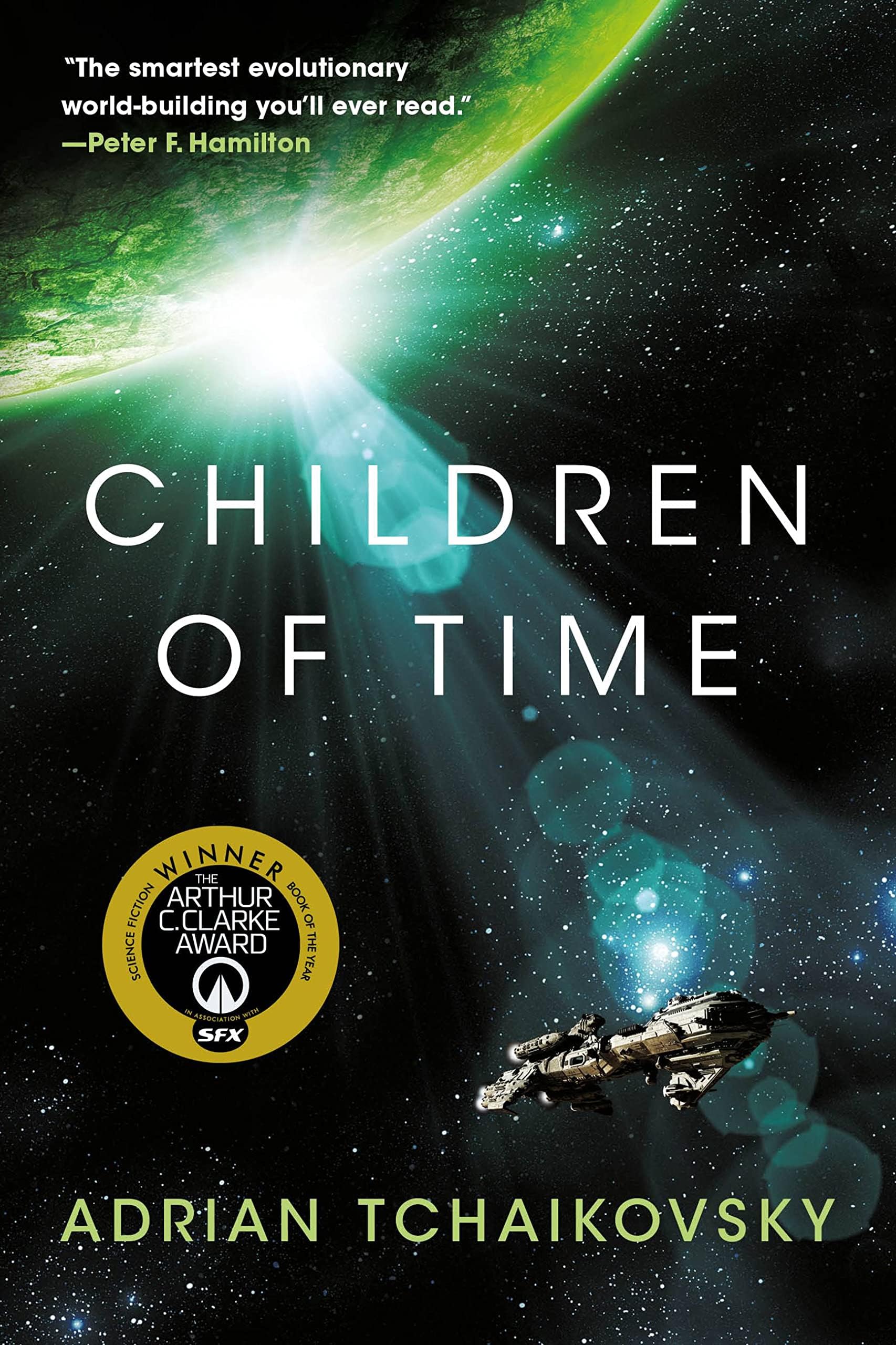
Adrian Tchaikovsky's Arthur C. Clarke Award-winning novel Children of Time is the epic story of humanity's battle for survival on a terraformed planet. The last remnants of the human race left a dying Earth, desperate to find a new home among the stars. Following in the footsteps of their ancestors, they discover the greatest treasure of the past age -- a world terraformed and prepared for human life. But all is not right in this new Eden. In the long years since the planet was abandoned, the work of its architects has borne disastrous fruit. The planet is not waiting for them, pristine and unoccupied. New masters have turned it from a refuge into mankind's worst nightmare. Now two civilizations are on a collision course, both testing the boundaries of what they will do to survive. As the fate of humanity hangs in the balance, who are the true heirs of this new Earth? Review: Stunning stories of two worlds colliding - I absolutely loved the back and forth between two different species trying to live on a plane together. The time jumps of the spiders over time, from wild animals to barbaric to civilized societies was great fun. The creativity and challenges faced by a spider society were well made and original. Similarly, the human crew on the Gilgamesh flying through space for a home offered a human experience on a large problem. The ending in particular was wildly original. I thought it would devolve into mindless violence, but the author surprised me with a twist ending. A great stand alone novel that is worth reading. Review: Brilliant, Unputdownable, and Well-Constructed, if Ultimately Disappointing—Read it! - About 15 years ago, after being disappointed by the ending of the Wachowskis' Matrix movies, it occurred to me that it would have been much more satisfying to learn that The Machines were not "machines" at all, but instead the engineered descendants of elite humans, whose will and consciousness they still embodied. That story could have been a powerful fable of the ways that people abuse and entrap each other into diseased social relations, and how true peace would have entailed a reunification of a species separated so long ago. Instead it was just a muddled and one-sided story of revolution against—what? Oppressive "systems" personified? So, after getting past the first few ham-handed pages of Adrian Tchaikovsky's Children of Time, and the bodily antics of the weirdly juvenile, unbelievably flat, and deeply unlikable Avrana Kern—who plays better as a garbled piece of software than as a physical person—I was excited for the possibilities implied by the setup. "Did Tchaikovsky have the same response to the Matrix movies that I did, but more productively?" I wondered. The book is extremely well-paced, with reasonably short chapters alternating between two narratives that are obviously racing toward each other. I mention the shortness of the chapters because, for me, there was hardly a likable character in the book, and the short chapters, alternating between such different stories, compensated for that. Of the spiders, the eccentric Bianca was probably the one I came closest to really liking. Among the humans, Holsten Mason, the "classicist," is about as likable as any of them got. But even he seems pretty drab, and not really believable as a classist, but seeming more as I suppose a scientist or an engineer might imagine a classicist. And that, unfortunately, is too often a weakness in this genre; It is difficult to find well-written students of the humanities in science fiction. There are excellent exceptions, and I might be painting with too broad a brush. But while writers and readers of science fiction like to hold out the genre as a way to explore the implications of science and technology, it seems to me far better as a vehicle to explore the implications for human persons not just of possible technologies and possible scientific facts, but of the cultural and economic structures for knowing and authority, and for the creation of meaning and morality, as those things are shaped by scientific and technological mindsets and practices. Which sets me on the path to unfolding the biggest disappointment of the book. But let me first qualify that the magnitude of the disappointment is directly proportional to the strength of Tchaikovsky's efforts—if I found the mountaintop lacking, it was only because he managed to scale the mountain. He clearly recognizes that science and technology only make sense when they are embedded in cultures, and has labored to create two distinct and contrasting cultures. The story of the nanovirus-infected spiders is brilliant, evocative, and stunningly well-imagined. I will come back to that. The story of the people on the generation ship Gilgamesh is a little less inspired, but solid. I would have liked to see a more penetrating examination of how exactly a "crew" hierarchy would be maintained (or make any sense at all) in such extreme circumstances. There are bits and pieces in the background of ideas about cult-like devotion, but those are tied to somewhat flat and less-than-credible foreground figures, like Vrie Guyen, who seems to be designed solely for the author to push him around mechanically and drive the plot forward (which makes his ultimate fate a little too on-the-nose, even if delightfully horrifying as a set piece). And the cult of Isa Lain just seems to appear out of nowhere, without much depth or explanation, for no persuasive reason except that it needs to be there. In other words, the parts of the book set on the Gilgamesh are standard fare for the genre, and not especially dazzling. The story of the spiders, however, is downright scintillating. If it were not so alien, it might have made a brilliant book in its own right. But it probably would have been difficult to hold readers' attention. This is another reason that Tchaikovsky was wise to set up the story so that the spider chapters are interspersed among the Gilgamesh chapters. Unlikeable though the human characters may be, their more recognizable antics are a helpful respite from the alienness of the spiders, and that allows Tchaikovsky to serve up this far more creative side of the story in manageable doses. I loved it. But for all their wonderful, web-like intelligence, and the communitarian ethic apparently instilled by the nanovirus (that somehow failed spectacularly to overcome rank sexism), all of which is vividly and persuasively imagined, the "religious" angle of their society is little more than a caricature. For all the sectarianism that happens mostly in the background (the way the cults happen mostly in the background on the Gilgamesh), I find it hard to believe that none of the spiders, in all their intricate wisdom, would have challenged the literalness of "God." Where were the spider mystics, in another words? Where the ones recognizing that, if ant colonies can be transformed into living machines, with the ability, even, to capture consciousness, and if there is such continuity in being that a "message" from beyond their world is even possible, that there must be some greater unity of existence? A "ground of being," perhaps? Maybe that is too much to ask. Maybe it would have made the book a thousand pages long, instead of just six hundred. But I think it would have been more satisfying. And it could have enabled a much more interesting version of the conflict that plays out in the final chapters of the book—more interesting, at least, than the one driven by a silly, shunted-in conversation about the Prisoner's Dilemma. A clash of civilizations precipitated by a logic game? Really? Despite having set up so much great potential for these weird, religious cultures? Just as I enjoyed but was disappointed by the Matrix movies, which could have been a piercing fable of class warfare and authentic humanity, I enjoyed but was disappointed by Children of Time, which could have been a far more interesting science fiction meditation on the "two greatest commandments"—love God, love your neighbor—and that old question, "And who is my neighbor?" Children of Time comes tantalizingly close to being that kind of a book, that uses the imaginative freedom of science fiction to press into the heart of what it means to be human in a complex, community at odds, or at least potentially at odds, with other complex communities. But it never quite crosses that line. Even so, it is brilliant, unputdownable, and definitely something that you should read.


| Best Sellers Rank | #3,412 in Books ( See Top 100 in Books ) #2 in Exploration Science Fiction #2 in First Contact Science Fiction (Books) #3 in Genetic Engineering Science Fiction (Books) |
| Customer Reviews | 4.5 out of 5 stars 51,054 Reviews |
A**R
Stunning stories of two worlds colliding
I absolutely loved the back and forth between two different species trying to live on a plane together. The time jumps of the spiders over time, from wild animals to barbaric to civilized societies was great fun. The creativity and challenges faced by a spider society were well made and original. Similarly, the human crew on the Gilgamesh flying through space for a home offered a human experience on a large problem. The ending in particular was wildly original. I thought it would devolve into mindless violence, but the author surprised me with a twist ending. A great stand alone novel that is worth reading.
P**L
Brilliant, Unputdownable, and Well-Constructed, if Ultimately Disappointing—Read it!
About 15 years ago, after being disappointed by the ending of the Wachowskis' Matrix movies, it occurred to me that it would have been much more satisfying to learn that The Machines were not "machines" at all, but instead the engineered descendants of elite humans, whose will and consciousness they still embodied. That story could have been a powerful fable of the ways that people abuse and entrap each other into diseased social relations, and how true peace would have entailed a reunification of a species separated so long ago. Instead it was just a muddled and one-sided story of revolution against—what? Oppressive "systems" personified? So, after getting past the first few ham-handed pages of Adrian Tchaikovsky's Children of Time, and the bodily antics of the weirdly juvenile, unbelievably flat, and deeply unlikable Avrana Kern—who plays better as a garbled piece of software than as a physical person—I was excited for the possibilities implied by the setup. "Did Tchaikovsky have the same response to the Matrix movies that I did, but more productively?" I wondered. The book is extremely well-paced, with reasonably short chapters alternating between two narratives that are obviously racing toward each other. I mention the shortness of the chapters because, for me, there was hardly a likable character in the book, and the short chapters, alternating between such different stories, compensated for that. Of the spiders, the eccentric Bianca was probably the one I came closest to really liking. Among the humans, Holsten Mason, the "classicist," is about as likable as any of them got. But even he seems pretty drab, and not really believable as a classist, but seeming more as I suppose a scientist or an engineer might imagine a classicist. And that, unfortunately, is too often a weakness in this genre; It is difficult to find well-written students of the humanities in science fiction. There are excellent exceptions, and I might be painting with too broad a brush. But while writers and readers of science fiction like to hold out the genre as a way to explore the implications of science and technology, it seems to me far better as a vehicle to explore the implications for human persons not just of possible technologies and possible scientific facts, but of the cultural and economic structures for knowing and authority, and for the creation of meaning and morality, as those things are shaped by scientific and technological mindsets and practices. Which sets me on the path to unfolding the biggest disappointment of the book. But let me first qualify that the magnitude of the disappointment is directly proportional to the strength of Tchaikovsky's efforts—if I found the mountaintop lacking, it was only because he managed to scale the mountain. He clearly recognizes that science and technology only make sense when they are embedded in cultures, and has labored to create two distinct and contrasting cultures. The story of the nanovirus-infected spiders is brilliant, evocative, and stunningly well-imagined. I will come back to that. The story of the people on the generation ship Gilgamesh is a little less inspired, but solid. I would have liked to see a more penetrating examination of how exactly a "crew" hierarchy would be maintained (or make any sense at all) in such extreme circumstances. There are bits and pieces in the background of ideas about cult-like devotion, but those are tied to somewhat flat and less-than-credible foreground figures, like Vrie Guyen, who seems to be designed solely for the author to push him around mechanically and drive the plot forward (which makes his ultimate fate a little too on-the-nose, even if delightfully horrifying as a set piece). And the cult of Isa Lain just seems to appear out of nowhere, without much depth or explanation, for no persuasive reason except that it needs to be there. In other words, the parts of the book set on the Gilgamesh are standard fare for the genre, and not especially dazzling. The story of the spiders, however, is downright scintillating. If it were not so alien, it might have made a brilliant book in its own right. But it probably would have been difficult to hold readers' attention. This is another reason that Tchaikovsky was wise to set up the story so that the spider chapters are interspersed among the Gilgamesh chapters. Unlikeable though the human characters may be, their more recognizable antics are a helpful respite from the alienness of the spiders, and that allows Tchaikovsky to serve up this far more creative side of the story in manageable doses. I loved it. But for all their wonderful, web-like intelligence, and the communitarian ethic apparently instilled by the nanovirus (that somehow failed spectacularly to overcome rank sexism), all of which is vividly and persuasively imagined, the "religious" angle of their society is little more than a caricature. For all the sectarianism that happens mostly in the background (the way the cults happen mostly in the background on the Gilgamesh), I find it hard to believe that none of the spiders, in all their intricate wisdom, would have challenged the literalness of "God." Where were the spider mystics, in another words? Where the ones recognizing that, if ant colonies can be transformed into living machines, with the ability, even, to capture consciousness, and if there is such continuity in being that a "message" from beyond their world is even possible, that there must be some greater unity of existence? A "ground of being," perhaps? Maybe that is too much to ask. Maybe it would have made the book a thousand pages long, instead of just six hundred. But I think it would have been more satisfying. And it could have enabled a much more interesting version of the conflict that plays out in the final chapters of the book—more interesting, at least, than the one driven by a silly, shunted-in conversation about the Prisoner's Dilemma. A clash of civilizations precipitated by a logic game? Really? Despite having set up so much great potential for these weird, religious cultures? Just as I enjoyed but was disappointed by the Matrix movies, which could have been a piercing fable of class warfare and authentic humanity, I enjoyed but was disappointed by Children of Time, which could have been a far more interesting science fiction meditation on the "two greatest commandments"—love God, love your neighbor—and that old question, "And who is my neighbor?" Children of Time comes tantalizingly close to being that kind of a book, that uses the imaginative freedom of science fiction to press into the heart of what it means to be human in a complex, community at odds, or at least potentially at odds, with other complex communities. But it never quite crosses that line. Even so, it is brilliant, unputdownable, and definitely something that you should read.
B**R
Arachnids & Empathy
Children of Time is an incredible epic spanning thousands of years, tracking two concurrent storylines: the desperate remnants of humanity searching for a new home on a terraformed world, and the unintended evolution of a spider species on that very planet. SPOILER ALERT: Detailed thoughts and plot points follow below. This was a solid 5 star read for me, primarily because of how Tchaikovsky handles the "monsters." The way he describes the spiders - the Portiids - is done with such genuine affection and care. It would have been easy to make them grotesque, calculating beats, but instead, you find yourself rooting for them. I actually learned a quite a bit about spider anatomy along the way (I had no idea what "book lungs" were before this). The religious evolution of the spiders was arguably the most brilliant part of the book. Watching a primitive species turn a relatively insignificant event - the mathematical signal from the satellite probe - into the foundation of their theology was fascinating. Character-wise, the human side had its highlights too. Lain’s romantic relationship was perfectly written; it captured her pragmatic character but remained very sweet. The detail of her holding onto Holston’s named ship suit after all that time was a touching anchor in a story that spans millennia. I also have to mention Chapter 4.1. It felt like a total reimagining of the specific dread of being a preteen in the early internet era, exposed to violent footage of war in the Middle East -only here, it’s space footage and astronaut explorers. It hit a very specific, visceral note for me. I did have a few minor gripes, though they didn't ruin the experience: * I found the first chapter confusing and a bit hard to buy into. I’m not sure I believe a corporation would fund such a massive experiment and virus research just to create fancy monkey slave labor. * The author really likes the word "abortive." Overall, a masterclass in world building with empathy at the hearth of that world.
G**D
Fantastic Book!
If we encountered intelligent life on another planet, would we even be able to recognize it as such? This question is really the driving force of the book. This book explores a lot of big ideas and concepts, but that question is the one that is at the center of it all. The book follows two story threads that happen over the course of thousands of years; a dying race floating through space, trying to find a new home, and another race rising into intelligence on a planet that was not originally meant for them. It tells this millennia spanning story through a series of connected vignettes that time jump with almost every chapter. If you're looking for a very character driven story, this is not the book for you. The characters are well done, but they are not necessarily what the book is about. This book is about bigger things, things that can only be explored over the course of vast amounts of time. And it is masterfully written. The prose was a little heavy for me at first, but a few chapters in I was hooked, and already beginning to love the prose. This is definitely the kind of book that will leave you severely disappointed if you go in with the wrong expectations as to what kind of book it's going to be. If you're going into it expecting some big space opera full of interesting and very compelling characters, you will be disappointed. Judging this book according to what kind of book it's meant to be, I would say it succeeds on almost every level. SPOILERS: it got me to see a race of spiders as more than "the other" for goodness sake! And society and technological development of the spiders was extremely well executed, as well as very imaginative yet grounded in complete believability -- a hard balance to maintain. It's a bit long, but I believe that length is very necessary for properly telling the story and exploring those concepts that it puts forth. Overall, I would highly recommend this book to anyone who loves great sci-fi that spans huge lengths of time and is very much about exploring certain questions, not necessarily about a group of characters doing stuff.
M**3
Interesting plot. A lot of psychology and inner thoughts and feelings.
I am currently reviewing a selection of highly-regarded Hard Science Fiction novels, including "Project Hail Mary," "Bobiverse," and "Children of Time." I've observed that "Children of Time" shares a thematic similarity with "Bobiverse" due to its focus on an AI probe, specifically Kern. However, Kern's character lacks the comedic elements present in Bob. This particular work offers a very serious exploration of space exploration and terraforming, though it features less emphasis on detailed physics or hard science compared to the other titles. It proves to be an engaging read for those who appreciate extensive world-buildinge. I would not categorize this as Hard Science Fiction; it leans more towards a fantasy aesthetic. Focusing a lot on philosophy, psychology instead of physics or engineering. The narrative itself is quite compelling, blending elements reminiscent of "Planet of the Apes," the "Upload" series, and "Bobiverse." My primary reservation concerns the climax, which I found to be underwhelming. Despite excellent build-up to the scenario, its execution felt like an afterthought, with minimal reaction or commentary. The conclusion also appeared somewhat rushed. I believe the book's length of 600 pages was unnecessary, as it contained a considerable amount of repetitive phrasing. Nevertheless, I am currently engaged with the second book in the series, which, after 230 pages, has demonstrated a more action-oriented approach.
E**N
Children (out) of Time
I’m always a bit apprehensive about starting on a new author. To paraphrase Forrest Gump: it’s like a box of chocolate. It could be anything beneath the thin layer of chocolate, and I hate it when I can’t finish a book because the author felt it was necessary for the reader to know his or her political standpoint. A good example is Stephen King’s hatred for a certain former POTUS, which has ruined many a book. Also, many sci-fi novelists don’t even bother doing proper research, and that ruins it for me. Adrian Tchaikovsky did none of these mistakes, and I’m very happy I chose him. When I ran out of books to read by my established favorites: Alastair Reynolds, Peter F. Hamilton, Neal Asher, et al., I bought Children of Time as a Kindle book. And it was awesome! Old Earth is no longer habitable. It’s gripped by an ice age, and to survive humanity goes deeper into space and starts terraforming planets. One of these planets is Kern’s World, the object of a scientific experiment that involves apes and a retrovirus. Except the apes don’t make it, and … I won’t spoil anything, but I can assure you that this is definitely not a Planet of the Apes rip-off! In fact the voyage of starship Gilgamesh reminds me a lot about my own debut novel that came out in 2014, and I read the whole 600 page brick in just three weeks! Everything is great! The science is sound, and space stations work the way they would in reality, with artificial gravity through spinning sections. Tchaikovsky has a keen mind, and he writes well. The characters seem so real, and it never gets boring. The Kindle book is beautifully formatted, with a straight margin on both sides. There are almost no errors, and I could only spot two: «flammable» and «fossil fuels». The first should be written «inflammable» (check out Elements of Style by William Strunk jr. for the complete explanation) and the second «oil». It’s very doubtful that people in the future will use Rockefeller’s marketing term for oil (and gas) since we already today know that oil and gas is an abiotic renewable resource made deep inside the Earth and also exists elsewhere in the Solar System, like on Titan. The term was invented to create an illusion of scarcity, as was the global warming scare and fearmongering about nuclear power plants, all ploys to maintain the artificially high price on oil. The correct word here would of course be «hydrocarbons». I loved this book and will rate it five stars, while also recommending it to everyone who loves sci-fi. Furthermore I’ll be sure to pick up the sequel to Children of Time. This review ends with my favorite sentence from the book: «He had half expected them to be dressed in hides and skins, a doubly unpleasant thought given that the Gilgamesh had only one animal in abundance.»
A**Y
An Unique and Interesting Concept That Forgets to Generate Empathy
Short review: a bold and original idea that deserves praise but ultimately drags on longer than it needs to and becomes hampered by its own story telling structure so that the reader may struggle with caring about anything or anyone. Longer review: Yep, I'm going to be the contrarian ... I know this book has mostly positive review, won an award, whatnot, but ... I just did not like this book all that much. We'll start with the positive, though. The author's narrative style is rich, like better than most. Like, probably in my experience, 75th percentile or so. A lot of the more philosophical meanderings on the author's part is rich with description and intelligence, the likes of which is often hard to come by in a lot of modern literature. For a story that spans literally thousands of years of time and untold light-years of space, this really helps to drum up the gravitas. In addition, the concept here is solid and kind of original: a fragment of humanity struggling to find a new home among the stars but constantly fighting back their own inherent nature, and then when they finally find their Eden, it's already occupied. The details ... are a bit spoiler-ish, so I'll leave it there, but those details further expand things out into some rich, original ideas. All of that said, this novel's biggest failure for me was getting me to CARE. This is a multi-faceted problem. The nature of this story, and the concept of the title is thus: there is no handy faster-than-light travel, no wormholes, no magic gates, just good old fashioned Einstein / Newton physics, so moving between stars takes decades, even centuries. And this is the primary conflict established in this story: that it takes so much damn time to do anything or get anywhere. It's realistic, and it creates a fascinating premise, but it's fractured and ultimately doesn't work well for several reasons. First, the novel follows a model in which the chapters trade off between two perspectives. Then, oftentimes, after a cluster of two chapters, we leap forward in time, decades or even centuries later. The author creates a few characters to follow between the two perspectives, but between the unique problems of the one perspective (which I'll get to later in a somewhat-spoiler-ish riff), and then the nature of the human ark ship and having to traverse centuries and light-years, it's ultimately difficult for any world building or character development to occur (more on this, again, in a spoiler-ish bit later). What's really remarkable is that, despite this book being a massive 600 pages, I ultimately found myself struggling to care much about the characters. The story following the ark ship is pretty straightforward, and centers, more or less, around the experiences of a "classicist" (whatever that means, but basically, a combination historian and an interpreter from the context). For this reason, this character has the most development in terms of monologues and emotional hurdles and whatnot. There's one other character that slowly builds into an interesting concept, but this is hampered by the issues of the narrative going in and out of "suspension" breaks (where the main character goes into cryogenic sleep for decades or centuries at a time). Most other characters that receive a name are entirely forgettable, or just archetypes. So at the end of the novel, there's like maybe 4 or 5 characters you could actually name and describe in any meaningful way. At the end of 600 pages. The nature of the narrative, that of a dying fragment of humanity struggling to live, is timeless and solid and pulls you in (it's literally timeless, because if you read an evolutionary biology book, proto-humans were nearly made extinct by rapidly changing environmental conditions, an element explored in THIS novel to interesting effect). So that's easy to relate too, and it draws some empathy out. But beyond that, the events of this story are just about entirely divorced from any concept of reality as the reader would know or understand it. The bi-perspective chapter trade-off model goes between the humans on a big ark-style spaceship to events on the "Eden-esque" planet. Further, there's really no appreciable discussion of culture or history in this novel. Occasionally a character will make a comment or a thought referencing some real-world concept, theory, or classic literature, but then, because it's so non sequitor, you, the reader, are jolted from the narrative and end up thinking "wait, that would be an absolutely ancient thing to reference at that point ... why does anyone know that or talk about it?" From the historian / interpreter's perspective, we often get high-level diatribes concerning the nature of human history and society, but nothing that's specific to him or real history or even events in the novel (beyond what's necessary to establish a chain of events linking various stages of the story). Ultimately, I reached a point where I was just kind of apathetic about this novel, about 55% or so through. I ended up taking a break and reading through a non-fiction book without coming back to this novel in between, then, realizing I was past the point of returning this purchase, and that it wasn't THAT bad, I slogged through it and was really disappointed by the bizarre and stupidly convenient ending. Now, for further context about this novel and why I didn't like it, there are spoilers. YOU'RE FAIRLY WARNED! *** SPOILERS *** So, the "other" civilization that the traveling humans eventually find are sentient spiders. You get that? Let me say it again. SENTIENT ... SPIDERS. That's who are occupying the planet that everyone is fighting over and that you see pictured on the novel's cover and that the human ark ship is trying to inhabit. When I started the novel (and no further spoilers about the details here), I thought that the other civilization would be just another colony of humans. I thought, given the context and the synopsis and other things, that it would be a simple case of a big galaxy civilization collapsing entirely, and these groups of peoples are separated for millennia, so they eventually become entirely different and unique cultures, maybe even biologically diverge a bit ... but no, it's SPIDERS. EIGHT LEGGED FREAKS. Ultimately, there's more to it than that, but that's the most important thing you need to know: this other culture that the humans encounter are neither human, nor alien, nor even mammals. So ... going back to the comment I made about the difficulty with one of the perspectives ... yeah, this is the 2nd perspective; every other chapter is from the point of view of the spider society. So beyond the obvious problems involved with trying to get a human reader to think from the perspective of an invertebrate arthropod, and what's more, one that like 90% of humans hate, there's the issues of trying to IMAGINE a spider society and then get a human reader to care about it. Further, the spiders will obviously not use human names, but then, apparently, dumbly, the author didn't even try to come up with spider-centric names. I kid you not, the author introduces 4 names to use during the spider chapters ... Portia, Fabian, Bianca, Vivian. Human names, but used by the author-narrator entirely as a labeling convenience, and not because that's anything like how the spiders refer to themselves. The author didn't even bother to fall back on a Native American style naming convention, like "She Who Treads Softly" or "Swift-Hunter". Shit, the author could have done a thing where they were like "among the spiders, this one is known by a moniker that roughly translates as 'Swift Hunter', or, for convenience, Swift". So using obviously human names (and weird names at that) breaks the narrative style and is jarring. But even weirder, the author refers to each successive generation of spider-character by that same name. On one level, I understood the idea: "this spider is a direct descendent of the last one we followed a century before". But on the other hand, each of these spiders, realistically, embodied a different personality at times and behaved different from their ancestor. So now here you are using the same character names for clearly different characters ... it was confusing at times, is what I'm saying. And then there's a lot of little mechanical, technical gripes I have about the novel that collectively warrants maybe a full star reduction. First, I don't know if English is a second language to the author, or this was translated, or if I'm just dumb, but not infrequently, the author uses the same bizarre words in describing something without ever giving clarification as to why that word is being used. For example, "classicist". My Kindle doesn't know that word. And I've never seen it. Or "book-lungs". He kept saying the spiders have "book-lungs". How these are different from normal lungs is never explained. Or "same-self". And probably a dozen other words used less often, but you get the idea. It got confusing and frustrating. Second, I'll leave the details about why this second civilization on an Eden world is one of spiders, but in general, the concept that spiders could evolve to a point of sentience roughly equivalent to humans is a bit bizarre and ultimately just too hard to swallow. This is for a multitude of reasons that, anyone who has a passing understanding of evolutionary biology, will understand. Spiders are invertebrates and have exoskeletons. The reason these animals (insects, other crawlies, etc) never got very large was due to the inherent biological limitations in this design. The largest bugs known to exist were with the dinosaurs (6 foot wingspan dragonflies), and they never came back because the atmosphere had a lot more oxygen back then (also why the dinosaurs existed). This is somewhat vaguely addressed in the novel, though, so ... okay, that one can fly. But also, exoskeletons are heavy. The way physics works at the level of an ant or a spider is entirely different from how it works with a human or a dog (which is roughly how large these spiders are supposed to be). I'm no scientist or mathematician, and thus, I couldn't spit the formulas at you, but it's something like an exponential increase in amount of energy necessary to perform an action as an animal gets larger. So an ant can lift 5 times it's body weight ... because of how physics works at that level, and the fact it spends very little energy moving its body. But a human can lift a bare fraction of its own body weight (unless your bodybuilding freak) because we spend so much of that energy just holding our body UP, AND THEN ALSO lifting that ARM up to lift the object. So the other reason giant bugs and spiders do not exist is because the concept of exoskeletons eventually reached a point of such vastly diminishing returns that it caused things to plateau. Evolution on Earth clearly demonstrates (through reptiles, fish, birds, and mammals) that having no spine and no endoskeleton proved less advantageous, especially on land and in the air. Next, there's the critical computing mass problem ... outside of mammals, the reason so few animals on earth exhibit anything approaching sentience is because they don't have enough neurons in their head. Parrots and octopi are an exception to this, but even then, they still just are not nearly as aware as dolphins, elephants or primates, all of whom have large brains (obviously, interconnectedness of the neurons plays a very big part in that, but that still requires a certain level of sheer neuronal density / size that is mostly a waste of calories in all other non-mammals). And since these spiders have 8 legs, a heavy exoskeleton, and are only a meter or two in size, apparently haven't mastered cooking or omnivorous behavior, it's questionable as to whether they'd be able to spend enough calories and nutrients on having a big brain. Beyond the questions of biological feasibility, there's just a huge question of how a species that has gut-liquefying venom and builds everything out of silk and doesn't have hands ... in other words, how a species with so little need to improvise and adapt could become sentient. The novel sets up a situation that more or less hand waves this (and this concept eventually and predictably reaches a point of absurdity), but still: the idea is that these spiders are still more or less following the rules of evolution, but at an accelerated pace and in a gently guided way. Keep in mind that humans are really wimpy when you consider us at a purely bio-mechanical perspective. And perhaps because of that very fact, we became sentient because we had to improvise and overcome and find ways to get around the glacial pace of evolution. Adversity is the mother of all invention (and evolution). Finally, going back to some of my original complaints, this novel is weirdly light on the details. I say weirdly because the author constantly starts to approach various topics with a spray of techno-babble and jargon and exposition ... and then just swerves away and leaves the specifics to your imagination. It's because of this constant back-and-forth of "details ... now no details. Details ... now no more details" that this is irritating and frustrating. Had the author approached everything from a high-level overview perspective and pushed the story largely through events and story-telling concepts, it would have been fine. Had he committed to developing a "hard sci-fi" with lots of jargon and science, would have been great. But beyond this mix of light fiction and technical fiction, there's a lot of little societal details that are missing if you stop to think about it. For example, no one ever eats. If you read this review and still read the book ... keep this in mind. NO ONE EVER EATS. Sure, there's the occasional obligatory "this person ate over this span of time", and of course, given the nature of how spiders eat, we see that explored quite a bit, but there's no CEREMONY to it. There's no "boy I'm hungry for a steak!" kind of chatter. There's exactly ONE scene of two people eating, and yet STILL there's no description of what it is they ate, just "the slop that was on board the station". Was it good?? Was it bad?? Was it oatmeal?? Roast duck?? A formless muck generated by some magical machine?? How about drinking? NO ONE EVER DRINKS. Ever. Not even the spiders. What about cultural references? What about entertainment? NOTHING. And I think that's part of why I could never really come to care about any character, human or otherwise. They're just humans in a vacuum (metaphorical here, not literal, which is also true in this story). They're completely detached from any semblance of society or personal hopes or joys or desires. Not even the spiders have culture. There's loose talk about artists, and some spiders at one point make a sculpture of silk (of course), but no discussion of how that fits into a wider society. Literally one of the first things that marks out humans in ancient history (from the apes that came before) was art. It's always art. Not tools (birds and other non-mammals use tools), not math, not writing, but ART. And that is just weirdly lacking in this story for a novel that explores, in large part, what it is to be human and what's worth fighting for. Of course, there's lots of other less important details that are missing (the spider planet is, by description, apparently only populated by spiders, one beetle species, a species of shrimp, mice, ants, and, namelessly, a few other insects, but nothing else. WHERE IS THE ENTIRE REST OF THIS ECOSYSTEM?).
K**R
Super well-written
I really like the writing style, with the shifting point of view and the different modes of time. The characters were, if not always likable, very realistic. I don’t want to give too much away, because I feel like if I’d known too much of the plot going into this, I’d have enjoyed it less. So all I’ll say is I was very hooked until pretty late in the book, and at that point I wanted to know what happened, so I was hooked anyway, I just had an easier time putting the book down. :)
B**D
Top Hard-SciFi
Tchaikovsky wie man ihn kennt: innovative Idee, spannend, ansprechend und Hard-SciFi mäßig umgesetzt! Sehr zu empfehlen! Man darf gespannt sein, wie es in der Serie weitergeht.
T**S
Splendido libro fantascentifico
Le epopee spaziali, le opere che guardano a un futuro lontanissimo con la Terra ormai distrutta e l'umanità persa nello spazio, in lotta per la propria sopravvivenza durante archi di tempo lunghissimi, mi hanno sempre intimorito. Perché solitamente il risultato o è un capolavoro, o è un mattone indigeribile farcito di filosofia, politica, psicologia e quanto altro, noioso e infinito. Beh, questo libro ricade senza dubbio nella prima categoria. Ti cattura, ti costringe a procedere nella lettura, ti fa domandare di continuo quanto tempo passerà tra una parte e l'altra, quante generazioni saranno saltate, cosa sarà successo sul mondo di Kern e cosa sarà accaduto agli abitanti della Gilgamesh. Perché si, la Terra alla fine ha alzato bandiera bianca di fronte alla stupidità umana, e ormai è stata avvelenata oltre il punto di non ritorno. Fortunatamente però in passato l'umanità, all'apice del proprio splendore, aveva conquistato lo spazio e la genetica, iniziando missioni di terraformazione di molti lontani pianeti. Su uno di questi, la dotteressa Kern aveva preparato anche un nanovirus in grado di far evolvere rapidamente delle scimmie accellerandone il naturale sviluppo, così da poter avere in breve tempo una nuova specie di umani, che avrebbero potuto accogliere coloni terrestri. Poi le guerre, e sopratutto una sorta di guerra santa portata contro questi scienziati colpevoli di sovvertire l'ordine naturale delle cose, avevano rovinato tutto e precipitato l'umanità indietro di secoli. Fino alla sua fine. O quasi. Perché l'umanità è in qualche modo sopravvissuta, e ora i figli della vecchia umanità devono lottare per la sopravvivenza. L'unico problema è che i figli sono due. Il primo figlio è a bordo della nave stellare Gilgamesh, un'Arca contenente migliaia di umani in stasi, con un equipaggio pronto a essere risvegliato in caso di necessità, diretta verso mete lontane secoli, i sistemi dove un tempo gli antichi umani avevano preparato mondi dove spostarsi, prima che la guerra annientasse questi geniali scienziati. Qui troviamo il comandante in capo, il capo della sicurezza, gli ingegnieri esperti di sistemi informatici, l'umanista esperto di antichi linguaggi e di storia antica. Tutti a lottare per salvare la propria specie e la propria storia, alla ricerca di un pianeta abitabile dove risvegliare il proprio "cargo". Il secondo figlio invece è sul mondo della dottoressa Kern. Che non ha mai potuto portare a termine il proprio esperimento a causa di un sabotaggio, con le scimmie morte prima di arrivare al suolo, ma col nanovirus efficacemente sparso sul pianeta. Con un effetto imprevedibile, una volta entrato in circolo negli organismi che ha potuto trovare. Ragni senzienti in grado di ricordare il passato dei propri antenati e di accumulare conoscenze, formiche che operano con una grande mente collettiva. Insetti evoluti in grado di elaborare operazioni matematiche e concetti complessi, ma anche di usare la chimica e la fisica. E noi assistiamo prima alla morte della Terra, poi al viaggio della Gilgamesh e all'evoluzione della vita senziente sul mondo di Kern. Due figli della Terra, due specie totalmente differenti e incompatibili tra loro. Due forze destinate a incontrarsi, e a scontrarsi. Scritto benissimo, mantiene sempre vivo l'interesse (da una parte abbiamo lo stupore per la civiltà dei ragni e per le loro conquiste, dall'altro l'empatia per gli esuli terrestri e per le sfide che si ritrovano a fronteggiare) ed è emozionante. E in più, fino all'ultimo può finire in ogni modo. Spettacolare.
R**O
Satisfação total desde a compra até o recebimento!
Ainda não li o livro por causa de outras leituras que estou fazendo no momento. No entanto, deixo registrada a minha satisfação quanto à entrega (do pedido cuja chegada levou 10 dias) e com o estado do produto, que veio muito bem embalado e sem partes amassadas. Espero que minha leitura e estudos com a língua inglesa possam ser beneficiados com essa história envolvente e cheia de aventuras! Recomendo a todos que estão interessados!
L**A
A clean, interesting read
My 13yo son is totally enraptured by this book and give me daily updates on the new developments with the characters. There is some profanity, but otherwise it is a clean read, free from on page romance
A**N
Worth to read even if you are not into Sci-Fi or just want to test the waters
I love techno thrillers and historical fiction and I just wanted to try science fiction cause i loved science fiction movies as a kid. I found a lot of science fiction to be dated, so after a long search ( It was recommended on the internet) I found this book read its blurb and then bought it. This book is as contemporary as it gets and it is as scientific fiction as it can get and yet does not feel like science fantasy ( fantasy is not my cup of tea or coffee or juice). The story that the author says and the world he builds is actually mind boggling, imaginative, informative and most importantly interesting and entertaining ( that's why i read books) Its like chaos theory, its like Jurassic park ( the book not the movie , not that i don't like the movie) where the author sets the pieces /characters and they just react in a chaotic and wonderful way, this book has it all, in fact the chaotic actions begin much earlier the Jurassic park. the characters mentioned in the book have been well written and each have their motives, strengths, weakness and oversight. Even if you are not into sci fi, you can read it as a simulation of what will probable happen if two species ( one human and another spider based) both having sixth sense and both having developed civilization independently on different planets and how they would perceive each other and try to understand each other. the development of a spider society to a civilizational level is also described, their culture , their language , their mode of communication is all wonderfully described and is completely believable. the climax is also unexpected , i don't know how they will take the second part ( its a trilogy, by the way) but i will read it soon
Trustpilot
1 month ago
3 weeks ago