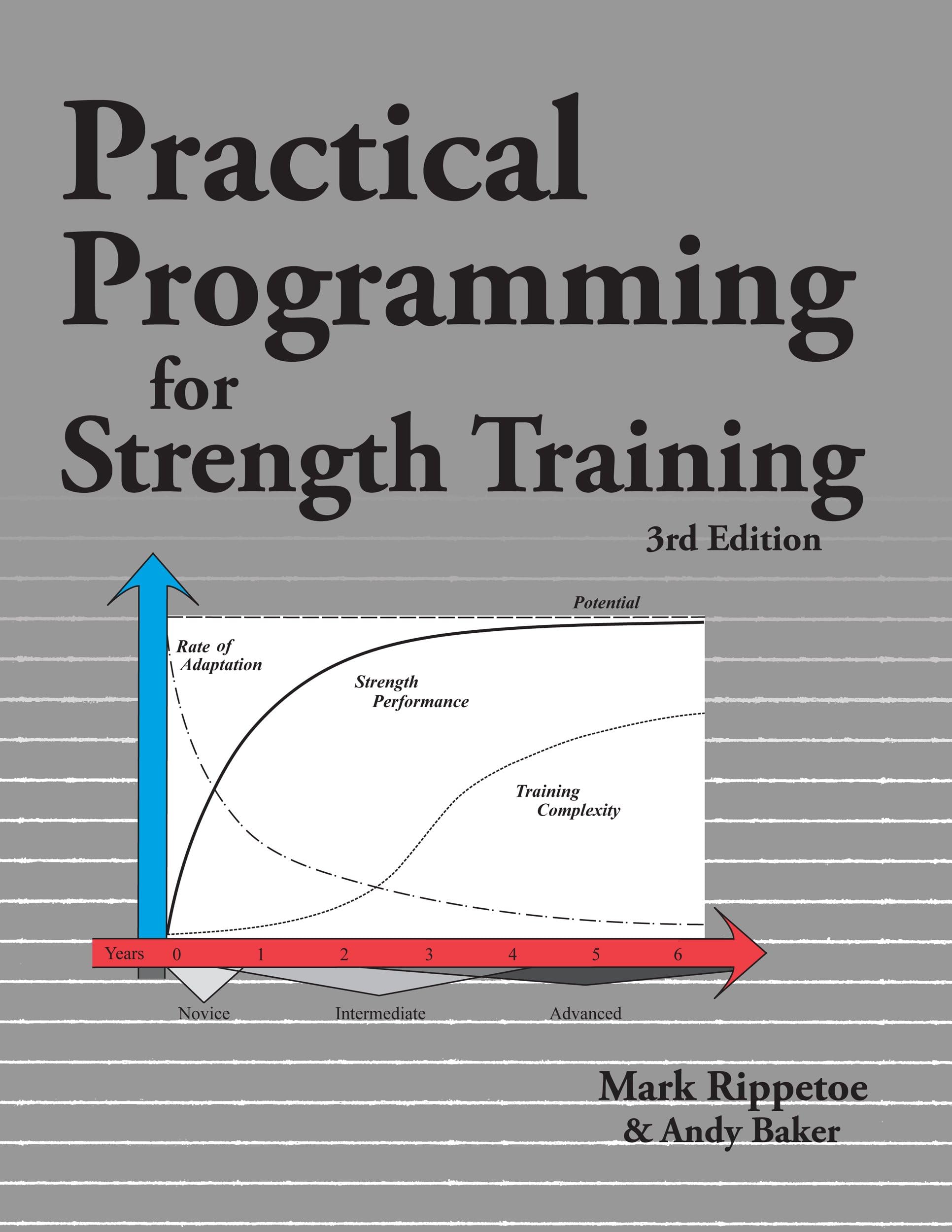
Practical Programming for Strength Training
Product ID: 109811199
Please note that due to the large amount of tables, this book will display best on large screens, as well as Kindle Fire series where the screens can be quicky rotated to optimize individual displays. Not suitable for Kindle 1 devices as these flatten tables. There is a difference between Exercise and Training. Exercise is physical activity for its own sake, a workout done for the effect it produces today, during the workout or right after you're through. Training is physical activity done with a longer-term goal in mind, the constituent workouts of which are specifically designed to produce that goal. Training is how athletes prepare to win, and how all motivated people approach physical preparation. Practical Programming for Strength Training 3rd Edition addresses the topic of Training. It details the mechanics of the process, from the basic physiology of adaptation to the specific programs that apply these principles to novice, intermediate, and advanced lifters. --Each chapter completely updated --New illustrations and graphics --Better explanations of the proven programs that have been helping hundreds of thousands of lifters get stronger more efficiently --Expanded Novice chapter with the details of 3 different approaches to the problem of getting stuck and special approaches for the underweight and overweight trainee --Expanded Intermediate chapter with 18 separate programs and 11 detailed examples --Expanded Advanced chapter with detailed examples of 9 different programs --Expanded Special Populations chapter with example programs for women and masters lifters training through their 50s, 60s, 70s, and 80s --Day-to-day, workout-to-workout, week-by-week detailed programs for every level of training advancement --The most comprehensive book on the theory and practice of programming for strength training in print Printed in a new larger format for better display of the programs, PPST3 will be an important addition to your training library. Review: Looking to get Strong? Buy this book! - I am a 30 year old Husband and Father of two. I love fitness and all things health related. But, let's be honest, the fitness industry is anything but straightforward, concise or, quite frankly, intelligible. Everything you see on the web seems to center on some type of "revolutionary" technique or "must-do" exercise. The amount of information pumped out by fitness gurus and websites simply cannot be integrated into a person's psyche, let alone their training regimen. I believe this might be the cause behind the increased popularity of Crossfit in recent years (though that's a topic for another day). Anyhow, I was seriously befuddled by what exactly I needed to be doing as a fairly young man who just wanted to get stronger (and not look too bad, either). I read through Mark's first book (Starting Strength) and loved it. I wasn't sure if this second book could top his first, but I was pleasantly surprised to find that it was an even better source of information. I won't spend all my time regurgitating the book's outline or contents,but I will give you its impact on my understanding of training. Simple is better. Training doesn't have to be, nor should it be complicated. Yes, as you progress from novice to intermediate to advanced you may have to integrate more "goal specific" lifts. But these exercises and training methods will actually supplant your previous ones, since you are tailoring your training for a specific goal (strength, hypertrophy, a sport, etc.). Also, Mark effectively demonstrates the crucial difference between "exercise" and "training", something I had never previously considered. So this book has done a wonderful job of easing my conscience when it comes to training. I figured out that even though I have been lifting weights for years, I had never proceeded through a legit novice training program. I had just been exercising all that time! I am currently finishing up my second straight month of the Starting Strength Novice program, and I have never been stronger. Weight that used to be my 1RM are now my working sets of 3x5. And I haven't gotten fat or slow or stiff. My diet has remained clean and I am building quality muscle and strength. I no longer worry about whether or not I'm "neglecting a muscle" because I know that keeping the "Big 5" in place and working toward record numbers in those lifts will produce muscle gain across the board. Once I finish the novice program I plan to begin the Texas Method with my wife and brother. If your confused about where you want to go with your fitness, are interested in getting stronger, more muscular, more generally fit for sports of any kind, then pick up a copy of this book. Whether you do Mark's programs or not, you will benefit in some way from the wealth of information available in this book, I guarantee it. Review: The definitive book on programming - Both of Mark Rippetoe's major contributions to strength training literature are now in their third editions. Starting Strength: Basic Barbell Training - 3rd Edition has established itself as one of the premiere pieces of literature for anyone interested in getting stronger, and now the 3rd edition of Practical Programming has joined it. The 2nd edition was full of wonderful information regarding the stress/recovery/adaptation cycle of strength training. Simply put, the more you do something (say, squat or deadlift), the better you become at it, and changes in programming (frequency, set/rep schemes, etc...) are required to further progress. New to the 3rd edition is an impressive amount of detail on how to go about the necessary changes in programming as a lifter progresses. The book contains its largest upgrade in chapters 6-8. With the assistance of Andy Baker of Kingswood Strength and Conditioning, programming for the novice, intermediate, and advanced lifters is covered in amazing detail. For the novice, the basic principles of the Starting Strength method are discussed as well as a fabulous real world example of a properly executed linear progression. New to the 3rd edition is an extensive look at how to elongate and squeeze every drop of usefulness out of a linear progression. It details resets, stalls, and recovering from the mistake of increasing your lifts too quickly. All of these scenarios are backed up with biomechanical details of the human body. Additionally, new to the novice section is a detailed account of the "advanced novice" lifter as well as specialized diet and training tips for the particularly overweight or underweight trainee. The Intermediate section has received the largest upgrade of all. While novice programming allows for progress from workout to workout, intermediate programming stretches out progress over a week to week basis. Though Rippetoe discussed his "Texas Method" style of programming in the 2nd edition, it prompted a lot of questions about variations and alternatives to the demanding programming. The details of the Texas Method are contained in 30+ pages of the most important, effective writing in strength programming literature. Broken into four phases, the amount of detail contained here is staggering, and should hopefully answer any questions and address all problems trainees may have with this very complex programming. Also included are "split routines" spread over four days, as well as a Heavy-Light-Medium system popularized by coaching great Bill Starr in the 1970's. The advanced chapter delves into periodization, or the structuring of training schedules beyond a week to week basis. The book makes very clear that this programming is for ADVANCED lifters who's progress on a week to week basis has stalled out completely. At this point, a strength athlete will be at the point where they are ready to specialize in a certain realm of athletics. Specific training details for powerlifters, MMA athletes, and Olympic weightlifters are described in exhaustive detail. Most recreational lifters will never reach this level, but its inclusion here is extremely welcome. The final chapter will prove extremely useful for current strength training coaches. It includes specific training details for females, youth, and an extensive section on older (35+ years) lifters. Simply put, Practical Programming 3rd Edition is required reading for anyone who has a desire to achieve their maximum potential in the weight room. Buy it, read it, read it again, and get stronger!
| Best Sellers Rank | #91,670 in Kindle Store ( See Top 100 in Kindle Store ) #26 in Sports Training (Books) #54 in Sports Training (Kindle Store) #130 in Exercise & Fitness (Kindle Store) |
D**R
Looking to get Strong? Buy this book!
I am a 30 year old Husband and Father of two. I love fitness and all things health related. But, let's be honest, the fitness industry is anything but straightforward, concise or, quite frankly, intelligible. Everything you see on the web seems to center on some type of "revolutionary" technique or "must-do" exercise. The amount of information pumped out by fitness gurus and websites simply cannot be integrated into a person's psyche, let alone their training regimen. I believe this might be the cause behind the increased popularity of Crossfit in recent years (though that's a topic for another day). Anyhow, I was seriously befuddled by what exactly I needed to be doing as a fairly young man who just wanted to get stronger (and not look too bad, either). I read through Mark's first book (Starting Strength) and loved it. I wasn't sure if this second book could top his first, but I was pleasantly surprised to find that it was an even better source of information. I won't spend all my time regurgitating the book's outline or contents,but I will give you its impact on my understanding of training. Simple is better. Training doesn't have to be, nor should it be complicated. Yes, as you progress from novice to intermediate to advanced you may have to integrate more "goal specific" lifts. But these exercises and training methods will actually supplant your previous ones, since you are tailoring your training for a specific goal (strength, hypertrophy, a sport, etc.). Also, Mark effectively demonstrates the crucial difference between "exercise" and "training", something I had never previously considered. So this book has done a wonderful job of easing my conscience when it comes to training. I figured out that even though I have been lifting weights for years, I had never proceeded through a legit novice training program. I had just been exercising all that time! I am currently finishing up my second straight month of the Starting Strength Novice program, and I have never been stronger. Weight that used to be my 1RM are now my working sets of 3x5. And I haven't gotten fat or slow or stiff. My diet has remained clean and I am building quality muscle and strength. I no longer worry about whether or not I'm "neglecting a muscle" because I know that keeping the "Big 5" in place and working toward record numbers in those lifts will produce muscle gain across the board. Once I finish the novice program I plan to begin the Texas Method with my wife and brother. If your confused about where you want to go with your fitness, are interested in getting stronger, more muscular, more generally fit for sports of any kind, then pick up a copy of this book. Whether you do Mark's programs or not, you will benefit in some way from the wealth of information available in this book, I guarantee it.
N**N
The definitive book on programming
Both of Mark Rippetoe's major contributions to strength training literature are now in their third editions. Starting Strength: Basic Barbell Training - 3rd Edition has established itself as one of the premiere pieces of literature for anyone interested in getting stronger, and now the 3rd edition of Practical Programming has joined it. The 2nd edition was full of wonderful information regarding the stress/recovery/adaptation cycle of strength training. Simply put, the more you do something (say, squat or deadlift), the better you become at it, and changes in programming (frequency, set/rep schemes, etc...) are required to further progress. New to the 3rd edition is an impressive amount of detail on how to go about the necessary changes in programming as a lifter progresses. The book contains its largest upgrade in chapters 6-8. With the assistance of Andy Baker of Kingswood Strength and Conditioning, programming for the novice, intermediate, and advanced lifters is covered in amazing detail. For the novice, the basic principles of the Starting Strength method are discussed as well as a fabulous real world example of a properly executed linear progression. New to the 3rd edition is an extensive look at how to elongate and squeeze every drop of usefulness out of a linear progression. It details resets, stalls, and recovering from the mistake of increasing your lifts too quickly. All of these scenarios are backed up with biomechanical details of the human body. Additionally, new to the novice section is a detailed account of the "advanced novice" lifter as well as specialized diet and training tips for the particularly overweight or underweight trainee. The Intermediate section has received the largest upgrade of all. While novice programming allows for progress from workout to workout, intermediate programming stretches out progress over a week to week basis. Though Rippetoe discussed his "Texas Method" style of programming in the 2nd edition, it prompted a lot of questions about variations and alternatives to the demanding programming. The details of the Texas Method are contained in 30+ pages of the most important, effective writing in strength programming literature. Broken into four phases, the amount of detail contained here is staggering, and should hopefully answer any questions and address all problems trainees may have with this very complex programming. Also included are "split routines" spread over four days, as well as a Heavy-Light-Medium system popularized by coaching great Bill Starr in the 1970's. The advanced chapter delves into periodization, or the structuring of training schedules beyond a week to week basis. The book makes very clear that this programming is for ADVANCED lifters who's progress on a week to week basis has stalled out completely. At this point, a strength athlete will be at the point where they are ready to specialize in a certain realm of athletics. Specific training details for powerlifters, MMA athletes, and Olympic weightlifters are described in exhaustive detail. Most recreational lifters will never reach this level, but its inclusion here is extremely welcome. The final chapter will prove extremely useful for current strength training coaches. It includes specific training details for females, youth, and an extensive section on older (35+ years) lifters. Simply put, Practical Programming 3rd Edition is required reading for anyone who has a desire to achieve their maximum potential in the weight room. Buy it, read it, read it again, and get stronger!
J**S
Must read for anyone involved in competitive sports or working with weights!
This book is excellent !!! The author describes in details the 3 levels of trainee experience as Novice,Intermediate and Advanced and what conditions should be fulfilled to belong in each one.He discusses the principles that need to exist in order to increase strength and why different level of athletes need different training programs.He will also go one step further and explain the difference between Force,Strength and Power analyzing them with scientific formulas.He will tell you what is the importance of each one in sports and why Power is so important or how to improve it.This book is adressed to anyone involved in competitive sports or just need to improve his performance.You can use it at any level you are and progress.Some things are repeated many times but not in a boring way as other books for just full the empty pages.It seems that this kind of repetition helps with understanding of the details without needing to turn back the pages and search for related info to clear things up.I would say that one full reading of book is enough to make things clear and just get back from time to time to refresh or focus on specific training programs as time and progress goes by. Almost all of the training programs are based on barbell training and he gives many examples with actual weights for better understanding.The training programs are very well written but there is some kind of confusion with reps and sets in some tables.It seems the reps have been confused with sets and vice versa,but if you read comprehensively and comprehend the principles you will find out the little mistakes (sometimes you will read 3x5 or 5x3 and actualy will mean the opossite of each one).He discusses the history of Periodization models and analyzes the most important ones that have proved their efficiency through the years.Many variations of each model can help build your own program for your specific needs of sport but not in a confusing way like other books.I have read Brawn for example and was very confused with training programs of that invisible author (It was most like saying do this,do that,do anything you like and drink a gallon of milk...something will work!) I have also read the Starting Strength book from same author and was amazed with the detailed offered to basic barbell moves.Mark Rippetoe seems a brilliant man that knows what is talking about and is not trying to sell you another book full of BS to get rich.Always on point with real life experience as trainee and coach for so many years and always expressed in a simple but comprehensive manner for the average reader.More experienced and smart people can absorb more out of his writing though and maybe can search for more info on specific aspects based on other sources.
C**S
Highly Recommended for a Solid Understanding of How to Conduct Strength Training and Why
I really enjoyed Practical Programming for Strength Training because it answers many of questions I was left with after reading Rippetoe's Starting Strength book. It has been useful for me as someone who trains, someone who advises his wife on how to train, and someone who demands to know the reasons behind the programs laid out by Rippetoe. The Starting Strength book focuses primarily on the major lifts - how to do them, and why they are done that way. It does a very good job of this and is an invaluable tool for trainees and coaches alike. The end of the book lays out the basic Starting Strength novice program, which is working impressively well for both my wife and me at this time. Staring Strength is an excellent book for what it purports to be: a guide to "starting" strength training. However, the layout of the Novice program laid out is very basic, and it does not answer a lot of the questions that a serious trainee will inevitably start asking: what if I advance beyond the novice stage? What do I do if I'm returning to training after being ill for a few weeks? What if I have an injury? What if someone does not fall within the 18 to 35 age range? Etc. And of course, there is always the burning question of "Why is the program set up as it is?" and the follow-up "What constitutes good programming and why?" Practical Programming for Strength Training answers these and other questions in a very clear, thorough, and well-ordered fashion. It gives the reader a well-rounded understanding of the physiological mechanisms behind strength adaptation, upon which it lays out and justifies the novice, intermediate, and advanced programs. It goes into detail about various circumstances trainees may encounter during their progress towards getting stronger. All-in-all it is a very thorough, easy-to-understand, and well-argued book which provides the serious trainee or coach with a solid foundation in knowledge about programming for strength training. Unless you have considerable competence with barbell training, I would recommend starting with the Starting Strength book before moving on to Practical Programming for Strength Training.
A**S
Better for coaches than lifters, and biased against bodybuilders
After reading and following Starting Strength, I was inspired to read the same author's Practical Programming. It was in some ways a disappointment, even if it is a very valuable book. Let me explain: First of all, there is a lot of discussion of muscle physiology at a very detailed scientific level, which I found uninteresting and not directly applicable to my training. There is a lot of discussion of various training approaches and what a good or bad coach would do, making it clear the book is aimed at people who devise the training programs rather than the athletes or weightlifters themselves. Some slight annoyances are (1) repeating all the time how important overall strength via squats, deadlifts and presses is and (2) bias against bodybuilders in favor of strength training for Olympic lifting or other strength based sports. While I care about strength, I also care about looks, which is where bodybuilding approaches come in. In Arnold Schwarzenegger's Encyclopedia, there is a photo of Franco Columbu deadlifting 700 lbs, so bodybuilders are strong too. I found it annoying when the author made fun of them, which was thankfully not too often. Although the author dislikes bodybuilding, he describes what creates the "pump" and muscle hypertrophy and validates what Arnold Schwarzenegger wrote in his Encyclopedia of Bodybuilding, so that all squares away. Follow Arnold if you want to look like him, or Rippetoe if you want to build strength alone. As others have said, Chapter 6 about the novice program is in itself very valuable and perhaps the best part of this book. It adds detail about exercises, rest, and diet (including a sample daily meal plan) which are not found in Starting Strength. Chapters 7 and 8 provide similar details for intermediate and advanced training. If you are a novice, Starting Strength is sufficient and this follow up book is not needed; too little of it would be applicable, esp. if you are still making steady strength gains. Also, while Starting Strength is chock-full of useful information that's worth re-reading, Practical Programming is relatively dry, boring, and directly useful insights for the athlete himself are relatively rare. If you are a more advanced lifter or if you are a coach or fitness instructor, this book is for you. The author is very knowledgeable and a little overly thorough :)
T**S
This Is The Real Deal
This and Starting Strength: Basic Barbell Training are the best money I've ever spent on anything related to lifting. I own a Rogue squat rack, safety arms, an olympic bar with exceptional spin and knurling, more bumper plates than I need, belts, squat shoes, and tons more and this is still the best money I've spent on this discipline. If you want to gain the knowledge that you need so that you can successfully, safely, efficiently, and STRONGLY apply yourself to strength training, then this is a superior tool. You will get strong quickly and safely if you follow and apply yourself to these programs. You'll learn how to create a novice linear program well suited to your body and your abilities. Then once you have a good strength base you will learn how to apply that to various periodized intermediate programs, whether you want to be a bodybuilder, a powerlifter, a strongman, an Olympic weightlifter, a football player, a rockclimber, or even if you want to be a stay at home parent then this book will help you be the best athlete that you can be. Once you've put years into a specialization, gains will slow and you will have to tweek the smallest of details to push yourself as close to your genetic potential as possible, and this book can even help you do that in the Advanced Trainee chapter. It details advanced programs just as well as the rest of the book does earlier programs. I recommend fully. If you can only buy one book on the subject then make it this one, if two, then get Starting Strength as well because it details how to safely execute many of the movements you will use during training. I've read some other books that are good, but I won't bash them in comparison here. This is the real deal.
B**S
Fundamental and practical advice
To use a poor analogy: It’s like learning how to cook so you make your own recipes. But here you are cooking up a better and stronger you. You learn when to go up, when to slow down and need to understand that it changes and is not a rite recipe to follow. But there are rules. And the rule for the beginner is to go slow, and do a linear progression — rest, add a little weight, repeat. On the core excercises! It’s hard to find a formulaic way when in strength training you are having a conversation with your bodies ability to grow stronger and it’s need to rest. This book gives you the language and dialogue to do that. I used this to to successfully migrate from the many-gym-machine program my YMCA had me on into a much more successful, safer, and knowable system for strength training. BTW: how does this compare to the other viable alternative out there? 5/3/1 I can’t tell you but it has worked for beginners and Rip also endorsed it. From this interview he gave (muscle and fitness) I quote: “Aside from "Starting Strength Basic Barbell Training," what other modern strength programs do you like? The only other one I like is Jim Wendler’s 5-3-1 program. It’s an excellent late intermediate and advanced program. ” But late intermediate means you should already be fluent in speaking weights. So do that here. Also: the advise in this book is gender neutral apart from very minor tweaks and for the ladies which is covered in a few pages. This will do wonders for your bones. See the Barbell Prescription book for more on that.
R**S
It’s the science of training. Great book.
One of the best books on training. The few complaints aren’t accurate because there is a large range of adaptations across levels and exercises. I’ve got a kindle and paperback copy as a reference. If you care about training buy the book!
J**U
Super livre, résume ce qu'il y a à savoir sur la musculation
Des variables basiques lors des séances (choix d'exercice, répétitions, récupération, ...) à la programmation de ces séances en fonction du niveau d'avancement de chacun (novice, intermédiaire, avancé), ce livre couvre toutes les bases de la musculation (en dehors de la technique d'exécution des exercices, vue dans le livre Starting Strength 3ème édition)
R**O
molto utile
Molto utile. Pie o di suggerimenti e pratiche di esercizi
M**J
El títutlo lo dice todo
El libro presenta de forma clara los conceptos necesarios para desarrollar un programa de entrenamiento de fuerza que permita avanzar desde una situación de falta de entrenamiento a conseguiruna buena forma física. Lo he utilizado para planificar mis entrenamientos desde comienzos del mes de septiembre y estoy viendo más evolución que en años anteriores. El libro es realmente recomendable, aunque gana enteros combinado con Starting Strength, otro libro del mismo autor en que se describen los movimientos básicos que desarrolla en este libro.
T**N
squat squat squat squat
Let me save you some time and money, this book advises you to squat, squat, squat, squat, squat, squat, squat, squat, ad infinitum,,,, If you are a professional football player, or sumo wrestler I recommend this book.
B**S
Excelente livro
O livro é bem didático e muito completo!!! Você consegue facilmente navegar pelos capítulos e encontrar com rapidez o que procura
Trustpilot
1 month ago
5 days ago