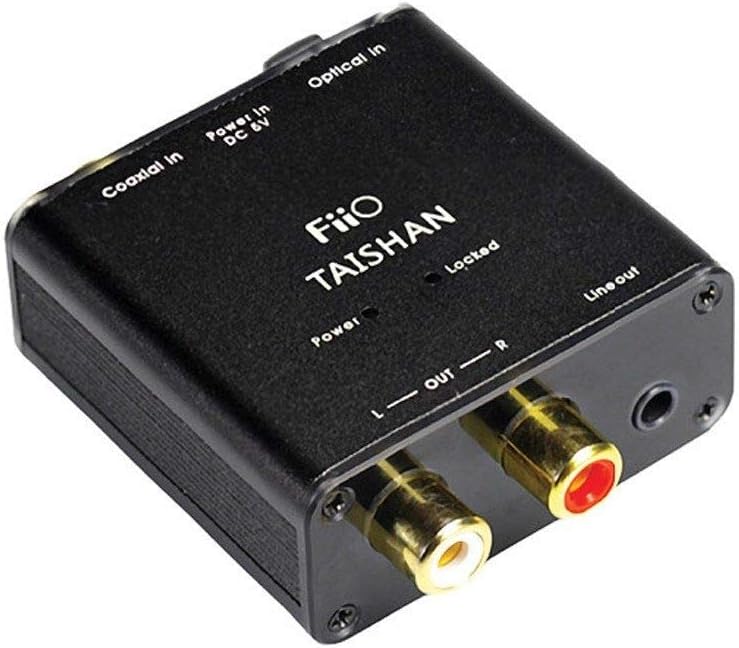

FiiO D3 (D03K) Digital to Analog Audio Converter - 192kHz/24bit Optical and Coaxial DAC
Product ID: 1467295
🎧192kHz/24bit Hi-Res Audio
🔄Optical & Coaxial Input Switch
🔌Compact USB-Powered Design
🎶 Unlock studio-quality sound with the FiiO D3 — your digital-to-analog game changer!
The FiiO D3 (D03K) is a compact, USB-powered digital-to-analog converter supporting up to 192kHz/24bit audio. Featuring optical and coaxial inputs with an easy switch, it converts digital signals from TVs, Blu-ray players, and gaming consoles into high-fidelity stereo analog output. With low jitter and high signal-to-noise ratio, it delivers clear, precise sound, making it an affordable upgrade for audiophiles and media enthusiasts alike.
| Best Sellers Rank | #204,558 in Electronics ( See Top 100 in Electronics ) #322 in Digital-Analog Converters #443 in Signal Converters |
| Customer Reviews | 4.5 out of 5 stars 2,396 Reviews |
D**H
Good Cheapie/fun DAC upgrade for Sonos and other devices
Well, here is a quickie review on the 3rd gen D03K that may help others trying to research for specific uses. For the $$ this nice little piece is a great, fun DAC. I am a big music library fan, with a nice networked music library ripped in bit-perfect wav files. I had added a Sonos Connect (ZP90) player to my not so bad of shop stereo comprised of some great, mid-fi, mostly outdated components laying around: PSB large format bookshelf speaks, HK analog Pre/Pro, Onkyo discrete stereo amp, decent interconnects, etc. This system has a pretty nice level of fidelity to where you can hear things and I was experiencing one of the only weaknesses of Sonos, their DAC is a little disappointing when playing on higher fidelity setups where you can hear such things. The analog outs on the ancient Sony DVD unit I was using to play CDs was slaying the Sonos in SQ. Enter the FiiO unit. Set Sonos to uncompressed (if your files are lossless), fixed volume out (for full bit depth), coax digital to FiiO/analog to pre. Yes!! The result is blacker background, increased precision, tightened yet solid bass, in this case it did cure the minor dissatisfaction of listening through the onboard Sonos DAC. Since I had both Sonos/FiiO connected to the amp, asked my audiophile in training kid to do a blind A/B (I level matched between switching, so there was a 4 sec delay) he chose the FiiO every time in random selections over a several minute period. So, not saying this will beat a Benchmark, or mod the opamps to TL^%$$^ or anything like that. (it's a shop stereo man!)But it is pretty fun to enjoy a marked audio improvement with this cute, no-brainer install, under $30.00 little DAC. Sure it works great for stereo TV if the set is outputting PCM too.
T**X
Exactly as hoped it would work (which means better than expected).
It performed exactly as I hoped... which was better than I expected for my situation. So, so I setup an outdoor movie theatre for my friends and family and here was my situation: - bluray player connected to a projector via HDMI cable - speakers connected to an amp with only stero inputs and stereo outputs I needed a device to take the digital coax output from the bluray player and preferably convert it into stereo LEFT/RIGHT analog connections or at a minimum just convert it to mono to send to both speakers. I also didn't want to pay for a new amplifier or receiver to do this outside. So, I tried this device. It works great so far. It translated the PCM signal from the bluray to stereo analog signals (RCA) With the location of the player and the speakers to the listening audience, I got lucky and connected the left/right properly as I noticed when vehicles zoomed across the screen. Something I should have double checked before the movie, but it was done correctly, and showed that this little DAC worked exactly as I hoped. ** NOTE: If you're not getting sound, just check 2 things: 1. Change your sound output on the bluray player to PCM 2. Make sure the input selector (located on the bottom of the FiiO D3 is set to coaxial (not optical). I can not attest to it being great with 5.1 or 7.2 surround sound because I used it to feed the digital output from my bluray player and feed into a DAC (digital to analog converter) to make stereo sound for an outdoor movie experience (the HDMI went to the projector so I needed to get the sound out separately). In this capacity, it worked flawlessly. The sound signal appeared to be clean and pure, and I got great sound out of the speakers, which means that the components and cables in all phases went well. I bought this and another cable (a 3' from Monoprice - also has a review) in case 1 had an issue, but both worked beautifully. I expect this cable to last a long time and it works great, but I'd have no problems buying this again should I need another digital audio coax cable.
R**A
Rather impressed, just not ecstatic... due to high expectation
I have intentionally waited instead of rushing to write a review, wound up waiting for over 1 year. Bought this to connect a $39.99 Kodi box's (https://www.amazon.com/gp/product/B01DZOBQ6O/ref=oh_aui_detailpage_o04_s00?ie=UTF8&psc=1) Toslink output to my stereo, hoping to provide reasonable good sound to the cheap-o HTPC setup. (Turned a then 7-yr old netbook into OpenELEC box, but found out it couldn't render 1080p smoothly. $40 seemed a great deal for a Kodi box!) The connected components are from the mid-90s: Conrad Johnson pre-amp, Aragon amp, Martin Logan speakers, MIT interconnects & AudioQuest speaker cables. After living with this little DAC for a year, watching many movies, TV shows & critically listening to music of various genres -- Bossa Nova, classical (symphonic, chamber, piano, aria...), jazz, vocal, Broadway, pop rock, New Tango... I would say that this unit has performed well, just not quite stellar. It's no doubt an improvement over the Kodi box's analog output -- crisper, more dynamic & much improved soundstage. Compared to my CD player's (Micromega, also from mid-90's) sound, however, it provides more presence at the expense of sounding somewhat 'bright' & induces some degree of listening fatigue. Not to the point of ruining instrument timbre, of course, but making some brass instruments and vocals sound harsher than hearing them live. I do wonder, though, if some recordings' intentionally boosted 10K-12K range (some older sound engineers' trick to make tracks sound more 'alive' on average playback systems) may be partly to blame. This DAC may have simply revealed that overcompensating flaws in the sound mastering. With that said, however, occasionally, sibilance in female voice can become overbearing -- 'Summer Samba' from Patricia Barber's 'Night Club' for example, whereas the Micromega CD player presented the sibilance just fine without drawing one's attention away the wonderful piano playing. It may seem unfair to compare this DAC to something 50X its price, but here it is anyway. 8-) I actually did hope that the past 20-yr+ of technical advancements in DAC would have made this unit at least on par with the CD player. To be fair, most recordings do sound wonderful, including remastered older analog recordings. Ella Fitzgerald's 'Nearness of You' simply oozes honey. Pretty awesome. In summary, a very impressive product for the price. I'm quite grateful that the unit allows the Kodi box (with a 3TB USB HDD attached) to become a nice sounding music server, allowing me to program 2 hours of music using my phone from the kitchen while the system is in the adjacent family room. Also, this unit is my first foray into a separate DAC unit, proving to me that perhaps any source of digital music, be it a phone, PC, Android box (with the right digital output of course) can be part of a great sound system with the aid of a modest DAC such as this unit. Maybe one day, I will upgrade to an even better DAC (by FiiO as well?) Either way, I'm keeping this little guy around. If you are looking to use your PC or Android box as a source of music playback, this unit should be on your short list!
A**H
Best DAC I could find after trying several. Built well and works perfectly.
This FiiO D3 was the last of 5 different budget-range DAC's that I purchased while setting up my new AV system...and the last one I'll ever NEED to purchase. As I described in the reviews for the other DAC's I bought, I had various issues ranging from bad interference through the speakers when the optical stream was turned off, to crackling during certain sound effects in games. I was getting frustrated because of these issues (especially as the problematic DAC's had good reviews) until I bought this FiiO D3. Immediately out of the box, the quality difference was evident. Instead of having a simple bent piece of sheet metal with a single Phillips self tapping screw holding it on, like some of the other DAC's, or a cheap molded plastic case, the FiiO has a nicely finished fully enclosed metal shell with end caps attached by machine screws, as well as flush-mounted status LED's on the top. Whether it looks like junk or not, however, is less important than whether or not it works correctly. I'm happy to report that the FiiO D3 works perfectly. There is no crackling, no interference, and no weird transient noises after the optical stream is turned off, like another of the DAC's that I had which was otherwise fine: this indicates to me that the signal conversion circuit is well isolated from the power supply circuit. Also unlike one of the other DAC's I bought, the R/L RCA outputs are not reversed, but actually output right and left stereo channels correctly. Please note that, like just about all DAC's in this price range, this device is only designed to handle conversion of a stereo signal. If you switch to 5.1, 7.1, Dolby DTS, or any other format besides stereo, you'll get an atrocious noise from your speakers and nothing else (I learned this early on with previous DAC's when my speakers happened to be turned up rather loud...it was not a good experience). Basically, the FiiO D3 is THE DAC to purchase if you need to convert optical stereo to analog stereo. It costs a few dollars more than the wide range of random off the shelf DAC's currently available on Amazon, but I find that a few extra dollars is more than worth it for a quality device that functions correctly.
S**E
Seems perfect for the computer audio newbie
I'm new to computer audio, but I enjoy the convenience, flexibility, and potential for near-audiophile sound reproduction it promises. I simply cannot afford to drop even $350, let alone $2,000, for an external DAC. I purchased the Fiio Taishan D03 and placed it into the following system: iMac running iTunes files through a mini-Toslink to Toslink optical cable to Fiio D03, then RCA cables first to a PAC LC-1 volume control (roughly $14 on Amazon) then from there to KRK Rokit 5's (self-powered, small bookshelf-sized studio monitors) set at half-volume. Very basic, yet very capable. Result? Very satisfying sound. Period. My iTunes files include much classical, jazz, and ambient electronica music ripped at anywhere from 192 to 256 kbps to Apple lossless, and my ears appreciate a neutral, uncolored presentation. I haven't allowed for a 50-100 hour burn-in period yet, but after 25-hours or so of continuous playing the Fiio Taishan is producing beautiful music through the KRK's. I am surprised, relieved, and gratified to have found a low-cost option that lets me hear my digital music files come alive again. Even if it doesn't improve with further burn-in, at this price the Fiio Taishan is a clear-cut no-brainer for anyone with a computer storing music digitally. If the product lasts, an important void has been filled.
J**N
Nice sounding dac
Streaming music from Apple TV. Connected optical output to this DAC, connected RCA out to my audio system. Works perfect! Very good sound quality, since I am using Airplay, resolution is limited to CD quality, which is fine. This little DAC performs and sounds as well as my Schiit Modi 3 DAC, which I use for USB streaming from an IPad. Very easy to install. Note: it does not come with a power supply, just a usb to mini-usb cable, which I connected to an Apple 12 watt charger, I recommend using a quality power supply as it will impact the sound quality. The Apple charger is a quality/clean 5 volt supply.
A**R
the sound quality itself was good, good reproduction of sound
I had high hopes for this DAC and it let me down a bit. I was using this for my computer in a near field listening environment and the DAC emits a slight static noise floor when audio comes through which is higher than the noise floor sans audio going through. You can actually hear the differences in noise floors between no signal (which is mostly black) compared to when audio is being played. The DAC is quiet though with no signal, this is a problem for other DACs of this size and price. Ultimately, this little guy is going in storage, it'll probably work well for a listening environment where you are several feet from your speakers or for outdoor monitors. It was under $30, you get what you pay for and it has a place for use. Outside of the aforementioned, the sound quality itself was good, good reproduction of sound, it didn't sound altered at all in my testing.
O**5
Very good.
This is the third version, with the gold connectors as in the description, and not the original or the in-between version. I'm just using it for isolating the analog signal from my computer's electronics, but I believe that it's a minor improvement over my computer's default alc 892 audio chip (the effect might just be a placebo, though). It also looks and feels very high quality; it's made out of metal painted black, and has clear, glossy plastic on the ends with the connectors that picks up fingerprints easily (but this probably doesn't matter unless you pick up your DAC regularly for some reason). It's also so small and light that, annoyingly, it tends to get flipped about by my thick cables when I move them. I was surprised that this was so cheap, because FiiO also sells the E10, a DAC/amp combo, for $70, despite this being basically the same thing minus the amp and potentiometer. On top of that, the little built-in amp in this DAC (meant to power the line out) is sufficient to drive my low-impedance headphones, which means that I can just control the volume from my computer and forgo having an extra component between me and the music. I have to say, despite being considered a budget solution, FiiO's E10 seems like kind of a rip-off compared to this thing, unless that amp is really worth an extra $50 over the one in this. As mentioned in the description, it doesn't require any driver support, but it is also worth mentioning that it doesn't decode any fancy surround sound audio signals (like dolby digital); It's just stereo. The 192.0 kHz mode is supported, though, which is pretty fantastic for a $20 DAC, especially considering that the $70 E10 is restricted to a step down at the 96 kHz setting! I actually asked a question three days ago about the E10 on its amazon store page about why you'd buy it over the d3. No one's answered it yet. Edit: A day after starting to use this, I noticed a loud ringing sound coming from the power brick that was supplied to plug the usb cable into. Not a big deal, but it's enough that I'll be replacing it with a different power brick.
R**K
Digital to Analogue - Has one job and does it well !
After using this product (almost daily) for the last 6 months, this is without a doubt - an excellent stereo DAC. As the description and product photos mention, this device can connect unidirectionally from: 1. Digital In - Either Optical or Coaxial cable on one end to 2. Analog Out - Both Standard 3.5mm (headphones or old 2.1 audio systems) and AV audio on the other end. The old speakers of my 2.1 Audio system could only connect via 3.5mm jack -- because the 3.5mm Output port was not present on the LED TV. Since the LED TV had Optical Audio Out, I interconnected a Digital Optical Audio cable (purchased separately) from the TV end with the 3.5mm jack (from Audio system) using this product and confirmed that the switch on the DAC is set to 'Optical input' in my case. After connecting the DAC, it needed a couple of minor confirmations on TV Software side (actual process differs based on TV manufacturer hence only describing generic steps below): 1. Confirm Digital Audio Out in your TV's Sound Settings is set to either: Auto or PCM as this DAC supports PCM only. 2. Switch on both TV and Audio system, play any random audio and listen for any lag/echo between the two systems. You may need to manually adjust PCM delay until both sounds seem to merge. After confirming above settings on the TV software side, the resulting audio sounded flawless from both the TV and speakers simultaneously. Audio was perfectly in sync between both systems. Since no power adapter is provided (only USB cable provided), any basic 1Amp power adapter can work. Luckily, the DAC can even be powered by the TV itself (just confirm if TV USB Connection is 1Amp; anything less may lead to static noise heard in audio system) Delivery was prompt (as per scheduled date), packaging was perfectly done and build quality is top-notch. After an initial setup requiring 5 mins, I've almost forgotten about the mini-DAC in the ensuing months.
T**L
Great for the price.
I was dubious because of the cheap price, but this thing sounds great. No complaints.
M**N
Excelente
Tardonu poco en llegar pero da excelente resultado en audio.
E**.
Cheap and good upgrade of tv sound
With this dac i switched from the internal Sony tv dac to this small external dac. Its solid and looks good. The sound improved. No more clipping and the sound is more clear. I cannot hear the difference anymore on my hifi speakers between the chromecast audio dac and this one. I guess the quality is similar.
M**N
Simple et efficace
J'aime bien écouter les films au casque, mais mon lecteur Blu-Ray/DVD Philips BDP2930 Lecteur DVD Blu-ray Full HD HDMI USB DiVx HD Wifi ready ne dispose pas de sortie analogique, et les circuits qui alimentent la prise casque de ma télé sont de qualité moyenne. La solution ? Ce convertisseur numérique-analogique, qui supporte les flux PCM jusqu'à 24 bits et 192kHz. Connecté sur la sortie SPDIF (coaxiale) du lecteur Blu-Ray, il délivre un signal analogique parfait, qu'il suffit d'injecter dans un ampli stéréo pour piloter des enceintes, ou dans un ampli casque comme le FIIO - E11 amplificateur de casque , pour obtenir un son clair et précis. Et comme le boitier s'alimente par un port mini-USB, je peux le brancher sur le port USB du lecteur Blu-Ray pour l'alimenter. Les plus : deux entrées numériques (coaxiale et optique), sélectables par un switch sous le boitier ; deux sorties analogiques (RCA et jack 3,5 mm) ; adaptateur secteur fourni. Les moins : ne supporte que les flux PCM, pas le DTS ou le Dolby Digital ; l'entrée optique utilise un petit bouchon, facile à perdre, plutôt qu'un clapet ; le cordon de l'adaptateur secteur est un peu court.
Trustpilot
1 month ago
1 day ago