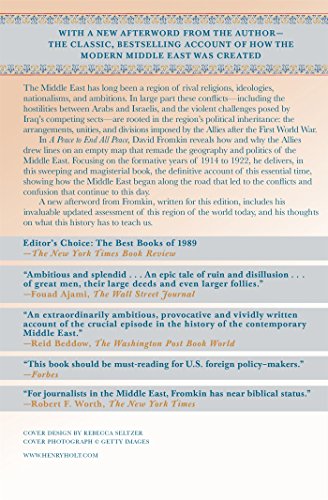
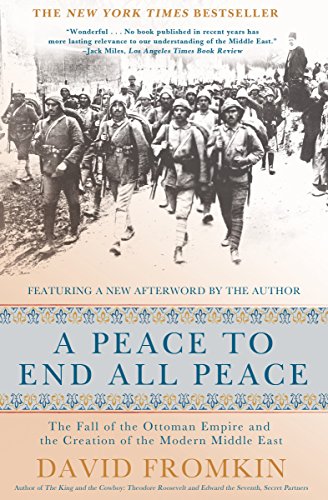

Buy Peace to End All Peace, 20th Anniversary Edition: The Fall of the Ottoman Empire and the Creation of the Modern Middle East 20th Anniversary ed. by Fromkin, David (ISBN: 9780805088090) from desertcart's Book Store. Everyday low prices and free delivery on eligible orders. Review: Marvellous Book about the Fall of the Ottoman Empire and the Creation of the Modern Middle East - The subtitle of this book is "The Fall of the Ottoman Empire and the Creation of the Modern Middle East", and that gives one a pretty good idea of what the book covers. Extremely well researched and documented by the American author, lawyer, and historian, David Fromkin, the book describes in detail—including much "insider" detail—about the complex, Machiavellian maneuvering of the imperial powers—Britain, France, Germany, Austria-Hungary, the Ottoman Empire, and Russia—in the theater of what we now call the "Middle East" in the period between 1914 and 1922, in other words, the imperial struggle that we label the First World War or the Great War. The book is particularly good at elucidating the machinations of (and struggles among) the British Foreign Office, Kitchener of Khartoum, and the India Office and their complicated relations with the French, the Turks and the Arabs that turned the "War to End All Wars" into what we now know today as "A Peace to End All Peace". Unflattering pictures emerge of David Lloyd George, Winston Churchill, Lord Kitchener and a host of Arab and Ottoman leaders; but they are condemned by their actions and not by slurs from Fromkin. Can't be read without taking notes unless you have a total photographic memory. Amazing how the best histories are not written by esteemed academic historians. Review: A mind-opening read - Before I read David Fromkin's account of how it all happened, I knew little about the source of the issues in the Middle East. It was fantastic to get the background. It is an account of human folly. Of pencil pushers deciding the destiny of millions of people without any understanding of the far-reaching consequences of their decisions. For anyone, with an interest in the Middle East..this book is a must-read.
| Best Sellers Rank | 120,830 in Books ( See Top 100 in Books ) 2,755 in World History (Books) 28,611 in Society, Politics & Philosophy |
| Customer reviews | 4.6 4.6 out of 5 stars (504) |
| Dimensions | 13.41 x 4.37 x 20.17 cm |
| Edition | 20th Anniversary ed. |
| ISBN-10 | 0805088091 |
| ISBN-13 | 978-0805088090 |
| Item weight | 499 g |
| Language | English |
| Print length | 688 pages |
| Publication date | 21 July 2009 |
| Publisher | Picador Paper |
L**C
Marvellous Book about the Fall of the Ottoman Empire and the Creation of the Modern Middle East
The subtitle of this book is "The Fall of the Ottoman Empire and the Creation of the Modern Middle East", and that gives one a pretty good idea of what the book covers. Extremely well researched and documented by the American author, lawyer, and historian, David Fromkin, the book describes in detail—including much "insider" detail—about the complex, Machiavellian maneuvering of the imperial powers—Britain, France, Germany, Austria-Hungary, the Ottoman Empire, and Russia—in the theater of what we now call the "Middle East" in the period between 1914 and 1922, in other words, the imperial struggle that we label the First World War or the Great War. The book is particularly good at elucidating the machinations of (and struggles among) the British Foreign Office, Kitchener of Khartoum, and the India Office and their complicated relations with the French, the Turks and the Arabs that turned the "War to End All Wars" into what we now know today as "A Peace to End All Peace". Unflattering pictures emerge of David Lloyd George, Winston Churchill, Lord Kitchener and a host of Arab and Ottoman leaders; but they are condemned by their actions and not by slurs from Fromkin. Can't be read without taking notes unless you have a total photographic memory. Amazing how the best histories are not written by esteemed academic historians.
C**R
A mind-opening read
Before I read David Fromkin's account of how it all happened, I knew little about the source of the issues in the Middle East. It was fantastic to get the background. It is an account of human folly. Of pencil pushers deciding the destiny of millions of people without any understanding of the far-reaching consequences of their decisions. For anyone, with an interest in the Middle East..this book is a must-read.
D**I
An excellent read
Excellent book, very well researched. It was a pleasure to read it. It is one of those books that explains a lot of today's problems and very much worth keeping it for future reference.
E**Z
Comprehensive, a tad wordy
I had to read this book for a class on the British Empire, but it was surprisingly better than I expected. Very comprehensive, it covered aspects of the Ottoman Empire and British/French influence from many points of view, and took into account various motives for actions of parties involved. If at times it was a bit wordy, it didn't leave any questions unanswered for me.
S**D
Excellent. Explained most of what puzzled me about artificial ...
Excellent. Explained most of what puzzled me about artificial division of the Middle East . A different world of Empites rivalries. Recommended reading.
A**N
Five Stars
great book thanks
T**R
A Peace to End All Peace, 20th Anniversary Edition: The Fall of the Ottoman...
Should be read by anyone interested in the 'modern' Middle East. As relevant today as when written - should be read by all senior students.
C**S
A very interesting analysis of the people and events behind the history of the emergence of the modern Middle East
The subject matter of this book is the histories surrounding the history of the fall of the Ottoman Empire and the creation of the Middle East as it currently stands. It focuses on the people and politics behind the events rather than the events themselves and includes a thorough account on the (misguided) motives behind the Balfour Declaration which contributed greatly to the birth of Israel. The account of the blunders, frailties, misconceptions and lack of knowledge behind the twists of history is detailed and quite frightening if one thinks that things may not have changed much since then. Highly recommended companion to a history for the fall of the Ottoman Empire.
F**I
Questo libro e bellissimo. Se si vuole capire qualcosa sulla Prima Guerra Mondiale che vada oltre i libri di testo di scuola bisogna leggerlo. Con la scusa di parlare della guerra sul fronte Ottomano, l’autore di fatto scrive una storia della Prima Guerra Mondiale incentrato non sulke battaglie ma sulla politica che ha influenzato l’andamento della guerra. Due cose appaiono in modo originale. Primo: la guerra sarebbe potuta finire prima (forse nel 1917) se Churchill e Loyd George avessero potuto far prevalere la loro strategia. Secondo: Laurence d’Arabia tanto osannato come eroe ne esce con le ossa rotte, risulta essere un impostore, un millantatore di successi mai avuti. Per capire questo leggere il libro ne vale veramente il prezzo.
V**S
Nicely presented with facts and analysis. However, Paperback version has small font size which strains the eyes.
Q**N
Es habe. so schließt David Fromkin, nach dem Fall des weströmischen Reiches 1500 Jahre gebraucht, bis sich eine allgemein akzeptierte Staatenordnung in Europa herausbildete. nach dem Fall des osmanischen Reiches 1917/18 könnte es ähnlich lange dauern. Die Friedensordnung von Sykes- Picot-sasonnov ist jedenfalls keine Ordnung, die von den Betroffenen als legitim akzeptiert wird. im Kernbereich des Abkommens - Syrien, Irak, Libanon. Jordanien, Israel und Palästina sind Staaten entstanden, deren Existenzrecht alltäglich, innerlich, äußerlich, wechselseitig in Frage steht. Warum es so kam, erschließt Fromkin in typisch angelsächsischer Erzählkunst mit Spannungsmoment und anekdotenoriginalität. Erstens ist die Ordnung des nahen Ostens entlang der Erfordernisse längst untergegangener Weltreiche definiert. Zweitens: die Handelnden selbst glaubten schlussendlich nicht an die Zielführung ihrer Bemühungen. Sir Mark Sykes nahm die Skepsis über das mit seinem Namen verbundene Abkommen 1918 mit ins Grab. Drittens: die völlige Ignoranz der Akteure gegenüber dem Lokalkolorit, auch der Religion. Lord Kitchener meinte, die Einsetzung eines haschemitischen Kalifen könne die Moslems für die alliierte Sache gewinnen. Viertens formte das britische Empire seine nahostkoalitionen mit sehr fragwürdigen Bündnispartnern und Techniken: feisal-, Abdullah- Hussein, Lawrence von Arabien, waren schwache bis gefährliche Bündnispartner oder Protagonisten. Palästina wurde drei Mächten gleichzeitig versprochen, jeweils aus augenblickserwägungen. Unter den Hypothesen des Autoren finden sich auch einige Extravaganzen. So die These, die balfour-Deklaration fusse auf dem Glauben an eine jüdische weltverschwörung, um die einflussreichen zionistischen Kreise in den Hauptstädten der Mittelmächte zum Umsturz zu bewegen, habe man ein Angebot machen müssen. Unglaublich oder wahr? Die staaten von Sykes/Pilot sind dysfunktional. möglicherweise wird es keine vollen 1500 Jahre dauern, bis sich die alte Welt neu sortiert. es wird Gewinner- und verliererstaaten geben, wie Burgund oder Savoyen. dass die windschiefen Gebäude des Iraks oder syriens diesen Prozess überstehen werden, fällt nach Lektüre dieses Buchs schwer. Höchstens als Hülle falsch verstandener unverletzlichkeitsdogmen des Völkerrechts haben diese Staaten eine Zukunft. territorial verfasster Zynismus des ersten Weltkriegs.
S**N
The book arrived in heart time and great condition. I am looking forward to reading it.
B**L
I was looking for a book to give me some background on the ongoing, and seemingly unending, conflict in the Middle East. After checking out a large selection of books, and authors, I settled on this one, and, so far I have not been disappointed. The amount of research that has gone into this book is epic! The amount of detail is almost mind boggling. Fromkin puts to rest the common perception that there is a simple cause and a simple solution to most situations. There are so many players, and motivations in "The Game", as Fromkin calls it, it is impossible to tell who is allied with whom, and for how long, and what is the "end game" for each player. It seems that many of the decisions made, that have far reaching consequences, were made on the basis of misinformation, greed, and stupidity. The book also makes the political leaders in many jurisdictions look like the self centered scoundrels that they profess not to be. I find that I am not "reading" this book but rather "studying" it. I hope that the rest of the book is as good as the part that I have read already.
Trustpilot
Hace 2 semanas
Hace 3 semanas