
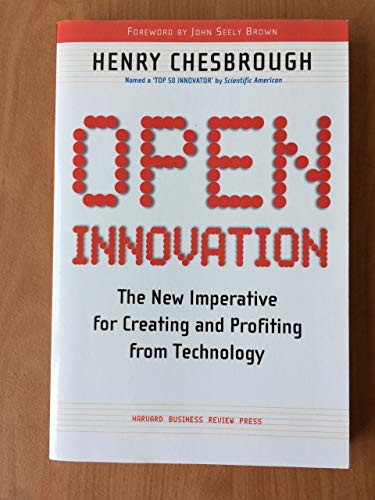

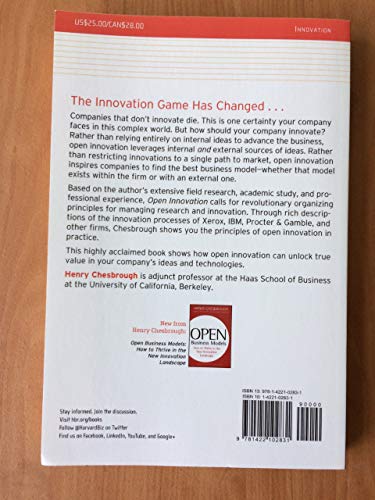


Open Innovation [Chesbrough, Henry William] on desertcart.com. *FREE* shipping on qualifying offers. Open Innovation Review: Open Innovation and Sharing for Success - The book primarily focuses on the concept of transforming a company from the methodology of closed innovation to open innovation. The author provides many examples in support of a closed to open innovation transition by walking through numerous case studies that show a benefit after implementing open innovation. The author begins by providing background for the test-case companies, Xerox and PARC. Afterwards, the author discusses the tactics (Chess and Poker games) that were implemented during the transition. Moving forward, the author discusses how to transform a firm with solely internal R&D (closed environment) into a firm that leverages both external and internal R&D (open environment). Three case studies are provided in support of the authors push for open innovation. The first case study focuses on how IBM overcame the pressures from market-dominating competition by using open innovation. IBM took the plunge and converted their methodology from closed to open innovation, yielding many benefits after switching. IBM is a legacy company that essentially created the underlying computer science used in both software and hardware for much of modern technology. One issue that IBM had to tackle was their complete vertical integration. To overcome their closed innovation and vertical integration, IBM turned to open innovation to broaden their capabilities. In doing this, IBM went from providing an end-to-end computing system in a closed environment to partnering with their clients to better meet the client’s goals. IBM stopped guarding their technology, and instead allowed other companies to leverage it, thus maximizing IBMs profits. The second case study reviews how Intel incorporated open innovation from the beginning, and the success that it brought them. The founders of Intel used lessons from prior employers and chose open innovation to close the divide between research and development from the start. Open innovation worked significantly better than traditional R&D as seen with IBM and Bell (AT&T). When companies like IBM and Bell significantly reduced their R&D budget, customers looked to Intel to continue improving to meet new customer demands. The third case study centers around the Lucent Bell Labs and how they created a new way of marketing through the establishment of venture capital firms. Lucent Bell adopted a systematic approach to designing a new business model for the company's internal technology after carefully studying Xerox's business model. Lucent Bell’s open success rule was to spread internal knowledge into the external marketplace, to commercialize the company’s internal technology through creating an external venture organization, and to create a new business model in the process. The author analyzes how the companies should use their internal and external intellectual property to create value through the study of business model. The author believes it crucial for a company to find a suitable model that maximizes the value of intellectual property by analyzing internal and external business model limitations. He goes on to assert that companies should first study the entire technology market, and then work on how to manage the intellectual property. He also briefly introduces the patent research and application process by citing case analysis of several large companies (Millennium Pharmaceuticals, IBM, and Intel). The conclusion recaps the concepts of how a company can make the transition from closed innovation to open innovation by defining a business model through the learnings of others, Launching the VC model, and most importantly, creating the relationship between company and knowledge source. In addition, there are key insights on advancing a current business by growing new business and discovering new opportunities to expand the current business. In summary, the author provides many facts to back the argument that companies should embrace Open Innovation. MAN6726.901F17 Review: Important Read on Innovation - Innovation is a critical driver for the competitiveness of firms and the overall economy. It is also a difficult and messy process to understand. I have read most of the well-known books on innovation as I am fascinated with the topic. Chesbrough brings a coherent and useful point of view into this arena. The contribution of this book is mostly synthesizing a number of principles to provide a useful mental model for managing innovation. It does not present some new ground-breaking theory that knocks your socks off. For example, the author uses the metaphors of "playing chess" and "playing poker" to describe the invention process. If everything about the technical and market application is known, playing chess (i.e., making careful, methodical moves based on having all available knowledge) is appropriate. However, most innovation occurs in an uncertain environment with plenty of market and technology risk. In such cases, you need to play poker. This means there are multiple hands to be played, you need to be ready to react to new information (newly exposed cards) and you must be willing to toss a hand in when it doesn't pan out. Chesbrough hits on the idea that successful innovation often requires innovation within the business model. In fact, new ideas shoved into the existing old business model is a classic way for innovations to fail. This is one reason why new firms are often the first ones to embrace radical ideas that change industries. This book is not just conceptual models dreamed up by an academic. The author uses plenty of real world examples from companies such as Xerox, IBM and Intel. I highly recommend this book for your innovation management bookshelf.
| Best Sellers Rank | #1,564,824 in Books ( See Top 100 in Books ) #337 in Industrial Management & Leadership #794 in Information Management (Books) #5,142 in Technology (Books) |
| Customer Reviews | 4.1 4.1 out of 5 stars (105) |
| Dimensions | 6 x 0.75 x 9.25 inches |
| Edition | 1st |
| ISBN-10 | 1422102831 |
| ISBN-13 | 978-1422102831 |
| Item Weight | 2.31 pounds |
| Language | English |
| Print length | 227 pages |
| Publication date | September 1, 2006 |
| Publisher | Harvard Business Review Press |
K**N
Open Innovation and Sharing for Success
The book primarily focuses on the concept of transforming a company from the methodology of closed innovation to open innovation. The author provides many examples in support of a closed to open innovation transition by walking through numerous case studies that show a benefit after implementing open innovation. The author begins by providing background for the test-case companies, Xerox and PARC. Afterwards, the author discusses the tactics (Chess and Poker games) that were implemented during the transition. Moving forward, the author discusses how to transform a firm with solely internal R&D (closed environment) into a firm that leverages both external and internal R&D (open environment). Three case studies are provided in support of the authors push for open innovation. The first case study focuses on how IBM overcame the pressures from market-dominating competition by using open innovation. IBM took the plunge and converted their methodology from closed to open innovation, yielding many benefits after switching. IBM is a legacy company that essentially created the underlying computer science used in both software and hardware for much of modern technology. One issue that IBM had to tackle was their complete vertical integration. To overcome their closed innovation and vertical integration, IBM turned to open innovation to broaden their capabilities. In doing this, IBM went from providing an end-to-end computing system in a closed environment to partnering with their clients to better meet the client’s goals. IBM stopped guarding their technology, and instead allowed other companies to leverage it, thus maximizing IBMs profits. The second case study reviews how Intel incorporated open innovation from the beginning, and the success that it brought them. The founders of Intel used lessons from prior employers and chose open innovation to close the divide between research and development from the start. Open innovation worked significantly better than traditional R&D as seen with IBM and Bell (AT&T). When companies like IBM and Bell significantly reduced their R&D budget, customers looked to Intel to continue improving to meet new customer demands. The third case study centers around the Lucent Bell Labs and how they created a new way of marketing through the establishment of venture capital firms. Lucent Bell adopted a systematic approach to designing a new business model for the company's internal technology after carefully studying Xerox's business model. Lucent Bell’s open success rule was to spread internal knowledge into the external marketplace, to commercialize the company’s internal technology through creating an external venture organization, and to create a new business model in the process. The author analyzes how the companies should use their internal and external intellectual property to create value through the study of business model. The author believes it crucial for a company to find a suitable model that maximizes the value of intellectual property by analyzing internal and external business model limitations. He goes on to assert that companies should first study the entire technology market, and then work on how to manage the intellectual property. He also briefly introduces the patent research and application process by citing case analysis of several large companies (Millennium Pharmaceuticals, IBM, and Intel). The conclusion recaps the concepts of how a company can make the transition from closed innovation to open innovation by defining a business model through the learnings of others, Launching the VC model, and most importantly, creating the relationship between company and knowledge source. In addition, there are key insights on advancing a current business by growing new business and discovering new opportunities to expand the current business. In summary, the author provides many facts to back the argument that companies should embrace Open Innovation. MAN6726.901F17
R**Y
Important Read on Innovation
Innovation is a critical driver for the competitiveness of firms and the overall economy. It is also a difficult and messy process to understand. I have read most of the well-known books on innovation as I am fascinated with the topic. Chesbrough brings a coherent and useful point of view into this arena. The contribution of this book is mostly synthesizing a number of principles to provide a useful mental model for managing innovation. It does not present some new ground-breaking theory that knocks your socks off. For example, the author uses the metaphors of "playing chess" and "playing poker" to describe the invention process. If everything about the technical and market application is known, playing chess (i.e., making careful, methodical moves based on having all available knowledge) is appropriate. However, most innovation occurs in an uncertain environment with plenty of market and technology risk. In such cases, you need to play poker. This means there are multiple hands to be played, you need to be ready to react to new information (newly exposed cards) and you must be willing to toss a hand in when it doesn't pan out. Chesbrough hits on the idea that successful innovation often requires innovation within the business model. In fact, new ideas shoved into the existing old business model is a classic way for innovations to fail. This is one reason why new firms are often the first ones to embrace radical ideas that change industries. This book is not just conceptual models dreamed up by an academic. The author uses plenty of real world examples from companies such as Xerox, IBM and Intel. I highly recommend this book for your innovation management bookshelf.
W**D
Interesting and well documented
Chesbrough's premise is that innovation is a technology company's wealth. That hasn't changed. What has changed since the 70s is how that wealth is use. Back then it was hoarded, now it is bought, sold, leased, borrowed, traded, and invested. This book covers a wide range of business models, both good and bad, with case studies for each. Most samples are mentioned only briefly, like RCA's response to the transistor. (They invested more in vacuum tubes!) Three major case studies show three major strategies for the trade in ideas: Xerox, Intel, and IBM. The Xerox model never successfully opened itself to the marketplace of ideas, and Xerox suffered for it. Intel, by contrast, went for years with no formal R&D group of its own. accepting and improving others' technology. IBM showed how a company could transform itself from an innovation hermit to a gregarious buyer and seller of technology. The book is very readable. It gives enough information to make each point clear, in terms of real companies in the recent past. The author avoids both MBA jargoneering and academic dryness, making this very accessible to any interested reader. This is a quick and rewarding read. It lacks academic rigor, but it's at a good level for anyone wanting a practical perspective on innovation strategies, yesterday, today, and in the transition between.
G**O
Open Innovation
In many parts of the world, the researches setting off from similar thoughts may put forth similar ideas. In the gradually developing information era, accessing this information is much easier. Open Innovation appears as a book supporting the concept of outsourcing in R&D. In this book, not only benefiting from the technology, but also the activities required to achieve it are explained. So, a new vision is provided to companies' innovation processes. This book is a study supporting the rapid development of opening out with regard to innovation.
春**燃
この本と「Open Business Model」は、H.Chesbroughによるオープンイノベーションの発想をまとめたものです。従来、企業の研究開発は閉じられた(Closed)なかたちで進められるのが定石とされていました。しかし、現在、いくつかの企業は外部に多様なアイディアを求めて、研究開発をおこなっています。その代表例はP&G社です。そのホームページを見て頂くと、Connect & Develop(C&D)という名称で外部の知識を求めていることが分かります。 研究開発過程でオープンなアイディアを求めることは、今後の企業発展のために非常に重要なことでしょう。クローズドな環境では、いかによい成果がもとっめられても、その方向性に偏りが生じてしまいます。最近のある種の分野での日本の企業の苦しみの原因の一つかとも思われます。 ともかく、チェスブローのこの2冊は、私の観点を開いてくれました。
A**A
Libro molto interessante
B**B
A very good book on Open Innovation. Open Innovation is not new - it has been around for around 50 years. Many companies used OI to give themselves and edge. it was not given a name until the 21st century when Chesbrough saw it, being used, described it, gave it the name Open Innovaton and cashed in with fancy words such as "The New Imperative For Creating & Profiting From Technology". Buy this book if you want to find out what Open Innovation is,from the guy who gave it a name, but don't expect anything practical to help you do it. The book is all about what OI is and why it is a jolly good thing, rather than anything.much you can use. Think of this as the Ladybird children's book on the subject written by someone who likes to use long words where plain Englsh would be better. Buy it though, because it is the primary work a spells out what Open Innovation is, but then buy another good book to tell you how to do it and make money.
A**H
Me interesa mucho todo el asunto de "innovación abierta" y este libro es pionero en la materia tocando casos como Xerox, Intel o IBM. Es muy bueno para asentar conceptos aunque quizá le falta más "chicha" en el "cómo", más ideas. Pero bueno, la idea de fondo es muy importante, la innovación no sólo sucede dentro de las empresas, también fuera, por lo que hay que estar preparados para recibirla, con mentalidad abierta
S**X
In a nutshell: Before Henry Chesbrough wrote this book, most companies and institutions were convinced that internal R&D was the ultimate asset for getting innovation and, therefore, essential competitive advantage. Once they read it, they realized that another way was possible. And this involved a new business model.
Trustpilot
Hace 2 semanas
Hace 1 semana