We remain fully operational. Our teams are working around the clock to ensure your deliveries continue safely.

Descargar la aplicación


Servicios al cliente
Sobre nosotros
Copyright © 2025 Desertcart Holdings Limited
Descargar la aplicación

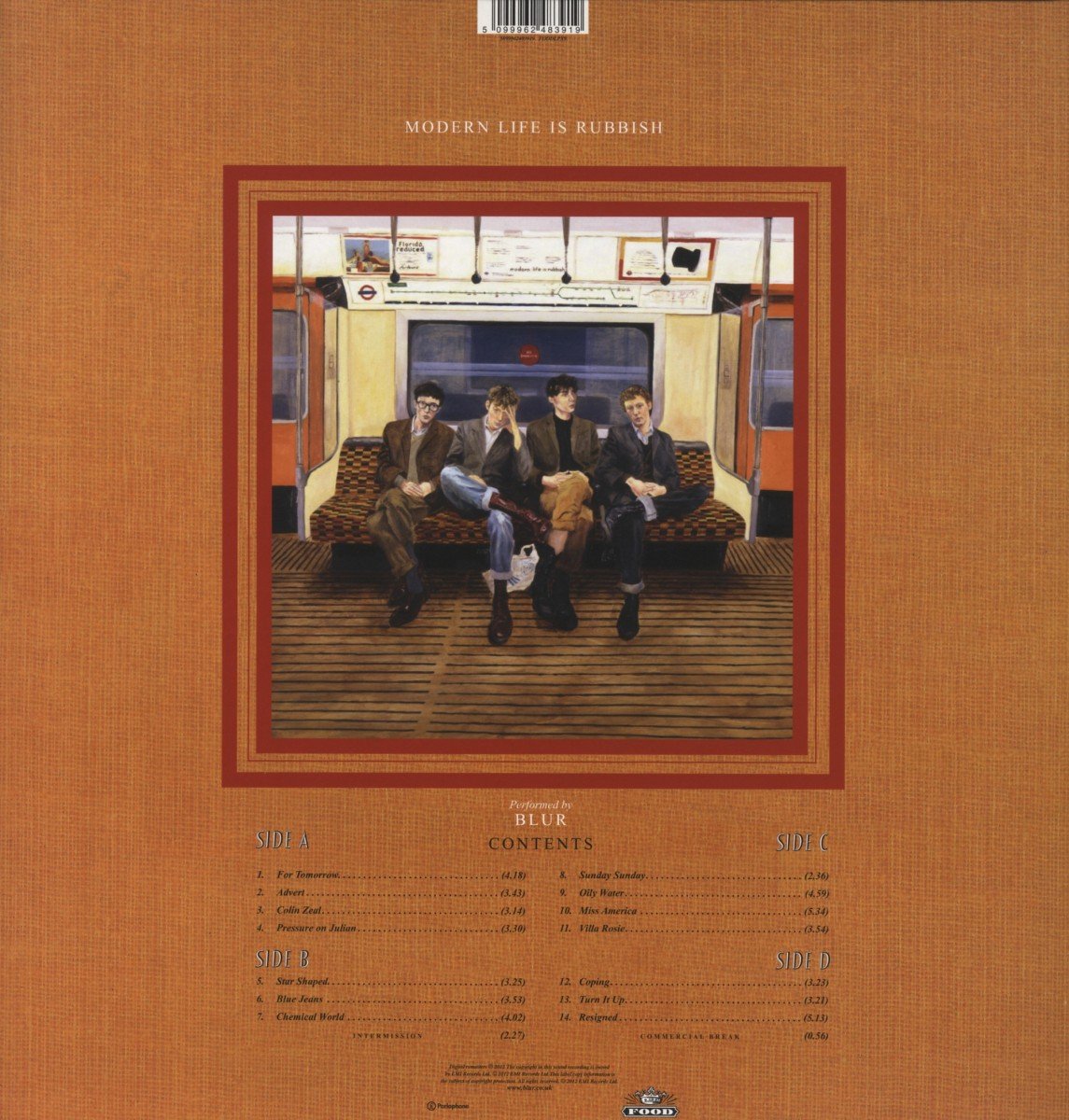
Recorded in 1993, Modern Life is Rubbish was Blur's second album and represented a change in style by the band, based on more melodic influences such as The Kinks and The Small Faces. This vinyl edition is remastered and repackaged. Review: Ah, 1993! - CONTEXT: 1993 has been rewritten as an era of guitar pop rejuvenation. Riot Grrrl had been and gone in a matter of months without leaving a trace, Suede were booted off the top table and disappeared for the rest of the year and Carter USM and Neds Atomic Dustbin lived out their final months. 1993 was all Shabba Ranks, Jamiroquai and pop songstresses. As the blip that was that year's crusty / Acid Jazz crossover boom headlined the summer festivals, lower down the bills our partisan bands slowly crept up the running orders as those 1991 tips-for-the-top misfired and sank lower down. Caught somewhere between the two, former baggy band Blur had just delivered their sophomore album, Modern Life Is Rubbish. It had been a long wait since their first incarnation passed time with fellow Madchester bandwagon-jumpers on weekend morning television. Through a veil of half-interest I watched as they outlived Candy Flip and Airhead and was surprised when they suddenly delivered the sharp euphoric blast of the previous years ‘Popscene’ single. Popscene was an excellent name for a song and its cover artwork was also brilliant. The chorus hook was obvious and familiar and hearing it bursting over the airwaves in April 1992 piqued my interest. I didn’t buy it of course, no one did, but new-Blur were duly noted. NINETEEN-NINTY-THREE: Watching from afar as I tuned 17, Blur’s reinvention was dramatic and fascinating. Their mid-1992 European festival look of boating blazers and faux-Mod suits, so nicely captured on clips shown on MTV 120 Minutes, was as way out-there as you could get in this era of fraggle and grunge. Now, in publicity shots for their new album, Blur posed in front of various graffitied slogans like ‘Modern Life Is Rubbish’ (gingerly spray painted onto a toilet wall in Clacton), and ‘British Image 1’ while dressed as Boover Boys with turned-up jeans and 16-hole ox-blood DMs. In one picture they even posed with a leashed and suitably aggressive looking council estate dog. Looking much like I had when nervously attending Scout events or being so hopelessly out of step in my handed-down threads when trying to assimilate with my cool chino-wearing pals in the late-eighties, Blur suddenly looked ace. As Brett Suede became a mincing parody on stage wearing smaller and smaller nylon negligees, so embarrassingly seen on their 1993 Brit Awards performance, Blur reset the acceptable look for a band. Poised somewhere between about 1977 and 1982, they looked cool and dangerous. The title of their new album Modern Life Is Rubbish, while usually taken as a fun state of the nation address, held a deeper meaning. As the band explained in the lead up to the release, modern life is built on the rubbish of the past. It was rummaging around in my old attic, my secondhand Bowie tapes, Hot Hits sound-alike compilations and the old family cars. Taking musical cues from The Kinks, XTC, Bowie and the New Wave, it was an album as triumphantly retro-now as Suede’s cocky first singles and Pulp's finger-on-the-pulse England vignettes. For a blank and so far disappointing 1993 made up of the tattered flags of an ascendant 1992, it was sharp and knowing. I initially took the new Blur to be a good old-fashioned knees up band, but there was a cutting, dark undercurrent there. ‘Blue Jeans' and ‘Resigned’ were beautifully somnolent and perfect for a lazy summer 1993 and the smattering of their 1993 B-sides hinted at a vast and occasionally superior hidden world as they exorcised their dark and misfiring 1992. A year which could have cost them their career as they got drunker and drunker on that first brief sliver of fame with their baggy-flavoured debut album Leisure. In 1992 Suede had reminded us all that guitar tunes could be louche, cocky and be somehow created out of a shared rock nostalgia, but Blur blew the bally doors off. Mentions of Portobello Road and Primrose Hill in the lyrics were moot. The scholarly ink spilt on the pre-Britpop Blur vs Suede chicken and egg is fascinating. While Blur’s glammy 'For Tomorrow' and 'Chemical World' singles in mid-1993 managed to out-Suede Suede by ticking all the Bowie references I understood back then, it was to be the oompah ‘Sunday Sunday’ and its accompanying video that would form the blueprint for little bands for the next three years. Stylized high-contrast footage of the band mucking around in a caravan pitched in a council estate and acting out all those British Sunday cliches with a knowing wink would become de rigueur. Suede would never have done something that knowingly daft. Especially dressing up like The Undertones. MORE CONTEXT: Lurking on the flipside of the ‘Sunday Sunday’ single were a couple of old music hall tracks suitably punked up by the out-on-a-limb 1993 Blur. ‘Let’s All Go Down The Strand’ was so ridiculously jaunty it served as a blueprint (a blur-print?) for their next moves. Kettles of fish all in one basket, Blur had no Plan B. It was overpowering. Together with raucous covers of ‘Substitute’ and ‘Oliver’s Army’ that could be found on various contemporary compilation albums, there were also a couple of notable bits of onstage banter that I managed to tape off the radio which contextualised Blur 1993 further for me: “This is a London song”, Finsbury Park, 13th June 1993: Introducing the current single ‘For Tomorrow’ during an acoustic performance at this XFM-sponsored festival, singer Damon Albarn inadvertently wrapped up all that nonsense I’d had in my head for a decade. War Of The Worlds, Queen racing up Wardour Street to record their first album, Bowie stood on a rainy Heddon Street in 1972, Suede playing their swooning glammy stuff to three people at The Camden Falcon. A London song. The nations little bands would start to write London songs. “This is ye olde song”, Glasgow Barrowlands, 3rd September 1993: Introducing a mid-set performance of their debut single ‘She’s So High’ and hoping to give context to this nugget of Blur’s previous life as shoe-gazing baggy chancers, this off the cuff remark exemplified a new language. A new and knowing code. This wasn’t a band to shout out, “Let’s see some hands out there!” Of course, over the years, they’d reduce themselves to that as the stadiums beckoned, but when they did, ‘She’s So High’, so reminiscent of a bygone era, was reborn as the late-in-the-set nostalgic-slowie. It was like Queen doing ‘In The Lap Of The God’ in 1986 or Bowie digging out ‘Sorrow’ and ‘Life On Mars?’ on the Serious Moonlight Tour. HISTORY: While Blur’s marking-time indie-dance debut album Leisure became a reborn curiosity for me in 1993 with its uncomplicated tales of longing matching my blossoming adventures in that area (see ‘Repetition’ and ‘Bang’), the energetic ‘Coping’ and ‘Advert’ off Modern Life Is Rubbish were like a new manifesto. Like Suede and the Manics before them, my tips for the top in 1992, Blur presented me with a complete worldview. A secret club to join just outside the Top Twenty. And just like the other people like me living in satellite towns around the country dream up all those 'what-ifs', the Britpop Wars of 1994 were to be lift-off. PRODUCT: Sorry, that went on a bit. As for this reissue, well, it's as good as you'd expect if you're already a fan of the album. I think I'd have preferred the gatefold to include some images of the band from the era, perhaps those British Image shots, so that seems like wasted cover real estate, but all the original booklet material seems to be included. Is the cover artwork a little more blurry than the original? I dunno. It's an album that looks great displayed next to the hifi. An album that explains 'me', every acrylic afternoon and every dusk of my teenage years, to those who visit. Review: A great album from start to finish - This is a brilliant album show casing Daman Albarns song writing talent just as blur were hitting it big
| ASIN | B007SAKYJW |
| Best Sellers Rank | 3,707 in CDs & Vinyl ( See Top 100 in CDs & Vinyl ) 55 in Britpop 1,044 in Vinyl 1,656 in Pop |
| Customer reviews | 4.7 4.7 out of 5 stars (451) |
| Is discontinued by manufacturer | No |
| Item model number | 509996248391 |
| Label | EMI |
| Manufacturer | EMI |
| Number of discs | 2 |
| Original Release Date | 2012 |
| Product Dimensions | 0.89 x 31.52 x 31.45 cm; 612.35 g |
T**E
Ah, 1993!
CONTEXT: 1993 has been rewritten as an era of guitar pop rejuvenation. Riot Grrrl had been and gone in a matter of months without leaving a trace, Suede were booted off the top table and disappeared for the rest of the year and Carter USM and Neds Atomic Dustbin lived out their final months. 1993 was all Shabba Ranks, Jamiroquai and pop songstresses. As the blip that was that year's crusty / Acid Jazz crossover boom headlined the summer festivals, lower down the bills our partisan bands slowly crept up the running orders as those 1991 tips-for-the-top misfired and sank lower down. Caught somewhere between the two, former baggy band Blur had just delivered their sophomore album, Modern Life Is Rubbish. It had been a long wait since their first incarnation passed time with fellow Madchester bandwagon-jumpers on weekend morning television. Through a veil of half-interest I watched as they outlived Candy Flip and Airhead and was surprised when they suddenly delivered the sharp euphoric blast of the previous years ‘Popscene’ single. Popscene was an excellent name for a song and its cover artwork was also brilliant. The chorus hook was obvious and familiar and hearing it bursting over the airwaves in April 1992 piqued my interest. I didn’t buy it of course, no one did, but new-Blur were duly noted. NINETEEN-NINTY-THREE: Watching from afar as I tuned 17, Blur’s reinvention was dramatic and fascinating. Their mid-1992 European festival look of boating blazers and faux-Mod suits, so nicely captured on clips shown on MTV 120 Minutes, was as way out-there as you could get in this era of fraggle and grunge. Now, in publicity shots for their new album, Blur posed in front of various graffitied slogans like ‘Modern Life Is Rubbish’ (gingerly spray painted onto a toilet wall in Clacton), and ‘British Image 1’ while dressed as Boover Boys with turned-up jeans and 16-hole ox-blood DMs. In one picture they even posed with a leashed and suitably aggressive looking council estate dog. Looking much like I had when nervously attending Scout events or being so hopelessly out of step in my handed-down threads when trying to assimilate with my cool chino-wearing pals in the late-eighties, Blur suddenly looked ace. As Brett Suede became a mincing parody on stage wearing smaller and smaller nylon negligees, so embarrassingly seen on their 1993 Brit Awards performance, Blur reset the acceptable look for a band. Poised somewhere between about 1977 and 1982, they looked cool and dangerous. The title of their new album Modern Life Is Rubbish, while usually taken as a fun state of the nation address, held a deeper meaning. As the band explained in the lead up to the release, modern life is built on the rubbish of the past. It was rummaging around in my old attic, my secondhand Bowie tapes, Hot Hits sound-alike compilations and the old family cars. Taking musical cues from The Kinks, XTC, Bowie and the New Wave, it was an album as triumphantly retro-now as Suede’s cocky first singles and Pulp's finger-on-the-pulse England vignettes. For a blank and so far disappointing 1993 made up of the tattered flags of an ascendant 1992, it was sharp and knowing. I initially took the new Blur to be a good old-fashioned knees up band, but there was a cutting, dark undercurrent there. ‘Blue Jeans' and ‘Resigned’ were beautifully somnolent and perfect for a lazy summer 1993 and the smattering of their 1993 B-sides hinted at a vast and occasionally superior hidden world as they exorcised their dark and misfiring 1992. A year which could have cost them their career as they got drunker and drunker on that first brief sliver of fame with their baggy-flavoured debut album Leisure. In 1992 Suede had reminded us all that guitar tunes could be louche, cocky and be somehow created out of a shared rock nostalgia, but Blur blew the bally doors off. Mentions of Portobello Road and Primrose Hill in the lyrics were moot. The scholarly ink spilt on the pre-Britpop Blur vs Suede chicken and egg is fascinating. While Blur’s glammy 'For Tomorrow' and 'Chemical World' singles in mid-1993 managed to out-Suede Suede by ticking all the Bowie references I understood back then, it was to be the oompah ‘Sunday Sunday’ and its accompanying video that would form the blueprint for little bands for the next three years. Stylized high-contrast footage of the band mucking around in a caravan pitched in a council estate and acting out all those British Sunday cliches with a knowing wink would become de rigueur. Suede would never have done something that knowingly daft. Especially dressing up like The Undertones. MORE CONTEXT: Lurking on the flipside of the ‘Sunday Sunday’ single were a couple of old music hall tracks suitably punked up by the out-on-a-limb 1993 Blur. ‘Let’s All Go Down The Strand’ was so ridiculously jaunty it served as a blueprint (a blur-print?) for their next moves. Kettles of fish all in one basket, Blur had no Plan B. It was overpowering. Together with raucous covers of ‘Substitute’ and ‘Oliver’s Army’ that could be found on various contemporary compilation albums, there were also a couple of notable bits of onstage banter that I managed to tape off the radio which contextualised Blur 1993 further for me: “This is a London song”, Finsbury Park, 13th June 1993: Introducing the current single ‘For Tomorrow’ during an acoustic performance at this XFM-sponsored festival, singer Damon Albarn inadvertently wrapped up all that nonsense I’d had in my head for a decade. War Of The Worlds, Queen racing up Wardour Street to record their first album, Bowie stood on a rainy Heddon Street in 1972, Suede playing their swooning glammy stuff to three people at The Camden Falcon. A London song. The nations little bands would start to write London songs. “This is ye olde song”, Glasgow Barrowlands, 3rd September 1993: Introducing a mid-set performance of their debut single ‘She’s So High’ and hoping to give context to this nugget of Blur’s previous life as shoe-gazing baggy chancers, this off the cuff remark exemplified a new language. A new and knowing code. This wasn’t a band to shout out, “Let’s see some hands out there!” Of course, over the years, they’d reduce themselves to that as the stadiums beckoned, but when they did, ‘She’s So High’, so reminiscent of a bygone era, was reborn as the late-in-the-set nostalgic-slowie. It was like Queen doing ‘In The Lap Of The God’ in 1986 or Bowie digging out ‘Sorrow’ and ‘Life On Mars?’ on the Serious Moonlight Tour. HISTORY: While Blur’s marking-time indie-dance debut album Leisure became a reborn curiosity for me in 1993 with its uncomplicated tales of longing matching my blossoming adventures in that area (see ‘Repetition’ and ‘Bang’), the energetic ‘Coping’ and ‘Advert’ off Modern Life Is Rubbish were like a new manifesto. Like Suede and the Manics before them, my tips for the top in 1992, Blur presented me with a complete worldview. A secret club to join just outside the Top Twenty. And just like the other people like me living in satellite towns around the country dream up all those 'what-ifs', the Britpop Wars of 1994 were to be lift-off. PRODUCT: Sorry, that went on a bit. As for this reissue, well, it's as good as you'd expect if you're already a fan of the album. I think I'd have preferred the gatefold to include some images of the band from the era, perhaps those British Image shots, so that seems like wasted cover real estate, but all the original booklet material seems to be included. Is the cover artwork a little more blurry than the original? I dunno. It's an album that looks great displayed next to the hifi. An album that explains 'me', every acrylic afternoon and every dusk of my teenage years, to those who visit.
A**S
A great album from start to finish
This is a brilliant album show casing Daman Albarns song writing talent just as blur were hitting it big
T**T
Classic Album.
Great album and a great pressing. The artwork looks amazing in a frame too.
R**S
Superb, but overlooked, release from 1993
'Modern Life Is Rubbish' suffered from '2nd album syndrome' and, for some reason, the public just didn't really connect with it en masse and the singles released failed to hit the Top 10. However, many of the excellent tracks on this LP such as 'For Tomorrow' and 'Chemical World' are firm favourites with the fans (and the band for that matter) and this collection is definitely worth checking out.
F**W
The best Blur Album! A masterpiece!
Blur's second album 'Modern Life Is Rubbish' is my hands-down favourite out of everything that these four men ever done. It truly brought Britpop to the focus at the time, and spawned three singles: the indie anthem 'For Tomorrow' (not only my favourite Blur song, but in a short list of my all time favourites by any artist), 'Chemical World' and 'Sunday Sunday', none of which hit the heights of their later hits, but made a lot of people take notice of them. I think that the front cover conveys the message that this is a great album (If I was to judge a book by it's cover then that's what I would think anyway) - and indeed it is. The title is appropriate as a lot of the songs give off the message that life in the modern world is well, 'rubbish', and at the same time manages to perfectly capture the sense of living in the city, creating an almost romantic and somewhat nostalgic picture of London at the same time. With strong of elements of The Beatles and The Kinks influencing throughout, it's the epitome of a British record. For the most part, the tracks on the album are slow-paced and relaxing (the laid-back, atmospheric 'Blue Jeans' is particularly sublime) whilst the others, including the outstanding 'For Tomorrow', and fan favourite 'Sunday Sunday' are quirky and upbeat, the perfect tunes to sing-a-long and lift your mood. The rather funny thing is, the whole record sounds just as fresh and modern today, which is quite an achievement for an album released in 1993. Please do yourself a favour, whilst this is an outstanding album, you should seriously consider buying the 2012 two disc Modern Life Is Rubbish edition to hear these songs in superb crystal clear remastered quality, and also to own the bonus disc which has 19 tracks, including all the B sides to the singles 'Popscene', 'For Tomorrow' and 'Chemical World', including a sweet cover of Rod Stewart's 'Maggie May', and the original 'Young and Lovely', a gem and still occasionally played live today. The packaging is also very neat, housed in a lift-off lid box with four artwork postcards and a booklet with never-seen-before photos and liner notes based on an interview with all the members of the band. It really is a superb, worthy re-issue of one of my all time favourite albums.
V**A
Blur es uno de mis grupos favoritos de la década de los noventa. El disco llegó en perfectas condiciones y el producto llegó antes de lo esperado. Estoy escuchando el disco y se oye bien. El precio fue muy accesible, Lo recomiendo ampliamente.
A**N
This is one of my favourite albums of the 90s. The sound quality of the vinyl is excellent. And it comes in a nice glossy jacket with glossy inner sleeves. Recommended.
B**Z
Blurs first great record. Parlophone deliver on an awesome pressing yet again.
C**N
A mio parere, Parklife, Modern Life e The Great Escape sono i 3 classici che ogni fan dei Blur dovrebbe avere nella collezione. Questo resta uno dei miei preferiti: l'ironia, i personaggi schiavi della venuta del nuovo secolo, della società moderna. Alle critiche della società Albarn mischia la grigia visione inglese in canzoni come "For Tomorrow" e "Chemical World". "Oily Water" è forse la mia preferita per il gioco di "chitarre vibranti" che non avevo mai sentito prima.
M**A
Sim meus amigos veio desta maneiro dos EUA , sem qualquer embalagem, e olha que não foi barato
Trustpilot
Hace 4 días
Hace 1 semana