We remain fully operational. Our teams are working around the clock to ensure your deliveries continue safely.

Descargar la aplicación


Servicios al cliente
Sobre nosotros
Copyright © 2025 Desertcart Holdings Limited
Descargar la aplicación

Buy anything from 5,000+ international stores. One checkout price. No surprise fees. Join 2M+ shoppers on Desertcart.
Desertcart purchases this item on your behalf and handles shipping, customs, and support to Nicaragua.
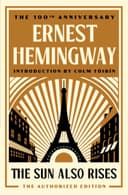
desertcart.com: The Sun Also Rises: The Authorized Edition: 9780743297332: Hemingway, Ernest: Books Review: Nothing is easy; the world is a hard place; enjoying it is almost impossible if your eyes are open - There is no point to reading Hemingway, particularly The Sun Also Rises, if you are looking merely for entertainment. The entire book is a denouncement of people who seek only entertainment and purposefully tries to exclude you from enjoying the book. Just don't read it if you read only for entertainment - you're already part of the Lost Generation, if that's what you're doing because, while you can deny it, that's you he is trying to capture in those dissolute spectators of the bullfight. They don't fight, they drink. In your case, reading is the same as drinking - a way to escape and be entertained. Hemingway and the proprietor of the bullfighter's hotel don't want you there. Go home. You're ruining it, he says. Hemingway saw that people were not, as he had been taught as a child, becoming more and more capable of enjoying and producing peace and beauty. This was only true if you kept your head in the sand and tried to live in the suburbs. Hemingway's father had not yet shot himself, but his wife's father had - and he knew that, even in Midwestern America, the truth of life's very harsh realities could creep in. He adores the Spanish for maintaining a culture that permits the age old practice of tauromachia, bullfighting. It keeps people's heads on straight. It does not allow them to be ostriches. It is only natural that young Americans, raised to believe that the world is mostly entertainment and mostly constructed for their own enjoyment, would be drawn to a grittier cultural event - even if only briefly. The truly alive, though, become aficionados (in the Spanish sense) of the fights. They open their eyes to everything, particularly the specter of their own death. Is it possible to enjoy contemplating death? One's own death? If you don't think it's possible, then this book is probably not for you. It is nothing like a horror story, it is not fake death made momentarily into an adrenalin rush, from which you can hide your face (you can hide your face while at the bullfights; you cannot hide from death itself). Hemingway was born in 1899, just 4 years after certain historians had proclaimed the Closing of the American West (meaning: subduing of the last of the hunter-gatherer tribes and the complete expansion of "traditional American values" into the entire North American continent. He was raised with notions similar to what parents seem to want for their kids today, ideas about family life going well, everyone being happy, no drinking problems, no one acting out sexually, everyone gender-normal, and so on. Yet, he knew it wasn't so. He knew that humans are humans and there was nothing new under the sun. Only men were sent into combat, young men with ideals in the case of World War I. Hemingway wants to capture the "Riau Riau" mindset that allows men, in a trancelike state, to rise up out of the trenches and charge forward while either being blown to bits or having other people's bits end up on your body (as happened to him). We are not going to live forever, are we? So why die as cowards? Die as a hero! We don't push the heroism meme as much as it was pushed prior to World War I or World War II. We sort of gave up on that - perhaps in the 60's. Hemingway was part of the extinction of this kind of hero. Oh, people still invent games for themselves in which they travel, play sports, climb mountains, run marathons and so on, to still be "heroes" but without killing anything. We don't want heroism associated with killing or dying for a cause and yet, in all of human history, there it is still. People in Kiev (right or wrong) deciding to advance against the police and getting themselves shot - with others watching. People finding that even a shot to the leg isn't a good thing, and doesn't feel as heroic as it felt just a few minutes earlier, while preparing to advance on the enemy. People love having enemies, but the fact that for most 21st century American (and other Anglophone) readers, the "enemies" are now either things like evil corporations or the other people's rugby team, makes the world rather different. In Hemingway's time, a huge war had just been fought, with people (much like oneself, by the way) as the real and true enemy. Germans had been part of the European community, just across the border from France, and now they were the enemy. Russia, once an ally, got itself a separate peace (and saved a bunch of Russians from being killed). Real people were killing real people with greater efficiency than ever before. But why? Because people, men in particular, are designed this way. They get into groups, worked up into various frenzies, and stuff happens. Cultures that can channel the "stuff" into the bullring, well, perhaps that's a partial solution. Perhaps not (Hemingway will consider that in For Whom the Bell Tolls). Perhaps the bullring is merely a way of keeping people perpetually ready to rise up in violence and die for a cause. Maybe that's what all sports do (the ones that are true sports, Hemingway might say - he hated tennis). If you are reading this book cold, you will probably have the reactions of many others (see the 3 star and lower reviews). I strongly suggest you read two volumes of Michael Reynolds's biography of Hemingway (the first two: Young Hemingway and the Paris Years). Read Paul Fussell's The Great War in Modern Memory before reading The Sun Also Rises. Don't just watch war movies, you will turn yourself into the very kind of reader that Hemingway is scathingly trying to insult. Remember, Hemingway was trying to needle and agitate people who may be just like you or me, people who sit at home reading and have not been in the trenches, people who don't go to bullfights. How would he feel about modern audiences, with all the vegans and vegetarians and animal rights people within them? I think he would say that while the ambition is noble, that the understanding of the killing is more important than ever. If you are going to save animals (including people), you must understand human nature and human history. Human nature, on the ground, in all its somewhat eccentric and boring detail, must be at least noticed, and if possible, understood. Even changed. When I first read The Sun, I deplored what I thought was the glorification of bullfighting and the cult of machismo. I was quite young and did not know much about the world then. I thought I would never read it again. When I read it the second time, I knew a lot more about Hemingway and I had read some of the 5 star reviews here. I realized I'd missed the whole point (and it isn't just about the symbolism - I got that part). Now, reading it again, slowly, a third time (because I am interested in understanding the craft of writing - so much is known about Hemingway's processes, reading it again with that information in mind is quite a new read), I realize that the intense literary criticism brought to bear on Hemingway, as well as his public persona, make this book completely amazing. It is a touchstone for not just one generation, but for almost a century's worth of modern readers. It changed how movies were made, it changed how people talked about reality. Because once upon a time, people simply ignored the "black sheep" in every family, until they were piled up so high that someone had to notice that there were more black sheep than white sheep. The entire symbology of this black sheep/white sheep business had to be thrown over. Well brought up and well-to-do people were behaving outside of the standards of puritanical Christendom. Oh no. What to do? What to say? There were gay people! And women who liked sex! And people who had affairs! And prostitutes! And alcohol! (Even during prohibition!!!) Did the puritanical beliefs fail to take hold because the people were flawed? Or were the beliefs flawed? Or had anyone ever really believed them? I think Hemingway leads us down many trails in answering these questions. He keeps his own cards close to his chest (he loved pictures of poker players and throwing dice; he spent money he didn't have on a painting of dice throwing by Masson). He knows that his parents seem to be "true believers" in the middle class, Midwestern ethos (he knows they will disapprove of the characters in the book, as so many readers here still do). He doesn't know, yet, that his father will shoot himself (and that two of his siblings will also be suicides). But he knows there's something amiss with the whole thing and in the end, prefers to slip back in time, and to another culture, to the corridas and the ancient dance with the bull. He knows that near Pamplona, some of the earliest art in the world depicts a human conception of a bull as powerful - but also the entire point of the Hunt. Even Hemingway, though, cannot make the actual bullfighter the protagonist of the novel, even if he intended him to be the Hero. Hemingway is too modern, himself, too much of a spectator to be a bullfighter - or, as he seems to say in The Sun, even a true aficionado. Without true love for something, we are lost. The entire generation was lost, it had lost the possibility of true love. He thought he loved Hadley, during the period depicted in The Sun and in the period when he was writing it, he became painfully aware that he no longer loved Hadley in the same way - he had another "true love." He did not want to admit, ever, that he had lost the capability of loving truly, which is why he tried to capture the minutiae of how love is born and how it dies. By becoming expert on this subject of love (Lady Brett is certainly loved in many different ways, all of them "true"), Hemingway hopes not to be lost. Many of his other themes are lost on today's readers, though, because we have all but given up on the notions of masculinity and femininity that Hemingway was steeped in (as was the next generation after him, and the one after that - the ones who fought in World War II; they still had those same notions); we have given up on the touchstone of extreme competition as an inherent value (we give ribbons and trophies to all the kids who "compete" in our suburban children's leagues). Showing people drunk or otherwise intoxicated is a commonplace (Jersey Shores, anyone?) and no one is shocked - in fact, they are apparently amused and entertained. Perhaps that's why that aspect of the book seems relatively boring. Finally, Hemingway doesn't want you to spectate. He purposefully took out interior monologues, bits about what people were thinking, many of the "explanations" of the action. He had this perverse idea that you, the reader, are supposed to be actively engaged - using your imagination. He was showing you exactly what happened. What did it mean? You are supposed to stop and think about it, imagine it. This book is a great one to read aloud with a significant other or older kids. We don't know a single family, anywhere, who doesn't have some of these people in them. In our neighborhood, there are drug addicts, 12 steppers, homeless people who apparently have wandered away from any sort of family - all kinds of "lost" people. Is your world really that different? If so, it will be changing soon. There is no where on the planet where a thinking person can live and not encounter the problems of death, destruction, unrequited loves and all that Hemingway scrupulously describes. But it is a literary description, not a self-help book. He provides no answers and he didn't intend to be uplifting. Review: Deduct One Star for Uneven Job by Hurt - This is one of the great books of the Twentieth Century, but the at times disappointing reading by Hurt causes me to deduct one star. Hurt is too intrusive as a reader. He hams up the part of Michael Campbell with a thick and drunken Scottish accent. His reading makes a likeable character like Jake's buddy Bill seem like an oaf. His impression of Lady Ashley leaves one wondering why Jake or anyone else would even bother with her. Actors, of course, are supposed to interpret the work, but a lighter hand is necessary when reading a book as opposed to acting out a play. Moreover, Hurt's interpretation is unjustifiably negative. Yes, Hemingway is writing about the post-World-War-I "Lost Generation" and, yes, Jake hangs with a bunch of alcoholic wretches, but Hurt's interpretation is a bit too cartoon-like. There is more subtlety to these characters than Hurt is willing to acknowledge. As for Hemingway's book, it's worth reading and re-reading. And this audiobook has allowed me to re-read the book easily at a later stage in life. In some ways the book does not age well. Robert Cohn is a central character, and the rank anti-semitism of the author as well as his characters is inexcusable. Cohn's "Jewishness" is totally gratuitous. Hemingway could have sketched this character without this cheap and mean-spirited use of the easy prejudices that so pervaded his time. Yes, we have to give Hemingway some slack and not judge him by modern standards; but not everyone was an anti-semite back then and a better man would have overcome this social prejudice. On the other hand, the book is extraordinary for the muscularity of its prose. The story is told largely through dialogue and spare descriptions. It is a riveting style that draws the reader into the book and requires the reader to make many of the essential judgments about the various characters. I can't agree with those reviewers who are left unmoved by the story. The story is quite interesting and fast moving. And it touches on the elemental themes of how to define a moral code in a lost world. Also striking is Hemingway's struggle with how to define masculinity in such a world. Jake seems to strike the best balance between assertiveness and empathy, but lacks the physical abilities. Cohn has the physical gifts but none of the emotional ones. The other characters seem to suffer from various self-destructive impulses, which seems to be a common outlet for the the masculine impulse. Perhaps the best masculine role model is the bullfighter, Romero, but there are hints that even he is prone to corruption and self-destructiveness. I recommend the book, but see if there is an older, better reading somewhere.


| Best Sellers Rank | #88,271 in Books ( See Top 100 in Books ) #2 in World War I Historical Fiction (Books) #185 in Classic Literature & Fiction #395 in Literary Fiction (Books) |
| Customer Reviews | 4.0 out of 5 stars 15,893 Reviews |
C**D
Nothing is easy; the world is a hard place; enjoying it is almost impossible if your eyes are open
There is no point to reading Hemingway, particularly The Sun Also Rises, if you are looking merely for entertainment. The entire book is a denouncement of people who seek only entertainment and purposefully tries to exclude you from enjoying the book. Just don't read it if you read only for entertainment - you're already part of the Lost Generation, if that's what you're doing because, while you can deny it, that's you he is trying to capture in those dissolute spectators of the bullfight. They don't fight, they drink. In your case, reading is the same as drinking - a way to escape and be entertained. Hemingway and the proprietor of the bullfighter's hotel don't want you there. Go home. You're ruining it, he says. Hemingway saw that people were not, as he had been taught as a child, becoming more and more capable of enjoying and producing peace and beauty. This was only true if you kept your head in the sand and tried to live in the suburbs. Hemingway's father had not yet shot himself, but his wife's father had - and he knew that, even in Midwestern America, the truth of life's very harsh realities could creep in. He adores the Spanish for maintaining a culture that permits the age old practice of tauromachia, bullfighting. It keeps people's heads on straight. It does not allow them to be ostriches. It is only natural that young Americans, raised to believe that the world is mostly entertainment and mostly constructed for their own enjoyment, would be drawn to a grittier cultural event - even if only briefly. The truly alive, though, become aficionados (in the Spanish sense) of the fights. They open their eyes to everything, particularly the specter of their own death. Is it possible to enjoy contemplating death? One's own death? If you don't think it's possible, then this book is probably not for you. It is nothing like a horror story, it is not fake death made momentarily into an adrenalin rush, from which you can hide your face (you can hide your face while at the bullfights; you cannot hide from death itself). Hemingway was born in 1899, just 4 years after certain historians had proclaimed the Closing of the American West (meaning: subduing of the last of the hunter-gatherer tribes and the complete expansion of "traditional American values" into the entire North American continent. He was raised with notions similar to what parents seem to want for their kids today, ideas about family life going well, everyone being happy, no drinking problems, no one acting out sexually, everyone gender-normal, and so on. Yet, he knew it wasn't so. He knew that humans are humans and there was nothing new under the sun. Only men were sent into combat, young men with ideals in the case of World War I. Hemingway wants to capture the "Riau Riau" mindset that allows men, in a trancelike state, to rise up out of the trenches and charge forward while either being blown to bits or having other people's bits end up on your body (as happened to him). We are not going to live forever, are we? So why die as cowards? Die as a hero! We don't push the heroism meme as much as it was pushed prior to World War I or World War II. We sort of gave up on that - perhaps in the 60's. Hemingway was part of the extinction of this kind of hero. Oh, people still invent games for themselves in which they travel, play sports, climb mountains, run marathons and so on, to still be "heroes" but without killing anything. We don't want heroism associated with killing or dying for a cause and yet, in all of human history, there it is still. People in Kiev (right or wrong) deciding to advance against the police and getting themselves shot - with others watching. People finding that even a shot to the leg isn't a good thing, and doesn't feel as heroic as it felt just a few minutes earlier, while preparing to advance on the enemy. People love having enemies, but the fact that for most 21st century American (and other Anglophone) readers, the "enemies" are now either things like evil corporations or the other people's rugby team, makes the world rather different. In Hemingway's time, a huge war had just been fought, with people (much like oneself, by the way) as the real and true enemy. Germans had been part of the European community, just across the border from France, and now they were the enemy. Russia, once an ally, got itself a separate peace (and saved a bunch of Russians from being killed). Real people were killing real people with greater efficiency than ever before. But why? Because people, men in particular, are designed this way. They get into groups, worked up into various frenzies, and stuff happens. Cultures that can channel the "stuff" into the bullring, well, perhaps that's a partial solution. Perhaps not (Hemingway will consider that in For Whom the Bell Tolls). Perhaps the bullring is merely a way of keeping people perpetually ready to rise up in violence and die for a cause. Maybe that's what all sports do (the ones that are true sports, Hemingway might say - he hated tennis). If you are reading this book cold, you will probably have the reactions of many others (see the 3 star and lower reviews). I strongly suggest you read two volumes of Michael Reynolds's biography of Hemingway (the first two: Young Hemingway and the Paris Years). Read Paul Fussell's The Great War in Modern Memory before reading The Sun Also Rises. Don't just watch war movies, you will turn yourself into the very kind of reader that Hemingway is scathingly trying to insult. Remember, Hemingway was trying to needle and agitate people who may be just like you or me, people who sit at home reading and have not been in the trenches, people who don't go to bullfights. How would he feel about modern audiences, with all the vegans and vegetarians and animal rights people within them? I think he would say that while the ambition is noble, that the understanding of the killing is more important than ever. If you are going to save animals (including people), you must understand human nature and human history. Human nature, on the ground, in all its somewhat eccentric and boring detail, must be at least noticed, and if possible, understood. Even changed. When I first read The Sun, I deplored what I thought was the glorification of bullfighting and the cult of machismo. I was quite young and did not know much about the world then. I thought I would never read it again. When I read it the second time, I knew a lot more about Hemingway and I had read some of the 5 star reviews here. I realized I'd missed the whole point (and it isn't just about the symbolism - I got that part). Now, reading it again, slowly, a third time (because I am interested in understanding the craft of writing - so much is known about Hemingway's processes, reading it again with that information in mind is quite a new read), I realize that the intense literary criticism brought to bear on Hemingway, as well as his public persona, make this book completely amazing. It is a touchstone for not just one generation, but for almost a century's worth of modern readers. It changed how movies were made, it changed how people talked about reality. Because once upon a time, people simply ignored the "black sheep" in every family, until they were piled up so high that someone had to notice that there were more black sheep than white sheep. The entire symbology of this black sheep/white sheep business had to be thrown over. Well brought up and well-to-do people were behaving outside of the standards of puritanical Christendom. Oh no. What to do? What to say? There were gay people! And women who liked sex! And people who had affairs! And prostitutes! And alcohol! (Even during prohibition!!!) Did the puritanical beliefs fail to take hold because the people were flawed? Or were the beliefs flawed? Or had anyone ever really believed them? I think Hemingway leads us down many trails in answering these questions. He keeps his own cards close to his chest (he loved pictures of poker players and throwing dice; he spent money he didn't have on a painting of dice throwing by Masson). He knows that his parents seem to be "true believers" in the middle class, Midwestern ethos (he knows they will disapprove of the characters in the book, as so many readers here still do). He doesn't know, yet, that his father will shoot himself (and that two of his siblings will also be suicides). But he knows there's something amiss with the whole thing and in the end, prefers to slip back in time, and to another culture, to the corridas and the ancient dance with the bull. He knows that near Pamplona, some of the earliest art in the world depicts a human conception of a bull as powerful - but also the entire point of the Hunt. Even Hemingway, though, cannot make the actual bullfighter the protagonist of the novel, even if he intended him to be the Hero. Hemingway is too modern, himself, too much of a spectator to be a bullfighter - or, as he seems to say in The Sun, even a true aficionado. Without true love for something, we are lost. The entire generation was lost, it had lost the possibility of true love. He thought he loved Hadley, during the period depicted in The Sun and in the period when he was writing it, he became painfully aware that he no longer loved Hadley in the same way - he had another "true love." He did not want to admit, ever, that he had lost the capability of loving truly, which is why he tried to capture the minutiae of how love is born and how it dies. By becoming expert on this subject of love (Lady Brett is certainly loved in many different ways, all of them "true"), Hemingway hopes not to be lost. Many of his other themes are lost on today's readers, though, because we have all but given up on the notions of masculinity and femininity that Hemingway was steeped in (as was the next generation after him, and the one after that - the ones who fought in World War II; they still had those same notions); we have given up on the touchstone of extreme competition as an inherent value (we give ribbons and trophies to all the kids who "compete" in our suburban children's leagues). Showing people drunk or otherwise intoxicated is a commonplace (Jersey Shores, anyone?) and no one is shocked - in fact, they are apparently amused and entertained. Perhaps that's why that aspect of the book seems relatively boring. Finally, Hemingway doesn't want you to spectate. He purposefully took out interior monologues, bits about what people were thinking, many of the "explanations" of the action. He had this perverse idea that you, the reader, are supposed to be actively engaged - using your imagination. He was showing you exactly what happened. What did it mean? You are supposed to stop and think about it, imagine it. This book is a great one to read aloud with a significant other or older kids. We don't know a single family, anywhere, who doesn't have some of these people in them. In our neighborhood, there are drug addicts, 12 steppers, homeless people who apparently have wandered away from any sort of family - all kinds of "lost" people. Is your world really that different? If so, it will be changing soon. There is no where on the planet where a thinking person can live and not encounter the problems of death, destruction, unrequited loves and all that Hemingway scrupulously describes. But it is a literary description, not a self-help book. He provides no answers and he didn't intend to be uplifting.
C**A
Deduct One Star for Uneven Job by Hurt
This is one of the great books of the Twentieth Century, but the at times disappointing reading by Hurt causes me to deduct one star. Hurt is too intrusive as a reader. He hams up the part of Michael Campbell with a thick and drunken Scottish accent. His reading makes a likeable character like Jake's buddy Bill seem like an oaf. His impression of Lady Ashley leaves one wondering why Jake or anyone else would even bother with her. Actors, of course, are supposed to interpret the work, but a lighter hand is necessary when reading a book as opposed to acting out a play. Moreover, Hurt's interpretation is unjustifiably negative. Yes, Hemingway is writing about the post-World-War-I "Lost Generation" and, yes, Jake hangs with a bunch of alcoholic wretches, but Hurt's interpretation is a bit too cartoon-like. There is more subtlety to these characters than Hurt is willing to acknowledge. As for Hemingway's book, it's worth reading and re-reading. And this audiobook has allowed me to re-read the book easily at a later stage in life. In some ways the book does not age well. Robert Cohn is a central character, and the rank anti-semitism of the author as well as his characters is inexcusable. Cohn's "Jewishness" is totally gratuitous. Hemingway could have sketched this character without this cheap and mean-spirited use of the easy prejudices that so pervaded his time. Yes, we have to give Hemingway some slack and not judge him by modern standards; but not everyone was an anti-semite back then and a better man would have overcome this social prejudice. On the other hand, the book is extraordinary for the muscularity of its prose. The story is told largely through dialogue and spare descriptions. It is a riveting style that draws the reader into the book and requires the reader to make many of the essential judgments about the various characters. I can't agree with those reviewers who are left unmoved by the story. The story is quite interesting and fast moving. And it touches on the elemental themes of how to define a moral code in a lost world. Also striking is Hemingway's struggle with how to define masculinity in such a world. Jake seems to strike the best balance between assertiveness and empathy, but lacks the physical abilities. Cohn has the physical gifts but none of the emotional ones. The other characters seem to suffer from various self-destructive impulses, which seems to be a common outlet for the the masculine impulse. Perhaps the best masculine role model is the bullfighter, Romero, but there are hints that even he is prone to corruption and self-destructiveness. I recommend the book, but see if there is an older, better reading somewhere.
J**R
Lacked a compelling plot.
I just don't know where to start here. Let's try this. I came to this book with the expectations of someone who had been told this is a spectacular novel. However, I don't have the honor of having been taught this book in an academic setting, nor have I read any other reviews of it. All I really know is that many people think Hemingway is brilliant and this is his first novel and it established him as a major literary voice for his generation. I looked forward to reading it. What intrigues me is the idea that someone would set out to purposely write a novel like this. It meanders along, with nothing in particular to sustain it. There are a few interesting characters, all of whom lack motivation to do anything. I'm wondering if the point of all of this was that the main character has suffered a wound in the war that left him impotent. He's in love with Brett, and can no nothing about it, since she is not the kind of girl to stick with a man who can't satisfy her physically. (Though neither can any other man, since she feels the needs to skip around to each and every man who enters the novel.) Perhaps his impotence was a metaphor for the whole novel, which could never really seem to get going anywhere. A one word title for this book might have been "Ennui". I was also disappointed that people spoke of this as a novel set in Paris, but that was only about one fourth of it. The rest is set in Spain, and I really have no interest in that country at all. There is a long sequence about fishing, which really helped to set the stage for this backdrop of ennui, and a week long festival of reveling centered around wine and bullfighting, which also keep me on the edge of my ennui-soaked seat. What kept me reading was Hemingway's style, which is always quick and easy to read. This kept me from hating the story. But I really wanted someone to stand up and do something. I was hoping for a really profound tragic ending. But that would have required someone doing something that would lead to tragic consequences. And that just wasn't going to happen.
G**G
Reading a classic for the first time
My eighth-grade literature teacher was a Hemingway fan. But she faced a problem. She’d already gotten into trouble for assigning “The Lord of the Flies” and “The Day of the Triffids” to our all-boys class. And she loved Hemingway, but she knew he might be problematic. Her solution was to have us read “The Old Man and the Sea,” which had won the Pulitzer Prize in 1952 and whose author had won the Nobel Prize for literature in 1954. How could the principal and parents argue with that? The author’s name you did not mention in her presence was F. Scott Fitzgerald. My American literature teacher during my junior year in high school was squarely in Fitzgerald’s camp. Hemingway was not a writer, she sniffed; at best you might consider him a journalist. She was eloquent in her praise of “The Great Gatsby,” but “The Old Man and the Sea” proved you couldn’t trust the judgment of the Pulitzer Prize jurors. And Hemingway wrote about all kinds of unseemly, unmentionable things. She didn’t say anything about Fitzgerald’s Tender is the Night, which, one might argue, has an unseemly, unmentionable thing at its heart. I had never read Hemingway’s “The Sun Also Rises,” which has at its core an unseemly, unmentionable thing, at least in the 1920s – a man’s impotence due to a war injury. The man is Jake Barnes, who works as a journalist (much like Hemingway did) in Paris. He speaks French and Spanish, in addition to his native American English, and he does what Americans of the Lost Generation do in Paris of the 1920s – visit night clubs and drink a lot. Barnes is in love with Lady Brett Ashley, an Englishwoman in the process of divorce and re-marriage, who also has a string of affairs. Because everyone loves Brett Ashley, everyone forgives her affairs. Even her fiancé. We suspect, but can’t prove, that Lady Ashley’s affairs have everything to do with the fact that she loves Barnes, but it is a love that can never be consummated. Everyone else becomes a substitute. Barnes and his circle travel to Spain for the annual running of the bulls and the bullfights. Barnes himself and his friend Bill also go for the trout fishing (Hemingway liked fishing stories). And it is there, in Spain, that the story reaches its crisis, although Hemingway’s famous writing style almost disguises the fact that the story is building toward a crisis. The bullfights are a metaphor, a plot development device, and a symbol for what the story is about. Barnes’ impotence, though barely mentioned, is also a symbol of a man who can’t fully live life and is consigned to living it vicariously through others (I’m not sure if it’s a commentary on journalism or not). “The Sun Also Rises” is almost a century old (first published in 1926), but it reads almost like a contemporary novel. Hemingway wrote sparingly; he didn’t like many adjectives or adverbs. He also wrote almost stepwise and very matter-of-factly, not unlike the way journalists used to write (“He picked up his glass; he drank from his glass; he put the glass down.”). It’s significant that, with the exception of Brett Ashley, all of the characters are male, and even Ashley has a male name. This masculine focus has made Hemingway something of a persona non grata in many academic and literary circles today. I was also somewhat surprised at the rather open anti-Semitism that focuses on one character. “The Sun Also Rises” builds slowly. You don’t realize the grip the story has on you until deep into the narrative. The people are indeed card-carrying members of the Lost Generation. They can’t have what they desire most, but that doesn’t stop them from trying to obtain it.
D**T
A very dark sun
The Sun Also Rises, published in 1926, is Hemingway's great first novel about the aftermath of World War I on a group of Americans living in Paris in the 1920's. It's view of life is bleak to the very end, almost to a fault; but it has a kind of sparse poetic grace in descriptive language that carries one through the pessimism on a wave of aesthetic bliss. The greatness is a product of this original narrative style executed to nearly perfect emotional and tonal effect. It is a new kind of stream of consciousness: not flashy, jazzy and allusive like Joyce, Woolf, or (three years later) Faulkner; but instead a steady chain of observations from the inner thoughts of someone who is sane, experienced, and who looks to report reality with a kind of shell-shocked, bunker objectivity; and whose emotions come through in the cynical realism one might expect from a survivor of an apocalypse. At times the spare descriptions created insufficient clarity, so that some sentences cannot be definitively intepreted and so the meaning is lost or diminished, but such sentences are rare. The emotion underneath the cynicism is subtle, and its impact is cumulative. It develops as one comes to trust Hemingway as a truth-teller. The narrator and main character tells a story of aimless and pleasure-less indulgence, in which war trauma (physical and psychological) is the felt but unspoken source and context of all the emptiness in the characters' actions. Jake Barnes is the owner of the consciousness being so artfully described. But Brett Ashley, the woman he loves and can't get away from, is the vortex of all the emotional action. She is a woman who loves Jake and is not deceptive to him, yet because he can't satisfy her she uses several other men for sex. She seems to have some vague variety of intermittent idealism and moral pride, so she occasionally struggles to manage the side-effects of her cold impulsiveness. Brett is a remarkable character in that clearly she is damaged like Jake (psychically if not physically), and yet she has a unique power that none of the men do, and in watching how she uses that power, one cannot decide to the very end of the story if she is more or less of a person than Jake, or if she has courage, or is worth much sympathy, or if her conscience is fully developed, or if she even has a conscience. That is, one wonders if her apparent moral pride and idealism are actually just grief for having lost any moral pride and idealism. Her deep, enigmatic complexity (and how it makes the reader react) is the greatest accomplishment in this story, but given her place as the emotional center of the story, the emptiness surrounding this elusive complexity also makes perhaps the most cynical statement in a book filled with such cynicism, about the powerlessness that emotionally damaged humans have over their own will. The book has a great last line which sums up all of this tough-minded despair. It may be a matter of opinion as to whether 'The Sun Also Rises' is a classic tragedy or just a well-executed exercise in morbid masochism. In any case, it is unforgettable.
M**T
My First Hemingway
At 73 years old I have now officially read my first Hemingway book. I decided on this one because of the time period. A few years back I read a book titled, "Bohemian Paris, Picasso, Modigliani, Matisse and the Birth of Modern Art." In it, Hemingway was often mentioned, along with F. Scott Fitzgerald, at bars drinking all the time. I remembered that and thought The Sun Also Rises, might be an interesting story. And it was. It took me awhile to keep up with the characters. Names were constantly appearing and I couldn't seem to understand what the story was about. After awhile, I got used to his writing and would look forward to finishing the chapters. It was like a "Peyton Place" story. Not necessarily my type but it did hold my interest. Mostly because of Hemingway's writing style. I did enjoy it and will probably read another of his books.
J**Z
As Humbled Observer
Upon closing The Sun Also Rises, I felt a neutral, pensive emotion wash over me—a sense that perhaps something had eluded me within the story's layers. Ernest Hemingway's celebrated iceberg theory is on full display, enriching the narrative with subtleties and implications that hint at deeper meanings beneath the surface. The narrative captures the essence of the post-World War I era, reflecting on the lives of those seeking to escape their world's harsh realities. The depiction of a life unburdened by financial constraints offers a window into the pursuits and distractions of the "Lost Generation," a term that resonates through Hemingway's portrayal of his characters' aimless wanderings. The Sun Also Rises is a complex work that leaves the reader grappling with its central themes. It's a lesson in how not to choose and treat friends and an exploration of inner circles and personal integrity. The book's complexity is akin to that of a deeply engaging film, offering a rich tapestry of interactions that challenge the observer to look beyond the surface. The book's ending, where Jake returns to Brett following her summoning, stands out. This moment raises questions about the ideals of masculinity and commitment. Jake's character, though seemingly dull, presents a profound reflection on personal sacrifice and adaptation. It prompts me to consider my life choices if faced with similar limitations. The Sun Also Rises sparked deep contemplation in me, particularly on toxic relationships and the elusiveness of truth, which seems to only surface in moments of inebriation. Jake's travels and his attempts to find peace away from drama prompted profound reflections on my own life and the subtle but significant moments that shape our existence. Inspired by this classic, I am compelled to delve deeper into the world of classic fiction, possibly revisiting The Great Gatsby to compare thematic explorations. Hemingway's work encourages a thoughtful engagement with the text, demanding a careful consideration of its every word and implication. The Sun Also Rises is not a book to be read once and forgotten, but a multifaceted experience that invites multiple readings. Its intricate construction and the masterful subtlety of Hemingway's prose reveal new depths with each revisit, making it a compelling choice for those who enjoy thoughtful engagement with a text.
D**Z
Boring
I really wanted to like this, but it mostly left me feeling bored and disconnected. The story follows a group of expatriates drifting through Paris and Spain, drinking constantly and having the same circular conversations without much real growth or purpose. It felt less like a story and more like watching people exist without direction. The characters were especially frustrating. Jake is passive, Brett is emotionally chaotic, and nearly everyone else blends together into a blur of alcohol, jealousy, and self-destruction. It was hard to care about any of them because they didn’t seem to learn or change in meaningful ways. Hemingway’s writing itself is clean and direct, and I can respect how influential his style is. There are moments where the atmosphere—especially during the bullfighting scenes—feels vivid and symbolic. But the lack of emotional depth and meaningful plot made it feel empty rather than profound. Overall, I understand why it’s considered a classic, but for me it was slow, repetitive, and emotionally distant. I finished it, but it wasn’t an enjoyable experience.
Trustpilot
Hace 1 semana
Hace 1 semana