We remain fully operational. Our teams are working around the clock to ensure your deliveries continue safely.

Descargar la aplicación


Servicios al cliente
Sobre nosotros
Copyright © 2025 Desertcart Holdings Limited
Descargar la aplicación
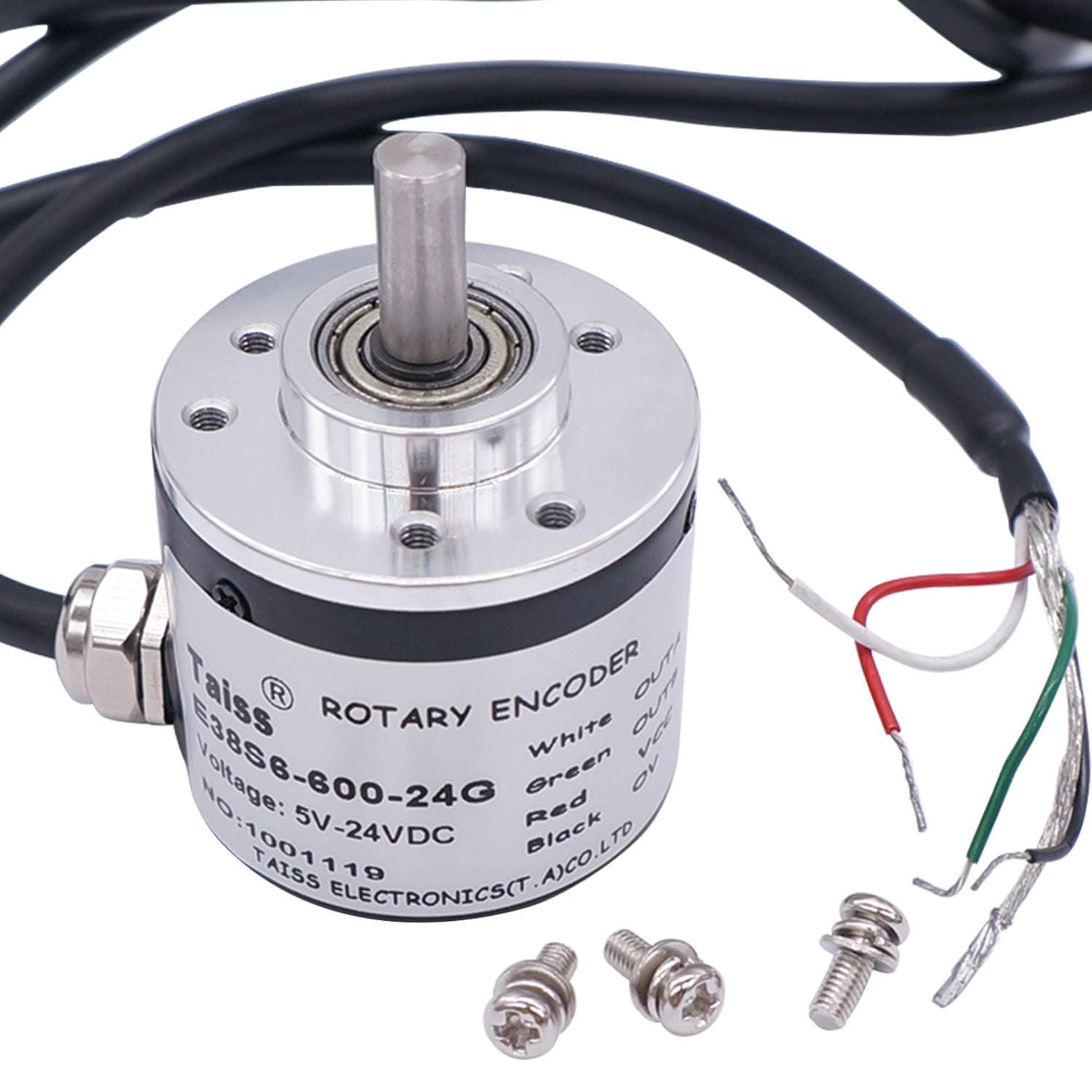



⚙️ Elevate your control game with precision that keeps you ahead!
The Taiss AB 2 Phase Incremental Rotary Encoder offers 600 pulses per revolution with AB two-phase quadrature output, supporting a wide DC voltage range of 5-24V and mechanical speeds up to 6300 RPM. Designed for precise rotational speed, angle, and displacement measurement, it’s ideal for intelligent control systems, robotics, and industrial automation. Featuring a durable 6mm shaft and backed by a 1-year warranty, this encoder ensures reliable performance and easy integration with microcontrollers like ESP32 when used with appropriate pull-up resistors.


| ASIN | B07MX1SYXB |
| Batteries Required? | No |
| Batteries included? | No |
| Best Sellers Rank | 113,599 in Business, Industry & Science ( See Top 100 in Business, Industry & Science ) 82 in Switch Encoders |
| Customer Reviews | 4.4 4.4 out of 5 stars (127) |
| Date First Available | 17 Jan. 2019 |
| Item Package Quantity | 1 |
| Item Weight | 139 g |
| Item model number | 600P/R |
| Manufacturer | Taiss |
| Package Dimensions | 8.6 x 8.3 x 6.1 cm; 139 g |
| Part number | 600P/R |
| Size | 600P/R |
T**Y
Very well priced and functional for a hobby grade encoder. Easily mated with a ESP32 for a motor drive project. Using this encoder required two pull-up resistors as the ESP32 IO's did pull up was not sufficient to give a clean signal.
A**R
Pretty decent encoders. If you want to use 5V directly they have provisions on the PCB. The regulator has a solder bridge between the input and output. Simply connect the bridge with a ball of solder or with a 0805 0 ohm resistor. Like wise on the back of the PCB there are two 0805 locations for pullup resistors. I used 10K and the output works great when connected to a DRO.
R**T
For those that need assistance here is what you need to know: 1) they work best at 6v and up. This is only required to power the board and transmitting LEDs. If has nothing to do with the output. You can take apart and wire directly to the output of the 5v regulator and supply it 5V. But nothing lower. 2) these are open collector NPN. This means the signal wire is connected to the collector of an NPN transistor. So you can use it with 3.3v, 5v, etc for control logic but you need to either tell your microcontroller to use a PULL UP resistor, or install your own pull up resistor that connects from the control voltage say 3.3V to the control/pulse wire. Then connect the grounds together and hook the control wire to the microcontroller input pin. I'm not certain the minimum voltage for the control transistor but I would guess anything over 1.5v would probably be fine. I use them on an esp32 and use the internal pull up on the input pins. The esp32 has a built-in counter up to 80Mhz that can be used for this purpose. These are smooth rotation, no exact stop points. So they work well for free spinning applications like motor control. They are not great for a knob because there are no detents. But if you wanted those there are other options. I put a pulley on it with GT2 belts to the wheels of my robot and they work perfect for that task. I hope this helps inform future customers.
D**.
Product works fine but the specified 5v input is not correct. Product will not work at this voltage. I was able to make it work with a 12v supply.
L**S
I usually don't write product reviews, but this encoder works and it works well. I used it with the hardware quadrature decoder on the Arduino Due and even at 1000 RPM, it does not skip a pulse. I bought the 600p/r version and was under the impression that it was total quadrature rising/falling edges, but it turned out to just be the rising/falling edges of a single phase. This means that the resolution is actually 2400 total rising and falling edges pulses per revolution.
Trustpilot
Hace 1 mes
Hace 2 meses