We remain fully operational. Our teams are working around the clock to ensure your deliveries continue safely.

Descargar la aplicación


Servicios al cliente
Sobre nosotros
Copyright © 2025 Desertcart Holdings Limited
Descargar la aplicación


🌟 Roll, travel, conquer—the Silk Road awaits your legend!
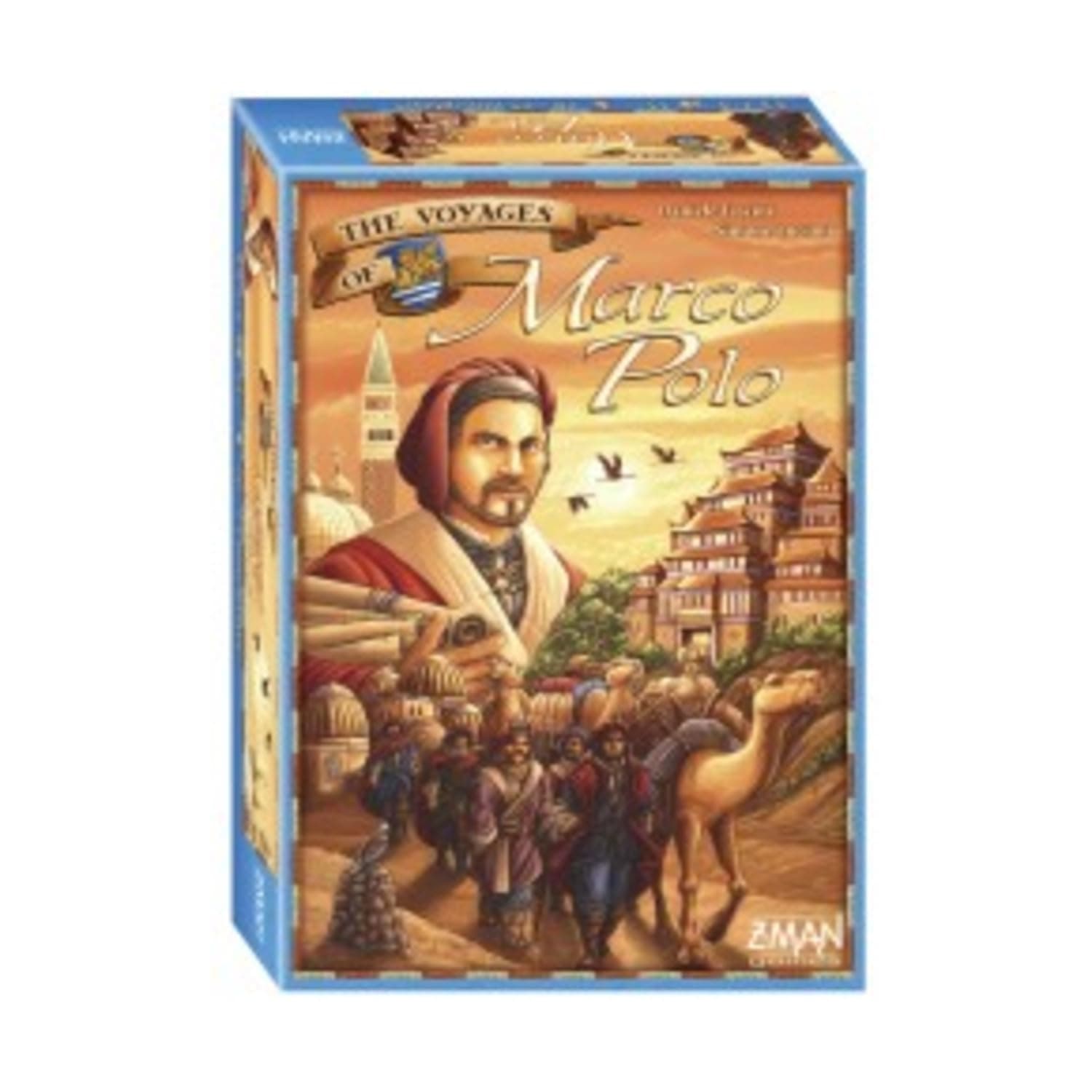
The Voyages of Marco Polo is a 2-4 player strategic board game by Z-Man Games that blends dice allocation, resource management, and route planning across a beautifully crafted Silk Road map. With 60-minute rounds, 8 unique characters, and multiple randomized elements, it offers deep replayability and immersive historical gameplay that challenges players to outwit rivals and master the art of trade and travel.
| ASIN | B00W0J3VEQ |
| Are Batteries Required | No |
| Brand Name | Z-Man Games |
| CPSIA Cautionary Statement | Choking Hazard - Small Parts |
| Colour | Multicolor |
| Customer Package Type | Standard packaging |
| Customer Reviews | 4.4 4.4 out of 5 stars (121) |
| Edition | Standard Edition |
| Genre | Economics & Finance |
| Global Trade Identification Number | 00681706715902 |
| Is Assembly Required | No |
| Item Dimensions | 19.2 x 2.5 x 7 centimetres |
| Item Weight | 1.7 Kilograms |
| Language | English |
| Manufacturer | Z-Man Games |
| Manufacturer Part Number | ZMG 71590 |
| Material Type | Cardboard |
| Maximum Age Recommendation | 1332.00 |
| Minimum Age Recommendation | 36.0 |
| Model Number | ZM7590 |
| Number of Items | 1 |
| Number of Players | 4 |
| Operation Mode | Manual |
| Size | One Size |
| Subject Character | Marco Polo |
| Theme | Marco Polo's Travels |
| UPC | 681706715902 793631917563 787799954850 |
S**E
It takes time to master this fascinating game
This is a really nice game. Beautifully produced and intriguing to play but I found it took quite a lot of effort to get to grips with how to play it. The first couple of games took about three times the predicted length and we're only slowly getting any quicker! There are a number of different things you can do in the game but you have to decide which you're going to focus on and not try to spread your efforts too thinly or the game will be over before you've achieved anything. In particular, it's quite hard to get from place to place so you have to plan journeys very carefully and conservatively. To me the challenges of getting to know the game add to its fascination as I that find games which take a while to "get" tend to be ones that can also offer lasting satisfaction to play year after year. I think this is one of the best games, for serious game enthusiasts, to come out in recent years.
M**S
Great Travel and Set Collecting Game
The Voyages of Marco Polo is a light to medium travel and set collecting game for 2 to 4 players with many replayability variables factored into the game design. There are also many well-designed components. (Note: that you are not really missing 1 camel - it is a confirmed misprint in the well-written rules; the publishers also left a number blank on the score track and misspelled Beijing but we can all work it out!). To give a sense of set-up and the replayability variables: Each player takes on the role of one of eight characters (1st replayability variable) that gives them a different power. Each character's power if quite extreme and will help dictate a player's strategy to some extent. The board is made up of a map (top half) which player's may travel from point-to-point on collecting bonuses (of which 7 are randomly distributed from 10 for 2nd replayability variable) and unlocking actions in cities (of which 9 are randomly distributed from 31 for 3rd replayability variable). Players are then given a starting contract that is fulfilled through set collection of gold, pepper, silk and camels (of which 1 per player is randomly distributed from 6 for 4th replayability variable). The remaining contracts are then set up in five piles of six contracts, where one pile will be used per each of the game's five rounds - there are spare contracts left over as well (so at the beginning 30 are stacked and 8 are in a special contract draw pile making 38 contracts for 5th replayability variable). Players are also given destination cards - if they make these destinations during the game's five rounds they will score bonuses - think Ticket to Ride (2 are randomly distributed per player from 18 for 6th replayability variable). All these replayability variables should keep the game fresh and different each time it is played. To give a sense of in-game mechanics: Players use their character's rolled dice (except one of the characters who has the power to place dice faces how they like) to occupy action spaces - thick Alien Frontiers use of dice as workers and with a bit of Castles of Burgundy for managing the dice face value up or down. Once an action space is occupied it is not locked (as in Agricola) but may be reused by paying money into the bank and placing a character's dice on top of the dice already present. There are a number of action spaces: Take money (5 coins); go to market to buy goods (gold, silk, pepper) or camels; the Favour of Kahn to get one good and two camels; obtain contracts (this is the set fulfilment mechanic that leads to rewards in victory points, goods, camels more contracts etc); or travel where the character's playing piece moves around the world unlocking bonuses additional actions and allowing for the placement of trading houses. To those new to this genre of board games - no one is eliminated from play, no matter how badly they are doing. In the games I have played there were clearly many paths to victory - victory points were awarded on the completion of contracts; the order of arrival in Beijing - if you get there at all; the placement of your penultimate and final trading house on the map; bonus tiles from large cities and bonuses from small towns; placing trading houses in the locations of your private destination cards; if in Beijing by the end of the game, then converting leftover goods into victory points; completing the most contracts vs. other players; converting leftover money into victory points and then totalling for the most victory points to determine the winner. Victory points in our games ranged from around 60 - 80 and most are calculated during game play with only a few bonuses scored at the end to keep everyone in suspense as to who has actually won. I really enjoyed playing Voyages of Marco Polo. If you can tolerate the set-up variability and build a strategy around your character's powers and making the most of your dice rolls in the context of other player's choices then you should really enjoy this game too.
N**E
just don't pay attention on the 13+ sign any 10 year-old can play this game
F**S
This is a very good classic "Euro" board game in the mold of Ticket to Ride, Settlers of Catan, Carcassone, Puerto Rico and the like. If you're at all familiar with any of these titles, The Voyages of Marco Polo will feel like an old friend, one with whom you'd gladly spend time with. But luckily that old friend has also been on a few new voyages recently, learned a few new tricks and a few new tales to tell. If I were to make a comparison, I'd say this game is an interesting, entertaining fusion of Ticket to Ride and Lords of Waterdeep. (I've heard Lords of Waterdeep is itself a simplified version of Agricola---or maybe it was Caylus?---but having never played either Agricola or Caylus I can't really comment on that). At its core this is a worker placement game, but Marco Polo adds a few fun "twists" to the tried-and-true formula that comes together into a fun, strategic game that hits the "sweet spot" between challenge and accessibility. The comparison to Ticket to Ride comes from the aptly titled "Voyages" portion of the game. You take the part of one of Marco Polo's traveling companions, where you must travel from Venice across Asia to the forbidden city of Beijing, stopping at well-known "Silk Road" cities along the way. As you travel, you'll leave behind trading posts, which unlock action areas and resource bonuses---not unlike purchasing new buildings to place within the city of Waterdeep if you're a Lords of Waterdeep aficionado. The main resource-gathering mechanic is classic worker placement; the catch is, instead of using good 'ole wooden "meeples" you're using dice as your workers---and the NUMBERS ON THE DICE play a huge part in determining how to maximize your resources. At the start of each round (there are 5 rounds total in each game) you'll roll your color-coded dice. Based on what you roll and where you place your dice "workers," the level of resources and actions available to you changes. This is a fun mini-game unto itself, because the lowest rolls on your dice typically control what you have available. If a resource-gathering space requires the use of two dice, and all you have is a six and a four, the lower of the two controls the effect of placement. When you roll a couple of sixes in one round, it suddenly becomes a test of maximizing your available placements. Though the dice do bring an element of chance to the proceedings, the game includes built-in mechanics for aiding players whose dice betray them. In addition to traveling and unlocking cities, you'll spend your four core resources (gold, silk, spices, and camels) to complete specific merchant contracts which contribute to your point total. Points can be gained by completing contracts, by being the first to reach Beijing, and through special action spaces. In addition, as a nod to Ticket to Ride, you can earn bonus points by placing trading posts in up to four specific cities along your routes. Which cities you need to unlock are based on quest cards dealt to you at the start of the game. Depending on which of Marco Polo's traveling companions you draw, you'll also have a specific "enhancement" which allows you to "break the rules" in specific ways to help you win. Some allow you to automatically draw extra dice/"workers" each round; some let you avoid paying coin penalties for using occupied spaces, etc. All in all there's nothing really revolutionary, daring, or exceptionally novel about Marco Polo that hasn't been done in other games, so if you're looking for some unique "hook" that hasn't been done before then this won't fit your bill. But if you're looking for something engaging, moderately challenging and fun, The Voyages of Marco Polo delivers an experience that rises above the mere sum of its parts. I wholeheartedly recommend this game; I've been a huge fan of Lords of Waterdeep since it arrived on the scene, but I can quickly see Marco Polo supplanting it as my favorite "worker placement" Euro game. Summary: Rating: 5 stars Time to play: -For your first game, depending on number of players, plan on at least 90 minutes. -For experienced players, I can easily see a 2-player gaming taking around 45 minutes. 3 or 4 player games with experienced players would probably take 70-80 minutes. Challenge level: I'd rate this a slightly-above-moderate level of strategy and complexity. It's slightly more complicated than Settlers of Catan and Lord of Waterdeep, while not quite reaching the level of games like Terra Mystica and Puerto Rico. For me, it's right in the "sweet spot" of a game I can play with less board-game-inclined friends and family while still giving me enough strategy to be satisfied, without scaring them away with the complexity of something like Terra Mystica.
I**A
Mal manejo del vendedor Global gaming warehouse, ya son 3 juegos los que me han enviado con la caja dañada este hasta ahora es el peor. Incluso por dentro venía acomodado sospechosamente no venía con el instructivo hasta arriba, parecía como si fuera usado una pieza de cartón venía rota, muy extraño.
D**Y
very good!
M**E
I love worker placement games. In fact, I've played so many that I thought yet another one would bore me. I was wrong! In Marco Polo, your workers are dice, which you roll at the beginning of each round and then place for actions. The number of pips on your dice determine the strength of your reward. The trick is to strategically place your dice to accomplish your goals while blocking your opponents from accomplishing theirs. In this game, you send your traveler(s) out to visit/discover new cities while collecting and managing resources which will allow you to complete contracts for victory points and resources. Traveling some routes are free while others cost camels or lira to travel over. Additionally, each player has up to four secret cities s/he is trying to visit for extra game-end victory points. The game is asymmetrical with each traveler having its own, unique, power. The powers seem to be crazy strong and will play a role in determining your strategy. This is one of my favorite aspects of the game. Other things I like about this game are: * the artwork - the board and components are beautifully crafted * the game mechanic - I love combining dice rolls with worker placement * playing time - I've played six 2-player games and one 3-player game with an average play time of about an hour. I love games that are a bit weighty in their play but those types of games often take up to four hours to play. This game plays much faster but still delivers a great gaming experience. *the variety of choices - what should I do on my turn? There are so many options: should I travel to gain end-game VPs by visiting my four cities? But to do that I need resources, so should I collect some resources? Or should I complete a contract for some VPs and resources? Maybe I should just go get some gold or camels so I can travel longer routes..... I haven't yet discovered anything I don't like about the game. Maybe, after more plays, something will occur to me. For now, the game seems to have the potential to remain fresh and exciting for a long time!
Trustpilot
Hace 2 semanas
Hace 3 semanas