Desert Online General Trading LLC
Dubai, United Arab Emirates
Desert Online General Trading LLC
Dubai, United Arab Emirates

Full description not available
S**L
A "Just Do It" Machine Learning Book
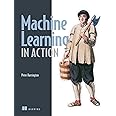
I am new to Machine Learning and I found the book a very good hands-on introduction on the subject. The author takes 8 of the Top 10 algorithms in Machine Learning (based on a 2007 survey paper) and implements them in Python. Other reviewers have pointed out that the theoretical explanations and code quality were somewhat lacking, and thats true. However, even though Python is an extremely readable language, machine learning algorithms are (generally) hard, and I found that it helped to understand them better if I typed them out myself, copying/copy-pasting and restructuring the code as I went, and experimenting with the contents of the intermediate data structures in the REPL. Also, once you have a general idea of how it works, it becomes easier to parse the math in the paper on which the algorithm is based.I still don't completely understand all the implementations, but the book did give me some intuition about how to choose the right algorithm for a given problem. I believe that is also important since ML practitioners often use third party algorithms rather than code everything up from scratch. Of course, for the times you do need to code it up from scratch, you can get some valuable insights about machine learning algorithm design from the style adopted in the book - start small, visualize in 2D/3D for insights, then generalize to higher dimensions. The examples cover a wide range, from dating sites to semiconductor plants, so you get a feel for all the different places these algorithms can be applied.In short, if you want to "Just do ML", ie, quickly get started and pick up anything else you need along the way, then this book may be for you.
Z**Z
A must have for python data scientists.
I teach data science, and have read many many many books on the subject. Of them all, I feel Machine Learning In Action is the best because it is the most clear, has the best example code, and covers the most topics. I recommend this book for beginning data scientists, and advanced alike. The example code and data is also on github. If you are a python user, this book is a MUST.
E**Y
Good Overview of Machine Learning
This book is a good introduction to the main algorithms used in machine learning: linear/logistics regression, kNN, decision and regression trees, naive Bayes, support vector machines, AdaBoost, SVD, and PCA. The author does a good job as presenting complex concepts in a simple fashion.However, many chapters feel more like simplistic summaries around Python code and the editing can be poor at times repeating the same information between a main paragraph and a shaded summary on the next page. I would still recommend this book as a fairly broad overview of these techniques and a valuable starting point for implementing them. It is easy to read and offers a good selection of algorithms.If you are looking for a more formal alternative, I can only recommend the book from Hastie, Tibshirani, and Friedman: The Elements of Statistical Learning. That book presents a more rigorous approach to the same algorithms, their goals, limitations and main variants. It is presented as a reference book but does not drown the reader in an sea of formulas, unlike similar reference books.
C**U
Great Book for machine learning and Python lover
Great Book for machine learning and Python lover, I am sure it is a great book for people who are not familiar with matlab, this may be the fast way to get yourself to do some really work rather than keep reading a lot of papers or pseudo codes.It is not very difficult to read and practice, sometimes you may think of some better ideas from the book.Also the idea of machine learning methods could also be helpful when you use other programming language to do some designs.
A**A
Good attempt but needs LOT of improvement
Looking at many good reviews on amazon, I decided to purchase this book. It's a decent book, but IMO it has been edited poorly and the code has not been tested properly.The introduction chapter got me really excited, just like other Manning's "in Action" books do. But once I started executing the code in chapter 2 "Classifying with k-nearest neighbors" I realized that the code had bugs. Though I could figure out what's wrong and fix the bugs, I did not expect this from Manning, after having read some of their excellent books like (The Quick Python Book, Second Edition, Spring in Action and Hadoop in Action).Moreover the book has some introduction to python and numpy in appendix A. I believe the author could have pointed the reader elsewhere for learning python and those pages could have been used to explain more of numpy and matplotlib, which the author uses freely without any explanation in the text. (Yup, be ready to read some online numpy and matplotlib tutorials and documentation.)If you don't know python, then you can do what I did: read The Quick Python Book, Second Edition and then attempt this book.The figures in the book are not in color so you need to execute the code to understand what the author is telling. It forces you to actually run the code, which is good, but you can't read this book without a computer in front of you.Finally, I am a big believer in following the conventions of a language. I would have been really happy had the author followed PEP8 ([...]), because along with learning machine learning, you could have learnt some good python coding practices.
M**H
Buy It
A really great book to get your feet wet in Machine Learning. I'm taking a course on Knowledge Based AI Agents at Georgia Tech and this book has been a great introduction to the subject. Highly recommend this book if you are interested in Machine Learning or practical AI.
Trustpilot
Hace 1 mes
Hace 2 meses