We remain fully operational. Our teams are working around the clock to ensure your deliveries continue safely.

Descargar la aplicación


Servicios al cliente
Sobre nosotros
Copyright © 2025 Desertcart Holdings Limited
Descargar la aplicación
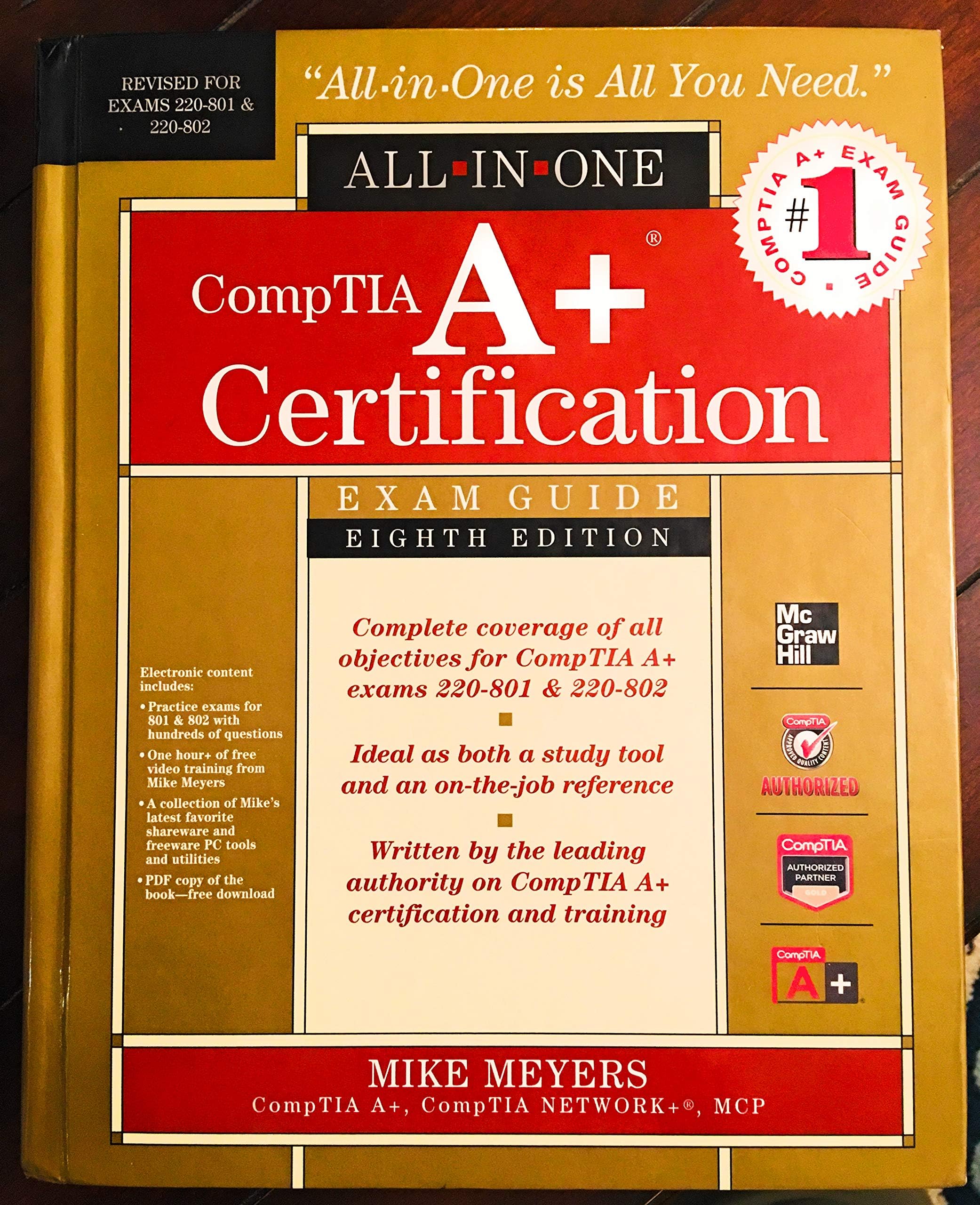
🎯 Your ultimate all-in-one ticket to IT certification success!
The Comptia A+ Certification All-In-One Exam Guide, 8th Edition, is a comprehensive 1150+ page resource designed to prepare aspiring IT professionals for the 220-801 & 220-802 exams. It covers foundational PC hardware, Windows troubleshooting, and networking with clear explanations, practical applications, quizzes, and practice tests. Highly rated by over 1,000 users, this guide balances technical depth with engaging content to ensure you pass your certification and kickstart your IT career.
| Best Sellers Rank | #3,456,079 in Books ( See Top 100 in Books ) #214 in Computer Hardware Upgrade & Repair #249 in PC Hardware #319 in CompTIA Certification Guides |
| Customer Reviews | 4.6 out of 5 stars 1,074 Reviews |
W**E
Something here for everyone
I may not represent the "typical" target for this book as I purchased it strictly to review CompTIA's Windows troubleshooting protocols; I'm sure my mindset of "let's nuke the entire site from orbit, it's the only way to be sure" when a computer encounters any moderately complex problem is probably not the most conventional (at my job I've found it more practical to keep a backup image on the network). Despite that, I've ended up reading it (mostly) cover to cover; no small feat considering it clocks in at 1150+ pages, and I think I've walked away with more than I expected. Mike Meyers takes a "let's start at the bottom" approach that I find ideal since I think it's easier to understand a complex subject when I get the building blocks first. I'd say the first quarter to third of the book is focused on the overview of the PC, its basic technology, and the evolution that brought us to the present day. Every chapter begins with a section titled "Historical/Conceptual" in which he will review the basic concepts of how the technology works, then become more concrete. For example, over the course of a few chapters the book covers the basis of computer language (the binary system) and how the processor physically communicates with the rest of the computer. He then applies this to describe the Intel 8088 processor, an old and very influential design, then explains how that design evolved over time to incorporate new innovations and discoveries to bring the reader to the present day's Intel Core series. The middle of the book moves into bringing the fundamentals together, and towards the end circles back to advanced/esoteric hardware implementation and networking. Some of the material in these sections may seem to have little bearing on the A+ exam, but it's critical to really knowing the basics of computers and how they work; after all, you can't fix something you don't understand. Generally, beyond Historical/Conceptual comes "Practical Application" which will delve into implementing and troubleshooting. I found the tone throughout well balanced, with the right amount of technical detail mixed with analogies where necessary to promote understanding, and enough humor keep a reader awake. There are also a fair amount of Windows screencaps and diagrams when discussing muddy or dense subjects. Every chapter wraps up with a brief quiz to ensure you've picked up the essentials, and closes with a section titled "Beyond A+" to further expand on relevant topics or suggest continued reading or practice. Later chapters move into what you would expect - Windows internals, hard-drives, LANs, networking, mostly with the same thoroughness as earlier chapters, though at times it does feel like the author is simply rattling off information from a list - I found the section on Windows Group Policies especially tedious, but that's Group Policies for you. Some of the analogies I thought might seem belaboured to a novice; the CPU as a man in a box flipping switches I thought was possibly confusing (like, so simple it's actually kind of obtuse) to someone who doesn't already know a bit about binary and electronics. If you're considering purchasing this book as a beginner looking to pass the A+ exams, I wouldn't think twice. I think this alone would be enough to pass the exams, provided you spend the time needed to actually practice what you can. The specifics the book gets into about troubleshooting particular problems (and the decent index) would also make this an ok reference to have lying around a shop, though not my first choice. I know when you're first starting out, it's hard to be patient, especially when you're making your way through a tome as hefty as this, but don't skim and don't think this book is "beneath you" (my mistake initially) and you'll have a good amount of knowledge under your belt by the time you hit the end. A+ is probably your first step, it's important that you get your first step right. Beyond A+ comes the brunt of computing today - networking. This same author's "Network+" guide book, written with the same attention to detail, would seem to be a natural starting point but it might also be beneficial to go hands on first and try "Computer Networking: Internet Protocols in Action"; it comes with a CD containing packet traces you'll be following with an analyzing program called Wireshark. I'd also suggest a classic, "TCP/IP Illustrated, Volume 1" if you really want to get how networking works. You'd also do well to check out the catalog of No Starch Press, and bookmark them; you'll be coming back to their heavy stuff in a year or two.
C**A
PERFECT STUDY HELPER!!!!!!!!!!
First off I have never reviewed anything I have ever purchased. This will be the first time and I have made hundreds if not thousands of purchases online. So that has to count for something. If I am taking the time too. This is the real deal here. The book was about $40 at the time I picked it up. My tip take the CD and install the practice trial test. Take the first one right off the bat and see what you score. Now the trial says you need an 85% to pass I had an 80%. The real test you need a 70%. I believe this extra 15% is to give you lean way for passing. This is a great technique to use for studying. Second I read the book cover to cover. Taking the chapter review test without cheating. I answered them on paper and then went to answers. The answers provide a breakdown as to why the answers are right and not right. Which helps a lot. Again this will only be good if you are honest and don't cheat. This is a really easy book to read. Very well written and with humor involved. It's far from dry and I have read some bad ones. I read it cover to cover in a weekend. There are a lot of pictures which make the 400ish pgs go by super fast. Lastly after all the chapters are read and tests done. Take the 2nd practice exam it has different questions and see how you score.I hit a 95% on that one. After the book. I also went to comptia.org and asked for some practice questions. I aced those and figured it was time for the real test. I just took it today and got a 97% It was pain free and easy to do. You could probably wing a 70% if you are familiar with IT World. However at roughly 100 bucks for the test would you rather spend $140 and pass or risk losing $100 instead if you fail. Some believe this test to be completely pointless. I don't know about that I learned a few new details I didnt before and in my opinion it shows two things. First it helps break you into the testing environment with a lot lower stress. It's an easy test and I rather take my first test on an easy setting then having to do it on super hard right out of the gate. It allows you to discover how to buy a voucher, redeem it sch your test, find your testing center which my gps was off by 10 miles and I was almost late. Secondly, It shows drive and initiative. It shows that you are willing to put in the extra time to study and take the time out of your life to achieve your goal you set no matter what that goal is. Those are my thoughts feel feel to chime in with you.
S**N
The Day After I Passed the A+ Tests
I really liked this text and I used it as my only source to pass the CompTIA A+ 801-802 exams. That being said, I will mention that I am not a total beginner at working with computers. I have been using Windows since Windows 95, have built PCs and even worked in an IT department for a year back in 2000. Not as a tech, but I did learn some things. After reading a few chapters, I decided to test my own knowledge and experience and took the practice exams, which come with this book's CD. I failed with a score of 60 out of 100 on each. This gave me an idea on my weak points, mainly what to do when Windows breaks (before a reinstall), the command line, networking, printers, security and a few other more technical details having to do with components. This book helped me fill in the blanks in a clever, well written, well organized way. The book is written, in a style that will keep you awake and interested, especially with the "Exam Tips" and the overall tone of the writing being less of a technical manual and more conversational. The first five chapters or so are an intro on proper personal tact, dress and safety (known on the exam objectives as Operational Procedures), the overall PC, Windows and networks. These chapters are not to be ignored though as they do give you a good foundation of info needed for the exams and how the rest of the book will go. After those initial chapters the book delves into a close breakdown of PC components and their drivers, then working with Windows and what to do with it when it fails. The final chapters cover networking, Mobile PCs and devices, printers, security, virtualization and more on operational procedures and troubleshooting methods. The number of photos and screenshots throughout every chapter is phenomenal and relevant to the topics discussed. Is this book for a beginner? I would recommend you at least have a working knowledge of how to get around in Windows XP, and Vista/7 Definitely follow along whenever you can in Windows, the command line and anything else you can to prep for the exam's simulations. The practice exams on the CD are all multiple choice questions. The real exams are a mixture of simulations, giving you a scenario and setting you to work running commands or changing settings, and then multiple choice questions. So be ready! Some complaints that the author is condescending are overly sensitive. He's not condescending. He makes several funny comments and geek references throughout the book. It's meant to be humorous to keep you from slipping into a technical coma. If you watch the intro video on the CD you will see that the author is that type of person, energetic and eager to pass on what he knows. Also, he is teaching what will/could be on the exams. I do instructing for law enforcement and you have to teach the material or your class is no good. If you are looking for a book that will help you pass the CompTIA A+ exams and/or expand your PC knowledge, this is a great one. It did both for me. Read it, take notes, and practice. Good luck!
J**.
GET THIS BOOK!
If you're studying for the 801 and/or 802, this book will get you through it. The author, Michael Meyers, has a very reader-friendly, easy-to-understand method of teaching. The author also puts a little personality into the text that keeps the text from being so dry. Here's what you get: - Perfectly suitable explanations, instructions, advice, and material that will teach you what you need to know to pass the exams - 10 practice questions at the end of each chapter with answers and a one- or two-sentence explanation - A CD-ROM that includes additional content as well as two free practice exams Here's what you should know: Physically this book is thick. There are plenty of photos, diagrams, charts, and other graphical content but it is all rendered in grayscale. The pages are just weighty enough that you can highlight terms and important passages, make notes, and flip back-and-forth-and-back-again without easily ripping or wrinkling the pages. I tend to use and abuse my study materials so the quality did not go unnoticed by me. Finally, for the price, I can't think of one reason not to get this book. If you're willing to spend a little more, I might consider a supplemental text with more practice questions or workbook-type material. Although I can't really complain for what I paid for this book (I had plenty of college textbooks cost 5x the price of this book or more), I did assume it would include more questions, answers, and practice exams. Enjoy, and for anyone reading this, best of luck on the exams!
J**.
Good for learning computer history
Great book, learned a lot quickly. Teaching you some history of the parts also.
N**A
The book came in excellent condition and in a quick manner
Shipping condition: The book came in excellent condition and in a quick manner. The book itself: It is a fantastic book for novices in the IT field (like myself). The author writes in such a way that makes it fun to read and makes great analogies to help you understand the material. This book is very in depth, but written so that anyone who has used a computer before (even on a casual user level) can understand. Recommendation: I would recommend this title to anyone, even if you were not to to take the exams for it. Speaking of which, before you buy this edition, keep in mind that the Author will be publishing a newer edition later this year (2015) and the tests for this book will cease towards the end of next year (or so. You can search around and find a precise answer. I read it on a forum on the CompTia website). So keep this in mind when purchasing this book. Personal Experience: I have been using the computer since I was around 5, but just as a basic user. I have only a few months of experience of IT so far and tis book is helping me understand quite a bit about the computer that I did not fully understand before. Good luck in your studies.
W**J
Don't depend solely on this
The book itself is pretty good. Probably compatible to others on the market for reading and gaining information. It is a well structured book and easy to understand. The take away is that there really isn't much after the reading material. It does come with about 220 questions (110 per exam sections). Not enough to help. The questions are way to easy. Of course the point in this is to get one to purchase more questions at a outrageous price. When looking for more question materials you are taken to a site where it costs $125 per exam section for more questions. This is no different with the supposed free videos. You have to pay get actually get what would benefit you. I believe the book and content is rated too high for what you don't get. This is by no means a book that will get you to the promise land in my opinion. I believe those that rated this book and content high and stated this book is responsible for their passing is doing nothing but taking away from their own ability and knowledge they posed already. If I was a real novice, I would have not passed the exam just depending on this material. What I end up doing. Like I said, the book itself is pretty informative. Realizing the accompanying material was very insufficient, I bout two question/answer study guilds. Those is conjunction with this book was all I needed to successfully pass the test. The two other books I purchased were the CompTIA A+ Certification Practice Exams, Second Edition (Exams 220-801 & 220-802) and CompTIA A+ 220-801 220-802 Q&A. Between the two books, I had an additional 2000 Q&As paying less than $25 for the two not the $250 this book requires. Also beware that the new exam has simulations on it. This is new for the 801/802 exams. The 801 sims were pretty easy but the 802 requires some command prompt requirements if you get them. I don't think any of the 801/802 materials have sims as it's new.
T**R
Read the book, use the practice exams on the disc, study, take the test....BOOM! You're A+ Certified!
I am a "professional PC Technician/Network Analyst". I have a bit over 12 years experience working with technology, mainly PC's, audio equipment, video, mobile devices, programming, wired and wireless networking, etc., divided between actual jobs (some were good jobs!) and the classroom. Well, I have been working on a BA for 5 1/2 years now (a 4 yr degree, of course) at 4 different universities and I actually have a 3.69 GPA, and lack 23 hours to finish...So, I will earn a BA, but only because Im so close, it would be stupid not to...This book is the reason why! I have known about the A+ exams since around 2001 when I was the "junior PC Tech" for my junior high(2001=9th grade), and my boss/teacher, Mr. Warrington, was so confident in my skills at that time, that he was willing to pay for my exam and help me earn it before I ever went to college, but I didn't want to work with computers for the rest of my life at the time...Im a Psychology/Addiction Studies Major...I was just good at working on them. Well, time went on and I had several jobs, one even for google, and Mcafee as well...BUT, little did I know, that little piece of paper that says you are A+ Certified was the difference in $12-$16 an hour, 32-40 hours a week (don't get me wrong that's decent money for nothing but a little exp. and a high-school diploma) to making a salary of $51,244 a year...I earned my A+ on the 3rd of May and started working for the company Im with now on the same day I was certified...That was the requirement. Think if I would've had that when I lived in downtown Austin, TX and worked for google...I would be making 6 figures at this point...Thanks to this book...I am a convicted felon (expunged) with a high-school diploma and 12+ years of hands-on work, a lot of which wasn't "on paper", and an A+ Certification I just got my first business cards on Saturday...I've never had a business card with MY name on it! I've never had an office...And Im just starting off now as a "professional", my past experience is irrelevant now, really. I know this is long but I cant explain enough how much of a difference maker this certification is and can be, and how easy it is to earn with this book. If you know a thing or two and know your way around. You can install a stick of RAM, and remove malware, and set up a wireless network in a home or small office, you know your way around Windows, VERY WELL, well then you pick up the book and study the 801-802 sections in each chapter and if you can correctly answer the questions at the end of the chapter, move on until the book is complete. Take the practice exams, if you score above a 90%, I would say your golden...And if you know nothing of computers other than how to turn it on and login to facebook and check your e-mail, maybe download some music and burn a cd, well read the book...give yourself time...read read read read read. Take the quiz at the end of each chapter, and when you can make 100% on every chapter quiz you should take the practice exams on the cd...when 95% or higher is achieved on each exam, call Pearson VUE and schedule the exam. And you come out with a little knowledge and a certification either way...I am starting an entirely new life...I just got my first paycheck and I have never had a check like that that I knew I had another one coming that month too! Changed my life...it's literally a $52000/yr book, at least to me...do it...
Trustpilot
Hace 2 semanas
Hace 1 semana