We remain fully operational. Our teams are working around the clock to ensure your deliveries continue safely.

Descargar la aplicación


Servicios al cliente
Sobre nosotros
Copyright © 2025 Desertcart Holdings Limited
Descargar la aplicación

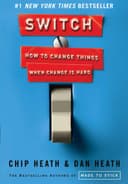

Switch: How to Change Things When Change Is Hard [Heath, Chip, Heath, Dan] on desertcart.com. *FREE* shipping on qualifying offers. Switch: How to Change Things When Change Is Hard Review: Great read, great evidence and made easy! - I would highly recommend this book to anyone looking at making changes in their lives, whether professional or personal. Switch (by same authors as Made to Stick) provides great tips and solutions presented at a user level and with a great framework. The authors first lay out the three big things: the Rider, the Elephant and the Path and describe what each of these are and provides examples so the reader can get it on his level and not some abstract thoughts. After the big introduction the authors broke the book up into parts concerning each one. The first then is about directing the Rider, the more of our conscious, self will side. To do this one should find the 'bright spots' by seeing how some things succeeded instead of what failed. Next one should script the critical moves by breaking stuff down to specific goals. Finally it's to point to the destination by giving Riders a clear view of where they're going. The second is about motivating the Elephant, more our unconscious and representative of all the inertia we have when wanting to change. Elephants are the more emotional and less logical side so the first step is finding the feeling (think those ASPCA commercials). Next one should shrink the change by making it more manageable (more on this later) and increasing the sense of accomplishment. Finally, it's about growing your people... Change will be easier if you expand the abilities and spirits of your people. The third is about shaping the Path. Within this it's about tweaking the environment (smokers know this about all the cues there are about smoking). Next it is building habits which are behaviors on autopilot and how to encourage habits. Finally one should rally the herd. Overall the book is very well written. The authors write in a very friendly style without being too personal... The couple times they do break from the books narrative to tell jokes, they work and actually made me laugh out loud. Their writing style helps the reader understand and so does the formatting, and maybe more so. While overall the book is 3 parts, there are chapters within those parts and then smaller bite sized sections. While also good for reading bit at time I have to imagine they used their own advice with it because it makes one feel more accomplished and thus wanting to read more. All their points are backed up with studies and not just opinions. Also for good measure they have independent 'Clinics' where they present a scenario and ask readers to work it out first. Therefore, overall this is a great book that I learned a lot from and have already started using both personally and in my job. Review: Review by J. Colannino - Switch is a book about managing change by the Heath brothers (Chip and Dan). Chip is a professor at the Graduate School of Business at Stanford University and Dan is a Senior Fellow at Duke University' Social Entrepreneurship center. The two have teamed up before -- in 2007 they released their critically acclaimed Made to Stick: Why Some Ideas Survive and Others Die. This latest effort focuses less on the stickiness of the idea and more on the change process itself. What should a change agent do to implement lasting change in a hard-headed organization that desperately needs it? The book is organized into eleven chapters in three parts: Part 1, Direct the Rider; Part 2, Motivate the Elephant; and Part 3, Shape the Path. The titles come from a vivid metaphor by University of Virginia psychologist Jonathan Haidt. In his book, The Happiness Hypothesis, Haidt likens a person to a rider on an elephant. The rider is the rational side of a person: the part that tells him to eat better, exercise more, and stop procrastinating, for example. The elephant is the emotional side that doesn't want to work to lose weight or exercise and would rather stay put; let's say willpower vs. won't-power; but why should that be? Whatever is autonomous and ingrained by habit belongs to the elephant. The rider is theoretically in control, but it is exhausting to continually tug on the reins and direct the stubborn elephant. Eventually the rider relents and the elephant goes back to doing what he's always done. Sound familiar? Before going much farther, you should know that two things separate Switch from so many other glib books about change: first, the book has a very solid psychological basis. Despite its accessible style, scores of major psychological findings and studies are reported and undergird the book's practical formulae for change. Second, Switch is not a self-help book. I have no doubt that the book could be used in this way, but it is really a book about how to change things. It is primarily directed toward organizational change, though its principles are much broader. And there are many surprises. The first big surprise occurs in the very first chapter. "We know what you're thinking -- people resist change. But it's not quite that easy. Babies are born every day to parents who, inexplicably, welcome that change. Yet people don't resist this massive change -- they volunteer for it. In our lives we embrace lots of big changes. So there are hard changes and there are easy changes. What distinguishes one from the other?" And the surprises keep coming. Like the two researchers who dramatically and permanently got folks to reduce their saturated fat intake. Or the doctor who saved over 100,000 lives and counting in American hospitals on schedule (18 months) by getting thousands of doctors and organizations to change their practices. Or the American who went to Vietnam and changed the face of malnutrition. Or the student who saved an endangered species in a Caribbean country that didn't give two hoots about it. What do all these stories have in common? For one, none of these change agents had the sufficient budget or authority to succeed; yet, they did. How? Every one of them gave clear rational direction to the rider by finding the bright spots, scripting the critical moves, and clearly pointing to the end goal. All of them motivated the elephant by emotionally connecting with it, and they shrunk the apparent change by carefully communicating progress. They refused to underestimate their people. Instead they provided them with a newfound identity that let them to grow into the challenge. But there was more. As the authors note, many times what looks like resistance is really confusion or even the result of misaligned incentives. That's why the path needs to be shaped by making manageable changes to the environment, building sound habits, rallying the herd, and reinforcing the new habit until it becomes a way of life. Well, maybe that sounds like a lot of work. I think it is. But speaking from firsthand experience, it will be a labor of love. And if your heart is not in the change and you do not think you can derive reward from the process, perhaps you are selling yourself short -- or, maybe you're the wrong person to lead the change and you should stop kidding yourself. And perhaps that is what I like most about this book. It does not promise a panacea. It tells it like it is without the jingoism that has become the substance of many change management essays. If you are leading organizational change, the book will provide a solid prescription for achieving lasting results because Switch uses real research, reports real experiences, and provides real guidance. Here, my recommendation is enthusiastic.


| Best Sellers Rank | #16,143 in Books ( See Top 100 in Books ) #43 in Decision-Making & Problem Solving #146 in Leadership & Motivation #228 in Personal Transformation Self-Help |
| Customer Reviews | 4.6 4.6 out of 5 stars (5,979) |
| Dimensions | 5.7 x 1.22 x 8.53 inches |
| Edition | 1st |
| ISBN-10 | 0385528752 |
| ISBN-13 | 978-0385528757 |
| Item Weight | 2.31 pounds |
| Language | English |
| Print length | 320 pages |
| Publication date | February 16, 2010 |
| Publisher | Crown Currency |
S**.
Great read, great evidence and made easy!
I would highly recommend this book to anyone looking at making changes in their lives, whether professional or personal. Switch (by same authors as Made to Stick) provides great tips and solutions presented at a user level and with a great framework. The authors first lay out the three big things: the Rider, the Elephant and the Path and describe what each of these are and provides examples so the reader can get it on his level and not some abstract thoughts. After the big introduction the authors broke the book up into parts concerning each one. The first then is about directing the Rider, the more of our conscious, self will side. To do this one should find the 'bright spots' by seeing how some things succeeded instead of what failed. Next one should script the critical moves by breaking stuff down to specific goals. Finally it's to point to the destination by giving Riders a clear view of where they're going. The second is about motivating the Elephant, more our unconscious and representative of all the inertia we have when wanting to change. Elephants are the more emotional and less logical side so the first step is finding the feeling (think those ASPCA commercials). Next one should shrink the change by making it more manageable (more on this later) and increasing the sense of accomplishment. Finally, it's about growing your people... Change will be easier if you expand the abilities and spirits of your people. The third is about shaping the Path. Within this it's about tweaking the environment (smokers know this about all the cues there are about smoking). Next it is building habits which are behaviors on autopilot and how to encourage habits. Finally one should rally the herd. Overall the book is very well written. The authors write in a very friendly style without being too personal... The couple times they do break from the books narrative to tell jokes, they work and actually made me laugh out loud. Their writing style helps the reader understand and so does the formatting, and maybe more so. While overall the book is 3 parts, there are chapters within those parts and then smaller bite sized sections. While also good for reading bit at time I have to imagine they used their own advice with it because it makes one feel more accomplished and thus wanting to read more. All their points are backed up with studies and not just opinions. Also for good measure they have independent 'Clinics' where they present a scenario and ask readers to work it out first. Therefore, overall this is a great book that I learned a lot from and have already started using both personally and in my job.
J**O
Review by J. Colannino
Switch is a book about managing change by the Heath brothers (Chip and Dan). Chip is a professor at the Graduate School of Business at Stanford University and Dan is a Senior Fellow at Duke University' Social Entrepreneurship center. The two have teamed up before -- in 2007 they released their critically acclaimed Made to Stick: Why Some Ideas Survive and Others Die. This latest effort focuses less on the stickiness of the idea and more on the change process itself. What should a change agent do to implement lasting change in a hard-headed organization that desperately needs it? The book is organized into eleven chapters in three parts: Part 1, Direct the Rider; Part 2, Motivate the Elephant; and Part 3, Shape the Path. The titles come from a vivid metaphor by University of Virginia psychologist Jonathan Haidt. In his book, The Happiness Hypothesis, Haidt likens a person to a rider on an elephant. The rider is the rational side of a person: the part that tells him to eat better, exercise more, and stop procrastinating, for example. The elephant is the emotional side that doesn't want to work to lose weight or exercise and would rather stay put; let's say willpower vs. won't-power; but why should that be? Whatever is autonomous and ingrained by habit belongs to the elephant. The rider is theoretically in control, but it is exhausting to continually tug on the reins and direct the stubborn elephant. Eventually the rider relents and the elephant goes back to doing what he's always done. Sound familiar? Before going much farther, you should know that two things separate Switch from so many other glib books about change: first, the book has a very solid psychological basis. Despite its accessible style, scores of major psychological findings and studies are reported and undergird the book's practical formulae for change. Second, Switch is not a self-help book. I have no doubt that the book could be used in this way, but it is really a book about how to change things. It is primarily directed toward organizational change, though its principles are much broader. And there are many surprises. The first big surprise occurs in the very first chapter. "We know what you're thinking -- people resist change. But it's not quite that easy. Babies are born every day to parents who, inexplicably, welcome that change. Yet people don't resist this massive change -- they volunteer for it. In our lives we embrace lots of big changes. So there are hard changes and there are easy changes. What distinguishes one from the other?" And the surprises keep coming. Like the two researchers who dramatically and permanently got folks to reduce their saturated fat intake. Or the doctor who saved over 100,000 lives and counting in American hospitals on schedule (18 months) by getting thousands of doctors and organizations to change their practices. Or the American who went to Vietnam and changed the face of malnutrition. Or the student who saved an endangered species in a Caribbean country that didn't give two hoots about it. What do all these stories have in common? For one, none of these change agents had the sufficient budget or authority to succeed; yet, they did. How? Every one of them gave clear rational direction to the rider by finding the bright spots, scripting the critical moves, and clearly pointing to the end goal. All of them motivated the elephant by emotionally connecting with it, and they shrunk the apparent change by carefully communicating progress. They refused to underestimate their people. Instead they provided them with a newfound identity that let them to grow into the challenge. But there was more. As the authors note, many times what looks like resistance is really confusion or even the result of misaligned incentives. That's why the path needs to be shaped by making manageable changes to the environment, building sound habits, rallying the herd, and reinforcing the new habit until it becomes a way of life. Well, maybe that sounds like a lot of work. I think it is. But speaking from firsthand experience, it will be a labor of love. And if your heart is not in the change and you do not think you can derive reward from the process, perhaps you are selling yourself short -- or, maybe you're the wrong person to lead the change and you should stop kidding yourself. And perhaps that is what I like most about this book. It does not promise a panacea. It tells it like it is without the jingoism that has become the substance of many change management essays. If you are leading organizational change, the book will provide a solid prescription for achieving lasting results because Switch uses real research, reports real experiences, and provides real guidance. Here, my recommendation is enthusiastic.
E**E
Indispensabile per Leaders e attori del cambiamento in genere. Tantissimi casi pratici da cui apprendere
K**E
Llegó en tiempo y forma
A**D
A must read for everyone
E**E
Excellent read. It’s been on my list of must reads for a while. I don’t know why it took me so long to get around to reading it. This is a book that reiterate the fact that change is hard but there are some predictable patterns that can help effect positive change. Yes ideas are not new however the Heath brothers bring together lots of difficult concepts to presents a powerful and easy to understand framework for effecting positive change. They provide us with some great case studies and stories that brings the framework to life. I loved the book and was surprised how quickly I was able to use the concepts in my own professional life. Highly recommend it
N**A
Great book to learn more about change management; for everyone: team members, leaders, CEOs...
Trustpilot
Hace 2 semanas
Hace 2 meses