
Descargar la aplicación


Servicios al cliente
Sobre nosotros
Copyright © 2025 Desertcart Holdings Limited
Descargar la aplicación
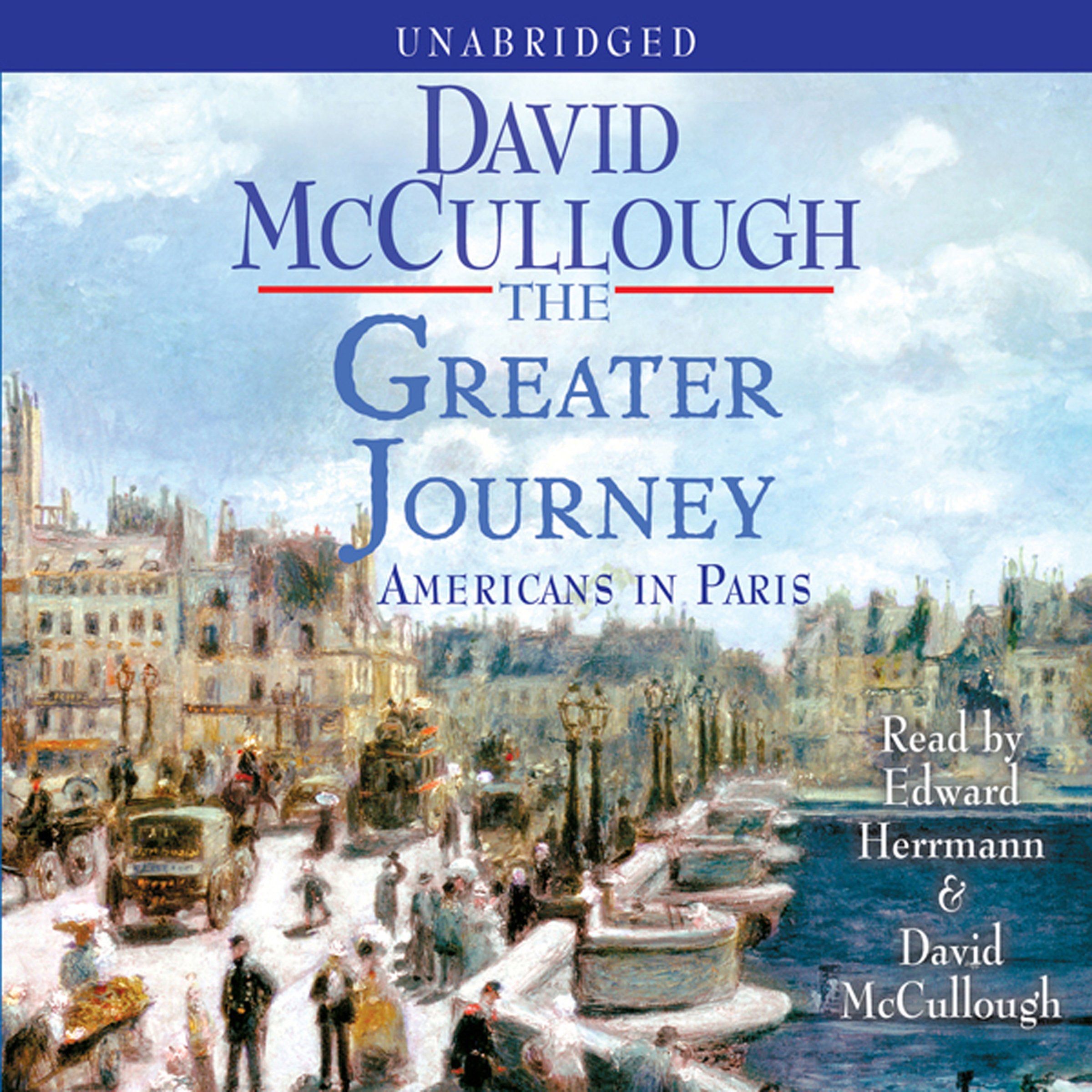
desertcart.com: The Greater Journey: Americans in Paris (Audible Audio Edition): Edward Herrmann, David McCullough, Simon & Schuster Audio: Books Review: History at its best. - From the year 1830 to about the 1900's many Americans crossed the Atlantic in search of an education in France. Their objective was to improve themselves and bring back to the US the knowledge they could only then acquire in the French capital, Paris. Politicians, doctors, writers and artists endured the trip driven by a desire to learn and expand their horizons. In most cases, they arrived in Paris with no money, no knowledge of the language and very little idea of what they should expect. Due to the difficulty of the trip, they stayed years in Paris, worked very hard and absorbed every idea they were exposed to. Their stories are amazing and very illuminating. The result of their journey was an elite group that really launched the US on its way to occupy its place at the forefront of civilized nations. Many books have been written about the original Franco-American relations after the Revolutionary war (Jefferson, B. Franklin, etc...) . Also, most people are familiar with the 20th century iconic Americans that paid a visit to the City of Lights (Heminway, Gertrude Stein or Scott Fitzgerald.). But the period covered in McCullough's book is a little more obscure even though it is by no means less important. It's the time of the American Civil War and the Third Republic in France, the time of Abolitionism and the Commune. These were tumultuous times by any standard and it is simply amazing to read about the talented people that risked everything not only for personal glory but to bring back to America culture and new ideas. For some reason the first three chapters of this book are a bit hard to get through however. These chapters deal will writers like Fenimore Cooper and doctors like Wendell Holmes. But by chapter five I wasn't able to put it down. First, the book has a nice way of weaving the stories of all the characters involved and follow them across time and historical events. Secondly, the biographies of these Americans were indeed interesting, even exceptional. Who knew Morse was a very talented painter before going on to invent the telegraph for example? That the first american female doctor graduated in Paris. Painters like George Healy, O. Tanner, Beckwith, Singer Sargent and Mary Cassatt. Sculptors like Saint-Gaudens. Politicians like Sumner and Wishburne. The American colony in Paris grew and was tested at times by the various upheavals that shook France and the US, the Franco-Prussia war and La Commune being probably the most dramatic and violent fro the french residents but also, of course, the American Civil War. McCullough is a good writer in that he is able to convey not only the facts but also delves into the difficulties, heroism, and even moods of the people he writes about by researching their correspondence and documents. I recently read a book that would be the perfect companion to McCullough's but from the perspective of french painters: "The Judgement of Paris" . As a painter myself, I found interesting to know that both Manet and Wishburne were both inside Paris during Bismarck's siege, that Singer Sargent and many other American painters were competing with the likes of Meissionier and the group that would eventually become the "Impressionists" for medals in the Salon. But also the conditions in which artists worked and studied in France would interest any art student today and put things in perspective as to what being an artist meant and means today. The statue of Liberty, the Tower Eiffel, the Smithsonian Institute , many monuments and museums that adorn American Cities, ideas about science and politics, art collections and emblematic artworks... they all make an appearance, step down from their pedestal and become alive , controversial and relevant once more. Review: Nobody writes History better than David McCullough - David McCullough is the master when it comes to bringing history to life. In the "The Greater Journey", Mr. McCullough tells the story of many famous American artists, doctors, politicians and authors who moved to Paris to mingle and learn from the greatest artists, writers and medical minds of the world. Elizabeth Blackwell went to Paris to become the first female doctor in the United States. Charles Sumner, Samuel F. B. Morse, James Fenimore Cooper, Harriet Beecher Stowe, Mark Twain, and Oliver Wendell Holmes provides a short list of the famous Americans who lived in Paris for various lengths of times, some returning several times, from 1830-1900. Mr. McCullough brings all of these Americans, along with their European counterparts, back to life. The characters are ambitious, talented, driven and remarkable, but no character in the book is greater than Paris itself. With great enthusiasm and careful detail, he tells the history of Paris, writing about it almost as if one would the greatest love of their life. Once can almost picture the great architecture and the remarkable minds that occupied space and time in this great city during this period. Reading this book made me want to live during that period and be part of that circle of enormous talent that collected in Paris. Many, if not most, of them were complete nobodies at the time. This is a great coming of age story of the great American men and women who would go on to provide this country some of our greatest politicians, artists, writers, philosophers, scientists and characters. We owe a great gratitude to Mr. McCullough for the enormous research, talent and care that went into this book. Like all his other books, "The Greater Journey" is an outstanding piece of work, providing a splendid combination of education and entertainment with each of the 578 pages of this masterpiece.
J**N
History at its best.
From the year 1830 to about the 1900's many Americans crossed the Atlantic in search of an education in France. Their objective was to improve themselves and bring back to the US the knowledge they could only then acquire in the French capital, Paris. Politicians, doctors, writers and artists endured the trip driven by a desire to learn and expand their horizons. In most cases, they arrived in Paris with no money, no knowledge of the language and very little idea of what they should expect. Due to the difficulty of the trip, they stayed years in Paris, worked very hard and absorbed every idea they were exposed to. Their stories are amazing and very illuminating. The result of their journey was an elite group that really launched the US on its way to occupy its place at the forefront of civilized nations. Many books have been written about the original Franco-American relations after the Revolutionary war (Jefferson, B. Franklin, etc...) . Also, most people are familiar with the 20th century iconic Americans that paid a visit to the City of Lights (Heminway, Gertrude Stein or Scott Fitzgerald.). But the period covered in McCullough's book is a little more obscure even though it is by no means less important. It's the time of the American Civil War and the Third Republic in France, the time of Abolitionism and the Commune. These were tumultuous times by any standard and it is simply amazing to read about the talented people that risked everything not only for personal glory but to bring back to America culture and new ideas. For some reason the first three chapters of this book are a bit hard to get through however. These chapters deal will writers like Fenimore Cooper and doctors like Wendell Holmes. But by chapter five I wasn't able to put it down. First, the book has a nice way of weaving the stories of all the characters involved and follow them across time and historical events. Secondly, the biographies of these Americans were indeed interesting, even exceptional. Who knew Morse was a very talented painter before going on to invent the telegraph for example? That the first american female doctor graduated in Paris. Painters like George Healy, O. Tanner, Beckwith, Singer Sargent and Mary Cassatt. Sculptors like Saint-Gaudens. Politicians like Sumner and Wishburne. The American colony in Paris grew and was tested at times by the various upheavals that shook France and the US, the Franco-Prussia war and La Commune being probably the most dramatic and violent fro the french residents but also, of course, the American Civil War. McCullough is a good writer in that he is able to convey not only the facts but also delves into the difficulties, heroism, and even moods of the people he writes about by researching their correspondence and documents. I recently read a book that would be the perfect companion to McCullough's but from the perspective of french painters: "The Judgement of Paris" . As a painter myself, I found interesting to know that both Manet and Wishburne were both inside Paris during Bismarck's siege, that Singer Sargent and many other American painters were competing with the likes of Meissionier and the group that would eventually become the "Impressionists" for medals in the Salon. But also the conditions in which artists worked and studied in France would interest any art student today and put things in perspective as to what being an artist meant and means today. The statue of Liberty, the Tower Eiffel, the Smithsonian Institute , many monuments and museums that adorn American Cities, ideas about science and politics, art collections and emblematic artworks... they all make an appearance, step down from their pedestal and become alive , controversial and relevant once more.
A**E
Nobody writes History better than David McCullough
David McCullough is the master when it comes to bringing history to life. In the "The Greater Journey", Mr. McCullough tells the story of many famous American artists, doctors, politicians and authors who moved to Paris to mingle and learn from the greatest artists, writers and medical minds of the world. Elizabeth Blackwell went to Paris to become the first female doctor in the United States. Charles Sumner, Samuel F. B. Morse, James Fenimore Cooper, Harriet Beecher Stowe, Mark Twain, and Oliver Wendell Holmes provides a short list of the famous Americans who lived in Paris for various lengths of times, some returning several times, from 1830-1900. Mr. McCullough brings all of these Americans, along with their European counterparts, back to life. The characters are ambitious, talented, driven and remarkable, but no character in the book is greater than Paris itself. With great enthusiasm and careful detail, he tells the history of Paris, writing about it almost as if one would the greatest love of their life. Once can almost picture the great architecture and the remarkable minds that occupied space and time in this great city during this period. Reading this book made me want to live during that period and be part of that circle of enormous talent that collected in Paris. Many, if not most, of them were complete nobodies at the time. This is a great coming of age story of the great American men and women who would go on to provide this country some of our greatest politicians, artists, writers, philosophers, scientists and characters. We owe a great gratitude to Mr. McCullough for the enormous research, talent and care that went into this book. Like all his other books, "The Greater Journey" is an outstanding piece of work, providing a splendid combination of education and entertainment with each of the 578 pages of this masterpiece.
S**B
Good insight on those times
B**A
This is a beautifully written and interesting narrative, concerning those Americans who sailed or came by steamer ships from New York and other eastern seaboard ports and as far south as Louisiana to France. Some arrived at Le Havre, others at Calais and Boulogne, after which they faced an onward 24 hour journey to Paris by a diligence. It certainly raises the question - what drove these Americans to undertake such a potentially dangerous crossing of the Atlantic, not necessarily speaking any French and having, in most cases, limited financial resources? David McCullough's book spans the period 1830 to 1900, a period known as the Belle Époque, meaning the Beautiful Epoch. Throughout this period, Paris was the acknowledged hub from the standpoint of technical and artistic knowledge and accomplishment and it was this that drew Americans from the New back to the Old World. Whilst Paris was an exciting, perhaps romantic city, until 1853 it was nonetheless a Medieval cesspit. The narrative follows the fortunes of a number of talented American (and French) individuals, some of whom will be well known, others not but there are plenty of surprises as their respective life-stories unfold. Many of the people David McCullough introduces would experience the July Revolution, culminating in the overthrow of King Charles X, equally, some remained in Paris during the Franco-Prussian War and the Siege of Paris. Not that it was in question but this is a further example of David McCullough's skill at historical narrative. It is an enjoyable, informative book. A highly recommended read.
I**S
Initially, I became familiar with McCullough’s work through the HBO series “John Adams”. I was amazed at his thorough style and attention to every detail in respect to a lesser known founding father. With “The Greater Journey” David McCullough has brought us another great century of American history. This time he follows the journey of ex-pats living in Paris, the center of civilization. They were there on a mission to learn and better themselves in order to help their new nation advance. There are so many stories and characters that when I picked up the book it was a bit intimidating. However, this book turned out to be a page turner, as the author masterfully intertwines all these stories into a beautiful work of art and history. And David McCullough knows about art. The book has a quite a few pictures of art works produced in this era by masters such as Morse, Healy, St. Gaudens, Sargant, and Cassat. The descriptions of these works and the creative process they went through is simply excellent. The bibliography alone is over one hundred pages. Furthermore, this book beyond the individual stories of its characters also brings to light the history of Paris in the 19th century. From revolutions, and violence, and war, to an age of enlightenment, and prosperity, finishing with the Belle Époque. I would highly recommend this book as good reading to be savored and cherished. The sacrifices that these generations of Americans went through in pursuit of knowledge and artistic growth are truly inspirational.
I**H
This is a fascinating book. Well-written (a very experienced author; winner of two previous Pulitzer Prizes I gather) and as much a biography of Paris in the Nineteenth Century as it is of the Americans of all sorts who lived in the city. Some famous names but many I'd not heard of before. The author uses their own letters to give an insider's feel to the book. The sections in the middle of it on the Second Empire, the Siege of Paris and the Commune are simply riveting.
P**S
Un libro espectacular, escrito por un gran historiador. Se lo di de regalo a mi madre y le encanto!
Trustpilot
Hace 2 días
Hace 3 días