Some deliveries may take a little longer than usual due to regional shipping conditions.
Descargar la aplicación


Servicios al cliente
Sobre nosotros
Copyright © 2025 Desertcart Holdings Limited
Descargar la aplicación
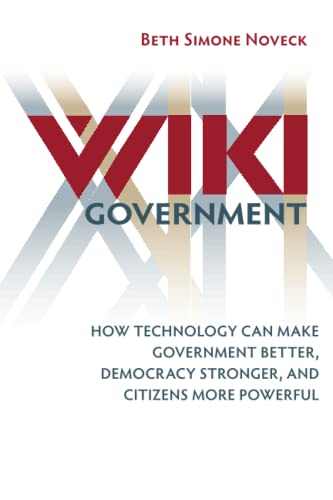
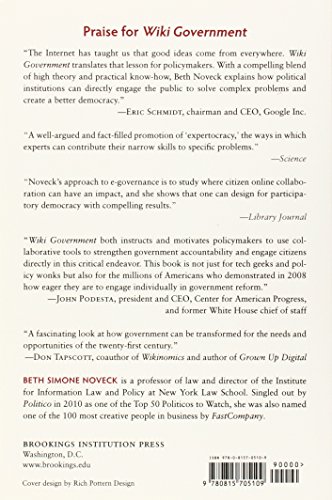
Full description not available
A**H
Required reading for improving government
Anyone interested in using the Internet to help improve the way government works should read this book. Noveck presents an excellent background describing the problems with existing government decision-making processes, a case study of the Peer-to-patent process she helped develop and recommendations for developing effective Internet based applications.The book is well written and edited, easy to read and full of examples that will spur your creativity. I read it quickly and thought it was very good, but as I go back and re-read sections I think it's extraordinary.
P**B
Electronic Government For The People?
Many feel that government will be improved when there is more participation by individual citizens. In Wiki Government,1 Beth Simone Noveck tells of the potential for using information technology to acquire more input from the citizenry. Noveck sees more social justice in a world in which government actions are influenced by the inputs of citizens on the Internet with social networking software.Peer-To-PatentWiki Government starts off by recounting one successful use by government of the interactive technology of Web 2.0. The author directed this project when she was a Professor at New York Law School. The demonstration project is the Peer-To-Patent Initiative, a system that now facilitates the processing of patents in the field of information technology at the US Patent Office.The problem faced by the Peer-To-Patent demonstration project is multi-faceted: the allocated time for a bureaucrat to approve a patent is short, many patents are approved in error, and this leads to costly litigation. The solution is to provide government officials with better information when they are making decisions. This information comes from the online collaboration of relevant volunteers who participate in Peer-To-Patent.A volunteer user of Peer-To-Patent initially chooses from a list of patent applications and joins a team that's reviewing one. The reviewers discuss the application's focus and quality with posted comments, suggest further research, and inputs of prior "art." The latter is documentation of significant advances in information technology that occurred before the date of the patent application. The intellectual property in this prior "art" is protected by functions that are built-in to Peer-To-Patent.Each member of a Peer-To-Patent team rates the team's findings and the best are provided to the US Patent Office in an Information Disclosure Statement. In this way, the team influences, but does not make, the decision of the US Patent Office on a patent application.Problems At (...)Right now there is a US government web page, (...), where citizens can leave comments about government regulations. An overall evaluation of this site indicates that it has not increased the amount of useful information available to government. It has become a place where participants tend to "notice and spam" rather than "notice and comment."Noveck sees a need to transform sites like (...) into places where citizens become better informed by reading others' comments, collaborators build on the inputs of others, and experts criticize and respond to what they see. Such processes are facilitated when each participant is assigned to a group whose members are discussing similar issues and topics. The resulting teams of participants will develop more meaningful outcomes that convey better information than the flood of one-off pronouncements that are currently received by (...).New InitiativesBeth Noveck foresees developing further Internet based applications, like Peer-To-Patent, in her current position of US Deputy Chief Technology Officer for Open Government. She leads the Open Government Initiative.One proposal is for a "bubble up" system for determining questions for the US President to answer in regular media sessions. In such a system, participants submit questions, the questions are rated by other participants, and only the best are presented to the President. Wiki Government tells of similar systems being used with the politicians in other countries, and television personalities.Another proposal is for a "civic jury." The jury is randomly chosen from volunteers to monitor the decisions of a policy maker in a government department - the example given is for policies in education. The jury members read and comment on an electronic blog in which the policy maker gives reasons for decisions taken. Sub-groups of the jury keep up wiki's about specific decisions and policy areas.Motivating the Right ParticipantsWiki Government does discuss problems of motivating knowledgeable people to participate in a system of electronic commenting. Wiki Government points out that the screens in successful systems are designed to respect users and give feedback in such a way that contributors feel that they are part of a community. The systems are also designed to quickly weed out frivolous communications so that meaningful participants feel they are speaking with others of similar stature.There may still be problems of motivating knowledgeable volunteers and specialists to spend their free time by continually returning to an Internet site and commenting on more than one issue. One way of obtaining the regular contribution of time is through public-private partnerships. As it is, many participants in Peer-To-Patent were employees of the major sponsoring
C**G
Broad sweeping tour of ideas. Short on details
In this book the author attempts to take the lessons learned from the successful peer-to-patent experiment and explain how they can be applied to other government functions. Disappointingly, the book does not describe the development of the peer-to-patent system in any great detail. While there are many interesting ideas, few are developed in sufficient detail.If you have read a few articles on the peer-to-patent experiment, then there is probably no need to buy this book.
E**M
Must-read Book for Open Government and Open Data Geeks
I absolutely loved this book. Chalk full of examples, passionate, articulate and well written, I found myself underlining passages like crazy! Highly recommend this book to open government aficionados and activists, information scientists, open data geeks, and anyone interested in making government effective. Noveck makes a great case for how government -- with the aid of technology and the Internet -- can be redesigned to allow for truly participatory and collaborative democracy.This is my first Amazon review. I loved the book so much that I decided to write a review. Happy reading![Note and hat tip: I first discovered Wiki Government via Lucy Bernholz's (@p2173) tweetstream which lead me to her thought-provoking blog post, "Open Philanthropy: A Modest Manifesto." [...]~Emily@emahlee
S**I
Zzzzzzzzzz...
Yawn. The author is far too taken with her previous work in pushing Washington to crowdsource patent applications. As nice as Peer-to-Patent may be, it does not define the totality of how the open-source movement can rebuild the way democracy works.
J**R
Intellectually Deft and Passionate
Beth Noveck has written a clear, cogent, practical "self-help" book for society as a whole."Wiki Government" delineates how technology can be leveraged to move us from wishful thinking concerning the myriad problems facing society to focused action. Noveck goes beyond analysis of the world's ills; she uses current Internet capabilities to focus the vast resources of the many on tasks traditionally the purview of a tiny handful of government employees. The expertise of specialists in any given field, as well as the insights of serious lay people, can successfully confront problems that currently overwhelm government resources. At the same time, online collaboration, by linking people into a problem-solving team, can create feelings of shared responsibility and achievement that enhance mutuality and community, and thus strengthen society as a whole.Noveck has accomplished something very rare: She has taken our dreams and shown how to render them real.
Trustpilot
Hace 1 semana
Hace 1 día