

⚡ Clamp the current, not your budget — pro-grade testing made affordable!
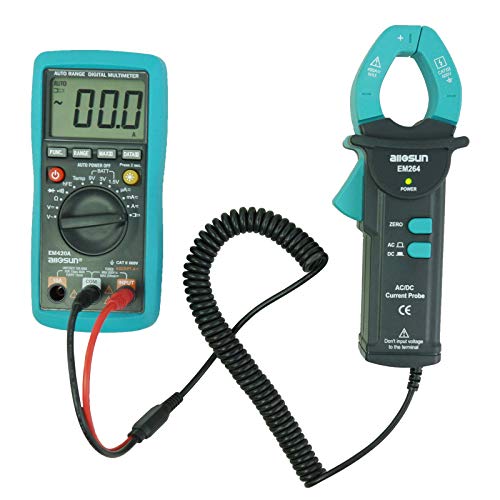
The allsun AC/DC Clamp Meter is a compact, industrial-grade current tester featuring advanced Hall Effect sensor technology for precise True RMS measurements up to 400A. Rated CAT III 600V for professional safety, it offers non-contact current testing with a 33mm jaw, low battery LED alerts, and auto zero calibration. Designed for seamless integration with any multimeter, this durable tool is perfect for HVAC, automotive, and industrial electrical troubleshooting, delivering high-end performance at a fraction of the cost.


| ASIN | B07Z7TXY8J |
| Batteries | 1 9V batteries required. |
| Best Sellers Rank | #78,336 in Industrial & Scientific ( See Top 100 in Industrial & Scientific ) #59 in Clamp Meters |
| Brand | allsun |
| Color | Black and Blue |
| Date First Available | October 17, 2019 |
| Item Weight | 12 ounces |
| Manufacturer | Zhangzhou Haimao Dianzi Keji Co., LTD |
| Measurement Type | Multimeter |
| Min. Operating Voltage | 7.5 Volts (DC) |
| Package Dimensions | 8.5 x 4.37 x 1.89 inches |
| Power Source | Battery Powered |
| Style | Mini Clamp Meter |
| UPC | 687551089472 |
| Upper Temperature Rating | 40 Degrees Celsius |
J**0
Surprisingly good quality AC/DC current clamp
I have a 87V MAX True-RMS and I really needed a current clamp, but I couldn’t afford the $300 for the brand specific clamp. Then I saw this Allsun EM264 AC/DC mini current clamp, and thought I will give it a shot. For $30 bucks, I’ve got nothing to lose. Plus, I had a cheap multimeter I could test it out on, before using it with my 87V MAX. But once I confirmed it worked, I had no concerns about using it with my 87V MAX. Well, when the clamp arrived, I was extremely surprised at the quality of it. It was not what I was expecting for $30 bucks. It’s the age-old problem of buying things online, you just don’t quite know what you’re really getting until you have it in your hands. The instructions they provide on the Amazon product page is essential for knowing how to hook it up correctly to a Multimeter, but once done correctly, it works like a charm. I was also able to check it’s readings against other, more expensive, AC/DC current clamps and was very pleased with how close the readings were. Mind you, I have only used it on a typical house circuit, running in the 10 to 14 Amp range, so I can’t attest to it’s performance for anything higher or lower than that. In short, if you want a CAT III AC/DC current clamp with a max capacity of 400A / 600V, but you are like me, and can’t justify, or can’t afford, spending $300 on a high-end, best-in-class ,current clamp, I would highly recommend considering the Allsun EM264 mini clamp. For the price, I give it 5 Stars. The only criticism I have is the two-position AC/DC selector button, and the current range, on/off, slider-switch. The two-position AC/DC selector button works fine, but the distinction between the two positions is not as robust as I would prefer, and it is a little easier to inadvertently press it during use than I would like. The current range, on/off, slider-switch is no different than any other such slider switch I’ve ever used, I just personally don’t like those kinds of slider switches. Again, like the two-position AC/DC selector button, the distinction between one position and those types of slider switches is not as robust as I would like, but it works fine just the same.
M**L
Pretty good clamp
I got this because I didn't want to change blown fuses on my new multimeter. The DC accuracy is very good! I'm impressed. The AC readings did not match with my old clamp meter. My main use for this is for DC circuits and as such it is a good purchase for my purposes.
C**N
It needs a separate multimeter that can measure DC millivolts.
It works as advertised. Its price is low because it requires a separate multimeter for display. It displays current on the multimeter's DC millivolt scale. on the low scale, 40 amps displays as 400 millivolts (0.4v), 1 amp as 10 millivolts and 0.1 amp as 1 millivolt. If your multimeter can read down to 0.1 millivolt, that corresponds to 0.01 amp (10 milliamps).
J**E
Doesn't work at all, not low accuracy, just doesn't display any reading.
I've tested 2 of these units now. I thought first one was defective, but it had the exact same measurements as the second that came in. Build quality feels ok, light lights up, but it shows no current for AC or DC. I've tested small, moderate, and larger amounts of current (figured a small space heater would be a decent enough larger current test). Doesn't show readings at all. Tried voltage setting 2 multimeters, shows nothing. Tried the dedicated clamp setting on my multimeter, shows no current. Interestingly enough it does show the frequency of the current on my DMM when measuring AC, but that's all I could get. It shows a small response when opening and closing the clamp but nothing while the clamp is on. Disappointed, cannot recommend.
2**T
Surprisingly good!
I bought this low-cost clamp-on ammeter figuring it would be -eh- just okay - to replace an old B&K unit. It has two sensitivities, 1 mV/A and 10 mV/A, which, with the maximum output of 400 mV, translates to 400A and 40A full scale, respectively. On the higher sensitivity setting, it had mA resolution with a high-quality DVM, which I already had. So it is not necessary to re-configure the DVM to measure current directly, and that removes the risk of blowing _yet another_ $5 fast-acting HRC fuse. That means it is sensitive enough enough for most electronics work, except for sub-milliamp or microamp circuits which always require dedicated bench top meters. And for household and light-industrial use, a 10x AC line splitter is a perfect complement for similar sensitivity reasons. The unit is the magnetic clamp, with its internal amplifier, and needs a DVM to get the reading. That isn't the drawback it might seem: 1 Many of us already have a DVM, often better than the one in the integrated clamp-ons. And if a meter is needed, the user has the flexibility to choose one is best-suited to the application, 2 It's less expensive that most clamp-ons with built-in DVMs, while offering better utility. and 3 It permits the display to be placed a few feet away from the clamp, which makes it easier to get a clear view. Don't be deceived! — most pictures of integrated clamp-ons can subtly fool you showing the meter up-front and center. In my experience that's rarely the case. Often, the wire needing to be measured is in a tangled mess of stiff copper wires way, in the back of a panel box. Because this unit can also measure direct current, I was most interested to learn how to zero the reading from the Hall effect sensor. The old B&K has a thumb-adjusted flat rotary wheel which is so fussy to set that it takes one hand to make the adjustment, and another to hold the clamp. And maybe a third to hold the DVM. But this product has a simple push-button auto-zero that can be operated with the thumb of the same hand holding the clamp. The auto-zero is not perfect, it left an offset equivalent to ~ 0.8 mA on my sample, still good enough for my needs. The reading drifted a bit, even when the clamp was still. I did not evaluate it in detail because it was low enough, and slow enough, to allow a typical measurement with little affect on a reading. It would also take a complex set of test equipment to be able differentiate between electronic drift and variation caused by change in magnetic fields, for which I wasn't equipped. The reading is sensitive to orientation and movement of the clamp relative to earth's magnetic field, or other nearby magnetic fields, such as from a transformer. That seems to be just the nature of the beast, and the effect can be minimized by zeroing the meter in-situ, already clamped on the wire. That eliminates changes that could be caused by moving the clamp for the reading. One area for improvement is the AC/DC button, which has weak tactile feedback and limited movement. I found it necessary to inspect the switch, sometimes operating it a few times to make sure it was in the right mode. The zero function button doesn't have that issue. In summary, I was surprised and impressed. It was much more useful than I expected, especially for the price. I immediately ordered one for my son also who has his own high-end DVM.
A**N
it works
This one works with my FNRSI 2C53P Plus, I ordered a slightly less expensive one and had to return it because it didn't function correctly (or at all) but this one works wonderfully in both AC and DC. It is a good addition to my scope/meter.
N**N
Shrouds small
Probe shroud very tight. Doesn’t fit all multimeters. Accurate for large current decimations +/- 1 amp
M**.
La précision semble assez bonne quand je compare les mesures faites à comparer à ma pince Amprobe AMP-220. Requière l'utilisation d'un multimètre avec une résolution d'au moins 0.1 mV DC pour avoir une lecture de faibles courants. La mâchoire est assez épaisse alors peut être difficile à utiliser dans des espaces restreints. La qualité des matériaux, des boutons et de la fabrication est assez bonne pour cette gamme de prix et la prise en mains n’est pas si mal. Le câble en boudin est très souple et s’étire bien jusqu’à au moins 8 pieds. Il n’y a pas de mise en arrêt automatique alors il ne faut pas oublier d’arrêter l’appareil pour ne pas décharger la pile après usage. Petit désagrément, il faut retirer complètement la vis du couvercle du compartiment de la pile pour retirer ce couvercle et la pile 9V n’est pas incluse. L’appareil vient avec un bel étui en similicuir pour le rangement et un livret d’instructions en anglais bien détaillé. Vraiment un bon achat pour le prix demandé par contre ce n’est pas un outil pour une utilisation professionnelle.
Trustpilot
Hace 1 mes
Hace 3 semanas