We remain fully operational. Our teams are working around the clock to ensure your deliveries continue safely.

Descargar la aplicación


Servicios al cliente
Sobre nosotros
Copyright © 2025 Desertcart Holdings Limited
Descargar la aplicación
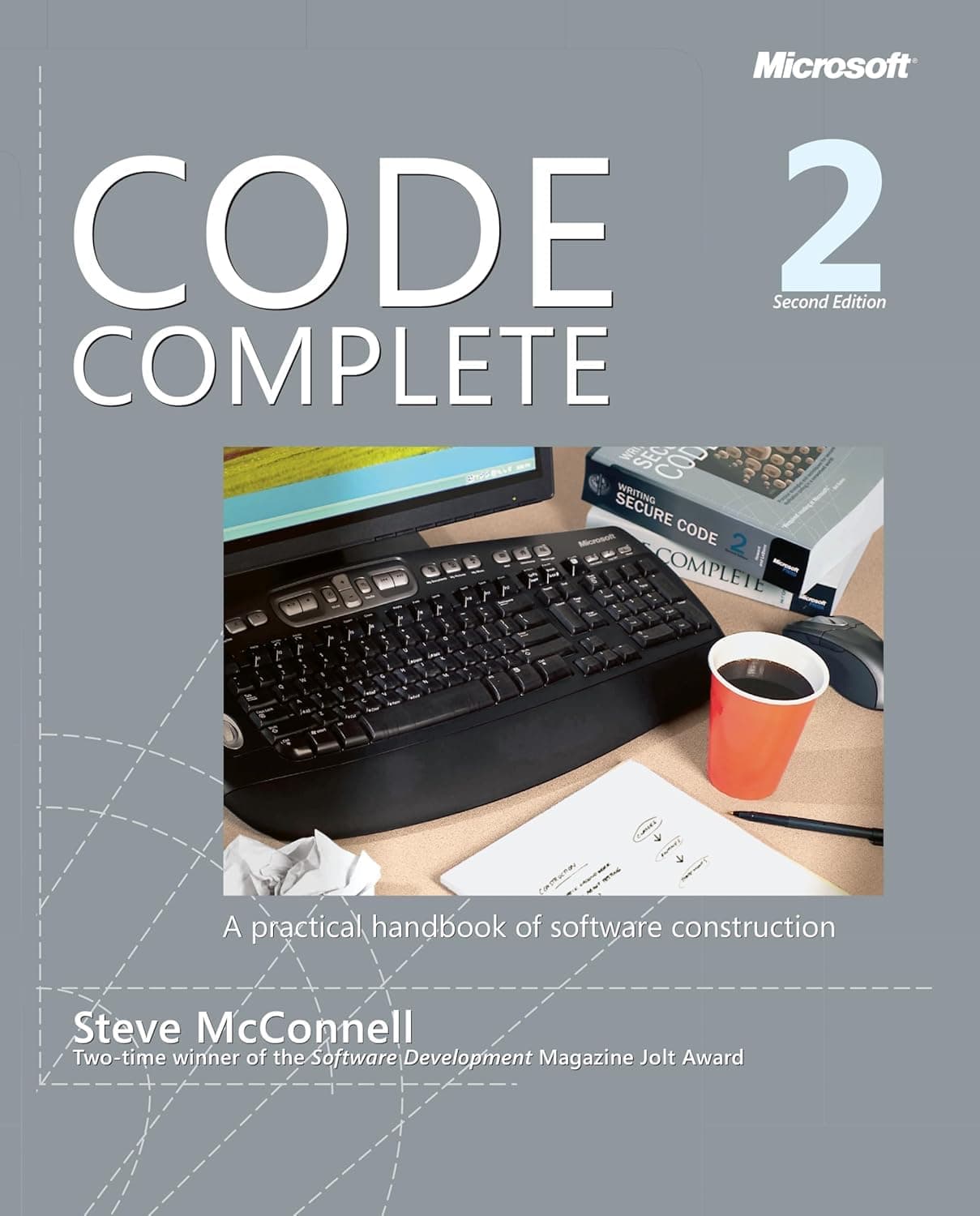
🚀 Code smarter, not harder — the ultimate blueprint for programming mastery!
Code Complete by Steve McConnell is a monumental 862-page programming guide focused on software construction, offering scientifically backed best practices, comprehensive coverage of coding essentials, and practical advice trusted by industry professionals. It’s a must-have reference for developers aiming to write cleaner, more maintainable code and accelerate their career growth.


| Best Sellers Rank | #68,976 in Books ( See Top 100 in Books ) #3 in Client-Server Networking Systems #42 in Software Development (Books) #76 in Computer Software (Books) |
| Customer Reviews | 4.6 4.6 out of 5 stars (1,344) |
| Dimensions | 7.5 x 1.63 x 9.13 inches |
| Edition | 2nd |
| ISBN-10 | 0735619670 |
| ISBN-13 | 978-0735619678 |
| Item Weight | 3.87 pounds |
| Language | English |
| Part of series | Developer Best Practices |
| Print length | 960 pages |
| Publication date | June 9, 2004 |
| Publisher | Microsoft Press |
H**E
A must-read for every programmer
The focus of Code Complete is software construction, i.e. the coding part of software development. As Steve McConnell notes in the preface, "construction is the only activity that is guaranteed to be done". You can skip almost any step (requirements, testing etc), but if you don't write any code there is not going to be any software. I bought my copy of the first edition of Code Complete in 1997, and I was immediately fascinated. I had never read anything like it before - a book that concentrated on the actual writing of the code. For example, it had a whole chapter on if- and case-statements, and another chapter on the naming of variables. I had no idea there was so much to learn about these seemingly straight forward activities. It was immediately useful to me, and I started to apply as much as I could of what I learnt from it. Although it concentrated on coding, it covered a broad spectrum of activities around coding, from requirements and design to testing, debugging and optimization. It also had a great reference section with suggestions of further reading in the area of software engineering. This became my starting point for finding lots of other good books to read, like Peopleware: Productive Projects and Teams (Second Edition) and Programming Pearls (2nd Edition) . So this summer I decided to re-read this seminal book, partly to see what's new in the second edition, and partly to see if still think it is such a great book. To answer my own question - yes, it is still the number one book on writing code. It is near encyclopaedic in its coverage of the nuts and bolts of programming. There are chapters on the naming of variables, on organizing straight-line code, on conditionals, on loops, on lay-out, on good commenting and on how to write good methods. In it, there are frequent references to scientific studies that support the advice given in the book. For example, how long should variable names be? Instead of just giving us his opinion, McConnell summarized the findings of several scientific studies on the subject. Each time there is reference to a study, there is a little "hard data" symbol in the margin. There are other symbols in the margin as well, "Coding Horror" for code examples of what not to do, and "Key Point" for, well, key points. The margin is also used for cross references to other chapters, and for quotes related to the subject discussed. For me, this works really well. It is both useful and makes the text easier to read. In general, the book is very well laid out. Some of my favourite advice from the book (all of which I remember from reading the first edition) are: Chapter 7.1 Valid Reasons to Create a Routine - for example: Reduce complexity, Introduce an intermediate understandable abstraction, and Avoid duplicate code (there are 6 more valid reasons in this chapter). The second part of the chapter is called Operations That Seem Too Simple to Put Into Routines and contains a great example of why it can be good to put even a one-line calculation in a routine - the code becomes more readable, and small operations tend to turn into larger operations. Page 172 (and 264 for variables) Use opposites precisely. When naming "opposite" methods and variables, be careful to use the correct pairs, like add/remove, begin/end, create/destroy etc. This makes the relationship between them clear and obvious. Page 433 Break complicated tests into partial tests with new boolean variables. This is such a simple thing, but it makes the code a lot more readable. Page 754 "Make the incompleteness of a statement obvi". For example, when breaking up a logical and over two lines, end the first line with && - that way, it is clear that the statement continues on the next line. Even though the book truly is great, there are a few things to complain about. In the first edition, the chapters on layout and comments came right after the chapters on the different control structures. But in the second edition, these two chapters have been moved further back. To me, that doesn't make sense, since they too are related to how you actually write your code. Now there are chapters on testing, debugging, optimization and refactoring in between. And talking about refactoring: while this is an important subject, I don't feel the chapter on refactoring is particularly good. This chapter is new in the second edition. The summary of refactoring is OK, but a good part of the chapter consists of just listing different kinds of refactorings. Overall though, the second edition is a nice face lift. The code examples are now mostly in Java, C++ or Visual Basic (in the first edition they were in Pascal, C or Ada). But since all the major themes of the book were already present in the first edition, it does not make a big difference if you happen to read the first edition instead of the second edition. Code Complete is thick - 862 pages (not counting the bibliography and index). If that feels like a lot to read, then I suggest you start by just reading one or two chapters, for example "Using Conditionals" or "Layout and Style". They (and pretty much any chapter in the book) can easily be read without first reading the preceding chapters, and these will give you a sense of what you can expect from the other chapters. Even if these are all you read, you will still get a lot of value from the book. However, if you are a programmer and care about how you write code, you owe it to yourself to read the whole book. It is considered by many (including me) to be the best book available on programming, and it will almost certainly make you a better programmer. Highly recommended.
B**S
Comprehensive, scientific, well-organized and monumental
This book deserves 5 stars because it is a comprehensive analysis of software construction, it is objective and scientific, it is well-written and well-organized and it carries a lot of weight in the software industry (yes, this is important). Comprehensive Analysis of Software Construction This book’s scope is the “construction” of software which primarily includes detailed design, coding, debugging, integration and developer testing. According to McConnell, there wasn’t a book written on the construction aspect of programming at the time of writing the first volume (in 1993). Also, according to McConnell, construction is the most important part of programming as it takes up the most time, it must be done, and it has the biggest impact on the success of a project. To sum it up, this book touches on everything you need to know during the construction phase and has a chapter devoted to each topic. My favorite chapters are Chapter 6 (Working Classes), Chapter 21 (Collaborative Construction) and Chapter 33 (Personal Character). Go look at the table of contents if you don’t believe this book is comprehensive. Objective and Scientific McConnell backs up most of his claims with scientific evidence (referencing the results of different programming studies) throughout the book. He is also objective and presents dissenting opinions when there isn’t a clear winner. He is also honest when there isn’t much evidence to support his claims (for example, there isn’t actually much evidence backing up his documentation techniques even though they are probably best practice). This builds trust between the reader and the author. We know he has done his due diligence and we don’t need to go fact check everything. His technique of backing up opinions with scientific studies is surprisingly lacking in most software communities. It makes me realize how often we spout opinions without backing them up with hard data. Well-written and Well-organized This book might be dry at times, but it’s very well-written and well-organized. You can skip around to different sections and use it more like a reference instead of reading cover-to-cover if you’d like. My favorite parts of its organization are the ‘Key Points’ highlighted throughout the text, the checklists and key points at the end of chapters, and helpful code examples which reinforce his points. Also, I love his metaphor that you should organize your code in a similar logical structure that you would organize a book (with table of contents, sections, chapters, etc.) Some will say the book is repetitive (and it can be), but repetition is important because you rarely remember anything after reading it once. Repetition is the way ideas are reinforced and remembered. Carries a Lot of Weight in the Industry Some might argue this shouldn’t be a factor when reviewing a book, but I disagree. When you are newer to the industry (I’ve been programming professionally for around 2 years), you need to learn from the best. The way you identify who is best is by someone’s reputation and status in an industry. This book (and McConnell himself) are held in high esteem by very influential people in the industry. This matters because you can trust the concepts he is advocating and move quicker in your learning. Conclusion Overall, this book is a must-read for programmers and will probably have the best ROI for programmers who have been working professionally for 1-2 years (because you’ve seen some of the good and some of the bad practices that McConnell talks about). Yes, this book is long, sometimes dry and repetitive, and some advice is obvious. But it absolutely helps give more confidence when constructing software, when giving code reviews, and when forming a culture of good habits on your team. The main takeaway is this: your number one goal as a programmer is to manage complexity. Make things easier to understand, more readable and more maintainable - it will save time in the long-run. We spend much more time reading code than writing code. It’s important to think about the programmer who will be reading and maintaining your code (a lot of times it is yourself). We aren’t smart enough to understand entire codebases and we are limited by our brains. Use techniques like abstraction, encapsulation, self-documenting code, and collaboration with other programmers to make your code better.
G**N
No podría describir con palabras lo que esta obra me ha aportado para mi trabajo diario. Resume en casi 900 páginas la experiencia en el desarrollo de software de toda una carrera profesional. Cualquier persona que quiera mejorar como desarrollador de software debería tenerlo en su estantería.
S**T
Après avoir appris un langage de programmation et pratiqué quelques années, je recommande chaudement de lire Code Complete. Ce livre a totalement changé la façon dont je programme, je fais maintenant beaucoup plus attention à la qualité du code, pour que le code soit facilement compréhensible. Avec comme résultat qu'il y a beaucoup moins de bugs dès le départ, et un code qui est maintenable à plus long terme, plus facile à modifier, etc. Ce livre est très complet sur les bonnes pratiques en programmation (pour la partie « construction »), et inclut également des chapitres sur les détails à petite échelle dans le code comme le nom des variables, le nom des fonctions, organiser une suite d'instructions, les bonnes pratiques pour les conditions et les boucles, etc etc. D'autres livres sur les bonnes pratiques en programmation ne vont pas aussi loin dans ces détails, pourtant c'est tout aussi important pour la compréhension du code et éviter des bugs.
L**L
teaches how do u write beautiful and cool code fr
C**R
If you're like me then you've probably purchased your fair share of "product and language" books over the years. Those books generally teach you the basics of how to use some company's product or language, but the knowledge doesn't transfer over, and they don't actually make you a better developer. Insert Code Complete. This is the book that the software development world has needed for a long time. Instead of focusing on languages, it focuses on general design best practices that are applicable to most languages. Knowing the material in this book will elevate you from the junior developer ranks up to a more senior skill level.
A**N
very good book
Trustpilot
Hace 2 semanas
Hace 4 días