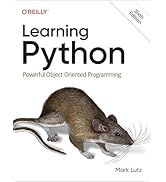
Learning Python, 5th Edition [Lutz, Mark] on desertcart.com. *FREE* shipping on qualifying offers. Learning Python, 5th Edition Review: huge but well worth it - I don't write too many reviews but I have to review this book. I'm just trying to learn the language to do some web, security, and rasberry pi development on my own. I tried to learn python over a year ago, got frustrated and quit. I tried to pick up the language again about 2 weeks ago. I have read and tried to work through Learning Python the Hard Way (LPHW). LPHW is a good resource and it did give me a general understand of the language. It teaches python version 2x. I have also read Dive into Python 3 (DP3). DP3 is also a good resource and it teaches python version 3x. I have also read and referenced [...] For the most part, I am able to write simple code. But I got frustrated when I tried to review and understand complex code structures. I had a hard time understanding the nuances of the language. I spent hours searching online and watching tutorial videos. But I was constantly frustrated because there were all these exceptions that didn't make sense to me. I kept on asking why this works and why that does not work. The best thing about this book is that it explain the nuances of the language by giving multiple examples. So it does explains it in a complete manner. A lot of other resources will touch upon a topic and then glance over it. I often wondered.. what about this... so a lot of other resources expect you to test the other cases out which in most circumstance will be okay, but in others, you are still left wondering "why?". This book does not do that. In fact, I almost didn't need to try the examples on the interactive python command line because it was so thorough. This book is not for the beginner. You will get lost among the trees in the forest because there is so much information in this book. If you are impatient or need to start coding right away, you really won't be able to do this with Learning Python. LPHW and DP3 are much better at getting you up and running. But to write error free code, you have to understand the nuances of the language which Learning Python teaches you. Learning Python the Hard Way (free on the internet) and Dive into Python 3 (also free) are great resources to get introduced to the language. I would recommend both before you delve into this book. But once you get an understand of the basics of python, this book will fill in the missing details. As a disclaimer, I have only been reading this book for a day. I have already read 300 pages. A lot of it was review. But I learned a lot of new stuff as well that filled in the gaps. I have not read the section on regex or the more advanced sections yet so this review is not complete. But so far, I am impressed on the thoroughness of the subject matter. The main grip I have is that I bought the kindle version. If I read it in a linear fashion the material seem to flow nicely. But when I come to certain sections, I need to jump around. You find this a lot with any technical book. The kindle version makes this difficult because I cannot "easily" keep track of what I was reading so I get side tracked a lot. I also cannot effectively add notes (yes, I know I can add notes). I ended up using 4 devices to read this book just to keep track of where I was. I may get the hardcopy so that I have an easy quick reference book to look at later at my desk. With a hard copy, I use bookmarkers that I can quickly page to. I know about the kindle bookmarks but they are cumbersome to use. Fortunately, its hard to beat the fact that I can carry this book on my phone if I wanted to. So I would rate the kindle version 3 stars. Overall, I would buy this again on kindle. Review: Absolutely amazing - I wanted to pick up programming as a little hobby to do in my spare time. After stumbling through countless websites picking up little tidbits of information here and there (and spending ALOT more time and effort than I expected) I was starting to doubt if this was even possible to learn myself. As said before, I would pick up little bits of information and try to make my own little programs. I got very very basic information down but couldn’t comprehend how to to write anything more than a simple 20 line script. I was about to give up. Then I bought this book. and WOW. This book was absolutely amazing. I read it for hours everyday from when I purchased it. I finished the book 3 weeks later. I can say this book was monumental in what it taught me. (And it’s size too - LOL - the thing is massive but so worth the read) He teaches everything so simple and easy to read. Go through his lines of every example and try to understand what is happening. You’ll find by about page 500 everything is slowly starting to make sense. By page 1000 you’ll be thinking wow I can read and understand each example of code (even the longer ones). You start seeing how programs are put together, how every single line has a purpose. The syntax, the wording, the placement , the white space. I’ve thoroughly enjoyed learning programming from this book. It has enabled me to complete an online python course. I love solving problems on my own - each one is like a puzzle and I get a little joy when I successfully complete the challenge. Thank you Mark - for allowing me to experience this journey. I surely would have given up had I not found this book. This book is like sitting directly in his college lectures for a semester. Only I didn’t have to spend 4 months to get the information. I could learn as fast as I could read. All told it was a 3 week book for me and it was very very very worth it. I’ve purchased his second book (Programming Python) and hope it will be just as good as this one. If you’re serious about learning python than stop looking further. This needs to be a book you buy. The contents are expansive and in depth without overloading you. It’s taught in a simple easy to understand way. And the appendix is well laid out so after you finish reading it and get into the nitty gritty of programming you can always know exactly where to look in the book to get help on how to do something. A+++. Again, thank you Mark.



| Best Sellers Rank | #211,182 in Books ( See Top 100 in Books ) #52 in Object-Oriented Design #108 in Introductory & Beginning Programming #170 in Python Programming |
| Customer Reviews | 4.5 out of 5 stars 1,969 Reviews |
W**E
huge but well worth it
I don't write too many reviews but I have to review this book. I'm just trying to learn the language to do some web, security, and rasberry pi development on my own. I tried to learn python over a year ago, got frustrated and quit. I tried to pick up the language again about 2 weeks ago. I have read and tried to work through Learning Python the Hard Way (LPHW). LPHW is a good resource and it did give me a general understand of the language. It teaches python version 2x. I have also read Dive into Python 3 (DP3). DP3 is also a good resource and it teaches python version 3x. I have also read and referenced [...] For the most part, I am able to write simple code. But I got frustrated when I tried to review and understand complex code structures. I had a hard time understanding the nuances of the language. I spent hours searching online and watching tutorial videos. But I was constantly frustrated because there were all these exceptions that didn't make sense to me. I kept on asking why this works and why that does not work. The best thing about this book is that it explain the nuances of the language by giving multiple examples. So it does explains it in a complete manner. A lot of other resources will touch upon a topic and then glance over it. I often wondered.. what about this... so a lot of other resources expect you to test the other cases out which in most circumstance will be okay, but in others, you are still left wondering "why?". This book does not do that. In fact, I almost didn't need to try the examples on the interactive python command line because it was so thorough. This book is not for the beginner. You will get lost among the trees in the forest because there is so much information in this book. If you are impatient or need to start coding right away, you really won't be able to do this with Learning Python. LPHW and DP3 are much better at getting you up and running. But to write error free code, you have to understand the nuances of the language which Learning Python teaches you. Learning Python the Hard Way (free on the internet) and Dive into Python 3 (also free) are great resources to get introduced to the language. I would recommend both before you delve into this book. But once you get an understand of the basics of python, this book will fill in the missing details. As a disclaimer, I have only been reading this book for a day. I have already read 300 pages. A lot of it was review. But I learned a lot of new stuff as well that filled in the gaps. I have not read the section on regex or the more advanced sections yet so this review is not complete. But so far, I am impressed on the thoroughness of the subject matter. The main grip I have is that I bought the kindle version. If I read it in a linear fashion the material seem to flow nicely. But when I come to certain sections, I need to jump around. You find this a lot with any technical book. The kindle version makes this difficult because I cannot "easily" keep track of what I was reading so I get side tracked a lot. I also cannot effectively add notes (yes, I know I can add notes). I ended up using 4 devices to read this book just to keep track of where I was. I may get the hardcopy so that I have an easy quick reference book to look at later at my desk. With a hard copy, I use bookmarkers that I can quickly page to. I know about the kindle bookmarks but they are cumbersome to use. Fortunately, its hard to beat the fact that I can carry this book on my phone if I wanted to. So I would rate the kindle version 3 stars. Overall, I would buy this again on kindle.
A**M
Absolutely amazing
I wanted to pick up programming as a little hobby to do in my spare time. After stumbling through countless websites picking up little tidbits of information here and there (and spending ALOT more time and effort than I expected) I was starting to doubt if this was even possible to learn myself. As said before, I would pick up little bits of information and try to make my own little programs. I got very very basic information down but couldn’t comprehend how to to write anything more than a simple 20 line script. I was about to give up. Then I bought this book. and WOW. This book was absolutely amazing. I read it for hours everyday from when I purchased it. I finished the book 3 weeks later. I can say this book was monumental in what it taught me. (And it’s size too - LOL - the thing is massive but so worth the read) He teaches everything so simple and easy to read. Go through his lines of every example and try to understand what is happening. You’ll find by about page 500 everything is slowly starting to make sense. By page 1000 you’ll be thinking wow I can read and understand each example of code (even the longer ones). You start seeing how programs are put together, how every single line has a purpose. The syntax, the wording, the placement , the white space. I’ve thoroughly enjoyed learning programming from this book. It has enabled me to complete an online python course. I love solving problems on my own - each one is like a puzzle and I get a little joy when I successfully complete the challenge. Thank you Mark - for allowing me to experience this journey. I surely would have given up had I not found this book. This book is like sitting directly in his college lectures for a semester. Only I didn’t have to spend 4 months to get the information. I could learn as fast as I could read. All told it was a 3 week book for me and it was very very very worth it. I’ve purchased his second book (Programming Python) and hope it will be just as good as this one. If you’re serious about learning python than stop looking further. This needs to be a book you buy. The contents are expansive and in depth without overloading you. It’s taught in a simple easy to understand way. And the appendix is well laid out so after you finish reading it and get into the nitty gritty of programming you can always know exactly where to look in the book to get help on how to do something. A+++. Again, thank you Mark.
R**H
A Mark Lutz Trifecta of Python Winners
At 65 I am "In-Progress" in Learning (attempting) Python. There is so much information out there on Learning and "Using" Python that it is very easy to become Overloaded and almost Entangled with Unexpected Results. The "Learning Python" book by Mark Lutz is Incredibly easy to read. Almost like a novel in some respects, where you find yourself reading one more page, one more section, one more chapter. Detail flows, and is presented in a meaningful way that you do not become exasperated with the volume. Mark lays a Path from the Start that begins with what Python is and Is Not. Then how to install, and entry to how to use. From there the Journey Begins. Learning, Experiencing, Practicing, and Acquiring the knowledge in useful bites, maybe bytes.... Mark has such a Fantastic Grasp on the Python Language that he uses his skill to Be Your Guide on Your Journey to Learning and Understanding How to Use Python. Whether in a Large Program, as a student, as a hobbyist, or as an integral component of your office work. He leads you on a level, paved pathway that leaves you with a smile. His approach is so unique, that many who suggest his work do so in the matter that it is "The Best". I have to agree. I am an engineer and use C++ at an Intermediate Level. But found Python to be Overall Cumbersome and with many holes and obstacles to implementation. Following from Start to Finish, my Linear Way, and probably as most will suggest more than a touch anal, none the less his Learning Python has lead me to Where I am Now Able to Construct Applications that work. Here at home, and out in the field. Mark has such a fantastic way of presenting data, descriptions and how to avoid syntax errors, that you will come to the same conclusion of the all the others; That Learning Python by Mark Lutz is the Pathway Forward. Having a Copy of the Book on my desk while going through Tutorials from Udemy and a few other On-Line Learning Sites has increased my ability to obtain and use constructively what I learn, and where to look when I am unsure. I am sure some would think of his works as a Bible, I would interject the caveat that "Yes, but it is so Well Written and Easy to Understand". Wars will not break out. Will maybe. Python vs C vs Ruby vs Java vs (The Next New Language) Simply Said: For a $50.00 Bill you will have a Reference that you will always Appreciate. Sincerely Robert M Tonkavich. Note: I was not paid in any way for this endorsement. It is mine, and under No Influence.
M**R
Good For Beginners
Mark Lutz provides a level of detail and explanation on many different topics regarding Python. While helpful for people who may have never programmed before and decided Python is a good language to start with (which it is), a lot of the material here will be review for somebody who has programmed before. That's not to say you should skip the chapters if you have programmed before however, as the way Python does things may be different from how one may expect them to be done (syntax, etc). So a quick gloss over may be very beneficial here. Most of the chapters are easily understandable as the author provides clear context and examples to accompany the topics presented. One of the things I disliked about the book was the author's constant voiced disapproval of C/C++ in this book. While I understand he may not like the language, I don't feel it worth pointing out how the author thinks certain aspects of Python are better than doing a similar task in C/C++. It's not needed in this book and serves no purpose. Somebody learning Python from this book already has a reason for wanting to learn it.
I**6
The book is long because it's thorough, and it's a quality book
This is a great, thorough, quality book on Python, targeted at individuals who have some experience writing programs, but who want to learn Python to write production-grade Python programs. All the people griping about how long this book is are obviously not the target audience of this book. Yes the book is long, but to effectively use a programming language, there is a lot to learn. And this book does a great job of metering out that information. All the people griping about how there's too many "forward references" to other topics, are obviously not the target audience of this book. Yes there are forward references, because there MUST be. You can't learn every topic about a language in a linear way-- it's simply not possible. If you are the target audience of this book, then you already understand that. If you've never programmed before, this is the WRONG book. If you want a quick get-acquainted book about Python, this is the WRONG book. If you want a reference manual for Python, this the WRONG book. This book does NOT claim to be any of those things. This book is a tutorial for people who have written programs before, who want to become an expert in Python. If that's you, then you understand that the book is necessarily long. The Python language is a somewhat "larger" language than "C" or old-school Java. So there is a lot to cover: "lists" are BUILT IN to the language, "sequences" are BUILT IN to the language, "dictionaries" are BUILT IN to the language, "tuples" are BUILT IN to the language, "sets" are BUILT IN to the language. This is in contrast to the Java language or "C" language. This book explains all of those BUILT INS and "why" they are built in. If you aren't interested in any of that, then this is the WRONG book for you. This book also goes into detail about why the language is designed the way it is. And it does this not only in regard to the high-level design of the language, but it does this for every nuance and detail of the language. This is great information if your goal is to follow best practices when actually using the language for real world problems. If you just want to write little toy programs and you don't care about best practices, then this is the WRONG book for you. The entirety of the Python ecosystem is MASSIVE, and this book goes into detail about a lot of that ecosystem. (Although even a book of this size does not cover ALL of that ecosystem). This includes things like: embedding Python in a larger "C" application, calling "C" functions from Python, properties, metaclasses, decorators, Unicode, exceptions, object-oriented classes, etc., etc., etc. You think it's possible to learn all that detail, learn all the best practices of managing all those language features, and do it in a 100 page book? Well, if you do, then you are not the target audience of this book. People who want to learn to use Python to do production-grade programming realize that understanding all this detail takes a lot of pages, it takes patience, and it takes forward references.
S**D
Was hoping to avoid Python, but this seems best book for learning python
Being a Java programmer for 20 years, it’s very difficult to transition to a language like python Java has two compilers (compiles to byte code, then JIT compiler which gives it excellent performance) So, working in a non compiled language is very challenging. Without compiler to correct syntax and optimize code progress is very slow But python persists, and eventually I was forced to learn it The final straw was when Google released its Tensor Processing Unit , TPU, for their AI framework Tensorflow. Tensorflow is written in C++, with a python wrapper. C++ is the correct choice, as about twice as fast as Java, and 1/3 memory use (depending on which benchmark you use) and maps well to hardware. The Java interface to C++, is quite tricky, so they wrapped their tensorflow with python (which interfaces well with C++). Python is good at gluing stuff together. If you want to learn cutting edge AI, Tensorflow from Google is the way forward , Their Tensor process unit, TPU, is the cutting edge. The interface for Tensorflow is python, so I am being forced to learn python Scripting languages are not easy to learn (in my opinion), hence the need for this large book. Remember, with a scripting language, YOU have to be the compiler, machine wont do syntax checking for you (not until run time ), so you need a large book. but I intend to slog through the book, as future is going to be python (at least for AI) Good book, don’t be put off by author's python sales pitch, just think AI, machine learning, access to latest AI stuff using Google Tensorflow via python and this will motivate you to slog though the book, and learn this scripting language. Summary: Python is difficult to learn compared to compiled languages (in my opinion), hence need for large book, and at 1600 pages this is largest book, and well written.
J**T
Good for complete beginners, experienced programmers may want something more concise.
Learning Python would make a solid choice for a Python programming class that spans several months. Experienced programmers who are looking to add Python to their programming repertoire may want to find a book with a more concise approach. On the plus side Mark identifies a lot of programming "gotchas" and successfully covers the differences between the two most popular versions of Python (2.7, and 3.X). Too often though the book dwells on unimportant topics for far too long, and gives other topics a short shrift... the phrase "we'll cover that in a later chapter" is easily the most common refrain in the book. A colleague of mine owns an earlier edition of Learning Python and it is several hundred pages shorter... seemingly as Python evolves the new information is added in with little effort to edit the existing content. I didn't really need the lengthy early chapters on why to use Python... I bought a book on Python, I obviously want to learn it. The comparison to other programming languages could be cut down by 75% or more. Topics of interest to me as an experienced programmer, such as multi-threading, and basic UI coding, are conspicuous by their absence. It's not a bad book, there is a lot of information covered here... but it would be better if it was shorter by a third, and covered some more diverse topics at the expense of some of the minutia on simpler topics. I read the whole 1400 pages (theres another 100+ pages of appendices) and felt that I had a reasonable foundation in Python, but that it was a slog getting there, which contrasts with an early chapters insistence that Python is fun.
G**N
let me try to explain why this 1600 page book may actually end up saving you a lot of time and making you a better Python progra
I know a 1600 page book seems almost crazy but, before you start looking elsewhere (as I did) for something shorter, let me try to explain why this 1600 page book may actually end up saving you a lot of time and making you a better Python programmer in the end. First of all, I've read many of the other well reviewed, up-to-date, Python books (yes, all of them were shorter), and being new to Python, I ended up spending most of my time searching online trying to fill in the gaps that the other authors failed to fill in. With this book you don't need to reference anything else because the author does a great job of answering every question. You can tell he's dedicated his life to teaching Python and knows what problems his readers will run into. While this books is long, it doesn't feel long. It's not just page after page of code samples. Each concept comes with a few code samples and is followed up by very well-written, clear explanations so it's actually a fairly quick read (for a 1600 page book). Does he repeat himself as other reviewers have noted? Yes, but it feels like when he does it's purposeful. Even though you often hear that Python is easy to learn, it's an incredibly deep language that requires time and effort. I believe that by having read this book that I'm starting out far ahead of other new Python programmers, I appreciate the language even more and I'm very comfortable even with Python's advanced topics.
Trustpilot
Hace 2 días
Hace 2 semanas