We remain fully operational. Our teams are working around the clock to ensure your deliveries continue safely.

Descargar la aplicación


Servicios al cliente
Sobre nosotros
Copyright © 2025 Desertcart Holdings Limited
Descargar la aplicación

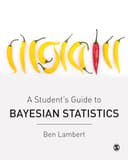
desertcart.com: A Student’s Guide to Bayesian Statistics: 9781473916364: Lambert, Ben: Books Review: A good book to start with - I waited until I got a couple of chapters into this book before I wrote a review. I must say that I am liking this book so far. It is just right for my situation where I am interested in using Bayesian analyses but it has been a few decades since I was a student in school. I appreciate the informal and direct way the author takes to introduce this topic and that he does not assume much prior knowledge for the reader. I would recommend this book to anyone just starting in Bayesian before you move on to more challenging texts in your studies. Review: Excellent Introduction to the World of Bayes for Scientists and Graduate Students - Ben Lambert does a wonderful job of introducing the field of Bayesian analysis to motivated readers who have heard about the power of the Bayesian framework and tools, but who have not formally studied them. Section II provides the background on the concepts and mathematics behind the methodology, then Section III is the meat of ways to apply these methods to problems that many of us encounter in our research. This combination of foundational review and applied methods is unique to many of the Bayesian books I have examined. It even provides an introduction to Stan, a highly advanced MCMC tool. I recommend this book highly to anyone who wants to get into the world of Bayesian analysis.
| Best Sellers Rank | #491,777 in Books ( See Top 100 in Books ) #58 in Social Sciences Methodology #110 in Sociology Research & Measurement #117 in Social Sciences Research |
| Customer Reviews | 4.6 4.6 out of 5 stars (231) |
| Dimensions | 7.44 x 1 x 9.69 inches |
| Edition | 1st |
| ISBN-10 | 1473916364 |
| ISBN-13 | 978-1473916364 |
| Item Weight | 2.2 pounds |
| Language | English |
| Print length | 520 pages |
| Publication date | May 4, 2018 |
| Publisher | SAGE Publications Ltd |
A**R
A good book to start with
I waited until I got a couple of chapters into this book before I wrote a review. I must say that I am liking this book so far. It is just right for my situation where I am interested in using Bayesian analyses but it has been a few decades since I was a student in school. I appreciate the informal and direct way the author takes to introduce this topic and that he does not assume much prior knowledge for the reader. I would recommend this book to anyone just starting in Bayesian before you move on to more challenging texts in your studies.
B**L
Excellent Introduction to the World of Bayes for Scientists and Graduate Students
Ben Lambert does a wonderful job of introducing the field of Bayesian analysis to motivated readers who have heard about the power of the Bayesian framework and tools, but who have not formally studied them. Section II provides the background on the concepts and mathematics behind the methodology, then Section III is the meat of ways to apply these methods to problems that many of us encounter in our research. This combination of foundational review and applied methods is unique to many of the Bayesian books I have examined. It even provides an introduction to Stan, a highly advanced MCMC tool. I recommend this book highly to anyone who wants to get into the world of Bayesian analysis.
M**N
An excellent introduction to the wonderful world of Bayes
A Student's Guide to Bayesian Statistics gives an excellent introduction to the wonderful world of Bayes. The book is well-suited for students that are new to the topic and do not have a strong mathematical or statistical background. For such students it is one of the best resources on the subject that is currently out there. What I particularly like about the book is that it does not skip the nitty gritty details of Bayesian computation, and that it takes the time to explain important issues on a conceptual level. In this way it covers the basics in a broad range of topics, including key numerical methods. I enjoyed teaching from this book.
M**J
Excellent overview
This text provides an excellent non-technical overview of the Bayesian framework for statistical analysis. It covers fundamentals through to sampling methods for estimating posterior distributions. Moreover, several important model classes are introduced. The text was clearly never meant as an in depth review but it is a very good place to start in order to get some intuition.
S**K
Cannot recommend this enough
If you want to get started on Bayesian Stats and find books like Bayesian Data Analysis (Gelman et al) somewhat intimidating for a beginner (or someone from a different STEM background), I recommend you get this book and work on it. I worked on this book cover to cover, worked out all the problems, and watched Dr Lambert's YouTube videos (he also mentions them in the book). I'm fairly comfortable with the basics now, and not only can I venture into Bayesian Data Analysis book, but also put what I learnt into practice in my own research.
A**A
Very helpful book indeed
What I liked about this book is that the author makes a tremendous effort to really teach you Bayes Statistics. He doesn’t take for granted that you know Bayes statistics as some books do. Besides using a mathematical intuitive approach, the author provides a wealth of material (exercises, videos, interactive simulations). Ah, one more thing, I would dare to say that it’s one of the best introductions to STAN. Do you really want to understand Bayesian Statistics? Then this book is a must.
J**E
Soft cover edition
The paperback version did not have any color diagrams, where it's clear it should have. Also, the text was very light. It almost looks like the copy I received was a bad photo copy.
Z**Z
an EXCELLENT student's guide to bayesian statistics
I accidentally saw this book on Amazon.com and was immediately attracted by the name of each chapter and section in this book; after I bought this book, I was impressed by the real contents in this book while reading. With little math in the book, the author is presenting bayesian statistics conceptually which is awesome and even more difficult than just listing tons of mathematical equations and probability density functions. Even best, there are problem sets at the end of each chapter and online videos and answers to the problems sets for you to learn, practice, and learn again!
M**O
I think that this book provides the best introduction to Bayesian Statistics. Ther are of course other excellent introductory books out there, but some of them provide a limited perspective to Bayesian data analysis, while Lambert's encompasses a wider range of approaches - including Bayes Factor through the Dickey-Savage density ratio - and provides a lot of figures and tables that ease the interpretation of some hard concepts (for instance, I loved that table that makes clear the difference between a Likelihood and a Probability distribution). A possible limitation - but some may see it as a strength - is that, although it introduces Stan programming in the last part of the book, it does not rely on R (or other programming languages) through the book. I typically find that the use of code makes it easier to understand mathematical and statistical concepts to readers who do not feel at comfort with math formulas. But the book compensates this weakness with a quite accessible language and the use of graphs and examples that make hard concepts intuitive. I strongly recommend it to the reader who wants to approach Bayesian Statistics, although some previous knowledge of statistics is required.
A**D
As an engineer we are taught almost exclusively from the frequentist paradigm, and I felt that I needed to self-teach Bayesian statistics if I wanted to get into the realm of forecasting and general modelling. Hours in the student library trawling through texts only came up with extremely dense material. I ended up turning to youtube for some introductory lessons and stumbled across the authors fantastic channel (It can be found by typing “Ben Lambert” into the search bar). The videos were clear, concise and very informative. I found that they were meant to be consumed alongside this text, which I promptly purchased. The quality of this text cannot be stressed enough. Humorous and engaging, it reads like a novel and explains like top quality lecture notes. It walks you through the mathematical fundamentals of Bayesian stats, terminating with a comprehensive guide to Conjugate and Uninformative priors. The final third of the text is dedicated to computational (read: practically used) Bayesian stats, covering topics including Stan and Hierarchical Modelling. The author recommends using R for the problem sets, but I managed with PyStan interface fine so that shouldn’t be a concern. I will certainly have this text on my desk for the foreseeable future as I get more comfortable with solving these problems regularly. The next step is “Bayesian Data Analysis” by the legend Gelman himself, which from what I have seen is prohibitively dense without a first studying a text such as this one.
K**N
As a bioinformatician specializing in applied statistics, I found this book to be an excellent introduction to Bayesian Statistics for students and researchers with a non-mathematical background. The concepts and ideas are introduced with exceptional clarity. For those aiming to learn more about Bayesian statistics on their own, this and McElreath’s book will be essential stepping stones towards generating an understanding of more advanced textbooks and modern literature in applied Bayesian statistics. Top aspects: + Clear pedagogical text layout; concise introductions and chapter summaries + Good coverage of topics relevant to applied Bayesian analysis work (probability theory interpretations, distributions, model evaluation, model fitting algorithms, hierarchical & regression modeling ) + Excellent introduction to Bayesian model fitting algorithms (Metropolis Hastings, Gibbs and HMC) from a conceptual angle + Excellent example figures + Brief introductory chapter on stan for those who haven’t used it before It is worth noting that the book has rather few applied statistics examples; the focus of the book clearly lies more on explaining the theory. On this end McElreath’s, Krushke’s and Hilbe’s books are more extensive and contain more examples with stan code. For those wanting to get started with Bayesian statistics I thus recommend getting one of these references and their corresponding R & stan code as a supplement to Lambert's book. I own both a hardcopy and digital copy of the book; the digital version (google play) is overall quite good but for some reason contains rather blurry pictures and weirdly formatted equations. The hardcopy version has excellent resolution figures and nicely formatted equations. I highly recommend getting a hardcopy of this book.
A**A
説明が丁寧で入門書としては最適だいと思います
M**V
I needed a refresher on Bayesian stats. While browsing/watching related youtube videos I have stumbled upon the author's channel. This is how I learned about 'A Student's Guide to Bayesian Statistics'. In retrospect I cannot believe this was such a random sequence of events, since the "Student's Guide' has now become my personal favourite text book I ever had. The material is presented in a very clear way, it builds up from simple examples to more complicated ones. To go one step further the book offers a few pretty advanced problems to work out (there are answers/solutions available on-line too on the author's web-site). In theory all the text books should be like that, but in practice it is not all that frequent, especially when it comes to any sort of applied math. It was important for me that the text has no insane logic gaps along the lines of 'now, obviously' on which I tend to hang up particularly badly. The illustrations are fantastic too. I feel if the author ever decides to write another book on any subject even remotely relevant to my fields of interest - I will buy it without hesitation.
Trustpilot
Hace 2 meses
Hace 2 semanas